
Exemplar Solution
Get insights from 1.3k questions on Exemplar Solution, answered by students, alumni, and experts. You may also ask and answer any question you like about Exemplar Solution
- 1.3k
Questions
- 0
Discussions
- 0
Active Users
- 0
Followers
Have a question about Exemplar Solution? Ask our experts
Keep it short & simple. Type complete word. Avoid abusive language.
The vector equation of the line through the points (3, 4, –7) and (1, –1, 6) is __________.
The vector equation of the line through the points (3, 4, –7) and (1, –1, 6) is __________.
This is a Fill in the blanks Type Questions as classified in NCERT Exemplar
 Upvote

The vector equation of the line <!-- [if gte mso 9]><xml>
The vector equation of the line <!-- [if gte mso 9]><xml>
This is a Fill in the blanks Type Questions as classified in NCERT Exemplar
Upvote This is a Fill in the blanks Type Questions as classified in NCERT Exemplar
Upvote A plane passes through the points (2, 0, 0), (0, 3, 0), and (0, 0, 4). The equation of the plane is __________.
A plane passes through the points (2, 0, 0), (0, 3, 0), and (0, 0, 4). The equation of the plane is __________.
This is a Fill in the blanks Type Questions as classified in NCERT Exemplar
Upvote The plane makes an angle with the x-axis. The value of is equal to:
(A) <!-- [if gte mso 9]><xml>
(B) <!-- [if gte mso 9]><xml>
(C) <!-- [if gte mso 9]><xml>
(D) <!-- [if gte mso 9]><xml>
The plane makes an angle with the x-axis. The value of is equal to:
(A) <!-- [if gte mso 9]><xml>
(B) <!-- [if gte mso 9]><xml>
(C) <!-- [if gte mso 9]><xml>
(D) <!-- [if gte mso 9]><xml>
This is a Objective Type Questions as classified in NCERT Exemplar
Upvote The locus represented by is:
(A) A pair of perpendicular lines
(B) A pair of parallel lines
(C) A pair of parallel planes
(D) A pair of perpendicular planes
The locus represented by is:
(A) A pair of perpendicular lines
(B) A pair of parallel lines
(C) A pair of parallel planes
(D) A pair of perpendicular planes
This is a Objective Type Questions as classified in NCERT Exemplar
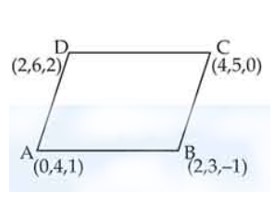
Upvote The area of the quadrilateral ABCD, where A(0, 4, 1), B(2, 3, –1), C(4, 5, 0) and D(2, 6, 2), is equal to:
(A) 9 sq. units
(B) 18 sq. units
(C) 27 sq. units
(D) 81 sq. units
The area of the quadrilateral ABCD, where A(0, 4, 1), B(2, 3, –1), C(4, 5, 0) and D(2, 6, 2), is equal to:
(A) 9 sq. units
(B) 18 sq. units
(C) 27 sq. units
(D) 81 sq. units
This is a Objective Type Questions as classified in NCERT Exemplar
Upvote The reflection of the point in the xy-plane is
(A) <!-- [if gte mso 9]><xml>
(B) <!-- [if gte mso 9]><xml>
(C) <!-- [if gte mso 9]><xml>
(D) <!-- [if gte mso 9]><xml>
The reflection of the point in the xy-plane is
(A) <!-- [if gte mso 9]><xml>
(B) <!-- [if gte mso 9]><xml>
(C) <!-- [if gte mso 9]><xml>
(D) <!-- [if gte mso 9]><xml>
This is a Objective Type Questions as classified in NCERT Exemplar
Upvote The sine of the angle between the straight line and the plane is:
(A) <!-- [if gte mso 9]><xml>
(B) <!-- [if gte mso 9]><xml>
(C) <!-- [if gte mso 9]><xml>
(D) <!-- [if gte mso 9]><xml>
The sine of the angle between the straight line and the plane is:
(A) <!-- [if gte mso 9]><xml>
(B) <!-- [if gte mso 9]><xml>
(C) <!-- [if gte mso 9]><xml>
(D) <!-- [if gte mso 9]><xml>
This is a Objective Type Questions as classified in NCERT Exemplar
Upvote The distance of the plane <!-- [if gte mso 9]><xml>
(A) 1
(B) 7
(C) <!-- [if gte mso 9]><xml>
(D) None of these
The distance of the plane <!-- [if gte mso 9]><xml>
(A) 1
(B) 7
(C) <!-- [if gte mso 9]><xml>
(D) None of these
This is a Objective Type Questions as classified in NCERT Exemplar
Upvote