Maths Integrals

Get insights from 376 questions on Maths Integrals, answered by students, alumni, and experts. You may also ask and answer any question you like about Maths Integrals

  • 376

    Questions

  • 0

    Discussions

  • 0

    Active Users

  • 0

    Followers

Have a question about Maths Integrals? Ask our experts

Ask Your Question

Keep it short & simple. Type complete word. Avoid abusive language.

New answer posted•a year ago

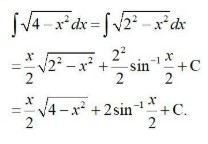
158. Kindly Consider the following

6 Views|Posted a year ago
Asked by Vishal Baghel
S
a year ago

Kindly go through the solution

Thumbs Up IconUpvote Thumbs Down Icon
New answer posted•a year ago
S
a year ago

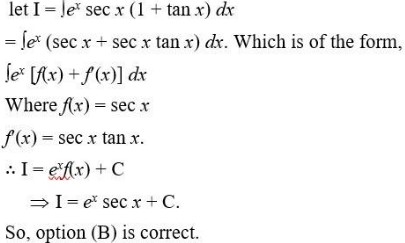
Kindly go through the solution

Thumbs Up IconUpvote Thumbs Down Icon
New answer posted•a year ago
S
a year ago

LetI=∫x2ex3dx.let, t=x3⇒ dt=3x2dx⋅⇒dt3=x2dxSo, =∫⋅etdt3=13∫etdt.=13et+ C=ex33+C.

So, option (A) is correct.

Thumbs Up IconUpvote Thumbs Down Icon
New answer posted•a year ago
S
a year ago

Let, I=∫sin−1 (2x1+x2)dx

Putting x = tanθ tan-1x = θ dx = sec2θdθ we get,
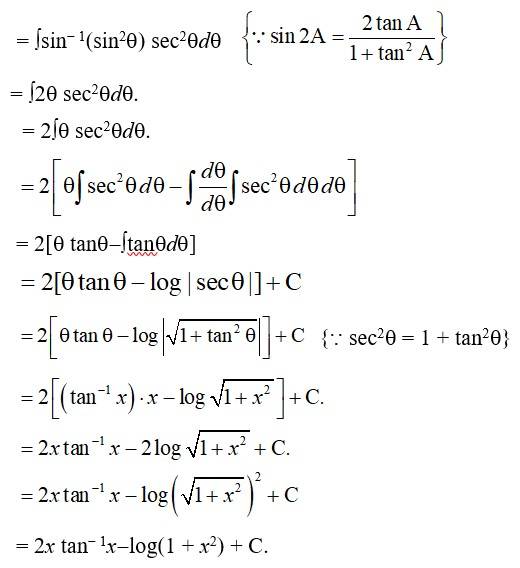
I=∫sin−1 [2tanθ1+tan2θ]⋅sec2θ  dθ

Thumbs Up IconUpvote Thumbs Down Icon
New answer posted•a year ago
S
a year ago

Let, I=∫e2xsinx dx.=sinx∫e2x−∫ddxsinx∫e2xdx dx=sinx⋅e2x2−∫cos x⋅e2x2dx=e2x2sinx−12∫cosx⋅× e2xdx=e2x2⋅sinx−12{cosx∫e2xdx−∫ddxcosx∫e2xdxdx}=e2x2sinx−12{cosx⋅e2x2+∫sinxe2x2dx}=e2x2sinx−e2x4cosx−14I+ C⇒I+I4=e2x2sinx−e2x4cosx+ C⇒5I4=e2x2sinx−e2x4cosx+ C⇒I=45[e2x2sinx−e2x4cosx]+ C=e2x5[2sinx−cosx]+ C

Thumbs Up IconUpvote Thumbs Down Icon
New answer posted•a year ago
S
a year ago

Let, I =∫x−3(x−1)3exdx.=∫(x−1)−2(x−1)3exdx.=∫ex[x−1(x−1)3−2(x−1)3]dx=∫ex[1(x−1)2+(−2)(x−1)3]dx,whichisinfore∫ex[f(x)+f′(x)]dx,Wheref(x)=1(x−1)2f′(x)=ddx(x−1)−2=−2(x−1)3.∴I=exf(x)+c=ex1(x−1)2+c=ex(x−1)2+ C

Thumbs Up IconUpvote Thumbs Down Icon
New answer posted•a year ago
S
a year ago

Let, I=∫ex (1x−1x2)dx∫ex [f (x)+f (x)] dxWhere, f (x)=1xf (x)=dxdx=−1x−2=−1x2

So, I = exf (x) + C

=ex1x+ c=exx+ c

Thumbs Up IconUpvote Thumbs Down Icon
New answer posted•a year ago
S
a year ago

Let,=∫ex(1+sinx1+cosx)dx.,

=∫ex1+2sinx2cosx22cos2x2dx. {∴ sin 2x = 2sin x cos x. cos 2x = cos- 2x- 1 1 + cos 2x = 2cos2x.

=∫ex[12cos2x2+2sinx2cosx22cos2x2]dx]=∫ex[12sec2x2+cosx⋅sinx2cosx2]dx

=∫ex[tanx2+12sin2x2]dx is in the form

  ex [f(x) + f(x)].dx where

f(x)=tanx2f′(x)=ddrtanx2=sec2x2ddx(x2)=12sec2x2=exf(x)+c=extanx2+ C

Thumbs Up IconUpvote Thumbs Down Icon
New answer posted•a year ago
S
a year ago

Let,I=∫xex(x+1)2 dx=∫x+1−1(x+1)2exdx

=∫ex[(x+1)(x+1)2+(−1)(x+1)2]dx. is of the form

ex [f(x) + f(x)] dx

Where,f(x)=x+1(x+1)2=1x+1So,f′(x)=d(x+1)−1dx=(−1)(x+1)2.∴∫x⋅⋅ex(1+x2)dx=ex[1x+1]+ C

Thumbs Up IconUpvote Thumbs Down Icon
New answer posted•a year ago
S
a year ago

∴f (x) = sin x

f (x) = cos x.

ex [f (x) + f (x)] dx = exf (x) + C

∫ex (sinx+cosx)dx=exsinx+c

Thumbs Up IconUpvote Thumbs Down Icon