
Physics
Get insights from 5.7k questions on Physics, answered by students, alumni, and experts. You may also ask and answer any question you like about Physics
- 5.7k
Questions
- 0
Discussions
- 18
Active Users
- 0
Followers
Have a question about Physics? Ask our experts
Keep it short & simple. Type complete word. Avoid abusive language.
Density of nuclei is order of 1017 kg m–3.
 Upvote

Power factor of series LCR circuit at resonance is
Power factor of series LCR circuit at resonance is
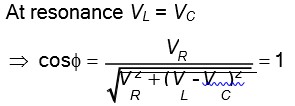
Upvote Can we convert a coherent wave into an incoherent wave (or vice versa)?
Can we convert a coherent wave into an incoherent wave (or vice versa)?
Yes, whether a wave is coherent or incoherent depends on its phase difference and frequency. For converting a coherent wave into an incoherent wave, you have to damage the stable phase of the wave. This can be done by making the medium tough or mixing them with incoherent waves.
Similarly, incoherent
Upvote Photocell works on photoelectric effect.
Upvote 


An electric bulb and a capacitor are connected in series with an AC source. On increasing the frequency of the source, the brightness of the bulb:
An electric bulb and a capacitor are connected in series with an AC source. On increasing the frequency of the source, the brightness of the bulb:
XC = 1/ ωC
On increasing w; XC decreases so Z decreases, current in circuit increases.
Upvote 

Does diffraction depend on the light's wavelength?
Does diffraction depend on the light's wavelength?
Yes, it strongly depends on the wavelength of the light wave. It is directly proportional to the length i.e. longer the wavelength, more will be the amount of diffraction. Similarly, short wavelength of the light will mean less diffraction comparatively.
Upvote What is the difference between reflection and diffraction?
What is the difference between reflection and diffraction?
Reflection is the concept of bouncing back of light waves when passed through a surface. Whereas, diffraction is a term used when light waves spread in different directions on being passed through an obstacle. Reflection requires a smooth surface whereas diffraction requires the edge of an object.
Upvote