
Probability
Get insights from 304 questions on Probability, answered by students, alumni, and experts. You may also ask and answer any question you like about Probability
- 304
Questions
- 0
Discussions
- 0
Active Users
- 4
Followers
Have a question about Probability? Ask our experts
Keep it short & simple. Type complete word. Avoid abusive language.
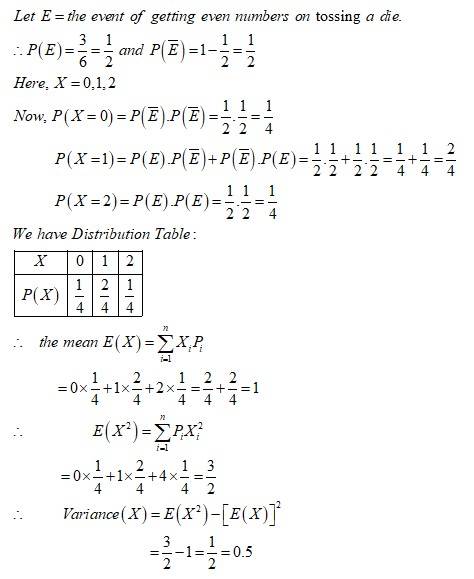
A die is tossed twice. A ‘success’ is getting an even number on a toss. Find the variance of the number of successes.
A die is tossed twice. A ‘success’ is getting an even number on a toss. Find the variance of the number of successes.
This is a Long Answer Type Questions as classified in NCERT Exemplar
Sol:
 Upvote

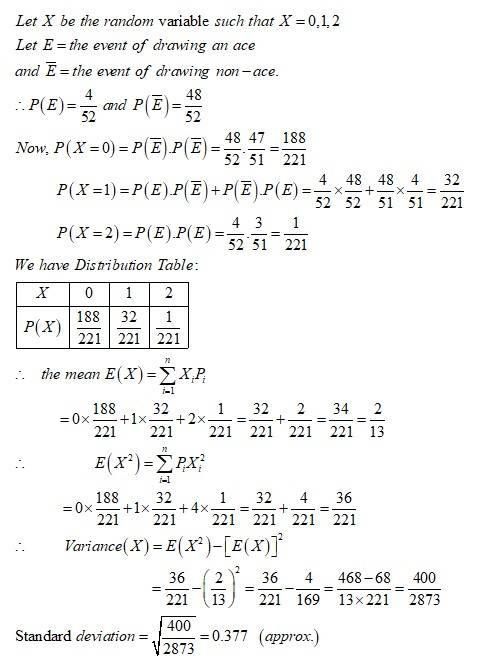
Two cards are drawn successively without replacement from a well-shuffled deck of cards. Find the mean and standard deviation of the random variable , where is the number of aces
Two cards are drawn successively without replacement from a well-shuffled deck of cards. Find the mean and standard deviation of the random variable , where is the number of aces
This is a Long Answer Type Questions as classified in NCERT Exemplar
Sol:
 Upvote
A bag contains coins. It is known that of these coins have a head on both sides, while the rest of the coins are fair. A coin is picked at random from the bag and tossed. If the probability that the toss results in a head is , determine the value of .
A bag contains coins. It is known that of these coins have a head on both sides, while the rest of the coins are fair. A coin is picked at random from the bag and tossed. If the probability that the toss results in a head is , determine the value of .
This is a Long Answer Type Questions as classified in NCERT Exemplar
Sol:
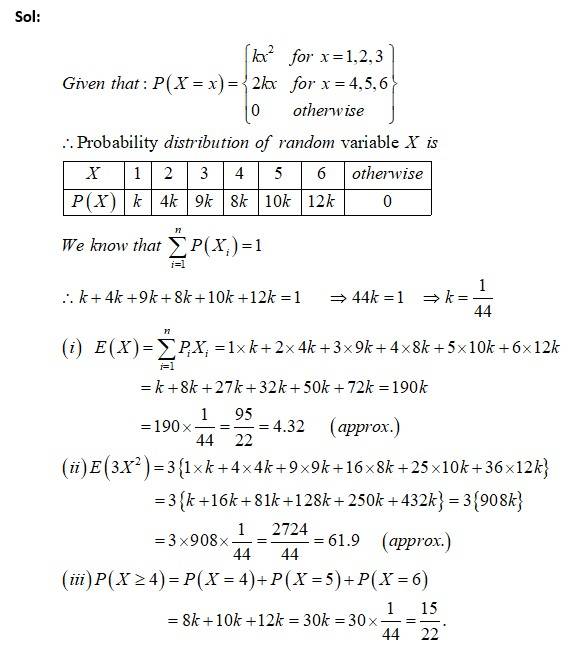
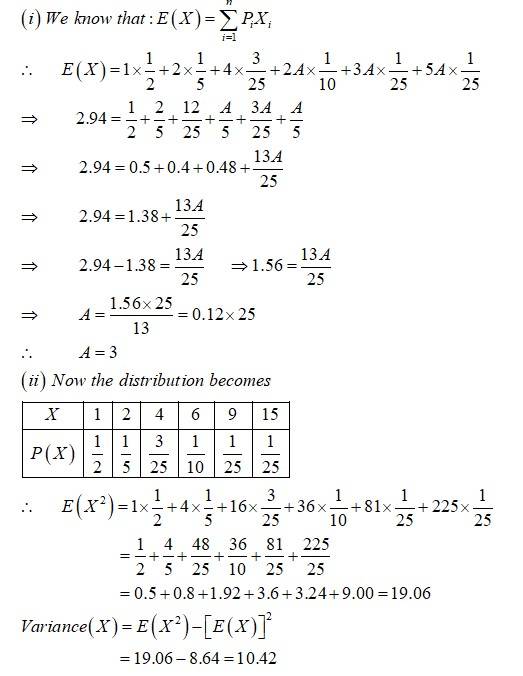
Upvote The probability distribution of a discrete random variable is given as under:
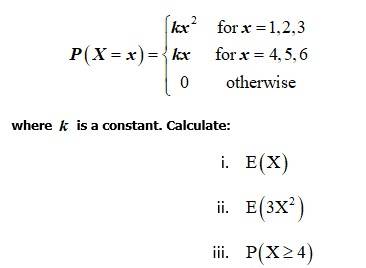
The probability distribution of a discrete random variable is given as under:

This is a Long Answer Type Questions as classified in NCERT Exemplar
Upvote The probability distribution of a discrete random variable is given as under:
X
1
2
4
2A
3A
5A
P(X)
1/2
1/5
3/25
1/10
1/25
1/25
Calculate:
The value of if (ii)Variance of X
The probability distribution of a discrete random variable is given as under:
|
X |
1 |
2 |
4 |
2A |
3A |
5A |
|
P(X) |
1/2 | 1/5 | 3/25 | 1/10 | 1/25 | 1/25 |
Calculate:
The value of if (ii)Variance of X
This is a Long Answer Type Questions as classified in NCERT Exemplar
Sol:
 Upvote
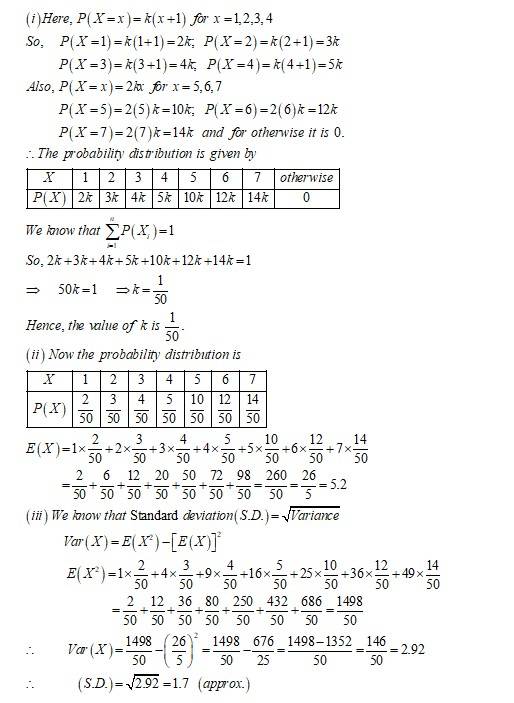
Let be a discrete random variable whose probability distribution is defined as follows:
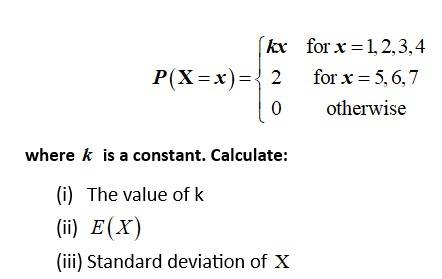
Let be a discrete random variable whose probability distribution is defined as follows:

This is a Long Answer Type Questions as classified in NCERT Exemplar
Sol:
Upvote An item is manufactured by three machines A, B, and C. Out of the total number of items manufactured during a specified period, 50% are manufactured on A, 30% on B, and 20% on C. 2% of the items produced on A and 2% of items produced on B are defective, and 3% of these produced on C are defective. All the items are stored at one godown. One item is drawn at random and is found to be defective. What is the probability that it was manufactured on machine A?
An item is manufactured by three machines A, B, and C. Out of the total number of items manufactured during a specified period, 50% are manufactured on A, 30% on B, and 20% on C. 2% of the items produced on A and 2% of items produced on B are defective, and 3% of these produced on C are defective. All the items are stored at one godown. One item is drawn at random and is found to be defective. What is the probability that it was manufactured on machine A?
This is a Long Answer Type Questions as classified in NCERT Exemplar
Sol:
Upvote By examining the chest X-ray, the probability that TB is detected when a person is actually suffering is 0.99. The probability of a healthy person diagnosed to have TB is 0.001. In a certain city, 1 in 1000 people suffers from TB. A person is selected at random and is diagnosed to have TB. What is the probability that he actually has TB?
By examining the chest X-ray, the probability that TB is detected when a person is actually suffering is 0.99. The probability of a healthy person diagnosed to have TB is 0.001. In a certain city, 1 in 1000 people suffers from TB. A person is selected at random and is diagnosed to have TB. What is the probability that he actually has TB?
This is a Long Answer Type Questions as classified in NCERT Exemplar
Sol:
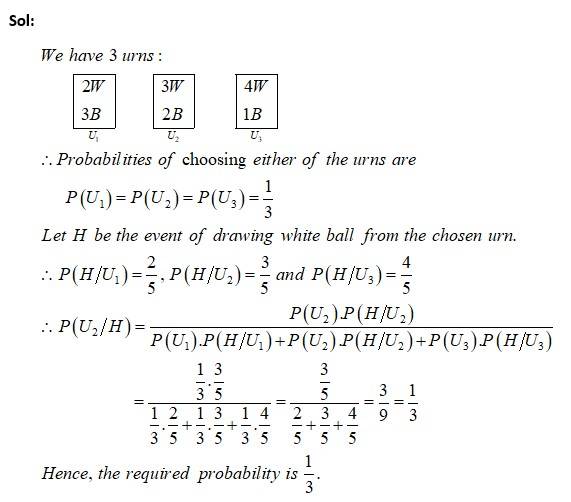
Upvote There are three urns containing: 2 white and 3 black balls 3 white and 2 black balls 4 white and 1 black ball respectively. There is an equal probability of each urn being chosen. A ball is drawn at random from the chosen urn, and it is found to be white. Find the probability that the ball drawn was from the second urn.
There are three urns containing: 2 white and 3 black balls 3 white and 2 black balls 4 white and 1 black ball respectively. There is an equal probability of each urn being chosen. A ball is drawn at random from the chosen urn, and it is found to be white. Find the probability that the ball drawn was from the second urn.
This is a Long Answer Type Questions as classified in NCERT Exemplar
Upvote There are two bags, one of which contains 3 black and 4 white balls while the other contains 4 black and 3 white balls. A die is thrown. If it shows up 1 or 3, a ball is taken from the first bag; if it shows up any other number, a ball is chosen from the second bag. Find the probability of choosing a black ball.
There are two bags, one of which contains 3 black and 4 white balls while the other contains 4 black and 3 white balls. A die is thrown. If it shows up 1 or 3, a ball is taken from the first bag; if it shows up any other number, a ball is chosen from the second bag. Find the probability of choosing a black ball.
This is a Long Answer Type Questions as classified in NCERT Exemplar
Sol:
Upvote