
Wave Optics
Get insights from 88 questions on Wave Optics, answered by students, alumni, and experts. You may also ask and answer any question you like about Wave Optics
- 88
Questions
- 0
Discussions
- 0
Active Users
- 0
Followers
Have a question about Wave Optics? Ask our experts
Keep it short & simple. Type complete word. Avoid abusive language.
Two sources S1and S2 of intensity I1 and I2 are placed in front of a screen .
(a) The pattern of intensity distribution seen in the central portion is given by Fig. (b).
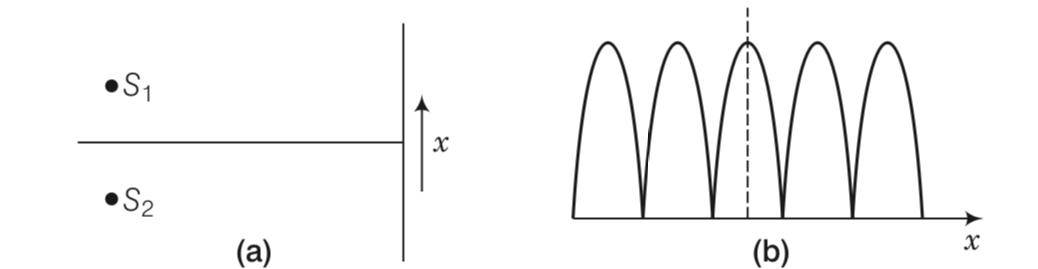
(a) s1 and s2 have same intensities
(b) s1 and s2 have constant phase difference
(c) s1 and s2 have same phase
(d) s1 and s2 have same wavelength
In this case, which of the following statements are true?
Two sources S1and S2 of intensity I1 and I2 are placed in front of a screen .
(a) The pattern of intensity distribution seen in the central portion is given by Fig. (b).

(a) s1 and s2 have same intensities
(b) s1 and s2 have constant phase difference
(c) s1 and s2 have same phase
(d) s1 and s2 have same wavelengthIn this case, which of the following statements are true?
This is a Multiple Choice Questions as classified in NCERT Exemplar
Answer- (a, b, d)
Explanation-Consider the pattern of the intensity shown in the figure
(i) As intensities of all successive minima is zero, hence we can say that two sources S1 and S2 are having same intensities.
(ii) As width of the
 Upvote

Figure shows a standard two slit arrangement with slits S1, S2, P1, P2 are the two minima points on either side of P (figure).
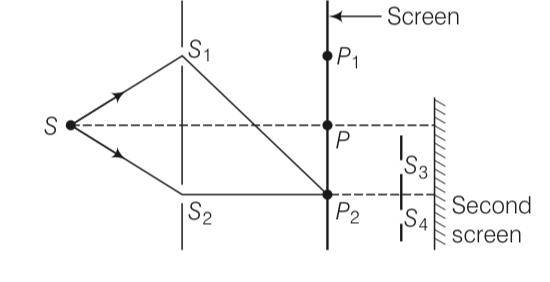
At P2 on the screen, there is a hole and behind P2.is a second 2-slit arrangement with slits S3, S4 and a second screen behind them.
(a) There would be no interference pattern on the second screen but it would be lighted
(b) The second screen would be totally dark
(c) There would be a single bright point on the second screen
(d) There would be a regular two slit pattern on the second screen
Figure shows a standard two slit arrangement with slits S1, S2, P1, P2 are the two minima points on either side of P (figure).

At P2 on the screen, there is a hole and behind P2.is a second 2-slit arrangement with slits S3, S4 and a second screen behind them.
(a) There would be no interference pattern on the second screen but it would be lighted
(b) The second screen would be totally dark
(c) There would be a single bright point on the second screen
(d) There would be a regular two slit pattern on the second screen
This is a Multiple Choice Questions as classified in NCERT Exemplar
Answer- d
Explanation- According to question, there is a hole at point P2. From Huygen's principle, wave will propagates from the sources S1 and S2. Each point on the screen will acts as secondary sources of wavelets. Now, there is a
Upvote In a Young’s double-slit experiment, the source is white light. One of the holes is covered by a red filter and another by a blue filter. In this case,
(a) There shall be alternate interference patterns of red and blue
(b) There shall be an interference pattern for red distinct from that for blue
(c) There shall be no interference fringes
(d) There shall be an interference pattern for red mixing with one for blue
In a Young’s double-slit experiment, the source is white light. One of the holes is covered by a red filter and another by a blue filter. In this case,
(a) There shall be alternate interference patterns of red and blue
(b) There shall be an interference pattern for red distinct from that for blue
(c) There shall be no interference fringes
(d) There shall be an interference pattern for red mixing with one for blue
This is a Multiple Choice Questions as classified in NCERT Exemplar
Answer – (c)
Explanation- For the interference pattern to be formed on the screen, the sources should be coherent and emits lights of same frequency and wavelength. In a Young's double-slit experiment, when one of the holes is covered
Upvote Consider a ray of light incident from air onto a slab of glass (refractive index n) of width d, at an angle θ. The phase difference between the ray reflected by the top surface of the glass and the bottom surface is
(a) ( )1/2+
(b) ( )1/2
(c) ( )1/2+ /2
(d) ( )1/2+
Consider a ray of light incident from air onto a slab of glass (refractive index n) of width d, at an angle θ. The phase difference between the ray reflected by the top surface of the glass and the bottom surface is
(a) ( )1/2+
(b) ( )1/2
(c) ( )1/2+ /2
(d) ( )1/2+
This is a Multiple Choice Questions as classified in NCERT Exemplar
Answer- a
Explanation- due to refraction from the glass medium there is a phase change of
= =

According to snells law n= sin /sinr
Cosr =
= ( )
Phase difference = = =&n
Upvote Consider sunlight incident on a slit of width 10 4 Å. The image seen through the slit shall
(a) Be a fine sharp slit white in colour at the centre
(b) A bright slit white at the centre diffusing to zero intensities at the edges
(c) A bright slit white at the centre diffusing to regions of different colours
(d) Only be diffused slit white in colour.
Consider sunlight incident on a slit of width 10 4 Å. The image seen through the slit shall
(a) Be a fine sharp slit white in colour at the centre
(b) A bright slit white at the centre diffusing to zero intensities at the edges
(c) A bright slit white at the centre diffusing to regions of different colours
(d) Only be diffused slit white in colour.
This is a Multiple Choice Questions as classified in NCERT Exemplar
Answer- ( a)
Explanation- given width of slit is 10410-10m= 10-6
Wavelength of sunlight varies from 4000A0 to 8000A0
As the width of slit is comparable to that of wavelength, hence diffraction occurs with maxima at centre. So, at the ce
Upvote Consider a light beam incident from air to a glass slab at Brewster’s angle as shown in figure.
A Polaroid is placed in the path of the emergent ray at point P and rotated about an axis passing through the centre and perpendicular to the plane of the polaroid.
(a) For a particular orientation, there shall be darkness as observed through the polaroid.
(b) The intensity of light as seen through the polaroid shall be independent of the rotation.
(c) The intensity of light as seen through the polaroid shall go minimum but not zero for two orientations of the polaroid.
(d) The intensity of light as seen through the polaroid shall go minimum for four orientations of the polaroid.
Consider a light beam incident from air to a glass slab at Brewster’s angle as shown in figure.
A Polaroid is placed in the path of the emergent ray at point P and rotated about an axis passing through the centre and perpendicular to the plane of the polaroid.
(a) For a particular orientation, there shall be darkness as observed through the polaroid.
(b) The intensity of light as seen through the polaroid shall be independent of the rotation.
(c) The intensity of light as seen through the polaroid shall go minimum but not zero for two orientations of the polaroid.
(d) The intensity of light as seen through the polaroid shall go minimum for four orientations of the polaroid.
This is a Multiple Choice Questions as classified in NCERT Exemplar
Answer- (c)
Explanation-Consider the diagram the light beam incident from air to the glass slab at Brewster's angle (ip ). The incident ray is unpolarised and is represented by dot (.).
The reflected light is plane polarised represente
Upvote Consider a two slit interference arrangements (figure) such that the distance of the screen from the slits is. half the distance between the slits. Obtain the value of D in terms of X such that the first minima on the screen falls at a distance D from the centre O.
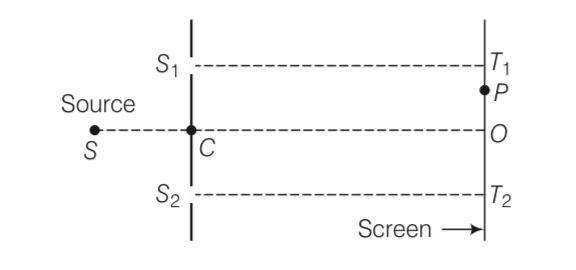
Consider a two slit interference arrangements (figure) such that the distance of the screen from the slits is. half the distance between the slits. Obtain the value of D in terms of X such that the first minima on the screen falls at a distance D from the centre O.

This is a Short Answer Type Questions as classified in NCERT Exemplar
Explanation- T2P= T2O+OP= D+x
T1P= T1O-OP= D-x
S1P =
S2P=
The minima will occur when S2P- S1P= (2n-1)
- =
[D2+4D2]1/2-[D2+0]1/2=
[5D2]1/2- [D2]1/2=
D-D=
we get D= 0.404
Upvote For the same objective, find the ratio of the least separation between two points to be distinguished by a microscope for light of 5000 Å and electrons accelerated through 100 V used as the illuminating substance.
For the same objective, find the ratio of the least separation between two points to be distinguished by a microscope for light of 5000 Å and electrons accelerated through 100 V used as the illuminating substance.
This is a Short Answer Type Questions as classified in NCERT Exemplar
Explanation- resolving power =1/d = = dmin= where is the wavelength of light
So dmin=
= = 0.12 10-9m
= = 0.2 10-3
Upvote Can reflection result in plane polarised light if the light is incident on the interface from the side with higher refractive index?
Can reflection result in plane polarised light if the light is incident on the interface from the side with higher refractive index?
This is a Short Answer Type Questions as classified in NCERT Exemplar
Explanation- When angle of incidence is equal to Brewster’s angle, the transmitted light is unpolarised and reflected light is plane polarised.

Consider the diagram in which unpolarised light is represented by dot and plane polarise
Upvote A polaroid (I) is placed in front,of a monochromatic source. Another polariod (II) is placed in front of this polaroid (I) and rotated till no light passes. A third polaroid (III) is now placed in between (I) and (II). In this case, will light emerge from (II). Explain
A polaroid (I) is placed in front,of a monochromatic source. Another polariod (II) is placed in front of this polaroid (I) and rotated till no light passes. A third polaroid (III) is now placed in between (I) and (II). In this case, will light emerge from (II). Explain
This is a Short Answer Type Questions as classified in NCERT Exemplar
Explanation- As per the given question, monochromatic light emerging from polaroid (I) is plane polarised. When polaroid (II) is placed infront of this polaroid (I), and rotated till no light passes through polaroid (II), then (I)
Upvote