
Wave Optics
Get insights from 88 questions on Wave Optics, answered by students, alumni, and experts. You may also ask and answer any question you like about Wave Optics
- 88
Questions
- 0
Discussions
- 0
Active Users
- 0
Followers
Have a question about Wave Optics? Ask our experts
Keep it short & simple. Type complete word. Avoid abusive language.
The human eye has an approximate angular resolution of ɸ = 5.8 x 10⁻⁴rad and a typical photoprinter prints a minimum of 300 dpi (dots per inch, 1 inch = 2.54 cm). At what minimal distance z should a printed page be held so that one does not see the individual dots.
The human eye has an approximate angular resolution of ɸ = 5.8 x 10⁻⁴rad and a typical photoprinter prints a minimum of 300 dpi (dots per inch, 1 inch = 2.54 cm). At what minimal distance z should a printed page be held so that one does not see the individual dots.
This is a Short Answer Type Questions as classified in NCERT Exemplar
Explanation- angular resolution of the eye? = 5.8 x 10⁻⁴
linear distance between two dots is l= 2.54/300=0.84 10-2cm
? = l/z
z=l/? = = 14.5cm
 Upvote

Why is the diffraction of Sound waves more evident in daily experience than that of light wave?
Why is the diffraction of Sound waves more evident in daily experience than that of light wave?
This is a Short Answer Type Questions as classified in NCERT Exemplar
Explanation- As we know that the frequencies of sound waves lie between 20 Hz to 20 kHz so that their wavelength ranges between 15 m to 15 mm. The diffraction occur if the wavelength of waves is nearly equal to slit width.
As the wa
Upvote What is the shape of the wavefront on earth for sunlight?
What is the shape of the wavefront on earth for sunlight?
This is a Short Answer Type Questions as classified in NCERT Exemplar
Explanation- We know that the sun is at very large distance from the earth. Assuming sun as spherical, it can be considered as point source situated at infinity. Due to the large distance the radius of wavefront can be considered a
Upvote Consider a point at the focal point of a convergent lens. Another convergent lens of short focal length is placed on the other side. What is the nature of the wavefronts emerging from the final image?
Consider a point at the focal point of a convergent lens. Another convergent lens of short focal length is placed on the other side. What is the nature of the wavefronts emerging from the final image?
This is a Short Answer Type Questions as classified in NCERT Exemplar
Explanation- The point image I1, due to L1 is at the focal point. Now, due to the converging lens L2, let final image formed is I which is point image, hence the wavefront for this image will be of spherical symmetry.
 Upvote
Is Huygen’s principle valid for longitudinal sound waves?
Is Huygen’s principle valid for longitudinal sound waves?
This is a Short Answer Type Questions as classified in NCERT Exemplar
Explanation- When we are considering a point source of sound wave. The disturbance due to the source propagates in spherical symmetry that is in all directions. The formation of
wavefront is in accordance with Huygen's principle.

So,
Upvote To ensure almost 100% transmittivity, photographic lenses are often coated with a thin layer of dielectric material. The refractive index of this material is intermediated between that of air and glass (which makes the optical element of the lens). A typically used dielectric film is MgF2 (n=138). What should the thickness of the film be so that at the centre of the visible spectrum (5500 Å) there is maximum transmission.
To ensure almost 100% transmittivity, photographic lenses are often coated with a thin layer of dielectric material. The refractive index of this material is intermediated between that of air and glass (which makes the optical element of the lens). A typically used dielectric film is MgF2 (n=138). What should the thickness of the film be so that at the centre of the visible spectrum (5500 Å) there is maximum transmission.
This is a Long Answer Type Questions as classified in NCERT Exemplar
Explanation- refractive index = 1.38 refractive index = 1.5
0

Consider a ray incident at an angle i. A part of this ray is reflected from the air-film interface And apart refracted inside.
This is partly reflected at the film-glass i
Upvote The optical properties of a medium are governed by the relative permittivity (εr) and relative permeability (μr). The refractive index is defined as = n.For ordinary material εr > 0 and μr > 0 and the positive sign is taken for the square root. In 1964, a Russian scientist V. Veselago postulated the existence of material with εr < 0 and μr < 0. Since then such ‘metamaterials’ have been produced in the laboratories and their optical properties studied. For such materials n = – . As light enters a medium of such refractive index the phases travel away from the direction of propagation. (i) According to the description above show that if rays of light enter such a medium from air (refractive index =1) at an angle θ in 2nd quadrant, them the refracted beam is in the 3rd quadrant. (ii) Prove that Snell’s law holds for such a medium.
The optical properties of a medium are governed by the relative permittivity (εr) and relative permeability (μr). The refractive index is defined as = n.For ordinary material εr > 0 and μr > 0 and the positive sign is taken for the square root. In 1964, a Russian scientist V. Veselago postulated the existence of material with εr < 0 and μr < 0. Since then such ‘metamaterials’ have been produced in the laboratories and their optical properties studied. For such materials n = – . As light enters a medium of such refractive index the phases travel away from the direction of propagation. (i) According to the description above show that if rays of light enter such a medium from air (refractive index =1) at an angle θ in 2nd quadrant, them the refracted beam is in the 3rd quadrant. (ii) Prove that Snell’s law holds for such a medium.
This is a Long Answer Type Questions as classified in NCERT Exemplar
Explanation-All points with the same optical path length must have the same phase.
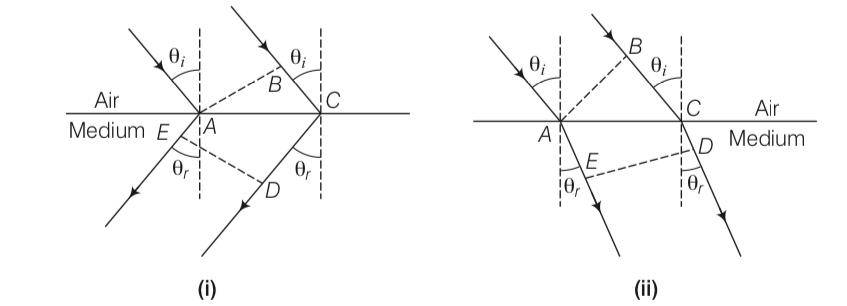
So – =BC-–
BC= (CD-AE)
BC>0, si must be greater than AD
But in other figure
–
So BC= –
But clearly here BE is less
Upvote Four identical monochromatic sources A, B, C, D as shown in the (figure)
produce waves of the same wavelength λ and are coherent. Two receiver
R1 and R2 are at great but equal distances from B.
(i) Which of the two receivers picks up the larger signal?
(ii) Which of the two receivers picks up the larger signal when B is turned off?
(iii) Which of the two receivers picks up the larger signal when D is turned off?
(iv) Which of the two receivers can distinguish which of the sources B or D has been turned off?
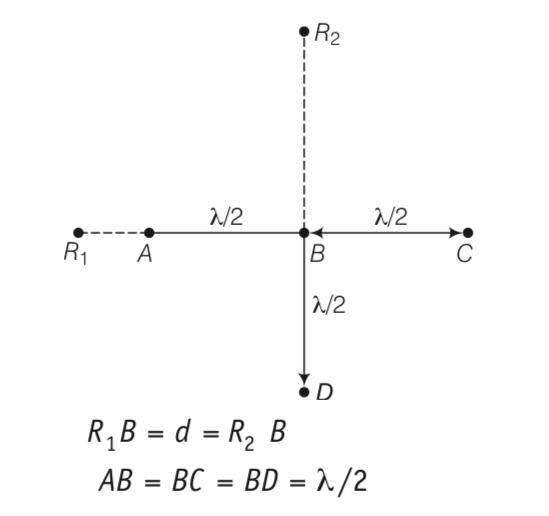
Four identical monochromatic sources A, B, C, D as shown in the (figure)
produce waves of the same wavelength λ and are coherent. Two receiver
R1 and R2 are at great but equal distances from B.
(i) Which of the two receivers picks up the larger signal?
(ii) Which of the two receivers picks up the larger signal when B is turned off?
(iii) Which of the two receivers picks up the larger signal when D is turned off?
(iv) Which of the two receivers can distinguish which of the sources B or D has been turned off?

This is a Long Answer Type Questions as classified in NCERT Exemplar
Explanation-consider the disturbance at the receiver R1 which is at a distance d from B
YA= acos(wt) and path difference is hence phase difference is .
Thus the wave R1 because of B
YB= acos(wt- )= - acoswt here path d
Upvote A small transparent slab containing material of µ = 1.5 is placed along AS2(figure). What will be the distance from O of the principal maxima and of the first minima on either side of the principal maxima obtained in the absence of the glass slab?
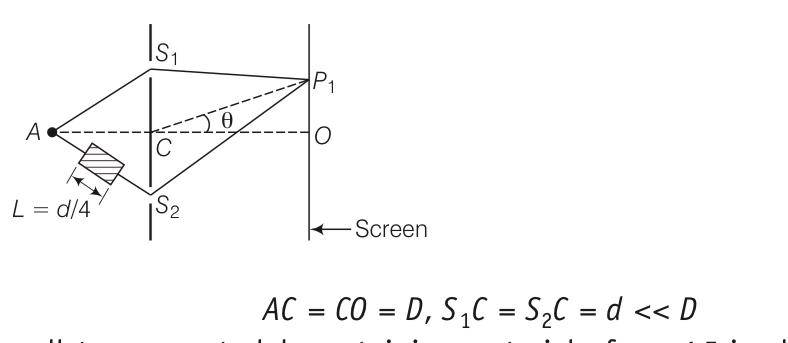
A small transparent slab containing material of µ = 1.5 is placed along AS2(figure). What will be the distance from O of the principal maxima and of the first minima on either side of the principal maxima obtained in the absence of the glass slab?

This is a Long Answer Type Questions as classified in NCERT Exemplar
Explanation- as the refractive index of the class , the path difference will be calculated as =2dsin +( )L
For principal maxima ,(path difference is zero)
2dsin 0+( )L=0
Sin 0= - =
Sin 0=-1/16
OP=Dtan 0= Dsin 0=-D/16
For p
Upvote Figure shown a two slit arrangement with a source which emits unpolarised light. P is a polariser with axis whose direction is not given. If I 0 𝐼 0 is the intensity of the principal maxima when no polariser is present, calculte in the present case, the intensity of the principal maxima as well as the first minima.
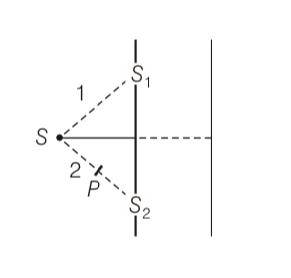
Figure shown a two slit arrangement with a source which emits unpolarised light. P is a polariser with axis whose direction is not given. If I 0 𝐼 0 is the intensity of the principal maxima when no polariser is present, calculte in the present case, the intensity of the principal maxima as well as the first minima.

This is a Long Answer Type Questions as classified in NCERT Exemplar
Explanation- when polariser is not used
A=Aperp+A
letA1= asinwt and A2=asin(wt+ )
now superposition principle for perpendicular polariser
AR= asinwt+ asin(wt+ )
AR=a(2cos sin(wt+ ))
AR=2acos sin(wt+ )
This eqn is also same for
Upvote