Law Colleges in Madhya Pradesh - Courses, Fees, Admissions 2026, Cutoff, Placements
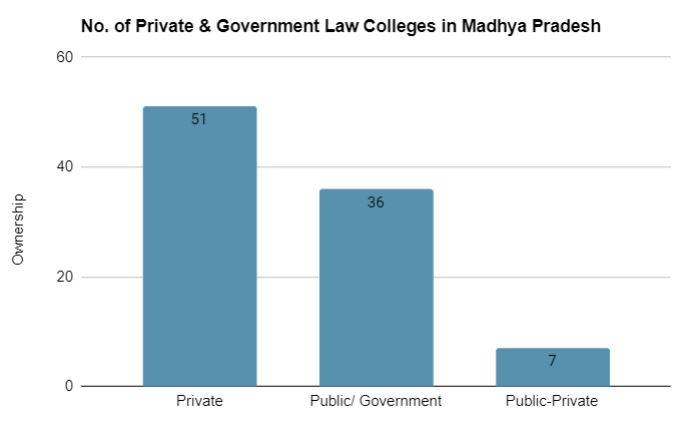
In Madhya Pradesh, there are nearly 110 colleges offering law programmes at various levels. Out of these, there are 54 per cent are private colleges, 38 per cent are government/ public owned colleges and the remaining ones falls under the category of public/ private.
Law Colleges in Madhya Pradesh Highlights
A brief highlight of the colleges in MP offering law programmes is mentioned in the following table.
| Parameters | Particulars/ Statistics |
|---|---|
| No. of Law Colleges in Madhya Pradesh | 110 (Approx.) |
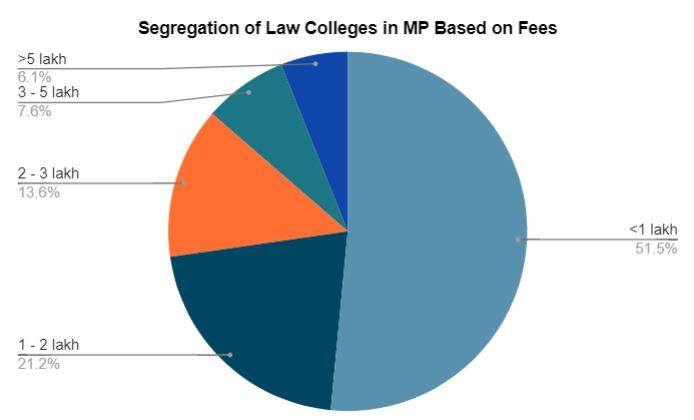
| Fees | <1 lakh: 51 per cent 1 - 2 lakh: 21 per cent 2 - 3 lakh: 14 per cent 3 - 5 lakh: 8 per cent >5 lakh: 6 per cent |
| Top Specialisations | Human Rights & International Humanitarian Law Criminal Law Cyber Law Intellectual Property Law Business Law |
| Admission Process | Entrance Exams: DAVV CET, CLAT, LSAT India and more Merit-Based for few courses |
Candidates who want to be attorneys or lawyers in the future often choose law as a course. The degree has a lot of potential because of the various specialisations and good pay available in the sector. Human Rights & International Humanitarian Law, Corporate Law and Criminal Law, are just a few of the top Law specialisations available at Madhya Pradesh law schools.
Law Colleges in Madhya Pradesh Eligibility Criteria
Candidates can study law in MP after completing their seconda
In Madhya Pradesh, there are nearly 110 colleges offering law programmes at various levels. Out of these, there are 54 per cent are private colleges, 38 per cent are government/ public owned colleges and the remaining ones falls under the category of public/ private.
Law Colleges in Madhya Pradesh Highlights
A brief highlight of the colleges in MP offering law programmes is mentioned in the following table.
| Parameters | Particulars/ Statistics |
|---|---|
| No. of Law Colleges in Madhya Pradesh | 110 (Approx.) |
| Fees | <1 lakh: 51 per cent 1 - 2 lakh: 21 per cent 2 - 3 lakh: 14 per cent 3 - 5 lakh: 8 per cent >5 lakh: 6 per cent |
| Top Specialisations | Human Rights & International Humanitarian Law Criminal Law Cyber Law Intellectual Property Law Business Law |
| Admission Process | Entrance Exams: DAVV CET, CLAT, LSAT India and more Merit-Based for few courses |
Candidates who want to be attorneys or lawyers in the future often choose law as a course. The degree has a lot of potential because of the various specialisations and good pay available in the sector. Human Rights & International Humanitarian Law, Corporate Law and Criminal Law, are just a few of the top Law specialisations available at Madhya Pradesh law schools.
Law Colleges in Madhya Pradesh Eligibility Criteria
Candidates can study law in MP after completing their secondary education or after graduation. The qualifying criteria for Law courses vary depending on the programme type (degree, diploma, certificate) and level (undergraduate or postgraduate). The broad qualifying criteria for all sorts of programmes are listed below.
Eligibility for UG Law Courses:
- Candidates who have cleared Higher Secondary School/Intermediate (10+2) or its equivalent exam from a recognised board with not less than 45% marks in aggregate are eligible to apply
Eligibility for PG Law Courses:
- Aspirants must be graduates of a recognised university to be admitted to the LLB (3-year) programme.
- Candidates must also have an LLB or equivalent degree from a recognised university in order to be admitted to the LLM programme.
Law Colleges in Madhya Pradesh with India Today Ranking and Shiksha Rating (Aggregate)
Every year, the India Today Group publishes rankings for institutions in several fields. The Group publishes the rankings after examining the colleges on a variety of factors such as faculty, infrastructure, and placements. In addition to this, we have also provided Shiksha Ratings based on students feedback as well.
| Name of the College | India Today Ranking | Shiksha Rating (Aggregate) |
|---|---|---|
| National Law Institute University, Bhopal | 3 | 4.3 |
| Indore Institute of Law, Indore | 36 | 3.6 |
| Dr Kailasnath Katju Law College, Ratlam | 61 | (-) |
| Career College of Law | 62 | 4.2 |
| Devi Ahilya Vishwavidyalaya, Takshashila Campus | (-) | 3.9 |
| State Law College, Bhopal | (-) | 3.0 |
| Prestige Institute of Management and Research | (-) | 3.8 |
| RKDF University, Bhopal | (-) | 3.1 |
| Amity University, Gwalior | (-) | 4.3 |
| Jagran Lakecity University | (-) | 4.3 |
| SAGE University | (-) | 4.2 |
List of Private and Government Law Colleges in Madhya Pradesh
One can check below the list of government and private law colleges along with their fees.
Private Law Colleges in Madhya Pradesh
The private law colleges in Madhya Pradesh are as follows:
| Name of the College | Fees (in Rs) |
|---|---|
| Prestige Institute of Management and Research | 1.96 L - 4.9 L |
| RKDF University, Bhopal | 1.1 L - 1.5 L |
| Amity University, Gwalior | 1.11 L - 5.16 L |
| Jagran Lakecity University | 1.35 L - 9.1 L |
| SAGE University | 90 K - 3 L |
| Indore Institute of Law, Indore | 84.4 K - 18.15 L |
| Career College of Law | 1.1 K - 2.75 L |
Government Law Colleges in Madhya Pradesh
The government law colleges in Madhya Pradesh are as follows:
| Name of the College | Fees (in Rs) |
|---|---|
| National Law Institute University, Bhopal | 1.46 L - 2 L |
| Devi Ahilya Vishwavidyalaya | 89.42 K - 2.35 L |
ROI of Top Law Colleges in Madhya Pradesh
Students can look up the return on investment to see how useful a course is to them. The return on investment (ROI) informs students about the advantages of taking a course. Choosing a college or university based on the ROI factor can be beneficial in the case of popular courses. This is useful when choosing between two or more colleges becomes difficult.
The best law colleges in Hyderabad are listed below, along with their average annual fees and average placement package:
| Name of the College | Fees (in Rs) | Median Salary |
|---|---|---|
| National Law Institute University, Bhopal | 1.46 L - 2 L | 5.5 - 14 LPA |
| RKDF University, Bhopal | 1.1 L - 1.5 L | 1.47 - 1.78 LPA |
| Amity University, Gwalior | 1.11 L - 5.16 L | 1.15 - 3 LPA |
| Jagran Lakecity University | 1.35 L - 9.1 L | 2.5 - 3.4 LPA |
| SAGE University | 90 K - 3 L | 3 LPA |
| Indore Institute of Law, Indore | 84.4 K - 18.15 L | 2.8 - 3.5 LPA |
Note: Above statistics are based on the latest available data.
Read More
Top Recruiters for Law Graduates in MP
Law graduates in any sector are in high demand. A few of the top corporations that hire law graduates from Madhya Pradesh colleges are listed in the table below. With this, the table also carries the placement ratings given by the students.
| Name of the College | Placement Ratings | Recruiters |
|---|---|---|
| NLIU Bhopal | 4.3 | Cyril Amarchand Mangladas, Khaitan and Co, Trilegal, Singh & Associates, Lakshmikumaran & Sridharan, L&L Law Offices, New Delhi Law Offices |
| Career College of Law | 4.2 | TCS, Wipro, Godrej, BSNL, New Delhi Law Offices |
| Jagran Lakecity University | 3.6 | ICICI Lombard, MK Motion Pictures, Legal Services, High Court, Legal Services, Kochar Infotech, Juris Corp, Ennoble IP |
| Indore Institute of Law | 3.1 | District Court, PCS Ashish Karodia & Co., Legal Excellence Law Firm, Legal Excellence, AMIT JINDAL INFRAWAYS INDORE PRIVATE LIMITED |
| Rani Durgavati Vishwavidyalaya | 3.0 | Singla Tayal & Co., R.K. International, Kotak Mahindra Bank, KPRC & Associates |
How affordable is studying Law Courses in Madhya Pradesh?
The following pie-chart will give you an idea of the annual programme fee that a college charges a student.
- Career College of Law
- Jiwaji University
- Renaissance University
About 13 per cent Law colleges in MP have a fee structure over Rs 3 lakh. Some such colleges include:
- Amity University Gwalior
- SAGE University, Indore
- Jagran Lakecity University
Which are the most popular Exams accepted by Law Colleges in Madhya Pradesh?
In Madhya Pradesh, some of the popular law entrance examinations are DAVV CET, CLAT, JLUET, AILET, and LSAT India.
 All FiltersClear All
- (1)


- (76)
- (51)
- (19)
- (2)
- (4)
- (4)
- (2)
- (2)
- (3)
- (24)
- (22)
Law Colleges in Madhya Pradesh - Courses, Fees, Admissions 2026, Cutoff, Placements

 UjjainPvt
 IndorePvtBetulPvt
 ShahdolPvt
Commonly asked questions On Law Colleges in Madhya Pradesh - Courses, Fees, Admissions 2026, Cutoff, Placements
Avantika University offers various scholarships, tuition fee waiver schemes, teaching and research assistance to meritorious, needy, and deserving students. Students who want to avail Avantika University scholarships are required to follow certaion procedure. Given below is the step-wise process to avail Avantika University scholarships:
STEP 1: The Student Office floats a notification calling-in application from the interested students. The notification of scholarship is generally released within one month of joining along with the datewise schedule.
STEP 2: Students must then fill out the online application form and add necessary enclosures, fetch a strong recommendation of their skills from the faculty members (if applicable) and must submit the hardcopy of Avantika University scholarships form to the Student Office.
STEP 3: The Scrutiny Committee then forwards the qualified applications to the Avantika Award Committe.
STEP 4: The Avantika Award Committee goes through all the applications and approves the final list of Avantika University scholarship achievers.
STEP 5: Selected students then receive the congratulatory mail along with relevant details.
Some medical field which offer best work and life balance are shown below -
Dentistry (BDS & MDS) – Fixed clinic hours, fewer emergencies.
Pharmacy (BPharm & MPharm) – Less stress compared to hospital-based jobs.
Physiotherapy (BPT & MPT) – Flexible working hours, minimal emergency calls.
Public Health & Community Medicine – Focus on preventive healthcare rather than emergency treatments.
Clinical Research & Medical Writing – Research-based work with no direct patient responsibilities.
Both the AP LAWCET and CLAT entrance exam are conducted for admission to the Law schools in India, however, the syllabus for these exams are different on many parameters and candidates should strategise differently for both the exams. AP LAWCET exam has sections including Current Affairs, Legal Aptitude, Contract Law, Constitution, etc. and the CLAT entrance exam sections include English Language, Legal Aptitude, Mathematics, etc. AP LAWCET does not have mathematics subjects, AP LAWCET exam focus more on regional knowledge. CLAT generally covers the deeper aspects of the particular subject.
Madhya Pradesh - OtherGovtJabalpurPvt RewaPvt
Commonly asked questions On Law Colleges in Madhya Pradesh - Courses, Fees, Admissions 2026, Cutoff, Placements
Both the AP LAWCET and CLAT entrance exam are conducted for admission to the Law schools in India, however, the syllabus for these exams are different on many parameters and candidates should strategise differently for both the exams. AP LAWCET exam has sections including Current Affairs, Legal Aptitude, Contract Law, Constitution, etc. and the CLAT entrance exam sections include English Language, Legal Aptitude, Mathematics, etc. AP LAWCET does not have mathematics subjects, AP LAWCET exam focus more on regional knowledge. CLAT generally covers the deeper aspects of the particular subject.
| Courses | Eligibility |
|---|---|
| B.A. | Candidate must have passed 10+2 or equivalent examination from a recognised school/board. |
| B.Com | Candidate must have passed 10+2 or equivalent examination from a recognised school/board. |
| B.A. LL.B. | Candidate must have passed 10+2 or equivalent examination from a recognised school/board. |
| Courses | Eligibility |
|---|---|
| LL.M. | Candidate must have completed LLB Degree with mentioned marks from any recognised university. |
| MSW | Candidate with post graduate with 50% marks can also apply. |
| B.Com | Candidate must have passed 10+2 with mentioned marks from any recognised board. |
| B.Lib.Sc. | Candidate must have passed 10+2 from a recognised board. |
| B.A. LL.B. | Candidate must have passed 10+2 with mentioned marks from any recognised board. |
| B.Sc. | Candidate must have passed 10+2 examination with Science stream from a recognised board. |
| BCA | Candidate must have passed 10+2 or Equivalent with mentioned marks from any recognised board. |
| B.Ed | Candidate with post graduation with 50% marks can also apply. |
Madhya Pradesh - OtherPvtShajapurGovtCommonly asked questions On Law Colleges in Madhya Pradesh - Courses, Fees, Admissions 2026, Cutoff, Placements
Both the AP LAWCET and CLAT entrance exam are conducted for admission to the Law schools in India, however, the syllabus for these exams are different on many parameters and candidates should strategise differently for both the exams. AP LAWCET exam has sections including Current Affairs, Legal Aptitude, Contract Law, Constitution, etc. and the CLAT entrance exam sections include English Language, Legal Aptitude, Mathematics, etc. AP LAWCET does not have mathematics subjects, AP LAWCET exam focus more on regional knowledge. CLAT generally covers the deeper aspects of the particular subject.
No, you cannot become a lawyer without a Law degree. You mandatorily need to obtain degrees such as BA/BCom/BSc/BBA LLB or LLB in order to be a lawyer in India. To become a lawyer, one must first complete three-year or five-year LLB from a recognised university and possess degree certificate. Then, they must enrol themselves in local Bar Council of the concerned state and enrolled as an advocate. Within two years of the enrolment, they must appear and clear AIBE in order to be eligible to practise anywhere in India.
Both the AP LAWCET and CLAT entrance exam are conducted for admission to the Law schools in India, however, the syllabus for these exams are different on many parameters and candidates should strategise differently for both the exams. AP LAWCET exam has sections including Current Affairs, Legal Aptitude, Contract Law, Constitution, etc. and the CLAT entrance exam sections include English Language, Legal Aptitude, Mathematics, etc. AP LAWCET does not have mathematics subjects, AP LAWCET exam focus more on regional knowledge. CLAT generally covers the deeper aspects of the particular subject.
IndoreBhopalPvtIndorePvtKatniPvtBhopalPvtCommonly asked questions On Law Colleges in Madhya Pradesh - Courses, Fees, Admissions 2026, Cutoff, Placements
Some medical field which offer best work and life balance are shown below -
Dentistry (BDS & MDS) – Fixed clinic hours, fewer emergencies.
Pharmacy (BPharm & MPharm) – Less stress compared to hospital-based jobs.
Physiotherapy (BPT & MPT) – Flexible working hours, minimal emergency calls.
Public Health & Community Medicine – Focus on preventive healthcare rather than emergency treatments.
Clinical Research & Medical Writing – Research-based work with no direct patient responsibilities.
| Courses | Eligibility |
|---|---|
| B.A. | Candidate must have completed 10+2 from any recognised Board/Council. |
| B.Com | Candidate must have passed 10+2 from any recognised Board/Council. |
| B.A. LL.B. | Candidate must have passed 10+2 from a recognised board. |
| B.Sc. | Candidate must have passed 10+2 examination with Science stream from a recognised board. |
| BBA | Candidate must have passed 10+2 from any recognised Board/Council. |
| B.Ed | Candidate must have completed Bachelor's Degree in Science/Social Science/Humanity/B.E/B.Tech with specialisation in Science and Mathematics with above mentioned marks from any reognised University/Institute. |
| BCA | Candidate must have passed 10+2 with Mathematics as compulsory subject from any recognised Board/Council. |
Madhya Pradesh - OtherGovtHoshangabadGovtCommonly asked questions On Law Colleges in Madhya Pradesh - Courses, Fees, Admissions 2026, Cutoff, Placements
No IPS Academy Institute of Business Management and Research is not more expensive than Medi-Caps University. The official websites of the two colleges respectively provide information on the two institutions, including their academic programs, rankings, and placements, and the details of their fees or tuition costs is also there. It is recommended to check the official websites of both institutions or contact them directly for more information on their fees and expenses.Students can also refer to the following link for detailed comparison between the to colleges:
https://www.shiksha.com/college/ips-academy-institute-of-business-management-and-research-indore-147313/compare
According to the NIRF report 2023, the median package offered to UG (3-year) and PG (2-year) during placements in 2022 stood at INR 5.90 LPA and INR 6.80 LPA, respectively. Further, a total of 394 UG (3-year) and 343 PG (2-year) students were placed during SRKU placements in 2022. The median package offered during Sarvepalli Radhakrishnan University for UG and PG placements 2023 stood at INR 7 LPA and INR 10 LPA, respectively.
BhopalPPPGwaliorGovt