Maths NCERT Exemplar Solutions Class 11th Chapter Ten: Overview, Questions, Preparation

Maths NCERT Exemplar Solutions Class 11th Chapter Ten 2025 ( Maths NCERT Exemplar Solutions Class 11th Chapter Ten )

Vishal Baghel
Updated on Aug 14, 2025 12:40 IST

By Vishal Baghel, Executive Content Operations

Table of contents
  • Straight Limes Short Answer Type Questions
  • Straight Limes Long Answer Type Questions
  • Straight Limes Objective Type Questions
  • Straight Limes Fill in the Blank
  • Straight Limes True or False Type Questions
  • JEE MAINS 26th February 2021 First Shift
  • JEE Mains 2025
View More
Maths NCERT Exemplar Solutions Class 11th Chapter Ten Logo

Straight Limes Short Answer Type Questions

Find the equation of the straight line which passes through the point (1, –2) and cuts off equal intercepts from axes.

Sol:

I n t e r c e p t     f o r m     o f     s t r a i g h t     l i n e                       x a + y b = 1 ,     w h e r e     a     a n d     b     a r e     t h e         o n     t h e     a x i s G i v e n     t h a t     a = b ∴                   x a + y a = 1                                                                                       … ( i ) I f     e q n . ( i )     p a s s e s     t h r o u g h     t h e         ( 1 , − 2 ) ,     w e     g e t                         1 a − 2 a = 1                   ⇒ − 1 a = 1           ⇒ a = − 1 S o ,     t h e     e q u a t i o n     o f     t h e     s t r a i g h t     l i n e     i s                         x − 1 + y − 1 = 1         ⇒ x + y = − 1           ⇒ x + y + 1 = 0 H e n c e ,     t h e     r e q u i r e d     e q u a t i o n     i s     x + y + 1 = 0 .

Find the equation of the line passing through the point (5, 2) and perpendicular to the line joining the points (2, 3) and (3, –1).

Sol:

S l o p e     o f     t h e     l i n e     j o i n i n g     t h r o u g h     t h e         ( 2 , 3 )     a n d     ( 3 , − 1 )     i s                             − 1 − 3 3 − 2 = − 4 S l o p e     o f     t h e     r e q u i r e d     l i n e     w h i c h     i s     p e r p e n d i c u l a r     t o     i t                         = − 1 − 4 = 1 4                                                     [ ∵ m 1 m 2 = − 1 ] E q u a t i o n     o f     t h e     l i n e         t h r o u g h     t h e         ( 5 , 2 )     i s                         y − 2 = 1 4 ( x − 5 )                           [ ∵ y − y 1 = m ( x − x 1 ) ] ⇒           4 y − 8 = x − 5 ⇒         x − 4 y + 3 = 0 H e n c e ,     t h e     r e q u i r e d     e q u a t i o n     i s     x − 4 y + 3 = 0 .

Q&A Icon
Commonly asked questions
Q:  

Find the equation of the straight line which passes through the point (1, –2) and cuts off equal intercepts from axes.

Read more
A: 

This is a Short Answer Type Questions as classified in NCERT Exemplar

Sol:

Intercept  form  of  straight  line           xa+yb=1,  where  a  and  b  are  the    on  the  axisGiven  that  a=b∴         xa+ya=1                                           …(i)If  eqn.(i)  passes  through  the    (1,−2),  we  get            1a−2a=1         ⇒−1a=1     ⇒a=−1So,  the  equation  of  the  straight  line  is            x−1+y−1=1    ⇒x+y=−1     ⇒x+y+1=0Hence,  the  required  equation  is  x+y+1=0.

Q:  

If the intercept of a line between the coordinate axes is divided by the point (–5, 4) in the ratio 1: 2, then find the equation of the line.

Read more
A: 

This is a Short Answer Type Questions as classified in NCERT Exemplar

Sol:

Let  a  and  b  be  the    on  the  given  line.∴  Coordinates  of  A  and  B  are  (a,0)  and  (0,b)  respectively∴       −5=1×0+2×a1+2⇒     2a=−15       ⇒a=−152                              [?     X=m1x2+m2x1m1+m2and  Y=m1y2+m2y1m1+m2]∴       A=(−152,0)and  4=1×b+0×21+2⇒     4=b3      ⇒b=12∴       B=(0,12)So,  the  equation  of  line  AB  is        y−y1=y2−y1x2−x1(x−x1)⇒     y−0=12−00+152(x+152)⇒            y=12×215(x+152)⇒            y=85(x+152)⇒         5y=8x+60⇒8x−5y+60=0Hence,  the  required  equation  is  8x−5y+60=0.

Q:  

Find the equation of a straight line on which the length of perpendicular from the origin is four units and the line makes an angle of 120° with the positive direction of the x-axis.

(Hint: Use normal form, where ω = 30°.)

Read more
A: 

This is a Short Answer Type Questions as classified in NCERT Exemplar

Sol:

Given  that:             OM=4 units       ∠BAX=1200∴    ∠BAO=1800−1200    or    ∠MOA+∠MAO=900                 [?  OM⊥AB]      θ+600=900     ⇒θ=900−600∴    θ=300So,  equation  of  AB  in  its  normal  form               xcosθ+ysinθ=p⇒xcos300+ysin300=4⇒             x×32+y×12=4        ⇒3x+y=8Hence,  the  required  equation  is  3x+y=8.

Q:  

Find the equation of the line passing through the point (5, 2) and perpendicular to the line joining the points (2, 3) and (3, –1).

Read more
A: 

This is a Short Answer Type Questions as classified in NCERT Exemplar

Sol:

Slope  of  the  line  joining  through  the    (2,3)  and  (3,−1)  is              −1−33−2=−4Slope  of  the  required  line  which  is  perpendicular  to  it            =−1−4=14                          [
m1m2=−1]Equation  of  the  line    through  the    (5,2)  is            y−2=14(x−5)             [
y−y1=m(x−x1)]⇒     4y−8=x−5⇒    x−4y+3=0Hence,  the  required  equation  is  x−4y+3=0.

Q:  

 Find the angle between the lines y = (2 – 3)(x + 5) and y = (2 + 3)(x – 7).

A: 

This is a Short Answer Type Questions as classified in NCERT Exemplar

Sol:

The  given  equations  are  y=(2−3)(x+5)                        …(i)                and                              y=(2+3)(x−7)                        …(ii)           Slope  of  the  eqn.(i)  m1  (say)=(2−3)and  slope  of  the  eqn.(ii)  m2  (say)=(2+3)Let  θ  be  the  angle  betqween  the  two  given  lines∴  tanθ=|m1−m21+m1m2|=|2−3−2−31+(2−3)(2+3)|=|−232|=|−3|⇒    tanθ=3  or  −3∴              θ=600  or  1200Hence,  the  required  angle  is  600  or  1200.

Q:  

Find the equation of the lines which passes through the point (3, 4) and cuts off intercepts from the coordinate axes such that their sum is 14.

Read more
A: 

This is a Short Answer Type Questions as classified in NCERT Exemplar

Sol:

Equation  of  line  having  a  and  b    on  the  axis  is                       xa+yb=1                                           …(i)Given  that  a+b=14     ⇒b=14−a⇒                       xa+y14−a=1                                     …(ii)If  eqn.(ii)  passes  through  the    (3,4)  then                         3a+414−a=1⇒            3(14−a)+4aa(14−a)=1⇒                             42+a=14a−a2⇒       a2+a−14a+42=0⇒               a2−13a+42=0⇒       a2−7a−6a+42=0⇒   a(a−7)−6(a−7)=0⇒              (a−6)(a−7)=0         ⇒a=6,7∴                b=14−6=8,  b=14−7=7Hence,  the  required  equation  of  lines  are               x6+y8=1       ⇒4x+3y=24and       x7+y7=1       ⇒x+y=7

Q:  

Find the points on the line x + y = 4 which lie at a unit distance from the line 4x + 3y = 10.

A: 

This is a Short Answer Type Questions as classified in NCERT Exemplar

Sol:

Let  (x1,y1)  be  any    lying  in  the  equation  x+y=4∴                 x1+y1=4                                               …(i)  of  the    (x1,y1)  from  the  equation  4x+3y=10                  4x1+3y1−10(4)2+(3)2=1                |4x1+3y1−105|=1                   4x1+3y1−10=±5Taking  (+)  sign           4x1+3y1−10=5⇒                                         4x1+3y1=15                         …(ii)From  eqn.(i)  we  get  y1=4−x1Putting  the  value  of  y1  in  eqn.(ii)  we  get            4x1+3(4−x1)=15⇒         4x1+12−3x1=15⇒                       x1+12=15⇒                      x1=3  and  y1=4−3=1So,  the  required    is  (3,1)Now  taking  (−)  sign,           4x1+3y1−10=−5⇒                                         4x1+3y1=5                         …(iii)From  eqn.(i)  we  get  y1=4−x1            4x1+3(4−x1)=5⇒         4x1+12−3x1=5⇒                       x1+12=5⇒                      x1=−7  and  y1=4−(−7)=11So,  the  required    is  (−7,11)Hence,  the   required    on  the  given  line  are  (3,1)  and  (−7,11).

Q:  

Show that the tangent of an angle between the lines x/a + y/b = 1 and x/a − y/b = 1 is 2ab / (a² − b²).

Read more
A: 

This is a Short Answer Type Questions as classified in NCERT Exemplar

Sol:

Given  that:           xa+yb=1                           …(i)and                           xa−yb=1                           …(ii)           Slope  of  the  eqn.(i)  m1  (say)=−baand  slope  of  the  eqn.(ii)  m2  (say)=baLet  θ  be  the  angle  betqween  the  two  given  lines∴  tanθ=|m1−m21+m1m2|=|−ba−ba1+(−ba)(ba)|=|−2ba1−b2a2|=|−2aba2−b2|⇒    tanθ=2aba2−b2.  Hence  proved.

Q:  

Find the equation of lines passing through (1, 2) and making an angle 30° with the y-axis.

A: 

This is a Short Answer Type Questions as classified in NCERT Exemplar

Sol:

Given  that  the  line  makes  angle  300  with  yaxis∴  Angle  made  by  the  line  with   xaxis  is  600∴  Slope  of  the  line           m=tan600⇒      m=3So,  the  equation  of  the  line    through  the    (1,2)  and  slope  3  is             y−y1=m(x−x1)⇒          y−2=3(x−1)⇒          y−2=3x−3⇒          y−3x−3−2=0Hence,  the  required  equation  of  line  is  y−3x−3−2=0.

Q:  

Find the equation of the line passing through the point of intersection of 2x + y = 5 and x + 3y + 8 = 0 and parallel to the line 3x + 4y = 7.

Read more
A: 

This is a Short Answer Type Questions as classified in NCERT Exemplar

Sol:

(a)Given

  that:      2x+y=5                             …(i)                               x+3y+8=0                             …(ii)                                   3x+4y=7                             …(iii)Equation  of  any  line    through  the    of    of  eqn.(i)  and  eqn.(ii)  is       (2x+y−5)+λ(x+3y+8)=0                 …(iv)        [λ=]⇒    2x+y−5+λx+3λy+8λ=0⇒(2+λ)x+(1+3λ)y−5+8λ=0        Slope  of  line  m1(say)=−(2+λ)1+3λ      [?m=−ab]        Slope  of  line  3x+4y=7  is                                     m2(say)=−34       If  eqn.(iii)  is  parallel  to  eqn.(iv)  then                           m1=m2∴          −(2+λ)1+3λ=−34⇒             2+λ1+3λ=34       ⇒8+4λ=3+9λ⇒         9λ−4λ=5        ⇒5λ=5     ⇒λ=1On  putting  the  value  of  λ  in  eqn.(iv)  we  get            (2x+y−5)+1(x+3y+8)=0⇒                 2x+y−5+x+3y+8=0⇒                                       3x+4y+3=0Hence,  the  required  equation  is  3x+4y+3=0.

Q:  

For what values of a and b the intercepts cut off on the coordinate axes by the line ax + by + 8 = 0 are equal in length but opposite in signs to those cut off by the line 2x – 3y + 6 = 0 on the axes.

Read more
A: 

This is a Short Answer Type Questions as classified in NCERT Exemplar

Sol:

The  given  equation  are     ax+by+8=0                         …(i)and                                              2x−3y+6=0                         …(ii)From  eqn.(i)  we  get,             ax+by+8=0       ⇒ax+by=−8⇒     a−8x+b−8y=1        ⇒x−8a+y−8b=1So,  the    on  the  axes  are  −8a  and  −8bFrom  eqn.(ii)  we  get,          2x−3y+6=0       ⇒2x−3y=−6⇒          2x−6−3y−6=1        ⇒x−3+y2=1So,  the    on  the  axes  are  −3  and  2.According  to  the  question            −8a=+3     ⇒a=−83and  −8b=−2     ⇒b=+4Hence,  the  required  values  of  a  and  b  are  −83  and  4.

Q:  

 Find the equation of one of the sides of an isosceles right-angled triangle whose hypotenuse is given by 3x + 4y = 4 and the opposite vertex of the hypotenuse is (2, 2).

Read more
A: 

This is a Short Answer Type Questions as classified in NCERT Exemplar

Sol:

Given  that  equation  of  the  hypotenuse  is  3x+4y=4  and  opposite  vertex  is  (2,2)Slope  BC=−34Let  slope  of  AC  be  m∴  tan450=|m+341+(−34)m|⇒            1=|4m+34−3m|      ⇒4m+34−3m=±1Taking  (+)  sign,  4m+34−3m=1⇒               4m+3=4−3m⇒               4m+3m=4−3     ⇒7m=1    ⇒m=17Taking  (−)  sign,  4m+34−3m=−1⇒               4m+3=−4+3m⇒               4m−3m=−4−3     ⇒m=−7∴  Equation  of  AC  with  slope  (17)  is            y−2=17(x−2)⇒7y−14=x−2      ⇒x−7y+12=0Equation  of  AC  with  slope  (−7)  is            y−2=−7(x−2)⇒       y−2=−7x+14⇒7x+y−16=0Hence,  the  required  equations  are  x−7y+12=0  and  7x+y−16=0.

Maths NCERT Exemplar Solutions Class 11th Chapter Ten Logo

Straight Limes Long Answer Type Questions

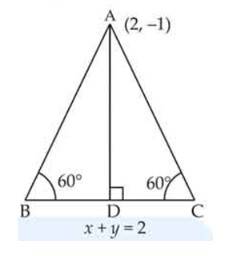
If the equation of the base of an equilateral triangle is x + y = 2 and the vertex is (2, –1), then find the length of the side of the triangle.

(Hint: Find the length of the perpendicular (p) from (2, –1) to the line and use p = l sin 60°, where l is the length of the side of the triangle.)

Sol:

E q u a t i o n     o f     t h e     b a s e     A B     o f     a     Δ A B C     i s     x + y = 2 I n     Δ A B D ,                               s i n 6 0 0 = A D A B             ⇒ 3 2 = A D A B         ⇒ A D = 3 2 A B L e n g t h     o f     p e r p e n d i c u l a r     f r o m     A ( 2 , − 1 )     t o     t h e     l i n e     x + y = 2     i s                           A D = | 1 × 2 + 1 × − 1 − 2 ( 1 ) 2 + ( 1 ) 2 | ⇒ 3 2 A B = | 2 − 1 − 2 2 | = | − 1 2 | ⇒ 3 2 A B = 1 2                 ⇒ A B = 2 3 H e n c e ,     t h e     r e q u i r e d     l e n g t h     o f     s i d e = 2 3 .

A variable line passes through a fixed-point P. The algebraic sum of the perpendiculars drawn from the points (2, 0), (0, 2), and (1, 1) on the line is zero. Find the coordinates of the point P.

(Hint: Let the slope of the line be m. Then the equation of the line passing through the fixed-point P (x₁, y₁) is y – y ₁ = m (x – x₁). Taking the algebraic sum of perpendicular distances equal to zero, we get y – 1 = m (x – 1). Thus (x₁, y₁) is (1, 1).

Sol:

L e t     ( x 1 , y 1 )     b e     t h e     c o o r d i n a t e s     o f     t h e     g i v e n         P     a n d     m     b e     t h e     s l o p e     o f     t h e     l i n e . ∴     E q u a t i o n     o f     t h e     l i n e     i s     y − y 1 = m ( x − x 1 )                                                                   … ( i ) G i v e n         a r e     A ( 2 , 0 ) ,     B ( 0 , 2 )     a n d     C ( 1 , 1 ) . P e r p e n d i c u l a r         f r o m     A ( 2 , 0 )     d 1     ( s a y )                                             d 1 = 0 − y 1 − m ( 2 − x 1 ) 1 + m 2 P e r p e n d i c u l a r         f r o m     B ( 0 , 2 )     d 2     ( s a y )                                             d 2 = 2 − y 1 − m ( 0 − x 1 ) 1 + m 2 S i m i l a r l y ,     p e r p e n d i c u l a r         f r o m     C ( 1 , 1 )     d 3     ( s a y )                                             d 3 = 1 − y 1 − m ( 1 − x 1 ) 1 + m 2 A c c o r d i n g     t o     t h e     q u e s t i o n ,     w e     h a v e                                 d 1 + d 2 + d 3 = 0 ∴     0 − y 1 − m ( 2 − x 1 ) 1 + m 2 + 2 − y 1 − m ( 0 − x 1 ) 1 + m 2 + 1 − y 1 − m ( 1 − x 1 ) 1 + m 2 = 0 ⇒                                             − y 1 − 2 m + m x 1 + 2 − y 1 + m x 1 + 1 − y 1 − m + m x 1 = 0 ⇒                                                   3 m x 1 − 3 y 1 − 3 m + 3 = 0                     ⇒ m x 1 − y 1 − m + 1 = 0     t h e         ( 1 , 1 )     s a t i f i e s     t h e     a b o v e     e q u a t i o n . H e n c e ,     t h e         ( 1 , 1 )     l i e s     o n     t h e     l i n e .

Q&A Icon
Commonly asked questions
Q:  

If the equation of the base of an equilateral triangle is x + y = 2 and the vertex is (2, –1), then find the length of the side of the triangle.

(Hint: Find the length of the perpendicular (p) from (2, –1) to the line and use p = l sin 60°, where l is the length of the side of the triangle.)

Read more
A: 

This is a Long Answer Type Questions as classified in NCERT Exemplar

Sol:

Equation  of  the  base  AB  of  a  ΔABC  is  x+y=2In  ΔABD,               sin600=ADAB      ⇒32=ADAB    ⇒AD=32ABLength  of  perpendicular  from  A(2,−1)  to  the  line  x+y=2  is             AD=|1×2+1×−1−2(1)2+(1)2|⇒32AB=|2−1−22|=|−12|⇒32AB=12        ⇒AB=23Hence,  the  required  length  of  side=23.

Q:  

A straight line moves so that the sum of the reciprocals of its intercepts made on axes is constant. Show that the line passes through a fixed point.

(Hint: 1/a+1/b=1, where a + b =” constant” =1/k (say). This implies that a + b = k. Line passes through the fixed point (k, k).)

Read more
A: 

This is a Long Answer Type Questions as classified in NCERT Exemplar

Sol:

Intercepts  form  of  a  straight  line  is            xa+yb=1where  a  and  b  are  the    made  by  the  line  on  the  axes.Given  that:       1a+1b=1k(say)⇒                 ka+kb=1which  shows  that  the  line  is    through  the  fixed    (k,k).

Q:  

If the sum of the distances of a moving point in a plane from the axes is 1, then find the locus of the point.

(Hint: Given that x + y = 1, which gives four sides of a square.

Read more
A: 

This is a Long Answer Type Questions as classified in NCERT Exemplar

Sol:

Let  coordinates  of  a  moving    P  be  (x,y).Given  that  the  sum  of  the  axes  to  the    is  always  1∴              |x|+|y|=1⇒               x+y=1⇒           −x−y=1      ⇒−x+y=1⇒               x−y=1Hence,  these  equations  gives  us  the  locus  of  the    which  is  a  square.

Q:  

P1, P2 are points on either of the two lines y – 3x = 2 at a distance of 5 units from their point of intersection. Find the coordinates of the foot of perpendiculars drawn from P?, P? on the bisector of the angle between the given lines.

(Hint: Lines are y = 3 x + 2 and y = – 3 x + 2 according as x ≥ 0 or x < 0

Y-axis is the bisector of the angles between the lines. P?, P? are the points on these lines at a distance of 5 units from the point of intersection of these lines which have a point on y-axis as the common foot of perpendiculars from these points. The y-coordinate of the foot of the perpendicular is given by 2 + 5 cos30°.)

Read more
A: 

This is a Long Answer Type Questions as classified in NCERT Exemplar

Sol:

Given  lines  are  y−3|x|=2⇒                                 y−3x=2,  if  x≥0                               …(i)and                              y+3x=2,  if  x<0                               …(ii)Slope  of  eqn.(i)  is  tanθ=3  ∴θ=600Slope  of  eqn.(ii)  is  tanθ=−3  ∴θ=1200Solving  eqn.(i)  and  eqn.(ii)  we  get                y  −  3x  =  2                y  +  3x  =  2_                             2y=4           ⇒y=2Putting  the  value  of  y  in  eqn.(i)  we  get                x=0∴    of    of  line  (i)  and  (ii)  is  Q  (0,2)∴             QO=2In  ΔPEQ,              cos300=PQQE⇒                 32=PQ5      ⇒PQ=532∴         OP=OQ+PQ                    =2+532Hence,  the  coordinates  of  the  foot  of  perpendicular=(0,2+532)

Q:  

If p is the length of perpendicular from the origin on the line xa+yb =1 and a2,p2,b2 are in A.P., then show that a2+b2 =0.

Read more
A: 

This is a Long Answer Type Questions as classified in NCERT Exemplar

Sol:

Given  equations  is   xa+yb=1,  p  is  the  length  of  perpendicular  drawn  from  the  origin  to  the  given  line.∴              p=|0a+0b−11a2+1b2|Squaring  both  sides,  we  have               p2=11a2+1b2⇒         1a2+1b2=1p2                            …(i),  a2,p2,b2  are  in  A.P.∴               2p2=a2+b2⇒               p2=a2+b22      ⇒1p2=2a2+b2Putting  the  value  of  1p2  is  eqn.(i)  we  get,             1a2+1b2=2a2+b2⇒        a2+b2a2b2=2a2+b2⇒(a2+b2)2=2a2b2⇒a4+b4+2a2b2=2a2b2⇒a4+b4=0.  Hence  proved.

Q:  

A variable line passes through a fixed-point P. The algebraic sum of the perpendiculars drawn from the points (2, 0), (0, 2), and (1, 1) on the line is zero. Find the coordinates of the point P.

(Hint: Let the slope of the line be m. Then the equation of the line passing through the fixed-point P (x?, y?) is y – y ? = m (x – x?). Taking the algebraic sum of perpendicular distances equal to zero, we get y – 1 = m (x – 1). Thus (x?, y?) is (1, 1).

Read more
A: 

This is a Long Answer Type Questions as classified in NCERT Exemplar

Sol:

Let  (x1,y1)  be  the  coordinates  of  the  given    P  and  m  be  the  slope  of  the  line.∴  Equation  of  the  line  is  y−y1=m(x−x1)                                 …(i)Given    are  A(2,0),  B(0,2)  and  C(1,1).Perpendicular    from  A(2,0)  d1  (say)                      d1=0−y1−m(2−x1)1+m2Perpendicular    from  B(0,2)  d2  (say)                      d2=2−y1−m(0−x1)1+m2Similarly,  perpendicular    from  C(1,1)  d3  (say)                      d3=1−y1−m(1−x1)1+m2According  to  the  question,  we  have                d1+d2+d3=0∴  0−y1−m(2−x1)1+m2+2−y1−m(0−x1)1+m2+1−y1−m(1−x1)1+m2=0⇒                      −y1−2m+mx1+2−y1+mx1+1−y1−m+mx1=0⇒                         3mx1−3y1−3m+3=0          ⇒mx1−y1−m+1=0  the    (1,1)  satifies  the  above  equation.Hence,  the    (1,1)  lies  on  the  line.

Q:  

In what direction should a line be drawn through the point (1, 2) so that its point of intersection with the line x + y = 4 is at a distance √5 from the given point?

Read more
A: 

This is a Long Answer Type Questions as classified in NCERT Exemplar

Sol:

Let  the  given  line  x+y=4  and  the  required  line  'l'    at  B(a,b)Slope  of  line  'l'  is  given  by  m=b−2a−1=tanθ                               …(i)Given  that  AB=63So,  by    formula  for    A(1,2)  and  B(a,b)                   (a−1)2+(b−2)2=63On  squaring  both  the  side                 a2+1−2a+b2+4−4b=69⇒                    a2+b2−2a−4b+5=69                                                     …(ii)  B(a,b)  also  satifies  the  eqn.  x+y=4∴                        a+b=4                                                                                     …(iii)On  solving  (ii)  and  (iii),  we  get  a=33+123,  b=53−123Putting  the  values  of  a  and  b  in  eqn.(i),  we  have              tanθ=53−123−233+123=53−1−4333+1−23=3−13+1∴         tanθ=tan150           ⇒θ=150

Q:  

Find the equation of the line which passes through the point (–4, 3), and the portion of the line intercepted between the axes is divided internally in the ratio 5: 3 by this point.

Read more
A: 

This is a Long Answer Type Questions as classified in NCERT Exemplar

Sol:

Let  AB  be  a  line    through  a    (−4,3)  and  meets  xaxis  at  A(a,0)  andyaxis  at  B(0,b).∴                 −4=5×0+3a5+3⇒               −4=3a8       ⇒a=−323           [?      X=m1x2+m2x1m1+m2and  Y=m1y2+m2y1m1+m2]and                3=5×b+3×05+3⇒               3=5b8       ⇒b=245Intercept  form  of  the  line  is                  x−323+y245=1⇒               −3x32+5y24=1⇒             −9x+20y=96       ⇒9x−20y+96=0Hence,  the  required  equation  is  9x−20y+96=0.

Q:  

Find the equations of the lines through the point of intersection of the lines x – y + 1 = 0 and 2x – 3y + 5 = 0 and whose distance from the point (3, 2) is √5.

Read more
A: 

This is a Long Answer Type Questions as classified in NCERT Exemplar

Sol:

Given  equations  are                 x−y+1=0                                 …(i)and   2x−3y+5=0                                 …(ii)Solving  eqn.(i)  and  eqn.(ii)  we  get             2x−2y+2=0              2x−3y+5=0      (−)     (+)     (−)             _                           y−3=0       ∴y=3From  eqn.(i)  we  have            x−3+1=0     ⇒x=2So,  (2,3)  is  the    of    of  eqn.(i)  and  eqn.(ii).Let  m  be  the  slope  of  the  required  line∴  Equation  of  the  line  is          y−3=m(x−2)⇒     y−3=mx−2m⇒mx−y+3−2m=0Since,  the  perpendicular    from  (3,2)  to  the  line  is  75  then                                                            75=|m(3)−2+3−2mm2+1|⇒                                                      4925=(3m−2+3−2m)2m2+1⇒                                                       4925=(m+1)2m2+1⇒                                        49m2+49=25m2+50m+25⇒49m2−25m2−50m+49−25=0⇒                           24m2−50m+24=0⇒                           12m2−25m+12=0⇒                12m2−16m−9m+12=0⇒            4m(3m−4)−3(3m−4)=0⇒                           (3m−4)(4m−3)=0⇒                3m−4=0  and  4m−3=0⇒              m=43,34Equation  of  the  line  taking  m=43  is                   y−3=43(x−2)⇒           3y−9=4x−8      ⇒4x−3y+1=0Equation  of  the  line  taking  m=34  is                   y−3=34(x−2)⇒           4y−12=3x−6      ⇒3x−4y+6=0Hence,  the  required  equations  are  4x−3y+1=0  and  3x−4y+6=0.

Maths NCERT Exemplar Solutions Class 11th Chapter Ten Logo

Straight Limes Objective Type Questions

A line cutting off intercept –3 from the y-axis and the tangent at angle θ to the x-axis is tanθ =  3 5  , its equation is

(a) 5y-3x+15=0

(b) 3y-5x+15=0

(c) 5y-3x-15=0

(d) None of these

Sol:

    t h e     l i n e s     c u t     o f f         − 3     o n     y a x i s     t h e n     t h e     l i n e     i s         t h r o u g h     t h e     ( 0 , − 3 ) . G i v e n     t h a t :                         t a n θ = 3 5         ⇒ S l o p e     o f     t h e     l i n e     m = 3 5 S o ,     t h e     e q u a t i o n     o f     t h e     l i n e     i s                                     y − y 1 = m ( x − x 1 ) ⇒                                 y + 3 = 3 5 ( x − 0 ) ⇒                         5 y + 1 5 = 3 x ⇒ 3 x − 5 y − 1 5 = 0                   ⇒ 5 y − 3 x + 1 5 = 0 H e n c e ,     t h e     c o r r e c t     o p t i o n     i s     ( a ) .

Slope of a line which cuts off intercepts of equal lengths on the axes is

(a) -1

(b) -0

(c) 2

(d) 3

Sol:

Intercept     f o r m     o f     a     l i n e     i s                           x a + y b = 1 ⇒                 x a + y a = 1                                   [ ∵ a = b ] ⇒                   x + y = a ⇒                                 y = − x + a ∴     S l o p e     i s     − 1 H e n c e ,     t h e     c o r r e c t     o p t i o n     i s     ( a ) .

Q&A Icon
Commonly asked questions
Q:  

A line cutting off intercept –3 from the y-axis and the tangent at angle θ to the x-axis is tanθ = 35 , its equation is

(a)   5y-3x+15=0

(b)  3y-5x+15=0

(c)   5y-3x-15=0

(d)  None of these

Read more
A: 

This is a Objective Type Questions as classified in NCERT Exemplar

Sol:

  the  lines  cut  off    −3  on  yaxis  then  the  line  is    through  the  (0,−3).Given  that:            tanθ=35    ⇒Slope  of  the  line  m=35So,  the  equation  of  the  line  is                  y−y1=m(x−x1)⇒                y+3=35(x−0)⇒            5y+15=3x⇒3x−5y−15=0         ⇒5y−3x+15=0Hence,  the  correct  option  is  (a).

Q:  

Slope of a line which cuts off intercepts of equal lengths on the axes is

(a)   -1

(b)  -0

(c)   2

(d)  3

Read more
A: 

This is a Objective Type Questions as classified in NCERT Exemplar

Sol:

  form  of  a  line  is             xa+yb=1⇒        xa+ya=1                 [?a=b]⇒         x+y=a⇒                y=−x+a∴  Slope  is  −1Hence,  the  correct  option  is  (a).

Q:  

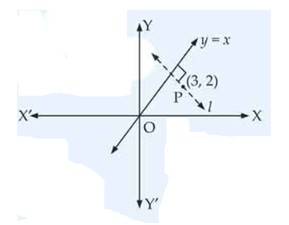
The equation of the straight line passing through the point (3, 2) and perpendicular to the line y=x is

(a)   X-y=5

(b)  X+y=5

(c)   X+y=1

(d)  X-y=1

Read more
A: 

This is a Objective Type Questions as classified in NCERT Exemplar

Sol:

Equation  of  line  'l'  is  given  by          y−y1=m(x−x1)  l  is    through  the    P(3,2).∴        y−2=m(x−3)⇒             y=mx+2−3m                                       …(i)  it  is  given  that  lines  y=x  and  'l'  are  perpendicular  to  each  other,∴        m×1=−1            [?m1×m2=−1]                m=−1Put  m=−1  in  eqn.(i),  we  get          y=−x+2−3(−1)          y=−x+5  x+y=5Hence,  the  correct  option  is  (b).

Q:  

The equation of the line passing through the point (1, 2) and perpendicular to the line x+y+1=0 is

(a)   Y-x+1=0

(b)  Y-x-1=0

(c)   Y-x+2=0

(d)  Y-x-2=0

Read more
A: 

This is a Objective Type Questions as classified in NCERT Exemplar

Sol:

Equation  of  any  line  perpendicular  to  the  given  line          x+y+1=0  is  x−y+k=0                                      …(i)If  eqn.(i)  is    through  the    (1,2)  then       1−2+k=0      ⇒k=1Putting  the  value  of  k  in  eqn.(i),  we  have      x−y+1=0      ⇒y−x−1=0Hence,  the  correct  option  is  (b).

Q:  

The tangent of angle between the lines whose intercepts on the axes are (a,-b) and (b,-a), respectively, is

(a) a 2 - b 2 a b

(b) b 2 - a 2 2

(c) b 2 - a 2 2 a b

(d) None of these

Read more
A: 

This is a Objective Type Questions as classified in NCERT Exemplar

Sol:

First  equation  of  line    on  the  axes          a,−b  is  xa−yb=1    ⇒bx−ay=ab                                                      …(i)  equation  of  line    on  the  axes          b,−a  is  xb−ya=1    ⇒ax−by=ab                                                     …(ii)Slope  of  eqn.(i)  m1=baSlope  of  eqn.(ii)  m2=ab∴                tanθ=|m1−m21+m1m2|=ba−ab1+ba.ab=b2−a22abHence,  the  correct  option  is  (c).

Q:  

If the line xa+yb=1 passes through the points (2, –3) and (4, –5), then (a, b) is

(a) (1, 1)

(b) (–1, 1)

(c) (1, –1)

(d) (–1, –1)

Read more
A: 

This is a Objective Type Questions as classified in NCERT Exemplar

Sol:

Equation  of  line    through  the    (2,−3)  and  (4,−5)  is              y+3=−5+34−2(x−2)⇒         y+3=−22(x−2)⇒         y+3=−(x−2)⇒         y+3=−x+2⇒         x+y=−1⇒        x−1+y−1=1         (Intercept  form)∴       a=−1,  b=−1Hence,  the  correct  option  is  (d).

Q:  

The distance of the point of intersection of the lines 2x – 3y + 5 = 0 and 3x + 4y = 0 from the line 5x – 2y = 0 is

(a)  130 17

(b)   13 7 29

(c)   130 7  

(d)  None of these

Read more
A: 

This is a Objective Type Questions as classified in NCERT Exemplar

Sol:

Given  equations  are:                  2x−3y+5=0                                 …(i)                         3x+4y=0                                 …(ii)From  eqn.(ii)  we  get,             4y=−3x  ⇒y=−34x                      …(iii)Putting  the  value  of  y  in  eqn.(i)  we  have             2x−3(−34x)+5=0⇒                  8x+9x+20=0⇒                          17x+20=0       ⇒x=−2017Putting  the  value  of  x  in  eqn.(iii)  we  get                 y=−34(−2017)=1517∴  of    is  (−2017,1517)Now  perpendicular    from  the  (−2017,1517)  to  the  given  line  5x−2y=0  is             |5(−2017)−2(1517)25+4|=|−10017−301729|=1301729Hence,  the  correct  option  is  (a).

Q:  

The equations of the lines which pass through the point (3, –2) and are inclined at 60° to the line 3x + y = 1 is

(a)  y + 2 = 0 , 3 x – y – 2 - 3 3 = 0  

(b)  x – 2 = 0 , 3 x – y + 2 + 3 3 = 0

(c)   3 x – y – 2 - 3 3 = 0  

(d) None of these

Read more
A: 

This is a Objective Type Questions as classified in NCERT Exemplar

Sol:

Equation  of  line  is  given  by         3x+y+1=0⇒     y=−3x−1∴Slope  of  this  line,  m1=−3Let  m2  be  the  slope  of  the  required  line∴                tanθ=|m1−m21+m1m2|⇒         tan600=|−3−m21+(−3)m2|⇒                  3=±(−3−m21−3m2)⇒                  3=−3−m21−3m2                  [Taking  (+)  sign]⇒     3−3m2=−3−m2⇒               2m2=23             ⇒m2=3and             3=−(−3−m21−3m2)                  [Taking  (−)  sign]⇒                3=3+m21−3m2⇒   3−3m2=3+m2⇒              4m2=0               ⇒m2=0∴  Equation  of  line    through  the    (3,−2)  with  slope  3  is                        y+2=3(x−3)⇒                   y+2=3x−33⇒3x−y−2−33=0and  the  equation  of  line    through  the    (3,−2)  with  slope  0  is                        y+2=0(x−3)    ⇒y+2=0Hence,  the  correct  option  is  (a).

Q:  

The equations of the lines passing through the point (1, 0) and at a distance 32 from the origin, are

(a)   3 x + y – 3 = 0 , 3 x – y – 3 = 0  

(b)    3 x + y + 3 = 0 , 3 x – y + 3 = 0

(c)   x + 3 y – 3 = 0 , x – 3 y – 3 = 0  

(d)    None of these

Read more
A: 

This is a Objective Type Questions as classified in NCERT Exemplar

Sol:

Equation  of  any  line    through  (1,0)  is          y−0=m(x−1)     ⇒mx−y−m=0  of  the  line  from  origin  is  32⇒        32=|m×0−0−m1+m2|⇒        32=|−m1+m2|Squaring  both  sides,  we  get                34=m21+m2⇒      4m2=3+3m2        ⇒4m2−3m2=3⇒         m2=3      ∴m=±3∴  equations  are     ±3x−y?3=0i.e.,  3x−y−3=0  and  −3x−y+3=0                                                    ⇒    3x+y−3=0Hence,  the  correct  option  is  (a).

Q:  

The distance between the lines y=mx+c1 and y=mx+c2 is

(a) c 1 - c 2 1 + m 2    

(b) ∣ c 1 - c 2 ∣ 1 + m 2     

(c) 2 c 1 - c 2 1 + m 2    

(d) 0

Read more
A: 

This is a Objective Type Questions as classified in NCERT Exemplar

Sol:

Given  equations  are  y=mx+c1                                        …(i)and                                     y=mx+c2                                        …(ii)Slopes  of  eqn.(i)  and  eqn.(ii)  are  same  i.e.,  mSo,  they  are  parallel  lines.∴  between  the  two  lines=|c1−c2|1+m2Hence,  the  correct  option  is  (b).

Q:  

The coordinates of the foot of the perpendicular from the point (2, 3) on the line y=3x+4 is given by

(a)  37 10 , - 1 10  

(b)   - 1 10 , 37 10  

(c)  - 10 37 , - 10 37  

(d)   2 3 , - 1 3  

Read more
A: 

This is a Objective Type Questions as classified in NCERT Exemplar

Sol:

Given  equation  is   y=3x+4⇒                  3x−y+4=0                                             …(i)                               Slope=3Equation  of  any  line    through  the    (2,3)  is              y−3=m(x−2)                                               …(ii)If  eqn.(i)  is  perpendicular  to  eqn.(ii)  then              m×3=−1                              [?m1×m2=−1]⇒                m=−13Putting  the  value  of  m  in  eqn.(ii)  we  get⇒         y−3=−13(x−2)⇒      3y−9=−x+2⇒      x+3y=11                                                           …(iii)Solving  eqn.(i)  and  eqn.(iii)  we  get           3x−y=−4       ⇒y=3x+4                        …(iv)Putting  the  value  of  y  in  eqn.(iii)  we  get         x+3(3x+4)=11⇒        x+9x+12=11⇒                       10x=−1     ⇒x=−110From  eqn.(iv)  we  get,      y=3(−110)+4⇒             y=−310+4        ⇒y=3710So,  the  required  coordinates  are(−110,3710).Hence,  the  correct  option  is  (b).

Q:  

 If the coordinates of the middle point of the portion of a line intercepted between the coordinate axes is (3, 2), then the equation of the line will be

(a) 2x + 3y = 12

(b) 3x + 2y = 12

(c)  4x – 3y = 6

(d)  5x – 2y = 10

Read more
A: 

This is a Objective Type Questions as classified in NCERT Exemplar

Sol:

Let  the  given  line  meets  the  axes  at  A(a,0)  and  B(0,b).Given  that  C(3,2)  is  the  mid  of  AB∴           3=a+02     ⇒a=6and     2=0+b2     ⇒b=4Intercept  form  of  the  line  AB    xa+yb=1⇒           x6+y4=1        ⇒2x+3y=12Hence,  the  correct  option  is  (a).

Q:  

Equation of the line passing through (1, 2) and parallel to the line y = 3x – 1 is

(a) y + 2 = x + 1

(b) y + 2 = 3 (x + 1)

(c)  y – 2 = 3 (x – 1)

(d)  y – 2 = x – 1

Read more
A: 

This is a Objective Type Questions as classified in NCERT Exemplar

Sol:

Given  equation  is  y=3x−1              Slope=3Slope  of  the  line    through  the  given    (1,2)  and  parallel  to  the  given  line=3So,  the  equation  of  the  required  line  is⇒          y−2=3(x−1)Hence,  the  correct  option  is  (c).

Q:  

Equations of diagonals of the square formed by the lines x = 0, y = 0, x = 1, and y = 1 are

(a) y = x, y + x = 1

(b) y = x, x + y = 2

(c) 2y = x, y + x = 1 3  

(d) y = 2x, y + 2x = 1

Read more
A: 

This is a Objective Type Questions as classified in NCERT Exemplar

Sol:

Given  equation  x=0,  y=0,  x=1  and  y=1  form  a  square  of  side  1  unitFrom  figure,  we  get  that  OABC  is  square  having  corners  O(0,0),  A(1,0),  B(1,1)  and  C(0,1)Equation  of  diagonal  AC⇒       y−0=1−00−1(x−1)⇒              y=−(x−1)⇒              y=−x+1⇒       y+x=1Equation  of  diagonal  OB  is⇒       y−0=1−01−0(x−0)      ⇒y=xHence,  the  correct  option  is  (a).

Q:  

For specifying a straight line, how many geometrical parameters should be known?

(a) 1

(b) 2

(c) 4

(d) 3

Read more
A: 

This is a Objective Type Questions as classified in NCERT Exemplar

Sol:

Different  form  of  equation  of  straight  lines  areSlope    form,  y=mx+c,  Parameter=2Intercept  form,  xa+yb=1,  Parameter=2One  form,  y−y1=m(x−x1),  Parameter=2Normal  form,  xcosw+ysinw=P,  Parameter=2Hence,  the  correct  option  is  (b).

Q:  

The point (4, 1) undergoes the following two successive transformations:

i. Reflection about the line y = x

ii. Translation through a distance 2 units along the positive x-axis

Then the final coordinates of the point are

(a) (4, 3)

(b) (3, 4)

(c)  (1, 4)

(d)   7 2 , 7 2  

Read more
A: 

This is a Objective Type Questions as classified in NCERT Exemplar

Sol:

Let  the  reflection  of  A(4,1)  in  y=x  be  B(a,b)  mid  of  AB=(4+a2,1+b2)which  lies  on  y=x⇒          4+a2=1+b2⇒           4+a=1+b⇒           a−b=−3                                           …(i)The  slope  of  the  line  y=x  is  1  and  slope  of  AB=b−1a−4∴      1(b−1a−4)=−1⇒              b−1=−a+4⇒             a+b=5                                           …(ii)Solving  eqn.(i)  and  eqn.(ii)  we  get              a=1  and  b=4∴  The    after  translation  is  (1+2,4)  or  (3,4)Hence,  the  correct  option  is  (b).

Q:  

A point equidistant from the lines 4x + 3y + 10 = 0, 5x – 12y + 26 = 0, and 7x + 24y – 50 = 0 is

(a) (1, –1)

(b) (1, 1)

(c) (0, 0)

(d) (0, 1)

Read more
A: 

This is a Objective Type Questions as classified in NCERT Exemplar

Sol:

Given  equations  are                        4x+3y+10=0                                       …(i)                     5x−12y+26=0                                       …(ii)and             7x+24y−50=0                                      …(iii)Let  (x1,y1)  be  any      from  eqn.(i),  eqn.(ii)  and  eqn.(iii)  of  (x1,y1)  from  eqn.(i)            =|4x1+3y1+1016+9|=|4x1+3y1+105|  of  (x1,y1)  from  eqn.(ii)            =|5x1−12y1+2625+144|=|5x1−12y1+2613|  of  (x1,y1)  from  eqn.(ii)            =|7x1+24y1−5049+576|=|7x1+24y1−5025|If  the    (x1,y1)  is    from  the  given  lines,  then|4x1+3y1+105|=|5x1−12y1+2613|=|7x1+24y1−5025|We  see  that  putting  x1=0  and  y1=0,  the  above  relation  is  satisfied  i.e.,        105=2613=5025=2Hence,  the  correct  option  is  (c).

Q:  

A line passes through (2, 2) and is perpendicular to the line 3x + y = 3. Its y-intercept is

(a) 1 3

(b) 2 3   

(c) 1

(d)   4 3  

Read more
A: 

This is a Objective Type Questions as classified in NCERT Exemplar

Sol:

Any  line  perpendicular  to  3x+y=3            x−3y=λ         (λ=)If  it  passes  through  the    (2,2)  then        2−3(2)=λ      ⇒λ=−4∴    equation  is  x−3y=−4⇒       −3y=−x−4⇒             y=13x+43               [?y=mx+c]So,  the  y  is  43.Hence,  the  correct  option  is  (d).

Q:  

The ratio in which the line 3x + 4y + 2 = 0 divides the distance between the lines 3x + 4y + 5 = 0 and 3x + 4y – 5 = 0 is

(a) 1 : 2

(b) 3 : 7

(c) 2 : 3

(d)  2 : 5

Read more
A: 

This is a Objective Type Questions as classified in NCERT Exemplar

Sol:

Given  equations  are                   3x+4y+5=0                                        …(i)                   3x+4y−5=0                                       …(ii)and          3x+4y+2=0                                       …(iii)Clearly,  eqn.(i),  (ii)  and  (iii)  are  parallel  to  each  other  as  the  coefficients  of  x  and  y  are  same.  between  parallel  lines  (i)  and  (iii)  we  get            =|5−2(3)2+(4)2|=35         [?  between  the  two  parallel  lines=|c1−c2|a2+b2]  between  parallel  lines  (ii)  and  (iii)  we  get            =|−5−2(3)2+(4)2|=75∴  Ratio  between  the  35:75=3:7Hence,  the  correct  option  is  (b).

Q:  

One vertex of the equilateral triangle with centroid at the origin and one side as x + y – 2 = 0 is

(a) (–1, –1)

(b) (2, 2)

(c)  (–2, –2)

(d) (2, –2)

Read more
A: 

This is a Objective Type Questions as classified in NCERT Exemplar

Sol:

L e t     A B C     b e     a n     e q u i l a t e r a l     t r i a n g l e     w i t h     v e r t e x     ( x 1 , y 1 ) . A D ⊥ B C     a n d     l e t     ( a , b )     b e     t h e     c o o r d i n a t e s     o f     D . G i v e n     t h a t     t h e     c e n t r o i d     G     l i e s     a t     t h e     o r i g i n     i . e . , ( 0 , 0 ) Since,  the  centroid  of  a  triangle,  divides  the  median  in  the  ratio  1:2 S o ,                         0 = 1 × x 1 + 2 × a 1 + 2                     ⇒ x 1 + 2 a = 0                                                                                           … ( i ) a n d                       0 = 1 × y 1 + 2 × b 1 + 2                   ⇒ y 1 + 2 b = 0                                                                                           … ( i i ) E q u a t i o n s     o f     B C     i s     g i v e n     b y     x + y − 2 = 0                                                                                       … ( i i i ) Point  D(a,b)  lies  on  the  line  x+y−2=0 S o ,                                                                                                                     a + b − 2 = 0                                                                                           … ( i v ) S l o p e     o f     e q n . ( i i i )     i s     = − 1 a n d     t h e     S l o p e     o f     A G = y 1 − 0 x 1 − 0 = y 1 x 1 Since,  they  are  perpendicular  to  each  other ∴                       − 1 × y 1 x 1 = − 1       ⇒ y 1 = x 1 F r o m     e q n . ( i )     a n d     ( i i )     w e     g e t                               x 1 + 2 a = 0         ⇒ 2 a = − x 1                               y 1 + 2 b = 0         ⇒ 2 b = − y 1 F r o m     e q n . ( i v )     w e     g e t                         a + b − 2 = 0 ⇒               a + a − 2 = 0 ⇒                         2 a − 2 = 0             ⇒ a = 1     a n d     b = 1               [ ? a = b ] ∴               x 1 = − 2 × 1 = − 2 a n d     y 1 = − 2 × 1 = − 2 H e n c e ,     t h e     c o r r e c t     o p t i o n     i s     ( c ) .


Maths NCERT Exemplar Solutions Class 11th Chapter Ten Logo

Straight Limes Fill in the Blank

If a, b, c are in A.P., then the straight lines ax + by + c = 0 will always pass through ____.

Sol:

G i v e n     e q u a t i o n     i s     a x + b y + c = 0                                                       … ( i )     a , b     a n d     c     a r e     i n     A . P . ∴                                           b = a + c 2 ⇒                       a + c = 2 b ⇒ a − 2 b + c = 0                                                                                                                             … ( i i ) C o m p a r i n g     e q n . ( i )     w i t h     e q n . ( i i )     w e     g e t ,                 x = 1 ,     y = − 2 S o ,     t h e     l i n e     w i l l     p a s s     t h r o u g h     ( 1 , − 2 ) H e n c e ,     t h e     v a l u e     o f     t h e     f i l l e r     i s     ( 1 , − 2 ) .

The line which cuts off equal intercepts from the axes and passes through the point (1, –2) is ____.

Sol:

I n t e r c e p t     f o r m     o f     t h e     l i n e     i s     x a + y b = 1                                                                             … ( i ) G i v e n     t h a t     a = b ∴                         x a + y a = 1                   ⇒ x + y = a                                                                                                           … ( i i ) I f     t h e     l i n e     ( i )     p a s s e s     t h r o u g h     ( 1 , − 2 )     w e     g e t                                   1 − 2 = a                   ⇒ a = − 1 S o ,     t h e     r e q u i r e d     e q u a t i o n     i s     x + y = − 1               ⇒ x + y + 1 = 0 H e n c e ,     t h e     v a l u e     o f     t h e     f i l l e r     i s     x + y + 1 = 0 .

Q&A Icon
Commonly asked questions
Q:  

If a, b, c are in A.P., then the straight lines ax + by + c = 0 will always pass through ____.

A: 

This is a Fill in the Blank Type Questions as classified in NCERT Exemplar

Sol:

Given  equation  is  ax+by+c=0                           …(i)  a,b  and  c  are  in  A.P.∴                     b=a+c2⇒           a+c=2b⇒a−2b+c=0                                                              …(ii)Comparing  eqn.(i)  with  eqn.(ii)  we  get,        x=1,  y=−2So,  the  line  will  pass  through  (1,−2)Hence,  the  value  of  the  filler  is  (1,−2).

Q:  

The line which cuts off equal intercepts from the axes and passes through the point (1, –2) is ____.

A: 

This is a Fill in the Blank Type Questions as classified in NCERT Exemplar

Sol:

Intercept  form  of  the  line  is  xa+yb=1                                      …(i)Given  that  a=b∴            xa+ya=1         ⇒x+y=a                                                     …(ii)If  the  line  (i)  passes  through  (1,−2)  we  get                 1−2=a         ⇒a=−1So,  the  required  equation  is  x+y=−1       ⇒x+y+1=0Hence,  the  value  of  the  filler  is  x+y+1=0.

Q:  

Equations of the lines through the point (3, 2) and making an angle of 45° with the line x – 2y = 3 are ____.

Read more
A: 

This is a Fill in the Blank Type Questions as classified in NCERT Exemplar

Sol:

Given  line  is  x−2y=3  and  the    is  (3,2)Equation  of  a  line    through  the    (3,2)  isAngle  between  eqn.(i)  and  the  given  line  x−2y=3  whose  slope  is  12∴             tanθ=|m1−m21+m1m2|⇒      tan450=|m−121+m×12|⇒                   1=|m−121+m2|        ⇒m−121+m2=±1Taking  (+)  sign⇒        m−121+m2=1         ⇒m−12=1+m2⇒        m−m2=1+12  ⇒m2=32    ⇒m=3Taking  (−)  sign⇒        m−121+m2=−1         ⇒m−12=−1−m2⇒        m+m2=−1+12  ⇒3m2=12    ⇒m=−13So,  the  required  equations  are,When  m=3,               y−2=3(x−3)⇒           y−2=3x−9⇒3x−y−7=0When  m=−13,          y−2=−13(x−3)⇒    3y−6=−x+3⇒x+3y−9=0Hence,  the  value  of  the  filler  are  3x−y−7=0  and  x+3y−9=0.

Q:  

The points (3, 4) and (2, –6) are situated on the ____ of the line 3x – 4y – 8 = 0.

A: 

This is a Fill in the Blank Type Questions as classified in NCERT Exemplar

Sol:

Given  line  is  3x−4y−8=0                                       …(i)and  given  the    are  (3,4)  and  (2,−6).For    (3,4),  line  becomes=3(3)−4(4)−8              =9−16−8=9−24=−15<0For    (2,−6),  line  becomes=3(2)−4(−6)−8              =6+24−8=30−8=22>0So,  the    (3,4)  and  (2,−6)  are  situated  on  the  opposite  sides  of  3x−4y−8=0.Hence,  the  value  of  the  filler  is  opposite.

Q:  

A point moves so that the square of its distance from the point (3, –2) is numerically equal to its distance from the line 5x – 12y = 3. The equation of its locus is ____.

Read more
A: 

This is a Fill in the Blank Type Questions as classified in NCERT Exemplar

Sol:

The  given  equation  of  line  is  5x−12y=3  and  the  given    is  (3,−2).Let  (a,b)  be  any  moving  ∴    between  (a,b)  and  the    (3,−2)=(a−3)2+(b+2)2and  the    of  (a,b)  from  the  line  5x−12y=3                    =|5a−12b−325+144|=|5a−12b−313|According  to  the  question,  we  have     [(a−3)2+(b+2)2]2=|5a−12b−313|Taking  numerical  values,  we  have               (a−3)2+(b+2)2=5a−12b−313⇒a2−6a+9+b2+4b+4=5a−12b−313⇒       a2+b2−6a+4b+13=5a−12b−313⇒13a2+13b2−78a+52b+169=5a−12b−3⇒13a2+13b2−83a+64b+172=0So,  the  locus  of  the    is  13a2+13b2−83a+64b+172=0.Hence,  the  value  of  the  filler  is  13a2+13b2−83a+64b+172=0.

Q:  

 Locus of the midpoints of the portion of the line xsinθ+ycosθ=p intercepted between the axes is ____.

Read more
A: 

This is a Fill in the Blank Type Questions as classified in NCERT Exemplar

Sol:

Given  equation  of  the  line  is         xcosθ+ysinθ=p                                        …(i)Let  C(h,k)  be  the  mid  of  the  given  line  AB  where  it  meets  the  two  axis  atA(a,0)  and  B(0,b).  (a,0)  lies  on  eqn.(i)  then        acosθ+0=p⇒        a=pcosθ                                                        …(ii)B(0,b)  also  lies  on  eqn.(i)  then         0+bsinθ=p⇒        b=psinθ                                                        …(iii)  C(h,k)  is  the  mid  of  AB∴          h=0+a2      ⇒a=2hand     k=b+02      ⇒b=2kPutting  the  values  of  a  and  b  is  eqn.(ii)  and  (iii)  we  get           2h=pcosθ    ⇒cosθ=p2h                          …(iv)and   2k=psinθ    ⇒sinθ=p2k                            …(v)Squaring  and  adding  eqn.(iv)  and  (v)  we  get    cos2θ+sin2θ=p24h2+p24k2⇒                          1=p24h2+p24k2So,  the  locus  of  the  mid  is                               1=p24x2+p24y2⇒               4x2y2=p2(x2+y2)Hence,  the  value  of  the  filler  is   4x2y2=p2(x2+y2).

Maths NCERT Exemplar Solutions Class 11th Chapter Ten Logo

Straight Limes True or False Type Questions

 If the vertices of a triangle have integral coordinates, then the triangle cannot be equilateral.

Sol:

W e     k n o w     t h a t     i f     t h e     v e r t i c e s     o f     t r i a n g l e     h a s         c o o r d i n a t e s ,     t h e n     t h e     t r i a n g l e     c a n     n o t     b e e q u i l a t e r a l . S o ,     t h e     g i v e n     s t a t e m e n t     i s     T r u e .

The points A(–2, 1), B(0, 5), C(–1, 2) are collinear.

Sol:

G i v e n         a r e     A ( − 2 , 1 ) ,     B ( 0 , 5 ) ,     C ( − 1 , 2 ) A r e a     o f     Δ A B C = 1 2 | − 2 1 1 0 5 1 − 1 2 1 |                                                                       = 1 2 | − 2 | 5 1 2 1 | − 1 | 0 1 − 1 1 | + 1 | 0 5 − 1 2 | |                                                                       = 1 2 | − 2 ( 5 − 2 ) − 1 ( 0 + 1 ) + 1 ( 0 + 5 ) |                                                                       = 1 2 | − 2 × 3 − 1 × 1 + 1 × 5 | = 1 2 | − 6 − 1 + 5 | = 1 2 | − 2 | = 1   s q . u n i t S o ,     t h e     g i v e n         a r e     n o t     c o l l i n e a r . S o ,     t h e     g i v e n     s t a t e m e n t     i s     F a l s e .

Q&A Icon
Commonly asked questions
Q:  

If the vertices of a triangle have integral coordinates, then the triangle cannot be equilateral.

A: 

This is a True or False Type Questions as classified in NCERT Exemplar

Sol:

We  know  that  if  the  vertices  of  triangle  has    coordinates,   then  the  triangle  can  not  beequilateral.So,   the  given  statement  is  True.

Q:  

The points A(–2, 1), B(0, 5), C(–1, 2) are collinear.

A: 

This is a True or False Type Questions as classified in NCERT Exemplar

Sol:

Given    are  A(−2,1),  B(0,5),  C(−1,2)Area  of  ΔABC=12|−211051−121|                                   =12|−2|5121|−1|01−11|+1|05−12||                                   =12|−2(5−2)−1(0+1)+1(0+5)|                                   =12|−2×3−1×1+1×5|=12|−6−1+5|=12|−2|=1 sq.unitSo,  the  given    are  not  collinear.So,  the  given  statement  is  False.

Q:  

Equation of the line passing through the point acos3θ,asin3θ and perpendicular to the line xsecθ+ycosecθ=a is xcosθ–ysinθ=asin2θ .

Read more
A: 

This is a True or False Type Questions as classified in NCERT Exemplar

Sol:

Equation  of  any  line  perpendicular  to  xsecθ+ycosecθ=a  is           xcosecθ−ysecθ=k                                         …(i)If  eqn.(i)  passes  through  (acos3θ,asin3θ)  then          acos3θ.cosecθ−asin3θ.secθ=k⇒     acos3θsinθ−asin3θcosθ=k∴    equation  is   xcosecθ−ysecθ=acos3θsinθ−asin3θcosθ⇒         xsinθ−ycosθ=a[cos4θ−sin4θsinθcosθ]⇒    xcosθ−ysinθsinθcosθ=a[(cos2θ+sin2θ)(cos2θ−sin2θ)sinθcosθ]⇒     xcosθ−ysinθ=a(cos2θ−sin2θ)⇒     xcosθ−ysinθ=acos2θSo,  the  given  statement  is  False.

Q:  

The straight line 5x + 4y = 0 passes through the point of intersection of the straight lines x + 2y – 10 = 0 and 2x + y + 5 = 0.

Read more
A: 

This is a True or False Type Questions as classified in NCERT Exemplar

Sol:

Given  equations  are  x+2y−10=0                                               …(i)and                                        2x+y+5=0                                              …(ii)From  eqn.(i)                                      x=10−2y                                …(iii)Putting  the  value  of  x  in  eqn.(ii)  we  get            2(10−2y)+y+5=0⇒              20−4y+y+5=0⇒                         −3y+25=0⇒                      y=253Putting  the  value  of  y  in  eqn.(iii)  we  get                x=10−2(253)                    =30−503=−203∴  =(−203,253)If  the  given  line  5x+4y=0    through  the    (−203,253)  then         5(−203)+4(253)=0⇒      −1003+1003=0⇒                0=0    satisfied.So,   the  given  line    through  the    of    of  the  given  lines.Hence,  the  given  statement  is  True.

Q:  

The vertex of an equilateral triangle is (2, 3) and the equation of the opposite side is x + y = 2. Then the other two sides are y–3=2±3x–2 .

Read more
A: 

This is a True or False Type Questions as classified in NCERT Exemplar

Sol:

Let  ABC  be  an  equilateral  triangle  with  vertex(2,3)  and  the  opposite  side  is  x+y=2with  slope  −1.  Suppose  slope  of  line  AB  is  m.  each  angle  of  equilateral  triangle  is  600.∴  Angle  between  AB  and  BC              tan600=|−1−m1+(−1)m|⇒                  3=|1+m1−m|⇒                  3=±(1+m1−m)Taking  (+)  sign⇒                  3=1+m1−m      ⇒3−3m=1+m⇒      3m+m=3−1     ⇒m(3+1)=3−1⇒                   m=3−13+1     ⇒m=3−13+1×3−13−1⇒                   m=3+1−233−1=2−3Taking  (−)  sign⇒                  3=−(1+m1−m)      ⇒3−3m=−1−m⇒      −3m+m=−1−3          ⇒m(−3+1)=−1−3⇒                     m=−1−31−3         ⇒m=−1−31−3×1+31+3⇒                     m=−1−3−3−31−3=−4−23−2=−2(2+3)−2=2+3So,  the  equations  of  other  two  lines  are                 y−3=(2±3)(x−2)Hence,  the  given  statement  is  True.

Q:  

The equation of the line joining the point (3, 5) to the point of intersection of the lines 4x + y – 1 = 0 and 7x – 3y – 35 = 0 is equidistant from the points (0, 0) and (8, 34).

Read more
A: 

This is a True or False Type Questions as classified in NCERT Exemplar

Sol:

Given  equations  are                4x+y−1=0                                             …(i)and  7x−3y−35=0                                            …(ii)From  eqn.(i)     y=1−4x                                  …(iii)Putting  the  value  of  y  in  eqn.(ii)  we  get          7x−3(1−4x)−35=0⇒          7x−3+12x−35=0⇒                           19x−38=0⇒                                          x=2From  eqn.(iii)     y=1−4×2   ⇒y=−7The    of    is  (2,−7).Equation  of  line  joining  the    (3,5)  to  the    (2,−7)  is                     y−5=−7−52−3(x−3)⇒                y−5=12(x−3)⇒                y−5=12x−36⇒ 12x−y−31=0                                                 …(iv)  of  eqn.(iv)  from  the    (0,0)=|−31(12)2+(−1)2|=31145  of  eqn.(iv)  from  the    (8,34)=|12×8−34−31(12)2+(−1)2|=|96−65145|=31145Hence  the  given  statement  is  True.

Q:  

The line xa+yb=1 moves in such a way that 1a2+1b2=1c2 , where c is a constant. The locus of the foot of the perpendicular from the origin on the given line is x2+y2=c2 .

Read more
A: 

This is a True or False Type Questions as classified in NCERT Exemplar

Sol:

The  given  equation  is  xa+yb=1                                             …(i)Equation  of  line    through  the  (0,0)  and  perpendicular  to  eqn.(i)  is                                                xb−ya=0                                             …(ii)Squaring  and  adding  eqn.(i)  and  (ii)  we  get                          (xa+yb)2+(xb−ya)2=1+0⇒x2a2+y2b2+2xyab+x2b2+y2a2−2xyab=1⇒       x2(1a2+1b2)+y2(1b2+1a2)=1⇒                         (x2+y2)(1a2+1b2)=1⇒                                    (x2+y2)(1c2)=1                 [?1c2=1a2+1b2]⇒                      x2+y2=c2Hence  the  given  statement  is  True.

Q:  

The lines ax+2y+1=0,bx+3y+1=0, and cx+4y+1=0 are concurrent if a, b, c are in G.P.

A: 

This is a True or False Type Questions as classified in NCERT Exemplar

Sol:

Given  equations  are                 ax+2y+1=0                                            …(i)                 bx+3y+1=0                                            …(ii)                 cx+4y+1=0                                            …(iii)Solving  eqn.(i)  and  (ii)  we  get                 ax+2y+1=0     ⇒y=−ax−12Putting  the  value  of  y  in  eqn.(ii)  we  have         bx+3(−ax−12)+1=0⇒          2bx−3ax−3+2=0⇒                      (2b−3a)x=1⇒          x=12b−3a∴            y=−a(12b−3a)−12                   =−a−2b+3a2(2b−3a)=2a−2b2(2b−3a)=a−b2b−3aSo,  the    of    of  eqn.(i)  and  (ii)  is               (12b−3a,a−b2b−3a)If  eqn.(i),(ii)  and  (iii)  are  concurrent,  then  the  above    must  lie  on  eqn.(iii)                cx+4y+1=0⇒     c[12b−3a]+4[a−b2b−3a]+1=0⇒                     c+4a−4b+2b−3a2b−3a=0⇒                                             c+a−2b=0⇒                                             2b=a+cSo,  a,b  and  c  are  in  A.P.  and  not  in  G.P.Hence  the  given  statement  is  False.

Q:  

The line joining the points (3, –4) and (–2, 6) is perpendicular to the line joining the points (–3, 6) and (9, –18).

Read more
A: 

This is a True or False Type Questions as classified in NCERT Exemplar

Sol:

The  given    are  (3,−4)  and  (−2,6),(−3,6)  and  (9,−18).Slope  of  the  line  joining  the    (3,−4)  and  (−2,6)                    m1=6+4−2−3=10−5=−2Slope  of  the  line  joining  the    (−3,6)  and  (9,−18)                    m2=−18−69+3=−2412=−2Since  m1=m2=−2So,  the  lines  are  parallel  and  not  perpendicular.Hence  the  given  statement  is  False.

Q:  

Match the following:

Column C1                                                            Column C2

(a) The coordinates of the points P and Q on the                                (i) 3 , 1 , – 7 , 11  

 line x + 5 y = 13 , which are at a distance of 2 units

 from the line 12 x – 5 y + 26 = 0 are

(b) The coordinates of the point on the                                                 (ii) 3 , 1 , – 7 , 11  

 line x + y = 4 , which is at a unit distance

 from the line 4 x + 3 y – 10 = 0 .

(c) The coordinates of the point on the line                                         (iii) 12 5 , 16 5 , 1 , – 3  

joining A(–2, 5) and B(3, 1) such that

  A P = P Q = Q B are

Read more
A: 

This is a True or False Type Questions as classified in NCERT Exemplar

Sol:

(a)Let  P(x1,y1)  be  any    on  the  given  line            x+5y=13           ∴x1+5y1=13         of  line  12x−5y+26=0  from  the   (x1,y1)            2=|12x1−5y1+26(12)2+(−5)2|          ⇒2=|12x1−(13−x1)+2613|⇒       2=|12x1−13+x1+2613|    ⇒2=|13x1+1313|⇒      2=±(x1+1)⇒      2=x1+1     ⇒x1=1               (Taking  (+)  sign)and   2=−x1−1  ⇒x1=−3            (Taking  (−)  sign)Putting  the  value  of  x1  in  eqn.  x1+5y1=13We  get    y1=125  and  165So,  the  required    are  (1,125)  and  (−3,165).Hence,  (a)↔(iii)(b)Let  P(x1,y1)  be  any    on  the  given  line            x+y=4           ∴x1+y1=4                                     …(i)         of  line  4x+3y−10=0  from  the   (x1,y1)            1=|4x1+3y1−10(4)2+(3)2|          ⇒1=|4x1+3(4−x1)−105|⇒       1=|4x1+12−3x1−105|  ⇒1=|x1+25|⇒       1=±(x1+25)⇒       x1+25=1                                 (Taking  (+)  sign)⇒        x1+2=5         ⇒x1=3and   x1+25=−1                                 (Taking  (−)  sign)⇒        x1+2=−5         ⇒x1=−7Putting  the  value  of  x1  in  eqn.(i)  we  getAt  x1=3,       y1=1At  x1=−7,    y1=11So,  the  required    are  (3,1)  and  (−7,11).Hence,  (b)↔(i).

( c ) G i v e n     t h a t     A P = P Q = Q B               E q u a t i o n     o f     l i n e     j o i n i n g     A ( − 2 , 5 )     a n d     B ( 3 , 1 )     i s                                   y − 5 = 1 − 5 3 + 2 ( x + 2 ) ⇒                           y − 5 = − 4 5 ( x + 2 ) ⇒                           5 y − 2 5 = − 4 x − 8 ⇒       4 x + 5 y − 1 7 = 0 Let  P(x1,y1)  and  Q(x2,y2)  be  any  two  points  on  the  line  AB P ( x 1 , y 1 )     d i v i d e s     t h e     l i n e     A B     i n     t h e     r a t i o     1 : 2 ∴                             x 1 = 1 . 3 + 2 ( − 2 ) 1 + 2 = 3 − 4 3 = − 1 3                                   y 1 = 1 . 1 + 2 . 5 1 + 2 = 1 + 1 0 3 = 1 1 3 S o ,     t h e     c o o r d i n a t e s     o f     P ( x 1 , y 1 ) = ( − 1 3 , 1 1 3 ) . Now  point  Q(x2,y2)  is  the  mid-point  of  PB ∴                             x 2 = 3 − 1 3 2 = 4 3                                   y 2 = 1 + 1 1 3 2 = 7 3 H e n c e ,     t h e     c o o r d i n a t e s     o f     Q ( x 2 , y 2 ) = ( 4 3 , 7 3 ) . H e n c e ,     ( c ) ↔ ( i i ) .

Q:  

The value of λ , if the lines 2 x + 3 y + 4 + λ 6 x – y + 12 = 0  are

Column C1                                                                  Column C2

i.       Parallel to y-axis is                                                 (i) λ = - 3 4  

ii.    Perpendicular to   7 x + y – 4 = 0 is                           (ii) λ = - 1 3  

iii.   passes through (1, 2) is                                            (iii) λ = - 17 41  

iv.  parallel to x-axis is                                                  (iv) λ = 3  

Read more
A: 

This is a True or False Type Questions as classified in NCERT Exemplar

Sol:

(a)Given??  equation  is             (2x+3y+4)+λ(6x−y+12)=0⇒       (2+6λ)x+(3−λ)y+4+12λ=0                          …(i)       If  eqn.(i)  is  parallel  to  yaxis,  then             3−λ=0     ⇒λ=3       Hence,  (a)↔(iv)(b)Given??  lines  are             (2x+3y+4)+λ(6x−y+12)=0                           …(i)⇒       (2+6λ)x+(3−λ)y+4+12λ=0        Slope=−(2+6λ3−λ)          equation  is  7x+y−4=0                               …(ii)        Slope=−7       If  eqn.(i)  and  eqn.(ii)  are  perpendicular  to  each  other∴          (−7)[−(2+6λ3−λ)]=−1⇒                                14+42λ3−λ=−1⇒                                 14+42λ=−3+λ⇒                                   42λ−λ=−3−14⇒                                            41λ=−17⇒                                                 λ=−1741       Hence,  (b)↔(iii)(c)Given??  equation  is  (2x+3y+4)+λ(6x−y+12)=0                               …(i)       If  eqn.(i)    through  the  given    (1,2)  then       (2×1+3×2+4)+λ(6×1−2+12)=0⇒                     (2+6+4)+λ(6−2+12)=0⇒                                                        12+16λ=0⇒                                                                       λ=−1216=−34       Hence,  (c)↔(i)(d)The  given??  equation  is  (2x+3y+4)+λ(6x−y+12)=0⇒       (2+6λ)x+(3−λ)y+4+12λ=0                          …(i)       If  eqn.(i)  is  parallel  to  xaxis,  then             2+6λ=0     ⇒λ=−13       Hence,  (d)↔(ii)

Q:  

The equation of the line through the intersection of the lines 2x–3y=0 and 4x–5y=2 and

Column C1Column C2

through the point (2, 1) is (i) 2x–y=4

perpendicular to the line x+2y+1=0 is (ii) x+y–5=0

parallel to the line 3x–4y+5=0 is (iii) x–y–1=0

equally inclined to the axes is (iv) 3x–4y–1=0

Read more
A: 

Sol:

( a ) G i v e n ? ? e q u a t i o n s ? ? a r e ? ? 2 x ? 3 y = 0 ? ? ? ? ? ? ? ? ? ? ? ? ? ? ? ? ? ? ? ? ? ? ? ? ? ? ? ? ? … ( i ) ? ? ? ? ? ? ? a n d ? ? ? ? ? ? ? ? ? ? ? ? ? ? ? ? ? ? ? ? ? ? ? ? ? ? ? ? ? ? ? ? ? ? ? ? ? ? 4 x ? 5 y = 2 ? ? ? ? ? ? ? ? ? ? ? ? ? ? ? ? ? ? ? ? ? ? ? ? ? ? ? ? ? … ( i i ) ??????Equations??of??line??passing??through??eqn.(i)??and??(ii)??we??get ? ? ? ? ? ? ? ? ? ? ? ? ? ? ? ? ? ? ? ( 2 x ? 3 y ) + k ( 4 x ? 5 y ? 2 ) = 0 ? ? ? ? ? ? ? ? ? ? ? ? ? ? ? ? ? ? ? ? ? ? ? ? … ( i i i ) ? ? ? ? ? ? I f ? ? e q n . ( i i i ) ? ? p a s s e s ? ? t h r o u g h ? ? ( 2 , 1 ) , ? ? w e ? ? g e t ? ? ? ? ? ? ? ? ? ? ? ? ? ? ? ? ? ? ? ( 2 × 2 ? 3 × 1 ) + k ( 4 × 2 ? 5 × 1 ? 2 ) = 0 ? ? ? ? ? ? ? ? ? ? ? ? ? ? ? ? ? ? ? ? ? ? ? ? ? ? ? ? ? ? ? ? ? ? ? ? ? ? ? ? ? ( 4 ? 3 ) + k ( 8 ? 5 ? 2 ) = 0 ? ? ? ? ? ? ? ? ? ? ? ? ? ? ? ? ? ? ? ? ? ? ? ? ? ? ? ? ? ? ? ? ? ? ? ? ? ? ? ? ? ? ? ? ? ? ? ? ? ? ? ? ? ? ? ? ? ? ? ? 1 + k ( 8 ? 7 ) = 0 ? ? ? ? ? ? ? ? ? ? ? ? ? ? ? ? ? ? ? ? ? ? ? ? ? ? ? ? ? ? ? ? ? ? ? ? ? ? ? ? ? ? ? ? ? ? ? ? ? ? ? ? ? ? ? ? ? ? ? ? ? ? ? ? ? ? ? ? ? ? ? ? ? ? ? ? ? ? ? ? ? k = ? 1 ? ? ? ? ? S o , ? ? t h e ? ? r e q u i r e d ? ? e q u a t i o n ? ? i s ? ? ? ? ? ? ? ? ? ? ? ? ? ? ? ? ? ? ? ? ? ( 2 x ? 3 y ) ? 1 ( 4 x ? 5 y ? 2 ) = 0 ? ? ? ? ? ? ? ? ? ? ? ? ? ? ? ? ? ? ? ? ? ? ? ? ? ? ? ? 2 x ? 3 y ? 4 x + 5 y + 2 = 0 ? ? ? ? ? ? ? ? ? ? ? ? ? ? ? ? ? ? ? ? ? ? ? ? ? ? ? ? ? ? ? ? ? ? ? ? ? ? ? ? ? ? ? ? ? 2 x + 2 y + 2 = 0 ? ? ? ? ? ? ? ? ? ? ? ? ? ? ? ? ? ? ? ? ? ? ? ? ? ? ? ? ? ? ? ? ? ? ? ? ? ? ? ? ? ? ? ? ? ? ? ? ? ? ? ? ? ? x ? y ? 1 = 0 ? ? ? ? ? ? H e n c e , ? ? ( a ) ? ( i i i ) (b)Equation??of??any??line??passing??through??the??point??of??intersection??of??the??line ? ? ? ? ? ? ? 2 x ? 3 y = 0 ? ? a n d ? ? 4 x ? 5 y = 2 ? ? i s ? ? ? ? ? ? ? ? ? ? ( 2 x ? 3 y ) + k ( 4 x ? 5 y ? 2 ) = 0 ? ? ? ? ? ? ? ? ? ? ? ? ? ? ? ? ? ? ? ? ? ? ? ? ? … ( i ) ? ? ? ( 2 + 4 k ) x + ( ? 3 ? 5 k ) y ? 2 k = 0 ? ? ? ? ? ? ? ? S l o p e = ? ( 2 + 4 k ) ? 3 ? 5 k = 2 + 4 k 3 + 5 k ? ? ? ? ? ? ? ? S l o p e ? ? o f ? ? t h e ? ? g i v e n ? ? l i n e ? ? x + 2 y + 1 = 0 ? ? i s ? ? ? 1 2 . ? ? ? ? ? ? ? ? I f ? ? t h e y ? ? a r e ? ? p e r p e n d i c u l a r ? ? t o ? ? e a c h ? ? o t h e r ? ? t h e n ? ? ? ? ? ? ? ? ? ? ? ? ? ? 1 2 ( 2 + 4 k 3 + 5 k ) = ? 1 ? ? ? ? ? ? ? ? ? ? ? ? ? ? ? ? ? ? ? ? ? ? ? ? 1 + 2 k 3 + 5 k = 1 ? ? ? ? ? ? ? ? ? ? ? ? ? ? ? ? ? ? ? ? ? ? ? ? 1 + 2 k = 3 + 5 k ? ? ? ? ? ? ? ? ? ? ? ? ? ? ? ? ? ? ? ? ? ? ? ? ? ? ? ? ? ? ? 3 k = ? 2 ? ? ? ? ? ? ? ? ? k = ? 2 3 ? ? ? ? ? ? P u t t i n g ? ? t h e ? ? v a l u e ? ? o f ? ? k ? ? i n ? ? e q n . ( i ) ? ? w e ? ? g e t ? ? ? ? ? ? ? ? ? ? ? ? ? ? ? ? ( 2 x ? 3 y ) ? 2 3 ( 4 x ? 5 y ? 2 ) = 0 ? ? ? ? ? ? ? ? ? ? ? ? ? ? ? ? ? ? ? ? ? ? 6 x ? 9 y ? 8 x + 1 0 y + 4 = 0 ? ? ? ? ? ? ? ? ? ? ? ? ? ? ? ? ? ? ? ? ? ? ? ? ? ? ? ? ? ? ? ? ? ? ? ? ? ? ? ? ? ? ? ? ? 2 x + y + 4 = 0 ? ? ? ? ? ? ? ? ? ? ? ? ? ? ? ? ? ? ? ? ? ? ? ? ? ? ? ? ? ? ? ? ? ? ? ? ? ? ? ? ? ? ? ? ? ? ? ? ? ? ? ? ? ? ? 2 x ? y = 4 ? ? ? ? ? ? H e n c e , ? ? ( b ) ? ( i )

( c ) G i v e n ? ? e q u a t i o n s ? ? a r e ? ? 2 x ? 3 y = 0 ? ? ? ? ? ? ? ? ? ? ? ? ? ? ? ? ? ? ? ? ? ? ? ? ? ? ? ? ? … ( i ) ? ? ? ? ? ? ? a n d ? ? ? ? ? ? ? ? ? ? ? ? ? ? ? ? ? ? ? ? ? ? ? ? ? ? ? ? ? ? ? ? ? ? ? ? ? 4 x ? 5 y = 2 ? ? ? ? ? ? ? ? ? ? ? ? ? ? ? ? ? ? ? ? ? ? ? ? ? ? ? ? … ( i i ) ??????Equations??of??line??passing??through??eqn.(i)??and??(ii)??we??get ? ? ? ? ? ? ? ? ? ? ? ? ? ( 2 x ? 3 y ) + k ( 4 x ? 5 y ? 2 ) = 0 ? ? ? ? ? ( 2 + 4 k ) x + ( ? 3 ? 5 k ) y ? 2 k = 0 ? ? ? ? ? ? ? S l o p e = ? ( 2 + 4 k ) ? 3 ? 5 k = 2 + 4 k 3 + 5 k ? ? ? ? ? ? ? ? S l o p e ? ? o f ? ? t h e ? ? g i v e n ? ? l i n e ? ? 3 x ? 4 y + 5 = 0 ? ? i s ? ? 3 4 . ? ? ? ? ? ? ? ? I f ? ? t h e ? ? t w o ? ? e q u a t i o n s ? ? a r e ? ? p a r a l l e l , ? ? t h e n ? ? ? ? ? ? ? ? ? ? ? ? ? ? ? ? ? ? ? ? ? ? ? ? 2 + 4 k 3 + 5 k = 3 4 ? ? ? ? ? ? ? ? ? ? ? ? ? ? ? ? ? ? ? 8 + 1 6 k = 9 + 1 5 k ? ? ? ? ? ? ? ? ? ? ? ? ? 1 6 k ? 1 5 k = 9 ? 8 ? ? ? ? ? ? ? ? ? ? ? ? ? ? ? ? ? ? ? ? ? ? ? ? ? ? ? ? ? ? k = 1 ? ? ? ? ? S o , ? ? t h e ? ? r e q u i r e d ? ? e q u a t i o n ? ? o f ? ? l i n e ? ? i s ? ? ? ? ? ? ? ? ? ? ? ? ? ? ? ? ? ? ? ? ? ( 2 x ? 3 y

Maths NCERT Exemplar Solutions Class 11th Chapter Ten Logo

JEE MAINS 26th February 2021 First Shift

JEE MAINS 26th February 2021 First Shift

Try these practice questions

Q1:

If sin−1xa=cos−1xb=tan−1yc;0<x<1, then the value of cos(πca+b)is:

Q2:

The value of |(1+1)(a+2)a+21(a+2)(a+3)a+31(a+3)(a+4)a+41|  is:

Q3:

The value of ∫−π2π2cos2x1+3xdx  is: 

Q&A Icon
Commonly asked questions
Q:  

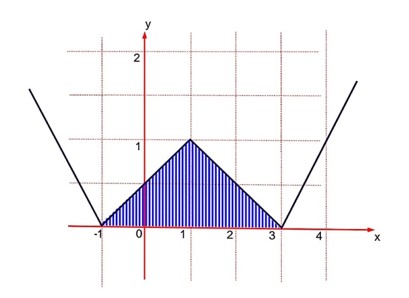
The area bounded by the lines y = ||x−2|−2| is-----------.

A: 

Information missing. The question was droppedby NTA.

 y=||x−1|−2|

Area bounded region = 12×4×2=4

Q:  

If 3(cos2x)=(3−1)cosx+1, the number of solutions of the given equation when x ∈ [0,π2] is------.

A: 

3cos2x= (3−1)cosx+1

(3cosx+1) (cosx−1)=0

∴cosx=−13 (rejected)

Hence, cos x = 1 x = 0 one solution

Q:  

The number of solution of the log4 (x-1) = log2 (x-3) is------------.

A: 

 log4 (x−1)=log2 (x−3)

⇒12log2 (x−1)=log2 (x−3)

⇒log2 (x−1)=log2 (x−3)2

⇒x−1=x2−6x+9

⇒x=2, 5

also x – 1 > 0 and x – 3 > 0

x > 1 & x > 3

Hence, x = 5 possible. Only one solution.

Q:  

If y = y(x) is the solution of the equation esin y cosydydx+esinycosx=cosx,  y(0)=0; then 1+y(π6)+32y(π3)+12y(π4) is equal to----------.

A: 

esinycosydydx+esin  ycosx=cosx

Put esin y = t

esin  ycosydydx=dtdx

∴dtdx+tcosx=cosx

I.F=e∫cosxdx=esinx

∴t esinx=∫esinxcosxdx

Put sin x = u, cos xdx = du

∴put  x=0, y (0)=0, 1=1+c⇒c=0

∴1+0+0+0=1

Q:  

Let (λ,2,1) be a point on the plane which passes which through the point (4, 2, 2). If the plane is perpendicular to the line joining the points (2, 21, 29) and (1, 16, 23), then (λ11)2−4λ11−4 is equal to----------.

Read more
A: 

Let A (−2, −21, 29), B (−1, −16, 23), P (λ, 2, 1), Q (4, −2, 2)

Given AB→⊥PQ→

∴AB→.PQ→=0

(i^+5j^−6k^). ( (4−λ)i^−4j^+k^)=0

4−λ−20−6=0

λ=−22

∴ (λ11)2+ (−4λ11)−4=4+8−4=8

Q:  

The number of integral values of ‘k’ for which the equation 3sinx + 4cos x = k + 1 has a solution, k ∈ R is------------.

Read more
A: 

3sinx+4cosx=k+1, cosα=35, sinα=45

5sin (x+α)=k+1,

∴−5≤k+1≤5⇒−6≤k≤4

∴ total number of integral values of k is 11.

Q:  

The sum of 162th power of the roots of the equation x 3 − 2 x 2 + 2 x − 1 = 0     i s -------------.

Read more
A: 

(x−1) (x2−x+1)=0

x=1, x=1±3i2=12+32i, 12−32i=eiπ3, e−iπ3

Sum of 162th power of roots = 1+ei54π+e−i54π=1+1+1=3

Q:  

Let m, n ∈ N and gcd (2, n) = 1. If 30 (300)+29(301)+.....+2(3028)+1(3029) = n. 2m, then n + m is equal to--------.

(Here(nk)=n?Ck)

Read more
A: 

30  30C0+29  30C1+.....+2   30C28+1.30C29=n.2m

∴n=15, m=0

∴n+m=15+30=45

Q:  

The difference between degree and order of a differential equation that represents the family of curves given by y2 = a (x+a2),  a>0  is --------------.

Read more
A: 

y2=a (x+a2), a>0

2yy1 = a

y2=2yy1 (x+2yy12)

y=2y1x+y12yy1

(y−2y1x)2=y12.2yy1=2yy13

∴order=1, degree=3

Hence, degree – order = 3 – 1 = 2

Q:  

The value of the integral ∫0π|sin2x|  dx  is -----------.

A: 

∫0π|sin2x|dx

=2∫0π/2sin2x  dx =2  [−cos2x2]0π/2 = 2 ( 1 2 − ( − 1 2 ) ) = 2

Maths NCERT Exemplar Solutions Class 11th Chapter Ten Logo

JEE Mains 2025

JEE Mains 2025

qna

Maths NCERT Exemplar Solutions Class 11th Chapter Ten Exam

Student Forum

chatAnything you would want to ask experts?
Write here...