
Coordination Compounds
Get insights from 147 questions on Coordination Compounds, answered by students, alumni, and experts. You may also ask and answer any question you like about Coordination Compounds
- 147
Questions
- 0
Discussions
- 0
Active Users
- 0
Followers
Have a question about Coordination Compounds? Ask our experts
Keep it short & simple. Type complete word. Avoid abusive language.
The major products of the following reaction are:
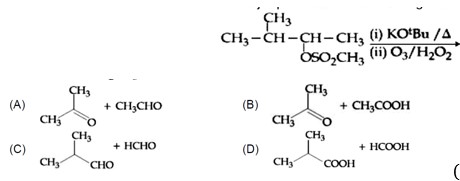
<!--[endif]-->
The major products of the following reaction are:
<!--[endif]-->
Kindly consider the following figure
 Upvote

Consider the following reactions:
'A' (C₇H₁₄) --(ozonolysis)--> 'B' + 'C'
'B' --(I₂ + NaOH)--> yellow ppt
'C' --(I₂ + NaOH)--> no yellow ppt
'C' --(Ag₂O/Δ)--> silver mirror
'C' --(LiAlH₄)--> 'D' --(Anhydrous ZnCl₂ & Conc. HCl)--> gives white turbidity within 5 minutes
'A' is:
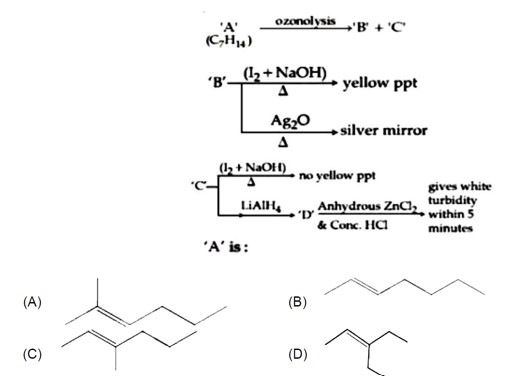
Consider the following reactions:
'A' (C₇H₁₄) --(ozonolysis)--> 'B' + 'C'
'B' --(I₂ + NaOH)--> yellow ppt
'C' --(I₂ + NaOH)--> no yellow ppt
'C' --(Ag₂O/Δ)--> silver mirror
'C' --(LiAlH₄)--> 'D' --(Anhydrous ZnCl₂ & Conc. HCl)--> gives white turbidity within 5 minutes
'A' is:
Kindly consider the following figure
Upvote Considering that ∆₀ > P, the magnetic moment (in BM) of [Ru(H₂O)₆]²⁺ would be
Considering that ∆₀ > P, the magnetic moment (in BM) of [Ru(H₂O)₆]²⁺ would be
Δ? > P
Pairing of electron will take place
Number of unpaired electron = 0
µ = 0.00
Upvote Consider the complex ions, trans-[Co(en)?Cl?]? (A) and cis-[Co(en)?Cl?]? (B). The correct statement regarding them is:
<!-- [if !supportLineBreakNewLine]-->
<!--[endif]-->
Consider the complex ions, trans-[Co(en)?Cl?]? (A) and cis-[Co(en)?Cl?]? (B). The correct statement regarding them is:
<!-- [if !supportLineBreakNewLine]-->
<!--[endif]-->
(A) Trans
(B) Cis
Optically inactive due to presence of plane of symmetry
Optically active no plane of symmetry
Upvote The number of possible optical isomers for the complexes with and hybridized metal atom, respectively is:
[Note: A and B are unidentate neutral and unidentate monoanionnic ligands, respectively]
<!-- [if !supportLineBreakNewLine]-->
<!--[endif]-->
The number of possible optical isomers for the complexes with and hybridized metal atom, respectively is:
[Note: A and B are unidentate neutral and unidentate monoanionnic ligands, respectively]
<!-- [if !supportLineBreakNewLine]-->
<!--[endif]-->
shows geometrical and not optical isomerism
Upvote Kindly consider the following figure
Upvote The theory that can completely/properly explain the nature of bonding in is
The theory that can completely/properly explain the nature of bonding in is
[Ni (C)4)] bonding diagram and energy can be explained by MOT clearly.
Upvote The number of geometrical isomers possible in triamminetrinitrocobalt(III) is X and in trioxalatochromate(III) is Y. Then the value of X + Y is _______.
The number of geometrical isomers possible in triamminetrinitrocobalt(III) is X and in trioxalatochromate(III) is Y. Then the value of X + Y is _______.
Number of GI in [Co (NH? )? (NO? )? ] is 2 i.e, X
Number of GI in [Cr (C? O? )? ]³? is 0 i.e. Y
[X + Y] = 2
Upvote Which one of the following species responds to an external magnetic field?
<!-- [if !supportLineBreakNewLine]-->
<!--[endif]-->
Which one of the following species responds to an external magnetic field?
<!-- [if !supportLineBreakNewLine]-->
<!--[endif]-->
(CH?)?N?HCl produces H? which reacts with NaHCO? and CO? gas evolved, because HCl is stronger acid than H?CO?
Upvote