Get insights from 2k questions on Ncert Solutions Chemistry Class 11th, answered by students, alumni, and experts. You may also ask and answer any question you like about Ncert Solutions Chemistry Class 11th
2k
Questions
0
Discussions
1
Active Users
29
Followers
Have a question about Ncert Solutions Chemistry Class 11th? Ask our experts
Ask Your Question
Keep it short & simple. Type complete word. Avoid abusive language.
This is a Multiple Choice Questions as classified in NCERT Exemplar
Ans: Option (i)
The electronic configuration of A 1S2 2S2 2P6 is having no unpaired electrons in the outer most shells. So, an atom having no unpaired electron in its valence shell is said to be stable.
This is a Multiple Choice Questions as classified in NCERT Exemplar
Ans: Option (ii)
For a molecule having a hybridization of sp2, its geometry in plane is trigonal planar. For a molecule having a trigonal planar geometry, its bond angle will be 120°
This is a Multiple Choice Questions as classified in NCERT Exemplar
Ans: Option (iv)
The electrons involved in the formation of any chemical bond are the valence shell electrons. In the given electronic configuration,1s2 2s2 2p6 3s2 3d2 4s2 the valence shell electrons are in d-orbital and s-orbital. S
This is a Multiple Choice Questions as classified in NCERT Exemplar
Ans: Option (ii)
Hydrogen bond is the strongest in that molecules have a higher difference in electronegativity. Due to the small size of the oxygen atom, it has the highest electronegative character. So, H2O molecules will have the s
This is a Multiple Choice Questions as classified in NCERT Exemplar
Ans: Option (iii)
The molecular orbital diagram of O22-, π∗2Px and π∗2Py molecular orbitals are completely filled, which are partially filled in O2. These are no unpaired electrons. So, O22-does n
This is a Multiple Choice Questions as classified in NCERT Exemplar
Ans: Option (iii)
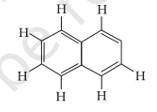
A double bond has one s bond and one π bond. In the above given structure 5π bonds are present. The s bonds are the additions of all the single bonds in the structure. There are 19s bonds in the above given structure
This is a Multiple Choice Questions as classified in NCERT Exemplar
Ans: Option (iv)
The number of bond pairs on the nitrogen atom of NO3-are 4 and the structure of - NO3 does not have any lone pairs of electrons. The structure of NO3- molecule is:
This is a Multiple Choice Questions as classified in NCERT Exemplar
Ans: Option (ii)
In a polyatomic molecule or an ion, the formal charge of an atom is defined as the difference between the valence electrons present in that atom and the number of electrons assigned to that atom in the Lewis structure

 Upvote