
Ncert Solutions Chemistry Class 11th
Get insights from 2k questions on Ncert Solutions Chemistry Class 11th, answered by students, alumni, and experts. You may also ask and answer any question you like about Ncert Solutions Chemistry Class 11th
- 2k
Questions
- 0
Discussions
- 0
Active Users
- 29
Followers
Have a question about Ncert Solutions Chemistry Class 11th? Ask our experts
Keep it short & simple. Type complete word. Avoid abusive language.
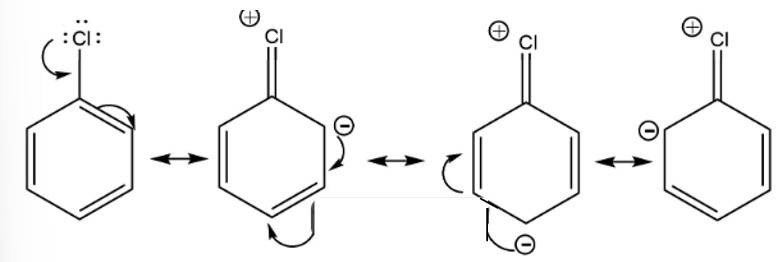
Despite their - I effect, halogens are o- and p-directing in haloarenes. Explain.
Despite their - I effect, halogens are o- and p-directing in haloarenes. Explain.
This is a short answer type question as classified in NCERT Exemplar
Due to the +R effect halogens are ortho and para directing groups.
 Upvote

The quantum numbers of six electrons are given below. Arrange them in order of increasing energies. List if any of these combination(s) has/have the same energy
(i) n = 4, l = 2, ml = -2, ms = -1/2
(ii) n = 3, l = 2, ml = 1, ms = +1/2
(iii) n = 4, l = 1, ml = 0, ms = +1/2
(iv) n = 3, l = 2, ml = -2, ms = -111
(v) n = 3, l = l, ml = -1, ms = +1/2
(vi) n = 4, l = 1, ml = 0, ms = +1/2
The electrons may be assigned to the following orbitals :
(i) 4d
(ii) 3d
(iii) 4p
(iv) 3d
(v) 3p
(vi) 4p.
The increasing order of energy is :
(v) < (ii) = (iv) < (vi) = (iii) < (i)
Upvote If the position of the electron is measured within an accuracy of ± 0.002 nm, calculate the uncertainty in the momentum of the electron. Suppose the momentum of the electron is h/4π x 0.05 nm. Is there any problem in defining this value?
If the position of the electron is measured within an accuracy of ± 0.002 nm, calculate the uncertainty in the momentum of the electron. Suppose the momentum of the electron is h/4π x 0.05 nm. Is there any problem in defining this value?
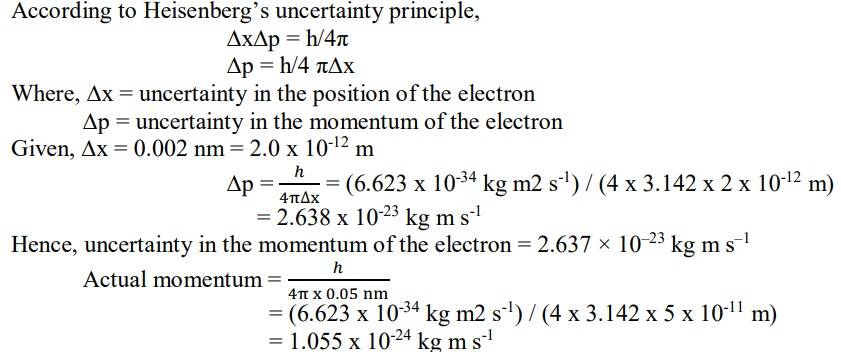
Since actual momentum is smaller than the uncertainty in measuring momentum, therefore, the momentum of electron cannot be defined
Upvote Arrange the following set of compounds in the order of their decreasing relative reactivity with an electrophile.Give reason
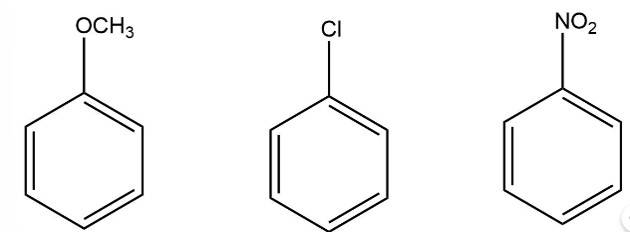
Arrange the following set of compounds in the order of their decreasing relative reactivity with an electrophile.Give reason
This is a short answer type question as classified in NCERT Exemplar
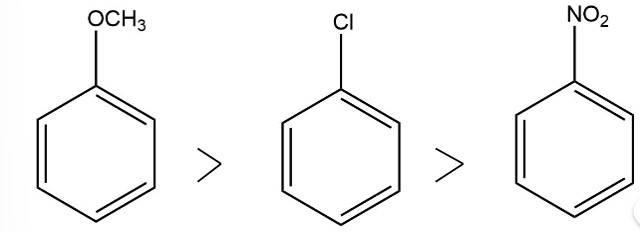
The electron donating group increases the reactivity in electrophilic substitution reaction whereas the electron withdrawing group decreases the reactivity in electrophilic substitution.
Thus, the order of reactivity
 Upvote
The velocity associated with a proton moving in a potential difference of 1000 V is 4.37 x 10⁵ m s-1. If the hockey ball of mass 0.1 kg is moving with this velocity, calculate the wavelength associated with this velocity.
The velocity associated with a proton moving in a potential difference of 1000 V is 4.37 x 10⁵ m s-1. If the hockey ball of mass 0.1 kg is moving with this velocity, calculate the wavelength associated with this velocity.
ν = 4.37 x 10⁵ m s-1, m = 0.1 kg
As per de Brogile’s equation,
λ= m/v = (6.626 x 10⁻³⁴ kg m2 s-1) / (0.1 kg) x (4.37 x 10⁵ m s-1)
=6.626/0.437 x 10-34-5 m
= 1.516 x 10-38 m
Upvote <p><strong>The velocity associated with a proton moving in a potential difference of 1000 V is 4.37 x 10<sup>5</sup> m s<sup>-1</sup>. If the hockey ball of mass 0.1 kg is moving with this velocity, calculate the wavelength associated with this velocity. </strong></p>
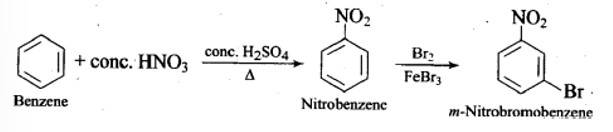
How will you convert benzene into
(i) p – nitrobromobenzene
(ii) m – nitrobromobenzene
How will you convert benzene into
(i) p – nitrobromobenzene
(ii) m – nitrobromobenzene
This is a short answer type question as classified in NCERT Exemplar
Upvote If the velocity of the electron in Bohr’s first orbit is 2.19 x 10⁶ m s-1, calculate the de Brogile wavelength associated with it.
If the velocity of the electron in Bohr’s first orbit is 2.19 x 10⁶ m s-1, calculate the de Brogile wavelength associated with it.
ν = 2.19 x 10⁶ m s-1
As per de Brogile’s equation,
λ= m/v = (6.626 x 10⁻³⁴ kg m2 s-1) / (9.1 x 10⁻³¹ kg) x (2.19 x 10⁶ m s-1)
6.626/91 * 2.19= x 10-34+25 m = 0.33243 x 10⁻⁹ m = 332.43 pm
Upvote Similar to electron diffraction, neutron diffraction microscope is also used for the determination of the structure of molecules. If the wavelength used here is 800 pm, calculate the characteristic velocity associated with the neutron.
Similar to electron diffraction, neutron diffraction microscope is also used for the determination of the structure of molecules. If the wavelength used here is 800 pm, calculate the characteristic velocity associated with the neutron.
λ = 800 pm = 800 x 10-12 m
m = 1.675 x 10⁻²⁷ kg
As per de Brogile’s equation,
ν =h/mλ = (6.626 x 10⁻³⁴ kg m2 s-1) / (1.675 x 10⁻²⁷ kg) x (800 x 10-12 m)
=6.626/1.675 * 8 x 10-34+27+10
= 0.494 x 10³ ms-1
= 494 ms-1
Upvote What will be the product obtained as a result of the following reaction and why?

What will be the product obtained as a result of the following reaction and why?

This is a short answer type question as classified in NCERT Exemplar
The benzene here would undergo Friedel-Crafts alkylation reaction where carbocation is formed as an intermediate, thus secondary carbocation is formed as an intermediate due to its greater stability than that of the primary carbocat
Upvote