Celeb technocrats from India
 Call 8585951111Got Doubts?

Celeb technocrats from India
All of us have often heard the term “technocrat” which immediately gets us to thinking about our gadget loving superheroes such as Batman and even our very own American engineer and industrialist Tony Stark (read that as the sharp witted Iron Man). But fiction aside, our country is known to produce some technological experts who through their intelligence, knowledge and experience have helped the world overcome the depressing ‘depression’, if we can call it so.
Shiksha thus, lists some India born technocrats who with their golden touch are not only helping India make a mark for itself in the global market but are also ideating and generating massive wealth for their own enterprises.
Nandan Nilekani
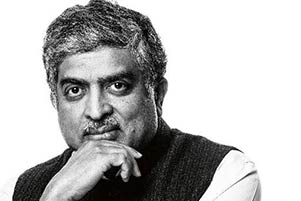
Nandan Nilekani
Course: Bachelor’s degree in electrical engineering
Institute: Indian Institute of Technology (IIT), Bombay
Year: 1978
Nandan Nikekani is often referred to as an entrepreneur, bureaucrat and now also as a politician. This Indian technocrat completed his bachelor’s in electrical engineering from IIT Bombay in 1978. But that is not the only thing IIT gave him. He also met his wife, Rohini Nilekani at a quizzing event held at the prestigious engineering institution.

After graduating from IIT, Nilekani met N R Narayana Murthy for an interview for Patni Computer Systems and readily joined the company. In 1981, Nilekani, Murthy and some other colleagues left Patni and set-up their own company – Infosys – wherein he served as the CEO. Nilekani left Infosys after 28 years of service to become the chairperson of Unique Identification Authority of India (UIDAI), a firm which is working to provide Aadhaar cards to every Indian resident.
Explore more B.Tech exams with upcoming dates

5 Aug '26
4 Aug '26
31 Jul '26 - 5 Aug '26
5 Aug '26
TS EAMCET

1 Aug '26 - 6 Aug '26
29 Jul '26 - 12 Aug '26
In 1999, this philanthropist set up the Bangalore Agenda Task Force (BATF) to offer solutions to problems faced by citizens of Bangalore.
For his achievements and contributions to the society, he was awarded the Padma Bhushan in 2006. He was also listed as one of the top 100 most influential people in the world in 2006 and 2009 by Times Magazine and as the Businessman of the Year in Asia by Forbes Magazine in 2006.
In March 2014, Nilekani joined active politics and would be contesting from South Bangalore constituency in the 2014 Lok Sabha elections.
Nilekani is known to have created and offered jobs to over 400,000 people during his career. At present his net worth is estimated by Forbes to be close to $1.3 billion.
Kaushik Basu
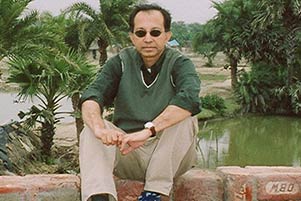
Kaushik Basu
Course: M.Sc in Economics
Institute: London School of Economics
Year: 1974
After completing his schooling in 1969 from St. Xavier’s Collegiate School in Kolkata, Kaushik Basu did not want to pursue further studies. However, after much persuasion from his father to study Physics, Basu finally settled mid-way from what he wanted to do and what his father was suggesting and finally decided to pursue Economics. He went on to Delhi University to pursue Economics honours with Maths as a subsidiary subject. Basu then completed his master’s degree in Economics from London School of Economics in 1974 after which he had planned to pursue law in order to be able to head his father’s legal practice. However, his future planning did not see the light of the day as he increasingly got involved and fascinated with the work of Amartya Sen, which got him to pursue PhD in Economics (1974-1976) from his college (London School of Economics).
Basu has held the post of visiting professor at many prestigious educational institutes such as Harvard University, Massachusetts Institute of Technology, London School of Economics, Institute for Advanced Study in New Jersey and Université catholique de Louvain's Center for Operations Research and Econometrics in Belgium. He has also served at Kolkata’s Indian Statistical Institute as a visiting scientist.
In 1992, Basu founded the Centre for Development Economics at Delhi School of Economics (DCE) where he held the post of executive director till 1996. Another achievement of Basu is that he is the brains behind the two-player version of the famous game Sudoku called Dui-doku.
He has held the post of the chief economic adviser of India's Ministry of Finance. In 2008, Basu was conferred the prestigious award, Padma Bhushan by the Government of India.
Basu, in 2012 was appointed as World Bank’s senior vice president and chief economist, a post he is serving at present.
Satya Nadella
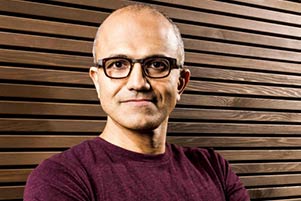
Satya Nadella
Course: MS in Computer Science
Institute: University of Wisconsin–Milwaukee
Year: 1990
Satya Nadella started his education from Hyderabad Public School situated at Begumpet (Andhra Pradesh). Thereafter, following his passion for building things, in 1987, he went on to pursue bachelor’s degree in electronics and telecommunication from Manipal Institute of Technology. Nadella has revealed in one of his interviews that a degree in computer sciences was his first choice, however, since that specialisation wasn’t available at Manipal University at that time he went on to study electronic engineering which he claims became his passion.
Nadella, after his graduation shifted to the United States where he completed his masters in Computer Science from University of Wisconsin–Milwaukee and later on joined University of Chicago Booth School of Business to pursue an MBA.
An avid reader, Nadella is fond of reading Indian and American poetry. This Hyderabad born techie is also passionate about cricket which he credits for instilling leadership qualities in him along with the ability to work in a team.
Nadella started his career as a member of the technology staff at Sun Microsystem. In 1992, he joined Microsoft and is known to play a major part in the transition of Microsoft to cloud computing. In February 2014, Nadella succeeded Steve Ballmer to become the CEO of Microsoft.
At present Satya Nadella’s net worth is estimated to be around $45 million.
Narayana Murthy
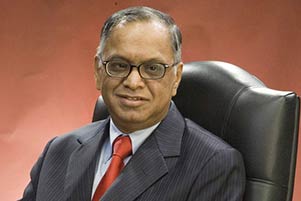
Narayana Murthy
Course: Master of Science
Institute: Indian Institute of Technology (IIT), Kanpur
Year: 1969
Described to be the Father of Indian IT sector by Time magazine, Nagavara Ramarao Narayana Murthy (N R Narayana Murthy) appeared for the IIT entrance test, but he couldn’t attend IIT for graduation. Thereafter he joined electrical engineering course at National Institute of Engineering, Mysore in 1967. Then he pursued his master’s degree in technological innovation in PC technology from IIT Kanpur in 1969.
Murthy commenced his career as the chief systems programmer at IIM Ahmedabad. He later went on to start a company called Softronics which did not scale up to the level he anticipated and so it was shut down after a year and a half. He then joined Pune’s Patni Computer Systems. In 1981, Murthy and six colleagues established Infosys with funds amounting to Rs 10,000 provided by his wife, Sudha Murthy.
Narayana Murthy served as Infosys CEO from 1981-2002. Murthy in 2013 re-joined Infosys to hold the post of executive chairman and additional director.
Murthy has been honoured with awards such as Padma Shri and Padma Vibhushan by the government of India. The Forbes magazine has estimated his net worth to be $1.7 billion (as in March 2014).
These are some popular technocrats from Indian origin. Stay tuned as we at Shiksha list some other popular technocrats who have led the paradigm shift in the world’s technology sector.
Explore more:
- Celeb technocrats from India – Part 2
