


As NEP 2020 completes five years, student enrolments in Kendriya Vidyalayas drop from 1.95 lakh in 2020–21 to 1.39 lakh in 2024–25; overall student strength also down by 37,000.

Five years after launch of National Education Policy, which promised enhanced access and equity in school education, enrolment in the Kendriya Vidyalayas has declined both in terms of new admissions and total student strength.
According to data shared by the Ministry of Education in the Lok Sabha, the number of new students enrolled in KVs fell from 1,95,081 in 2020–21 to 1,39,660 in 2024–25, marking a sharp 28% drop in fresh admissions over the five-year period. The total number of students studying in these schools also dipped from 13.87 lakh to 13.50 lakh in the same timeframe—a net decline of over 37,000 students.
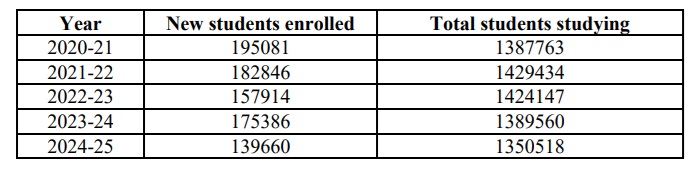
Decline in Key States: Andhra Pradesh, Uttar Pradesh
Downward trend is mirrored in major states like Andhra Pradesh and Uttar Pradesh, where KVs have seen consistent reductions in new enrolments.
Andhra Pradesh:

| Year |
New Admissions |
Total Students |
| 2020–21 |
5,195 |
32,688 |
| 2024–25 |
3,527 |
29,547 |
New admissions down by 32%, total strength down by over 3,000 students.
Uttar Pradesh:
| Year |
New Admissions |
Total Students |
| 2020–21 |
22,762 |
1,74,079 |
| 2024–25 |
14,569 |
1,66,080 |
New enrolments declined by 36%, total strength dipped by around 8,000.
Over 1,200 KVs Functional, 85 New Sanctioned
Despite the falling numbers, the government said that a total of 1,280 KVs are currently operational across India, including 125 in Uttar Pradesh, 78 in Rajasthan, 41 in Jharkhand, and 37 in Andhra Pradesh.

Commonly asked questions
No, CBSE does not deduct marks for exceeding the word limit in the board exams. However, marks may be deducted for spelling mistakes and other errors in language papers.
To improve access, 85 new KVs were approved in December 2024, including several in Andhra Pradesh, Uttar Pradesh, Rajasthan, Jharkhand, and Tamil Nadu, with an estimated investment of ₹5,872 crore. This includes a capital expenditure of ₹2,862 crore and operational costs of ₹3,009 crore.
Budget and PM SHRI Support
Government has steadily increased the annual allocation to Kendriya Vidyalayas, from ₹6,437 crore in 2020–21 to ₹8,727 crore in 2024–25. KVs under the PM SHRI Scheme have received infrastructure upgrades such as smart classrooms and ICT labs.
| Financial Year |
Total Allocation (₹ crore) |
| 2020–21 |
6,437.68 |
| 2021–22 |
6,800.00 |
| 2022–23 |
7,461.25 |
| 2023–24 |
8,500.00 |
| 2024–25 |
8,727.00 |
On its fifth anniversary, NEP 2020’s goals of equity and access in school education are under scrutiny, decline in KV admissions raising questions about reach of central institutions. While KVs remain a preferred choice for many parents, especially those in transferable government services, dip in enrolments suggests that capacity constraints, shifting demographics, and rising private alternatives may be influencing the trend.
Read More:
Follow Shiksha.com for latest education news in detail on Exam Results, Dates, Admit Cards, & Schedules, Colleges & Universities news related to Admissions & Courses, Board exams, Scholarships, Careers, Education Events, New education policies & Regulations.
To get in touch with Shiksha news team, please write to us at news@shiksha.com
Abhay Anand is an experienced education journalist with over 15 years in print and digital media. Currently serving as Manager- Editorial at Shiksha.com, he specializes in higher education policy, student mobility,
Read Full Bio