Maths NCERT Exemplar Solutions Class 11th Chapter Eleven: Overview, Questions, Preparation

Maths NCERT Exemplar Solutions Class 11th Chapter Eleven 2025 ( Maths NCERT Exemplar Solutions Class 11th Chapter Eleven )

Payal Gupta
Updated on Sep 17, 2025 14:52 IST

By Payal Gupta, Retainer

Table of contents
  • Conic Section Short Answer Type Questions
  • Conic Section Long Answer Type Questions
  • Conic Section True or False Type Questions
  • Conic Section Fill in the Blanks Type Questions
  • Conic Section Objective Type Questions
  • JEE_Mains_01 MT
Maths NCERT Exemplar Solutions Class 11th Chapter Eleven Logo

Conic Section Short Answer Type Questions

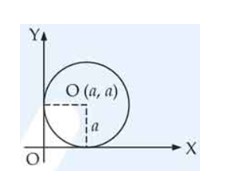
1. Find the equation of the circle which touches both axes in the first quadrant and whose radius is a .
Sol. C l e a r l y     c e n t r e     o f     t h e     c i r c l e = ( a , a ) a n d     r a d i u s = a E q u a t i o n     o f     c i r c l e     w i t h     r a d i u s     r     a n d     c e n t r e ( h , k )     i s                             ( x − h ) 2 + ( y − k ) 2 = r 2 S o ,     t h e     e q u a t i o n     o f     r e q u i r e d     c i r c l e ⇒                                               ( x − a ) 2 + ( y − a ) 2 = a 2 ⇒ x 2 − 2 a x + a 2 + y 2 − 2 a y + a 2 = a 2 ⇒                       x 2 + y 2 − 2 a x − 2 a y + a 2 = 0 H e n c e ,     t h e     r e q u i r e d     e q u a t i o n     i s     x 2 + y 2 − 2 a x − 2 a y + a 2 = 0 .

2. Show that the point ( x , y ) given by x = 2 a t 1 + t 2 and y = a ( 1 − t 2 ) 1 + t 2 lies on a circle for all real values of t , such that − 1 < t < 1 , where a is any given real number.

Sol. G i v e n     t h a t :     x = 2 a t 1 + t 2     a n d     y = a ( 1 − t 2 ) 1 + t 2 ⇒         x 2 + y 2 = ( 2 a t 1 + t 2 ) 2 + ( a ( 1 − t 2 ) 1 + t 2 ) 2                                                 = 4 a 2 t 2 ( 1 + t 2 ) 2 + a 2 ( 1 − t 2 ) 2 ( 1 + t 2 ) 2 = 4 a 2 t 2 + a 2 ( 1 + t 4 − 2 t 2 ) ( 1 + t 2 ) 2                                                 = 4 a 2 t 2 + a 2 + a 2 t 4 − 2 a 2 t 2 ( 1 + t 2 ) 2 = a 2 + a 2 t 4 + 2 a 2 t 2 ( 1 + t 2 ) 2                                                 = a 2 ( 1 + t 4 + 2 t 2 ) ( 1 + t 2 ) 2 = a 2 ( 1 + t 2 ) 2 ( 1 + t 2 ) 2 = a 2 ∴           x 2 + y 2 = a 2     w h i c h     i s     t h e     e q u a t i o n     o f     a     c i r c l e . H e n c e ,     t h e     g i v e n     points     l i e     o n     a     c i r c l e .
Q&A Icon
Commonly asked questions
Q:  

Find the equation of the circle which touches both axes in the first quadrant and whose radius is a .

Read more
A: 

This is a short answer type question as classified in NCERT Exemplar
C l e a r l y     c e n t r e     o f     t h e     c i r c l e = ( a , a ) a n d     r a d i u s = a E q u a t i o n     o f     c i r c l e     w i t h     r a d i u s     r     a n d     c e n t r e ( h , k )     i s                             ( x − h ) 2 + ( y − k ) 2 = r 2 S o ,     t h e     e q u a t i o n     o f     r e q u i r e d     c i r c l e ⇒                                               ( x − a ) 2 + ( y − a ) 2 = a 2 ⇒ x 2 − 2 a x + a 2 + y 2 − 2 a y + a 2 = a 2 ⇒                       x 2 + y 2 − 2 a x − 2 a y + a 2 = 0 H e n c e ,     t h e     r e q u i r e d     e q u a t i o n     i s     x 2 + y 2 − 2 a x − 2 a y + a 2 = 0 .

Q:  

Show that the point ( x , y ) given by x = 2 a t 1 + t 2 and y = a ( 1 − t 2 ) 1 + t 2 lies on a circle for all real values of t , such that − 1 < t < 1 , where a is any given real number.

Read more
A: 

This is a short answer type question as classified in NCERT Exemplar
G i v e n     t h a t :     x = 2 a t 1 + t 2     a n d     y = a ( 1 − t 2 ) 1 + t 2 ⇒         x 2 + y 2 = ( 2 a t 1 + t 2 ) 2 + ( a ( 1 − t 2 ) 1 + t 2 ) 2                                                 = 4 a 2 t 2 ( 1 + t 2 ) 2 + a 2 ( 1 − t 2 ) 2 ( 1 + t 2 ) 2 = 4 a 2 t 2 + a 2 ( 1 + t 4 − 2 t 2 ) ( 1 + t 2 ) 2                                                 = 4 a 2 t 2 + a 2 + a 2 t 4 − 2 a 2 t 2 ( 1 + t 2 ) 2 = a 2 + a 2 t 4 + 2 a 2 t 2 ( 1 + t 2 ) 2                                                 = a 2 ( 1 + t 4 + 2 t 2 ) ( 1 + t 2 ) 2 = a 2 ( 1 + t 2 ) 2 ( 1 + t 2 ) 2 = a 2 ∴           x 2 + y 2 = a 2     w h i c h     i s     t h e     e q u a t i o n     o f     a     c i r c l e . Hence,  the  given  points  lie  on  a  circle.

Q:  

If a circle passes through the points ( 0 , 0 ) , ( a , 0 ) , ( 0 , b ) , then find the coordinates of its center.

Read more
A: 

This is a short answer type question as classified in NCERT Exemplar

Given  points  are  (0,0),(a,0)  and  (0,b) G e n e r a l     e q u a t i o n     o f     t h e     c i r c l e     i s                     x 2 + y 2 + 2 g x + 2 f y + c = 0     w h e r e     t h e     c e n t r e     i s ( − g , − f )     a n d     r a d i u s = g 2 + f 2 − c I f     i t     p a s s e s     t h r o u g h ( 0 , 0 ) ∴     c = 0 I f     i t     p a s s e s     t h r o u g h ( a , 0 )     a n d     ( 0 , b )     t h e n                 a 2 + 2 g a + c = 0           ⇒ a 2 + 2 g a = 0                                             [ ? c = 0 ] ∴               g = − a 2 a n d       0 + b 2 + 0 + 2 f b + c = 0         ⇒ b 2 + 2 f b = 0                 [ ? c = 0 ] ⇒       f = − b 2 H e n c e ,     t h e     c o o r d i n a t e s     o f     c e n t r e     o f     t h e     c i r c l e     a r e     ( − g , − f ) = ( a 2 , b 2 )

Q:  

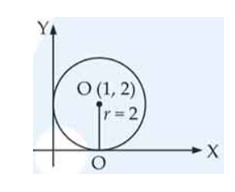
Find the equation of the circle which touches the x -axis and whose center is ( 1 , 2 ) .

Read more
A: 

This is a short answer type question as classified in NCERT Exemplar

Since  the  circle  whose  centre  is  (1,2)  touch  x-axis ∴     r = 2 S o ,     t h e     e q u a t i o n     o f     t h e     c i r c l e     i s                                   ( x − h ) 2 + ( y − k ) 2 = r 2 ⇒                             ( x − 1 ) 2 + ( y − 2 ) 2 = ( 2 ) 2 ⇒ x 2 − 2 x + 1 + y 2 − 4 y + 4 = 4 ⇒                   x 2 + y 2 − 2 x − 4 y + 1 = 0 H e n c e ,     t h e     r e q u i r e d     e q u a t i o n     i s     x 2 + y 2 − 2 x − 4 y + 1 = 0 .

Q:  

If the lines 3 x − 4 y + 4 = 0 and 6 x − 8 y − 7 = 0 are tangents to a circle, then find the radius of the circle.
[Hint: Distance between given parallel lines gives the diameter of the circle.]

Read more
A: 

This is a Short Answer Type Questions as classified in NCERT Exemplar

Sol: 
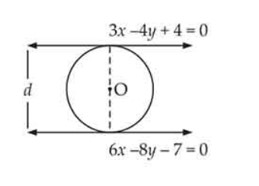
Sol:

Given  equation  are  3x−4y+4=0and                                   6x−8y−7=0     ⇒3x−4y−72=0
Since 36=−4−8=12  then  the  lines  are  parallel.So,  the    between  the  parallel  lines=|c1−c2a2+b2|=|4+72(3)2+(−4)2|                 =|1525|=32  Diameter=32∴     Radius=34Hence,  the  required  radius=34.

Q:  

Find the equation of a circle which touches both axes and the line 3 x − 4 y + 8 = 0 and lies in the third quadrant.
[Hint: Let a
be the radius of the circle, then ( − a , − a ) will be the center, and the perpendicular distance from the center to the given line gives the radius of the circle.]

Read more
A: 

This is a Short Answer Type Questions as classified in NCERT Exemplar

Sol:
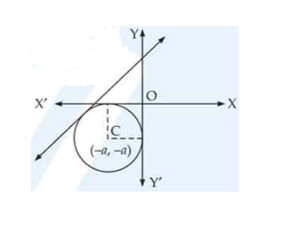
Sol:

Let  a  be  the  radius  of  the  circle.Centre  of  the  circle=(−a,−a)  Distance of  the  line  3x−4y+8=0From  the  centre=Radius  of  the  circle   |−3a+4a+8(3)2+(−4)2|=a⇒                 |a+85|=32⇒         ±(a+85)=a⇒                  a+85=a  and  −(a+85)=a⇒          a=5a−8⇒       4a=8           ⇒a=2and  a+85=−a    ⇒a+8=−5a⇒          6a=−8    ⇒a=−43∴  a=2  and  a≠−43∴  The  equation  of  the  circle  is                   (x+2)2+(y+2)2=(2)2⇒x2+4x+4+y2+4y+4=4⇒         x2+y2+4x+4y+4=0Hence,  the  required  equation  of  the  circle  is  x2+y2+4x+4y+4=0.

Q:  

If one end of a diameter of the circle x 2 + y 2 − 4 x − 6 y + 1 1 = 0 is ( 3 , 4 )   , then find the coordinates of the other end of the diameter.

Read more
A: 

This is a Short Answer Type Questions as classified in NCERT Exemplar
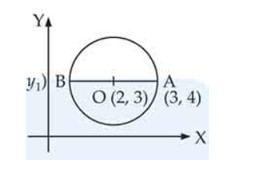
Sol:
Let  the  other  end  of  the  diameter  is  (x1,y1).Equation  of  the  given  circle  is          x2+y2−4x−6y+11=0Centre=(−g,−f)=(2,3)∴         x1+32=2    ⇒x1+3=4     ⇒x1=1and   y1+42=3    ⇒y1+4=6     ⇒y1=2Hence,  the  required  coordinates  are  (1,2).

Q:  

Find the equation of the circle having ( 1 , − 2 ) as its center and passing through the line 3 x + y = 1 4 , 2 x + 5 y = 1 8 .

A: 

This is a Short Answer Type Questions as classified in NCERT Exemplar
Sol:
Given  equations  are              3x+y=14                                   …(i)and   2x+5y=18                                   …(ii)From  eq.(i)  we  get                       y=14−3x                        …(iii)Putting  the  value  of  y  in  eq.(ii)  we  get⇒                2x+5(14−3x)=18⇒                    2x+70−15x=18⇒                                    −13x=−70+18⇒                                    −13x=−52          ⇒x=4From  eq.(iii)  we  get,   y=14−3×4=2∴    point ofintersection     is  (4,2)Now,       radius  r=(4−1)2+(2+2)2=(3)2+(4)2=9+16=5So,  the  equation  of  circle  is                    (x−h)2+(y−k)2=r2⇒                (x−1)2+(y+2)2=(5)2⇒   x2−2x+1+y2+4y+4=25⇒       x2+y2−2x+4y−20=0Hence,  the  required  equation  is  x2+y2−2x+4y−20=0.

Q:  

If the line y = 3 x + k touches the circle  x 2 + y 2 = 1 6 , then find the value of k .

[Hint: Equate perpendicular distance from the center of the circle to its radius.]

Read more
A: 

This is a Short Answer Type Questions as classified in NCERT Exemplar

Sol:
Given  circle  is     x2+y2=16Perpendicular  from  the  origin  to  the  given  line  y=3x+k  is  equal  to  the  radius.∴     4=|0−0−k(1)2+(3)2|=|−k4|⇒   4=±k2     ⇒k=±8Hence,  the  required  values  of  k  are  ±8.

Q:  

Find the equation of a circle concentric with the circle x 2 + y 2 − 6 x + 1 2 y + 1 5 = 0 and has double its area.

[Hint: Concentric circles have the same center.]

Read more
A: 

This is a Short Answer Type Questions as classified in NCERT Exemplar

Sol:
Given  equation  of  the  circle  is           x2+y2−6x+12y+15=0                           …(i)Centre=(−g,−f)=(3,−6)       [?  2g=−6  ⇒g=−3    2f=12  ⇒f=6]  Since the  circle  is  concentric  with  the  given  circle∴      Centre=(3,−6)Now  let  the  radius  of  the  circle  is  r∴     r=g2+f2−c=9+36−15=30Area  of  the  given  circle(i)=πr2=30π  sq.unitArea  of  the  required  circle=2×30π=60π  sq.unitIf  r1  be  the  radius  of  the  required  circle                      πr12=60π    ⇒r12=60So,  the  required  equation  of  the  circle  is                                  (x−3)2+(y+6)2=60⇒x2+9−6x+y2+36+12y−60=0⇒                   x2+y2−6x+12y−15=0Hence,  the  required  equation  is  x2+y2−6x+12y−15=0.

Q:  

If the latus rectum of an ellipse is equal to half of its minor axis, then find its eccentricity.

A: 

This is a Short Answer Type Questions as classified in NCERT Exemplar

Sol:
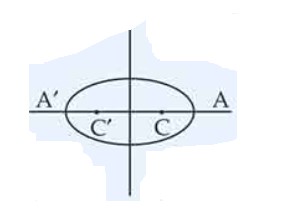
Sol:

Let  the  equation  of  an  ellipse  is           x2a2+y2b2=1Length  of  major  axis=2aLength  of minor   axis=2band  the  length  of latusrectum=2b2aAccording  to  the  question,  we  have        2b2a=2b2        ⇒b=a2Now  b2=a2(1−e2),  where  e  is  the  eccentricity⇒       b2=4b2(1−e2)⇒         1=4(1−e2)      ⇒1−e2=14        ⇒e2=34∴          e=±32So,  e=32                [?  e  is  not(−)]Hence,  the  required  value  of  eccentricity  is  32.


Q:  

Given the ellipse with equation 9 x 2 + 2 5 y 2 = 2 2 5 , find the eccentricity and foci.

Read more
A: 

This is a Short Answer Type Questions as classified in NCERT Exemplar

Sol:

Given  equation  of  an  ellipse  is                 9x2+25y2=225⇒9225x2+25225y2=1⇒                  x225+y29=1Here,  a=5  and  b=3Now  b2=a2(1−e2),  where  e  is  the  eccentricity⇒         9=25(1−e2)⇒1−e2=925        ⇒e2=1−925=1625∴          e=45Now  foci=(±ae,0)=(±5×45,0)=(±4,0)Hence,  eccentricity  is  45,  foci=(±4,0).

Q:  

If the eccentricity of an ellipse is 5 8 and the distance between its foci is 10, then find the latus rectum of the ellipse.

Read more
A: 

This is a Short Answer Type Questions as classified in NCERT Exemplar

Sol:
Equation  of  an  ellipse  is   x2a2+y2b2=1Distance  between  its  foci=ae+ae=2ae∴           2ae=10⇒           ae=5    ⇒a×58=5    ⇒a=8Now  b2=a2(1−e2),  where  e  is  the  eccentricity⇒       b2=64(1−2564)⇒       b2=64×3964        ⇒b2=39So,  the  length  of  the  latusrectum=2b2a=2×398=394Hence,  length  of  the  latusrectum=394.

Q:  

Find the equation of the ellipse whose eccentricity is 32 , latus rectum is 5, and the center is (0, 0)

Read more
A: 

This is a Short Answer Type Questions as classified in NCERT Exemplar

Sol:
Equation  of  an  ellipse  is   x2a2+y2b2=1                                  …(i)Given  that,  e=23and  latusrectum=2b2a=5⇒                          b2=52a                                                                   …(ii)We  know  that  b2=a2(1−e2)⇒    52a=a2(1−49)⇒       52=a×59      ⇒a=92       ⇒a2=814and        b2=52×92=454Hence,  the  required  equation  of  ellipse  is          x281/4+y245/4=1       ⇒         481x2+445y2=1

Q:  

Find the distance between the directrices of the ellipse x 2 3 6 + y 2 2 0 = 1 .

Read more
A: 

This is a Short Answer Type Questions as classified in NCERT Exemplar

Sol:
Given  equation  of  an  ellipse  is   x236+y220=1Here,  a2=36    ⇒a=6    and    b2=20    ⇒b=25We  know  that  b2=a2(1−e2)⇒          20=36(1−e2)⇒   1−e2=2036     ⇒e2=1−2036=1636⇒            e=46=23Now Distance   between  the  directrices  is           ae−(−ae)=ae+ae=2ae                                 =2×62/3=2×6×32=18Hence,  the  required  distance=18.

Q:  

Find the coordinates of a point on the parabola y2=8x whose focal distance is 4.

A: 

This is a Short Answer Type Questions as classified in NCERT Exemplar

Sol:

Given  parabola  is  y2=8x                                       …(i)Comparing  with  the  equation  of  parabola  y2=4ax               4a=8     ⇒a=2Now  focalDistance  =|x+a|⇒   |x+a|=4⇒(x+a)=±4    ⇒x+2=±4⇒             x=4−2=2  and  x=−6But  x≠−6  ∴x=2Put  x=2  in  equation(i)  we  get       y2=8×2=16∴       y=±4So,  the  coordinates  of  the  points are(2,4),(2,−4).Hence,  the  required  coordinates  are(2,4),(2,−4).

Q:  

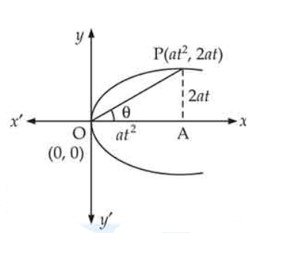
Find the length of the line segment joining the vertex of the parabola y2=4ax and a point on the parabola where the line segment makes an angle θ to the x-axis.

Read more
A: 

This is a Short Answer Type Questions as classified in NCERT Exemplar

Sol:

Given  parabola  is  y2=4axLet  P(at2,2at)  be  any    on  the  parabola.In  ΔPOA,      tanθ=2atat2=2t⇒          t=2tanθ⇒          t=2cotθ                                      …(i)OP=(at2−0)2+(2at−0)2         =a2t4+4a2t2         =att2+4         =a×2cotθ4+4         [?t=2cotθ]         =2acotθ.2cot2θ+1=4acotθcosecθ         =4a.cosθsinθ.1sinθ=4acosθsin2θHence,  the  required  length=4acosθsin2θ.

Q:  

If the points (0, 4) and (0, 2) are respectively the vertex and focus of a parabola, then find the equation of the parabola.

Read more
A: 

This is a Short Answer Type Questions as classified in NCERT Exemplar

Sol:

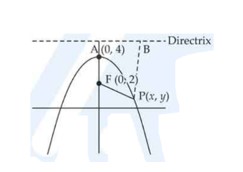
Given  that:         Vertex=(0,4)  and  Focus=(0,2)Let  P(x,y)  be  any  point  on  the  parabola.  PB  is  perpendicular  to  the  directrix.According  to  the  definition  of  parabola,  we  have           PF=PB⇒(x−0)2+(y−2)2=|0+y−60+1|            [?Equation  of  directrix  is  y=6]⇒             x2+(y−2)2=(y−6)Squaring  both  sides,  we  have                  x2+y2+4−4y=y2+36−12y⇒        x2−4y+12y−32=0⇒                      x2+8y−32=0Hence,  the  required  equation  is  x2+8y=32.

Q:  

If the line y=mx+1 is tangent to the parabola y2=4x , then find the value of m .
[Hint: Solving the equation of the line and parabola, obtain a quadratic equation and apply the tangency condition to find m ].

Read more
A: 

This is a Short Answer Type Questions as classified in NCERT Exemplar

Sol:

Given  that                y2=4x                               …(i)and                                 y=mx+1                       …(ii)From  eqn.(i)  and  (ii)  we  get                           (mx+1)2=4x⇒m2x2+1+2mx−4x=0⇒m2x2+(2m−4)x+1=0Applying  condition  of   tangency we  have           (2m−4)2−4m2×1=0⇒4m2+16−16m−4m2=0⇒                                  −16m=−16      ⇒m=1Hence,  the  required  value  of  m  is  1.

Q:  

If the distance between the foci of a hyperbola is 16 and its eccentricity 2 is, then obtain the equation of the hyperbola.

Read more
A: 

This is a Short Answer Type Questions as classified in NCERT Exemplar

Sol:

Equation  of  hyperbola  is  x2a2−y2b2=1 Distance between  the  foci=2ae              2ae=16    ⇒ae=8⇒   a×2=8      ⇒a=82=42       [?e=2]Now,      b2=a2(e2−1)         [For  hyperbola]⇒           b2=(42)2(2−1)⇒           b2=32   a=42      ⇒a2=32Hence,  the  required  equation  is  x232−y232=1    ⇒x2−y2=32.

Q:  

Find the eccentricity of the hyperbola 9y2−4x2=36 .

A: 

This is a Short Answer Type Questions as classified in NCERT Exemplar

Sol:

Given  equation  is  9y2−4x2=36⇒              y24−x29=36Clearly  it  is  vertical  hyperbola.Where  a=3  and  b=2Now,      b2=a2(e2−1)⇒              4=9(e2−1)⇒      e2−1=49      ⇒e2=1+49=139∴                 e=133Hence,  the  required  value  of  e  is  133.

Q:  

Find the equation of the hyperbola with eccentricity 2 and foci at (±2,0) .

A: 

This is a Short Answer Type Questions as classified in NCERT Exemplar

Sol:

Given  that  e=32  and  foci=(±2,0)We  know  that  foci=(±ae,0)∴       ae=2     ⇒a×32=2    ⇒a=43⇒      a2=169We  know  that  b2=a2(e2−1)⇒                         b2=169(94−1)=169×54=209So,  the  equation  of  the  hyperbola  is                 x216/9−y220/9=1⇒               9x216−9y220=1        ⇒x24−y25=49Hence,  the  required  equation  is  x24−y25=49.

Maths NCERT Exemplar Solutions Class 11th Chapter Eleven Logo

Conic Section Long Answer Type Questions

1. If the lines 2 x − 3 y = 5  and  3 x − 4 y = 7  are the diameters of a circle with an area of 154 square units, then obtain the equation of the circle.

Sol:

W e     k n o w     t h a t     t h e      intersection point       o f     t h e     d i a m e t e r     g i v e s     t h e     c e n t r e     o f     t h e     c i r c l e . G i v e n     e q u a t i o n s     o f     d i a m e t e r s     a r e                     2 x − 3 y = 5                                                                                                                               … ( i )                     3 x − 4 y = 7                                                                                                                           … ( i i ) F r o m     e q n . ( i )     w e     h a v e     x = 5 + 3 y 2                                                 … ( i i i ) P u t t i n g     t h e     v a l u e     o f     x     i n     e q n . ( i i )     w e     h a v e                           3 ( 5 + 3 y 2 ) − 4 y = 7 ⇒                               1 5 + 9 y − 8 y = 1 4             ⇒ y = 1 4 − 1 5             ⇒ y = − 1 N o w     f r o m     e q n . ( i i i )     w e     h a v e     x = 5 + 3 ( − 1 ) 2           ⇒ x = 5 − 3 2         ⇒ x = 1 S o ,     t h e     c e n t r e     o f     t h e     c i r c l e = ( 1 , − 1 ) G i v e n     t h a t     a r e a     o f     t h e     c i r c l e = 1 5 4 ⇒                   π r 2 = 1 5 4 ⇒ 2 2 7 × r 2 = 1 5 4             ⇒ r 2 = 1 5 4 × 7 2 2 ⇒                         r 2 = 7 × 7         ⇒ r = 7 S o ,     t h e     e q u a t i o n     o f     t h e     c i r c l e     i s                                       ( x − 1 ) 2 + ( y + 1 ) 2 = ( 7 ) 2 ⇒ x 2 + 1 − 2 x + y 2 + 1 + 2 y = 4 9 ⇒                               x 2 + y 2 − 2 x + 2 y = 4 7 H e n c e ,     t h e     r e q u i r e d     e q u a t i o n     o f     t h e     c i r c l e     i s     x 2 + y 2 − 2 x + 2 y = 4 7 .

2. Find the equation of the circle which passes through the points (2, 3) and (4, 5), and its center lies on the straight line y − 4 x + 3 = 0  .

Sol:

L e t     t h e     e q u a t i o n     o f     t h e     c i r c l e     i s                                   ( x − h ) 2 + ( y − k ) 2 = r 2                                                                               … ( i ) I f     t h e     c i r c l e      passes   t h r o u g h     ( 2 , 3 )     a n d     ( 4 , 5 )     t h e n                                   ( 2 − h ) 2 + ( 3 − k ) 2 = r 2                                                                               … ( i i ) a n d                   ( 4 − h ) 2 + ( 5 − k ) 2 = r 2                                                                               … ( i i i ) S u b t r a c t i n g     e q n . ( i i i )     f r o m     e q n . ( i i )     w e     h a v e             ( 2 − h ) 2 − ( 4 − h ) 2 + ( 3 − k ) 2 − ( 5 − k ) 2 = 0 ⇒ 4 + h 2 − 4 h − 1 6 − h 2 + 8 h + 9 + k 2 − 6 k − 2 5 − k 2 + 1 0 k = 0 ⇒               4 h + 4 k − 2 8 = 0 ⇒                                               h + k = 7                                                                                                                       … ( i v ) ,     t h e     c e n t r e     ( h , k )     l i e s     o n     t h e     l i n e     y − 4 x + 3 = 0 t h e n     k − 4 h − 3 = 0             ⇒ k = 4 h − 3 P u t t i n g     t h e     v a l u e     o f     k     i n     e q n . ( i v )     w e     g e t                     h + 4 h − 3 = 7                 ⇒ 5 h = 1 0           ⇒ h = 2 F r o m     ( i v )     w e     g e t     k = 5 P u t t i n g     t h e     v a l u e     o f     h     a n d     k     i n     e q n . ( i i )     w e     g e t                               ( 2 − 2 ) 2 + ( 3 − 5 ) 2 = r 2           ⇒ r 2 = 4 S o ,     t h e     e q u a t i o n     o f     t h e     c i r c l e     i s                                                 ( x − 2 ) 2 + ( y − 5 ) 2 = 4 ⇒ x 2 + 4 − 4 x + y 2 + 2 5 − 1 0 y = 4 ⇒                   x 2 + y 2 − 4 x − 1 0 y + 2 5 = 0 H e n c e ,     t h e     r e q u i r e d     e q u a t i o n     i s     x 2 + y 2 − 4 x − 1 0 y + 2 5 = 0 .

Q&A Icon
Commonly asked questions
Q:  

If the lines 2x−3y=5 and 3x−4y=7 are the diameters of a circle with an area of 154 square units, then obtain the equation of the circle.

Read more
A: 

This is a Long Answer Type Questions as classified in NCERT Exemplar

Sol:

We  know  that  the   intersection point    of  the  diameter  gives  the  centre  of  the  circle.Given  equations  of  diameters  are          2x−3y=5                                                               …(i)          3x−4y=7                                                             …(ii)From  eqn.(i)  we  have  x=5+3y2                        …(iii)Putting  the  value  of  x  in  eqn.(ii)  we  have             3(5+3y2)−4y=7⇒               15+9y−8y=14      ⇒y=14−15      ⇒y=−1Now  from  eqn.(iii)  we  have  x=5+3(−1)2     ⇒x=5−32    ⇒x=1So,  the  centre  of  the  circle=(1,−1)Given  that  area  of  the  circle=154⇒         πr2=154⇒227×r2=154      ⇒r2=154×722⇒            r2=7×7    ⇒r=7So,  the  equation  of  the  circle  is                   (x−1)2+(y+1)2=(7)2⇒x2+1−2x+y2+1+2y=49⇒               x2+y2−2x+2y=47Hence,  the  required  equation  of  the  circle  is  x2+y2−2x+2y=47.

Q:  

Find the equation of the circle which passes through the points (2, 3) and (4, 5), and its center lies on the straight line y−4x+3=0 .

Read more
A: 

This is a Long Answer Type Questions as classified in NCERT Exemplar

Sol:

Let  the  equation  of  the  circle  is                 (x−h)2+(y−k)2=r2                                       …(i)If  the  circle   passes through  (2,3)  and  (4,5)  then                 (2−h)2+(3−k)2=r2                                       …(ii)and         (4−h)2+(5−k)2=r2                                       …(iii)Subtracting  eqn.(iii)  from  eqn.(ii)  we  have      (2−h)2−(4−h)2+(3−k)2−(5−k)2=0⇒4+h2−4h−16−h2+8h+9+k2−6k−25−k2+10k=0⇒       4h+4k−28=0⇒                       h+k=7                                                           …(iv),  the  centre  (h,k)  lies  on  the  line  y−4x+3=0then  k−4h−3=0      ⇒k=4h−3Putting  the  value  of  k  in  eqn.(iv)  we  get          h+4h−3=7        ⇒5h=10     ⇒h=2From  (iv)  we  get  k=5Putting  the  value  of  h  and  k  in  eqn.(ii)  we  get               (2−2)2+(3−5)2=r2     ⇒r2=4So,  the  equation  of  the  circle  is                        (x−2)2+(y−5)2=4⇒x2+4−4x+y2+25−10y=4⇒         x2+y2−4x−10y+25=0Hence,  the  required  equation  is  x2+y2−4x−10y+25=0.

Q:  

 Find the equation of a circle whose center is (3, -1) and which cuts off a chord of length 6 units on the line 2x−5y+18=0 .

[Hint: To determine the radius of the circle, find the perpendicular distance from the center to the given line.]

Read more
A: 

This is a Long Answer Type Questions as classified in NCERT Exemplar

Sol:


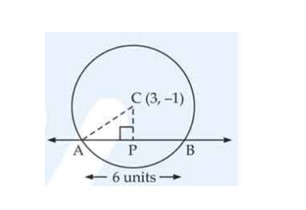
Given  that:        Centre  of  the  circle=(3,−1)Length  of  chord  AB=6 units      CP=|2×3−5×1+18(2)2+(−5)2|              =|6+5+1829|=29Now  AB=6 units.∴  AP=12AB=12×6=3 unitsIn  ΔCPA,  AC2=CP2+AP2                                 =(29)2+(3)2=29+9=38∴    AC=38So,  the  radius  of  the  circle,  r=38∴  Equation  of  the  circle  is                    (x−3)2+(y+1)2=(38)2⇒               (x−3)2+(y+1)2=38⇒x2+9−6x+y2+1+2y=38⇒               x2+y2−6x+2y=28Hence,  the  required  equation  is   x2+y2−6x+2y=28.

Q:  

Find the equation of a circle of radius 5 which is touching another circle x2+y2−2x−4y−20=0 at (5, 5).

A: 

This is a Long Answer Type Questions as classified in NCERT Exemplar

Sol:


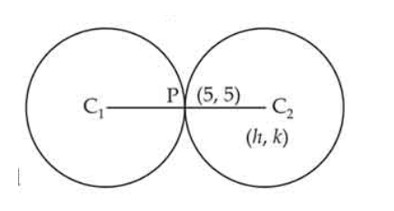
Given  circle  is=(3,−1)x2+y2−2x−4y−20=0             2g=−2       ⇒g=−1            2f=−4       ⇒f=−2∴  Centre  C1=(1,2)and  radius  r=g2+f2−c                             =1+4+20=5Let  the  centre  of  the  required  circle  be  (h,k).Clearly,  P  is  the  mid  of  C1C2∴        5=1+h2    ⇒h=9and  5=2+k2    ⇒k=8Radius  of  the  required  circle=5∴  Equation  of  the  circle  is                               (x−9)2+(y−8)2=(5)2⇒    x2+81−18x+y2+64−16y=25⇒x2+y2−18x−16y+145−25=0⇒           x2+y2−18x−16y+120=0Hence,  the  required  equation  is   x2+y2−18x−16y+120=0.

Q:  

Find the equation of a circle passing through the point (7, 3), having a radius of 3 units, and whose center lies on the line y=x−1 .

Read more
A: 

This is a Long Answer Type Questions as classified in NCERT Exemplar

Sol:

Let  the  equation  of  the  circle  be                      (x−h)2+(y−k)2=r2If  it  passes  through  (7,3)  then                        (7−h)2+(3−k)2=(3)2             [?r=3]⇒49+h2−14h+9+k2−6k=9⇒         h2+k2−14h−6k+49=0                                        …(i)If  centre  (h,k)  lies  on  the  line  y=x−1  then               k=h−1                                                                              …(ii)Putting  the  value  of  k  in  eqn.(i)  we  get              h2+(h−1)2−14h−6(h−1)+49=0⇒       h2+h2+1−2h−14h−6h+6+49=0⇒                                                 2h2−22h+56=0⇒                                             2(h2−11h+28)=0⇒                                                     h2−11h+28=0⇒                                             h2−7h−4h+28=0⇒                                         h(h−7)−4(h−7)=0⇒       (h−7)(h−4)=0     ⇒h=7,4From  eqn.(ii)  we  get  k=4−1=3  and  k=7−1=6.So,  the  centres  are  (4,3)  and  (7,6).Equation  of  the  circle  isTaking  centre  (4,3)                     (x−4)2+(y−3)2=9⇒x2+16−8x+y2+9−6y=9⇒         x2+y2−8x−6y+16=0Taking  centre  (7,6)                             (x−7)2+(y−6)2=9⇒x2+49−14x+y2+36−12y=9⇒            x2+y2−14x−12y+76=0Hence,  the  required  equations  are                x2+y2−8x−6y+16=0and   x2+y2−14x−12y+76=0

Q:  

Find the equation of each of the following parabolas:

Directrix x=0 , focus at (6, 0).

Vertex at (0, 4), focus at (0, 2).

Focus at (-1,-2), directrix x−2y+3=0 .

Read more
A: 

This is a Long Answer Type Questions as classified in NCERT Exemplar

Sol:


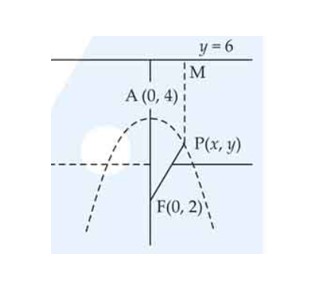
(i)Given  that  directrix=0  and  focus  (6,0)∴  The  equation  of  the  parabola  is                     (x−6)2+y2=x2⇒     x2+36−12x+y2=x2⇒               y2−12x+36=0      Hence,  the  required  equation  is  y2−12x+36=0(ii)Given  that  vertex  at(0,4)  and  focus  at  (0,2).        So,  equation  of  directrix  is  y−6=0        According  to  the  definition  of  the  parabola         PF=PM         (x−0)2+(y−2)2=|y−6|⇒x2+y2+4−4y=|y−6|       Squaring  both  sides,  we  get         x2+y2+4−4y=y2+36−12y⇒              x2+4−4y=36−12y⇒            x2+8y−32=0⇒            x2=32−8y      Hence,  the  required  equation  is  x2=32−8y(iii)Given  that  focus  at  (−1,−2)  and  directrix  x−2y+3=0         Let  (x,y)  be  any    on  the  parabola.        According  to  the  definition  of  the  parabola         PF=PM                   (x+1)2+(y+2)2=|x−2y+3(1)2+(−2)2|⇒  x2+1+2x+y2+4+4y=|x−2y+35|       Squaring  both  sides,  we  get                  x2+1+2x+y2+4+4y=x2+4y2+9−4xy−12y+6x5⇒5x2+5+10x+5y2+20+20y=x2+4y2+9−4xy−12y+6x⇒4x2+y2+4xy+4x+32y+16=0      Hence,  the  required  equation  is  4x2+y2+4xy+4x+32y+16=0.

Q:  

Find the equation of the set of all points the sum of whose distances from the points (3, 0) and (9, 0) is 12.

Read more
A: 

This is a Long Answer Type Questions as classified in NCERT Exemplar

Sol:

Let  (x,y)  be  any  Given    are  (3,0)  and  (9,0)According  to  the  question,  we  have(x−3)2+(y−0)2+(x−9)2+(y−0)2=12⇒x2+9−6x+y2+x2+81−18x+y2=12Putting  x2+9−6x+y2=k⇒     k+72−12x+k=12⇒                 72−12x+k=12−kSquaring  both  sides,  we  have⇒          72−12x+k=144+k−24k⇒                       24k=144−72+12x⇒                       24k=72+12x⇒                          2k=6+xAgain  squaring  both  sides,  we  get⇒                              4k=36+x2+12xPutting  the  value  of  k,  we  have         4(x2+9−6x+y2)=36+x2+12x⇒4x2+36−24x+4y2=36+x2+12x⇒            3x2+4y2−36x=0Hence,  the  required  equation  is  3x2+4y2−36x=0.

Q:  

 Find the equation of the set of all points whose distance from (0, 4) equals their distance from the line y=9

Read more
A: 

This is a Long Answer Type Questions as classified in NCERT Exemplar

Sol:

Let  (x,y)  be  any  According  to  the  question,  we  have         (x−0)2+(y−4)2=23|y−91|Squaring  both  sides,  we  have⇒                     x2+(y−4)2=49(y2+81−18y)⇒               9x2+9(y−4)2=4y2+324−72y⇒9x2+9y2+144−72y=4y2+324−72y⇒   9x2+5y2+144−324=0⇒                9x2+5y2−180=0Hence,  the  required  equation  is  9x2+5y2−180=0.

Q:  

 Show that the set of all points such that the difference of their distances from (4, 0) and (-4, 0) is always equal to 2 represents a hyperbola.

Read more
A: 

This is a Long Answer Type Questions as classified in NCERT Exemplar

Sol:

Let  (x,y)  be  anypoint  According  to  the  question,  we  have(x−4)2+(y−0)2−(x+4)2+(y−0)2=2⇒x2+16−8x+y2−x2+16+8x+y2=2Putting  x2+y2+16=z                                                        …(i)⇒     z−8x−z+8x=2Squaring  both  sides,  we  have⇒     z−8x+z+8x−2(z−8x)(z+8x)=4⇒                                          2z−2z2−64x2=4⇒                                                z−z2−64x2=2⇒                                                                  (z−2)=z2−64x2Again  squaring  both  sides,  we  get⇒        z2+4−4z=z2−64x2⇒  4−4z+64x2=0Putting  the  value  of  z,  we  have⇒      4−4(x2+y2+16)+64x2=0⇒       4−4x2−4y2−64+64x2=0⇒                            60x2−4y2−60=0⇒                                      60x2−4y2=60⇒                                     60x260−4y260=1⇒                                            x21−y215=1Which  represent  a  hperbola.  Hence  proved.

Q:  

Find the equation of the hyperbola with:

Vertices (±5,0) , foci (±7,0) .

Vertices (0,±7) , eccentricity e=2 .

Foci (0,±10) , passing through (2, 3).

Read more
A: 

This is a Long Answer Type Questions as classified in NCERT Exemplar

Sol:

(i)Given  that  vertices  (±5,0),  foci(±7,0)      Vertex  of  hyperbola=(±a,0)  and  foci(±ae,0)∴   a=5  and  ae=7    ⇒5×e=7    ⇒e=75    Now  b2=a2(e2−1)⇒     b2=25(4925−1)    ⇒b2=25×2425    ⇒b2=24    The  equation  of  the  hyperbola  is              x225−y224=1(ii)Given  that  vertices  (0,±7),  e=43        Clearly,  the  hyperbola  is  vertical.∴      a=5  and  e=43         We  know  that  b2=a2(e2−1)⇒     b2=49(169−1)    ⇒b2=49×79    ⇒b2=3439         The  equation  of  the  hyperbola  is              y249−9x2343=1          ⇒9x2−7y2+343=0(iii)Given  that:         foci(0,±10)         ∴  ae=10      ⇒a2e2=10         We  know  that  b2=a2(e2−1)⇒    b2=a2e2−a2      ⇒b2=10−a2        Equation  of  the  hyperbola  is                y2a2−x2b2=1      ⇒y2a2−x210−a2=1       If  it  passes  through  the    (2,3)  then⇒9a2−410−a2=1       ⇒90−9a2−4a2a2(10−a2)=1⇒        90−13a2=10a2−a4     ⇒a4−23a2+90=0⇒           a4−18a2−5a2+90=0⇒a2(a2−18)−5(a2−18)=0⇒                (a2−18)(a2−5)=0⇒                       a2=18,a2=5∴      b2=10−18=−8  and  b2=10−5=5∴        b≠−8  and  b2=5Hence,  the  required  equation  is  y25−x25=1  or  y2−x2=5.

Maths NCERT Exemplar Solutions Class 11th Chapter Eleven Logo

Conic Section True or False Type Questions

1. The line x + 3 y = 0  is a diameter of the circle  x 2 + y 2 + 6 x + 2 y = 0  . True or False?

Sol:

G i v e n     e q u a t i o n     o f     t h e     c i r c l e     i s                       x 2 + y 2 + 6 x + 2 y = 0 C e n t r e     i s     ( − 3 , − 1 ) I f     x + 3 y = 0     i s     t h e     e q u a t i o n     o f     d i a m e t e r ,     t h e n     t h e     c e n t r e     ( − 3 , − 1 )     w i l l     l i e     o n     x + 3 y = 0           − 3 + 3 ( − 1 ) = 0 ⇒                                   − 6 ≠ 0 S o ,     x + 3 y = 0     i s     n o t     t h e     d i a m e t e r     o f     t h e     c i r c l e . H e n c e ,     t h e     g i v e n     s t a t e m e n t     i s     F a l s e .

2. The shortest distance from the point (2, -7) to the circle x 2 + y 2 − 1 4 x − 1 0 y − 1 5 1 = 0  is equal to 5.

[Hint: The shortest distance is equal to the difference of the radius and the distance between the center and the given point.]

Sol:

G i v e n     e q u a t i o n     o f     t h e     c i r c l e     i s     x 2 + y 2 − 1 4 x − 1 0 y − 1 5 1 = 0 S h o r t e s t    distance =distance     b e t w e e n     t h e     ( 2 , − 7 ) a n d     t h e     c e n t r e − r a d i u s     o f     t h e     c i r c l e C e n t r e     o f     t h e     g i v e n     c i r c l e     i s                         2 g = − 1 4           ⇒ g = − 7                       2 f = − 1 0           ⇒ f = − 5 ∴ C e n t r e = ( − g , − f ) = ( 7 , 5 ) a n d                   r = ( − 7 ) 2 + ( − 5 ) 2 + 1 5 1 = 4 9 + 2 5 + 1 5 1                                           = 2 2 5 = 1 5 ∴     S h o r t e s t     = ( 7 − 2 ) 2 + ( 5 + 7 ) 2 − 1 5                                                                                     = 2 5 + 1 4 4 − 1 5 = 1 3 − 1 5 = | − 2 | = 2 H e n c e ,     t h e     g i v e n     s t a t e m e n t     i s     F a l s e .

Q&A Icon
Commonly asked questions
Q:  

The line x+3y=0 is a diameter of the circle x2+y2+6x+2y=0 . True or False?

A: 

This is a true and false Type Questions as classified in NCERT Exemplar

Sol:

Given  equation  of  the  circle  is           x2+y2+6x+2y=0Centre  is  (−3,−1)If  x+3y=0  is  the  equation  of  diameter,  then  the  centre  (−3,−1)  will  lie  on  x+3y=0     −3+3(−1)=0⇒                 −6≠0So,  x+3y=0  is  not  the  diameter  of  the  circle.Hence,  the  given  statement  is  False.

Q:  

The shortest distance from the point (2, -7) to the circle x2+y2−14x−10y−151=0 is equal to 5.

[Hint: The shortest distance is equal to the difference of the radius and the distance between the center and the given point.]

Read more
A: 

This is a true and false Type Questions as classified in NCERT Exemplar

Sol:

Given  equation  of  the  circle  is  x2+y2−14x−10y−151=0Shortest  distance=distance  between  the  (2,−7)and  the  centre−radius  of  the  circleCentre  of  the  given  circle  is            2g=−14     ⇒g=−7           2f=−10     ⇒f=−5∴Centre=(−g,−f)=(7,5)and         r=(−7)2+(−5)2+151=49+25+151                     =225=15∴  Shortest  =(7−2)2+(5+7)2−15                                          =25+144−15=13−15=|−2|=2Hence,  the  given  statement  is  False.

Q:  

If the line lx+my=1 is a tangent to the circle x2+y2=a2 , then the point (l, m) lies on a circle. True or False?

Read more
A: 

This is a true and false Type Questions as classified in NCERT Exemplar

Sol:

Given  equation  of  the  circle  is  x2+y2=a2and  the  tangent   is  lx+my=1Here  centre  is  (0,0)  and  radius=aIf  (l,m)  lies  on  the  circle∴  (l−0)2+(m−0)2=a⇒                      l2+m2=a       ⇒l2+m2=a2        (which  is  a  circle)So,  the    (l,m)  lies  on  the  circle.Hence,  the  given  statement  is  True.

Q:  

The point (1, 2) lies inside the circle x2+y2−2x+6y+1=0 . True or False?

A: 

This is a True and False Type Questions as classified in NCERT Exemplar

Sol:

Given  equation  of  the  circle  is  x2+y2−2x+6y+1=0Here,      2g=−2    ⇒g=−1                 2f=6       ⇒f=3∴  Centre=(−g,−f)=(1,−3)and  radius  r=g2+f2−c=1+9−1=3∴    Distance between  the point   (1,2)  and  the  centre  (1,−3)                            =(1−1)2+(2+3)2=5Here,  5>3,  so  the point    lies  outside  the  circle.Hence,  the  given  statement  is  False.

Q:  

 The line lx+my+n=0 will touch the parabola y2=4ax if ln=am2 . True or False?

A: 

This is a True and False Type Questions as classified in NCERT Exemplar

Sol:

Given  equation  of  parabola  is  y2=4ax                                   …(i)and  the  equation  of  line  is  lx+my+n=0                               …(ii)From  eqn.(ii),  we  have                y=−lx−nmPutting  the  value  of  y  in  eqn.(i)  we  get                                   (−lx−nm)2=4ax⇒l2x2+n2+2lnx−4am2x=0⇒l2x2+(2ln−4am2)x+n2=0If  the  line  is  tangent the   to  the  circle,  then                                b2−4ac=0⇒                           (2ln−4am2)2−4l2n2=0⇒4l2n2+16a2m4−16lnm2a−4l2n2=0⇒                                  16a2m4−16lnm2a=0⇒                                     16am2(am2−ln)=0⇒                                          am2(am2−ln)=0⇒     am2≠0      ∴am2−ln=0⇒          ln=am2Hence,  the  given  statement  is  True.

Q:  

 If P is a point on the ellipse x216+y225=1 , whose foci are S and S′ , then PS+PS′=8

Read more
A: 

This is a True and False Type Questions as classified in NCERT Exemplar

Sol:

Let  P(x1,y1)  be  apoint on   on  the  ellipse.foci=(±ae,0)Here,         a2=25      ⇒a=5                     b2=16      ⇒b=4                     b2=a2(1−e2)                     16=25(1−e2)⇒                1625=1−e2      ⇒e2=1−1625      ⇒e2=925∴            e=35∴          ae=5×35=3So,  the  foci  are  S(3,0)  and  S'(−3,0).  Since PS+PS'=2a=2×5=10.Hence,  the  given  statement  is  False.

Q:  

The line 2x+3y=12 touches the ellipse x29+y24=1 at the point (3, 2). True or False?

A: 

This is a True and False Type Questions as classified in NCERT Exemplar

Sol:

If  line  2x+3y=12  touches  the  ellipse   x29+y24=2,then  the  point (3,2)  satisfies  both  the  line  and  ellipse.∴  For  line  2x+3y=12                 2(3)+3(2)=12       ⇒6+6=12    ⇒12=12  TrueFor  ellipse  x29+y24=2⇒               (3)29+(2)24=2       ⇒99+44=2    ⇒1+1=2    ⇒2=2  TrueHence,  the  given  statement  is  True.

Q:  

The locus of the point of intersection of lines 3x−y−43k=0 and 3kx+ky−43=0 for different values of k is a hyperbola whose eccentricity is 2.

[Hint: Eliminate k between the given equations.]

Read more
A: 

This is a True and False Type Questions as classified in NCERT Exemplar

Sol:

The  given  equations  are          3x−y−43k=0                                   …(i)and  3kx+ky−43=0                                  …(ii)From  eqn.(i)  we  get              43k=3x−y∴                    k=3x−y43Putting  the  value  of  k  in  eqn.(ii),  we  get          3[3x−y43]x+[3x−y43]y−43=0⇒           (3x−y4)x+(3x−y43)y−43=0⇒               (3x−3y)x+(3x−y)y−4843=0⇒                       3x2−3xy+3xy−y2−48=0⇒                                                                 3x2−y2=48⇒              x216−y248=1       (which  is  a  hyperbola)Here  a2=16,  b2=48We  know  that  b2=a2(e2−1)⇒                          48=16(e2−1)⇒                             3=e2−1        ⇒e2=4     ⇒e=2Hence,  the  given  statement  is  True.

Maths NCERT Exemplar Solutions Class 11th Chapter Eleven Logo

Conic Section Fill in the Blanks Type Questions

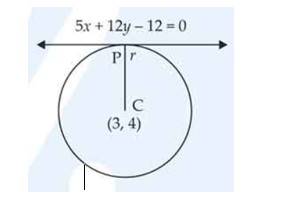
1. The equation of the circle having its center at (3,-4) and touching the line 5 x + 1 2 y − 1 2 = 0  is ______.

[Hint: To determine the radius, find the perpendicular distance from the center of the circle to the line.]

Sol:


G i v e n     e q u a t i o n     o f     t h e     l i n e     i s     5 x + 1 2 y − 1 2 = 0     a n d     t h e     c e n t r e     i s     ( 3 , − 4 ) C P = r a d i u s     o f     t h e     c i r c l e             | 5 × 3 + 1 2 × ( − 4 ) − 1 2 ( 5 ) 2 + ( 1 2 ) 2 | = r ⇒                                   | 1 5 − 4 8 − 1 2 1 3 | = r ⇒                                                                     | − 4 5 1 3 | = r                 ⇒ r 2 = 2 0 2 5 1 6 9 S o ,     t h e     e q u a t i o n     o f     t h e     c i r c l e     i s     ( x − 3 ) 2 + ( y + 4 ) 2 = ( 4 5 1 3 ) 2 H e n c e ,     t h e     v a l u e     o f     t h e     f i l l e r     i s     ( x − 3 ) 2 + ( y + 4 ) 2 = ( 4 5 1 3 ) 2 .

2. The equation of the circle circumscribing the triangle whose sides are the lines y = x + 2  ,  3 y = 4 x  , and  2 y = 3 x  is ______.

Sol:

L e t     A B     r e p r e s e n t s     2 y = 3 x                                                                               … ( i )                   B C     r e p r e s e n t s     3 y = 4 x                                                                             … ( i i ) a n d       A C     r e p r e s e n t s     y = x + 2                                                                   … ( i i i ) F r o m     e q n . ( i )     a n d   ( i i )                 2 y = 3 x                   ⇒ y = 3 x 2 P u t t i n g     t h e     v a l u e     o f     y     i n     e q n . ( i i )     w e     g e t             3 ( 3 x 2 ) = 4 x         ⇒ 9 x = 8 x ⇒                       x = 0     a n d     y = 0 ∴     C o o r d i n a t e s     o f     B ( 0 , 0 ) F r o m     e q n . ( i )     a n d   ( i i i )     w e     g e t                             y = x + 2 P u t t i n g     y = x + 2     i n     e q n . ( i )     w e     g e t                     2 ( x + 2 ) = 3 x ⇒                   2 x + 4 = 3 x         ⇒ x = 4     a n d     y = 6 ∴     C o o r d i n a t e s     o f     A ( 4 , 6 ) S o l v i n g     e q n . ( i i )     a n d   ( i i i )     w e     g e t                           y = x + 2 P u t t i n g     t h e     v a l u e     o f     y     i n     e q n . ( i i )     w e     g e t                         3 ( x + 2 ) = 4 x               ⇒ 3 x + 6 = 4 x           ⇒ x = 6     a n d     y = 8 ∴     C o o r d i n a t e s     o f     C ( 6 , 8 ) I t     i m p l i e s     t h a t     t h e     c i r c l e     i s         t h r o u g h     ( 0 , 0 ) , ( 4 , 6 )     a n d     ( 6 , 8 ) . W e     k n o w     t h a t     t h e     g e n e r a l     e q u a t i o n     o f     t h e     c i r c l e     i s                                           x 2 + y 2 + 2 g x + 2 f y + c = 0                                                                                   … ( i v )    Since t h e    points     ( 0 , 0 ) , ( 4 , 6 )     a n d     ( 6 , 8 )     l i e     o n     t h e     c i r c l e     t h e n                                           0 + 0 + 0 + 0 + c = 0                 ⇒ c = 0               1 6 + 3 6 + 8 g + 1 2 f + c = 0                 ⇒ 8 g + 1 2 f + 0 = − 5 2 ⇒                                                               2 g + 3 f = − 1 3                                                                                                           … ( v )           3 6 + 6 4 + 1 2 g + 1 6 f + c = 0                 ⇒ 1 2 g + 1 6 f + 0 = − 1 0 0 ⇒                                                                 3 g + 4 f = − 2 5                                                                                                           … ( v i ) S o l v i n g     e q n . ( v )     a n d   ( v i )     w e     g e t                                       2 g + 3 f = − 1 3                   ⇒             6 g     +     9 f = − 3 9                                       3 g + 4 f = − 2 5                   ⇒             6 g     +     8 f = − 5 0                                                                                                                               ( − )             ( − )                 ( + )                   _                                                                                                                                                                         f = 1 1 P u t t i n g     t h e     v a l u e     o f     f     i n     e q n . ( v )     w e     g e t                                     2 g + 3 × 1 1 = − 1 3                   ⇒ 2 g + 3 3 = − 1 3 ⇒                                                           2 g = − 4 6                   ⇒ g = − 2 3 P u t t i n g     t h e     v a l u e     o f     g , f     a n d     c     i n     e q n . ( i v )     w e     g e t                                 x 2 + y 2 + 2 ( − 2 3 ) x + 2 ( 1 1 ) y + 0 = 0 ⇒                                                                       x 2 + y 2 − 4 6 x + 2 2 y = 0 H e n c e ,     t h e     v a l u e     o f     f i l l e r     i s     x 2 + y 2 − 4 6 x + 2 2 y = 0 .

Q&A Icon
Commonly asked questions
Q:  

The equation of the circle having its center at (3,-4) and touching the line 5x+12y−12=0 is ______.

[Hint: To determine the radius, find the perpendicular distance from the center of the circle to the line.]

Read more
A: 

This is a Fill in the Blanks Type Questions as classified in NCERT Exemplar

Sol:

Given  equation  of  the  line  is  5x+12y−12=0  and  the  centre  is  (3,−4)CP=radius  of  the  circle      |5×3+12×(−4)−12(5)2+(12)2|=r⇒                 |15−48−1213|=r⇒                                  |−4513|=r        ⇒r2=2025169So,  the  equation  of  the  circle  is  (x−3)2+(y+4)2=(4513)2Hence,  the  value  of  the  filler  is  (x−3)2+(y+4)2=(4513)2.
Q:  

The equation of the circle circumscribing the triangle whose sides are the lines y=x+2 , 3y=4x , and 2y=3x is ______.

Read more
A: 

This is a Fill in the Blanks Type Questions as classified in NCERT Exemplar

Sol:

Let  AB  represents  2y=3x                                       …(i)         BC  represents  3y=4x                                      …(ii)and   AC  represents  y=x+2                                 …(iii)From  eqn.(i)  and (ii)        2y=3x         ⇒y=3x2Putting  the  value  of  y  in  eqn.(ii)  we  get      3(3x2)=4x    ⇒9x=8x⇒           x=0  and  y=0∴  Coordinates  of  B(0,0)From  eqn.(i)  and (iii)  we  get              y=x+2Putting  y=x+2  in  eqn.(i)  we  get          2(x+2)=3x⇒         2x+4=3x    ⇒x=4  and  y=6∴  Coordinates  of  A(4,6)Solving  eqn.(ii)  and (iii)  we  get             y=x+2Putting  the  value  of  y  in  eqn.(ii)  we  get            3(x+2)=4x       ⇒3x+6=4x     ⇒x=6  and  y=8∴  Coordinates  of  C(6,8)It  implies  that  the  circle  is    through  (0,0),(4,6)  and  (6,8).We  know  that  the  general  equation  of  the  circle  is                     x2+y2+2gx+2fy+c=0                                         …(iv)  Since the  points  (0,0),(4,6)  and  (6,8)  lie  on  the  circle  then                     0+0+0+0+c=0        ⇒c=0       16+36+8g+12f+c=0        ⇒8g+12f+0=−52⇒                   &th

Q:  

An ellipse is described by using an endless string that passes over two pins. If the axes are 6 cm and 4 cm, the length of the string and the distance between the pins are ______.

Read more
A: 

This is a Fill in the Blanks Type Questions as classified in NCERT Exemplar

Sol:


Let  the  equation  of  an  ellipse  is   x2a2+y2b2=1Here,  2a=6    ⇒a=3and      2b=4    ⇒b=2We  know  that  c2=a2−b2                                     =(3)2−(2)2=9−4=5∴                               c=5,  we  have  e=ca     ⇒e=53Length  of  string=2a+2ae=2a(1+e)                                      =6(1+53)=6(3+5)3=6+25 Distance between  the  pins=CC'=2ae=2×3×53=25Hence,  the  value  of  filler  are  6+25 cm  and  25 cm.

Q:  

The equation of the ellipse having foci (0, 1), (0, –1), and a minor axis of length 1 is ______.

A: 

This is a Fill in the Blanks Type Questions as classified in NCERT Exemplar

Sol:

We  know  that  the  foci  of  the  ellipse  are  (0,±ae)  and  given  foci  are  (0,±1),  so  ae=1Length  of  minor  axis=2b=1    ⇒b=12We  know  that  b2=a2(1−e2)                         (12)2=a2−a2e2⇒                            14=a2−1      ⇒a2=1+14=54∴Equation  of  an  ellipse  is   x2b2+y2a2=1⇒                              x21/4+y25/4=1⇒                              4x21+4y25=1Hence,  the  value  of  filler  is  4x21+4y25=1.

Q:  

The equation of the parabola having focus at (–1, –2) and the directrix x−2y+3=0 is ______.

A: 

This is a Fill in the Blanks Type Questions as classified in NCERT Exemplar

Sol:

Let  (x1,y1)  be  any  point  on  the  parabola.According  to  the  definition  of  the  parabola      (x1+1)2+(y1+2)2=|x1−2y1+3(1)2+(−2)2|Squaring  both  sides,  we  get           x12+1+2x1+y12+4+4y1=x12+4y12+9−4x1y1−12y1+6x15⇒              x12+y12+2x1+4y1+5=x12+4y12−4x1y1−12y1+6x1+95⇒5x12+5y12+10x1+20y1+25=x12+4y12−4x1y1−12y1+6x1+9⇒4x12+y12+4x1+32y1+4x1y1+16=0Hence,  the  value  of  the  filler  is  4x2+4xy+y2+4x+32y+16=0.

Q:  

The equation of the hyperbola with vertices at (0,±6) , eccentricity 53 , and foci at (0,±10) is ______

Read more
A: 

This is a Fill in the Blanks Type Questions as classified in NCERT Exemplar

Sol:

Let  equation  of  the  hyperbola  is   −x2a2+y2b2=1Vertices  are  (0,±b)  ∴  b=6  and  e=53We  know  that  e=1+a2b2                             53=1+a236         ⇒259=1+a236⇒                     a236=259−1=169   ⇒a2=169×36⇒                      a2=64So,  the  equation  of  the  hyperbola  is               −x264+y236=1      ⇒y236−x264=1and  foci=(0,±be)=(0,±6×53)=(0,±10)Hence,  the  value  of  the  filler  is  y236−x264=1  and  (0,±10).

Maths NCERT Exemplar Solutions Class 11th Chapter Eleven Logo

Conic Section Objective Type Questions

1. The area of the circle centered at (1, 2) and passing through (4, 6) is

(a) 5 π

(b) 1 0 π

(c) 2 5 π

(d) None of these

Sol:

G i v e n     t h a t     t h e     c e n t r e     o f     t h e     c i r c l e     i s ( 1 , 2 ) R a d i u s     o f     t h e     c i r c l e = ( 4 − 1 ) 2 + ( 6 − 2 ) 2                                                                                           = 9 + 1 6 = 5 S o ,     t h e     a r e a     o f     c i r c l e = π r 2 = π ( 5 ) 2 = 2 5 π H e n c e ,     t h e     c o r r e c t     o p t i o n     i s     ( c ) .

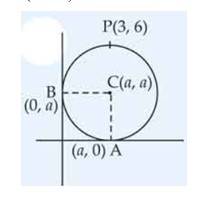
2. The equation of a circle that passes through (3, 6) and touches the axes is

(a) x 2 + y 2 + 6 x + 6 y + 3 = 0
(b) x 2 + y 2 − 6 x − 6 y − 9 = 0
(c) x 2 + y 2 − 6 x − 6 y + 9 = 0
(d)  None of these

Sol:


L e t     t h e     r e q u i r e d     c i r c l e     t o u c h     t h e     a x e s     a t     ( a , 0 )     a n d     ( 0 , a ) ∴     C e n t r e     i s     ( a , a )     a n d     r = a S o ,     t h e     e q u a t i o n     o f     t h e     c i r c l e     i s                                               ( x − a ) 2 + ( y − a ) 2 = a 2 I f     i t     p a s s e s     t h r o u g h     a      point   P ( 3 , 6 )     t h e n                                                 ( 3 − a ) 2 + ( 6 − a ) 2 = a 2 ⇒ 9 + a 2 − 6 a + 3 6 + a 2 − 1 2 a = a 2 ⇒                                                           a 2 − 1 8 a + 4 5 = 0 ⇒                                         a 2 − 1 5 a − 3 a + 4 5 = 0 ⇒                             a ( a − 1 5 ) − 3 ( a − 1 5 ) = 0 ⇒                                                       ( a − 3 ) ( a − 1 5 ) = 0 ⇒                     a = 3     a n d     a = 1 5     w h i c h     i s     n o t     p o s s i b l e ∴                     a = 3 S o ,     t h e     r e q u i r e d     e q u a t i o n     o f     t h e     c i r c l e     i s                                               ( x − 3 ) 2 + ( y − 3 ) 2 = 9 ⇒           x 2 + 9 − 6 x + y 2 + 9 − 6 y = 9 ⇒                           x 2 + y 2 − 6 x − 6 y + 9 = 0 H e n c e ,     t h e     c o r r e c t     o p t i o n     i s     ( c ) .

Q&A Icon
Commonly asked questions
Q:  

The area of the circle centered at (1, 2) and passing through (4, 6) is

(a) 5 π

(b) 1 0 π

(c) 2 5 π

(d) None of these

Read more
A: 

This is an objective Type Questions as classified in NCERT Exemplar

Sol:

Given  that  the  centre  of  the  circle  is(1,2)Radius  of  the  circle=(4−1)2+(6−2)2                                             =9+16=5So,  the  area  of  circle=πr2=π(5)2=25πHence,  the  correct  option  is  (c).

Q:  

The equation of a circle that passes through (3, 6) and touches the axes is

(a) x 2 + y 2 + 6 x + 6 y + 3 = 0
(b) x 2 + y 2 − 6 x − 6 y − 9 = 0
(c) x 2 + y 2 − 6 x − 6 y + 9 = 0
(d)  None of these

Read more
A: 

This is an objective Type Questions as classified in NCERT Exemplar

Sol:

Let  the  required  circle  touch  the  axes  at  (a,0)  and  (0,a)∴  Centre  is  (a,a)  and  r=aSo,  the  equation  of  the  circle  is                       (x−a)2+(y−a)2=a2If  it  passes  through  a   point P(3,6)  then                        (3−a)2+(6−a)2=a2⇒9+a2−6a+36+a2−12a=a2⇒                             a2−18a+45=0⇒                    a2−15a−3a+45=0⇒              a(a−15)−3(a−15)=0⇒                           (a−3)(a−15)=0⇒          a=3  and  a=15  which  is  not  possible∴          a=3So,  the  required  equation  of  the  circle  is                       (x−3)2+(y−3)2=9⇒     x2+9−6x+y2+9−6y=9⇒             x2+y2−6x−6y+9=0Hence,  the  correct  option  is  (c).
Q:  

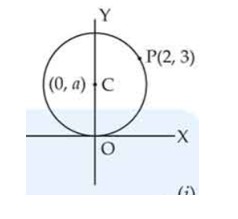
The equation of the circle with its center on the y-axis and passing through the origin and the point (2, 3) is

(a) x 2 + y 2 + 1 3 y = 0
(b) x 2 + y 2 + 1 3 x + 3 = 0
(c) x 2 + y 2 − 1 3 y = 0
(d) None of these


Read more
A: 

This is an objective Type Questions as classified in NCERT Exemplar

Sol:


Let  the  equation  of  the  circle  be                       (x−h)2+(y−k)2=r2Let  the  centre  be  (0,a)  and  r=aSo,  the  equation  of  the  circle  is            (x−0)2+(y−a)2=a2⇒                  x2+(y−a)2=a2⇒      x2+y2+a2−2ay=a2⇒                x2+y2−2ay=0                                       …(i)Now  CP=r⇒   (2−0)2+(3−a)2=a⇒          4+9+a2−6a=a⇒                13+a2−6a=a⇒                    13+a2−6a=a2⇒                              13−6a=0⇒          a=136Putting  the  value  of  a  in  eqn.(i)  we  get⇒             x2+y2−2(136)y=0⇒                  3x2+3y2−13y=0Hence,  the  correct  option  is  (a).

Q:  

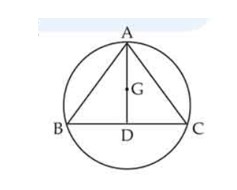
The equation of a circle with the origin as the center and passing through the vertices of an equilateral triangle whose median is of length 3a is

(a) (a) x 2 + y 2 = 9 a 2
(b) x 2 + y 2 = 9 a 2
(c) x 2 + y 2 = 4 a 2
(d) x 2 + y 2 = a 2

[Hint: The centroid of the triangle coincides with the center of the circle, and the radius is 23 of the median.]

Read more
A: 

This is an objective Type Questions as classified in NCERT Exemplar

Sol:


Let  ABC  be  an  equilateral  triangle  in  which  median  AD=3a.Centre  of  the  circle  is  same  as  the  centroid  of  the  triangle  i.e.,  (0,0)          AG:GD=2:1So,      AG=23AD=23×3a=2a∴  The  equation  of  the  circle  is          (x−0)2+(y−0)2=(2a)2⇒                           x2+y2=4a2Hence,  the  correct  option  is  (c).

Q:  

If the focus of a parabola is (0, -3) and its directrix is y=3 , then its equation is

(a) x 2 = − 1 2 y
(b) x 2 = 1 2 y
(c) y 2 = − 1 2 x
(d) y 2 = 1 2 x

Read more
A: 

This is an objective Type Questions as classified in NCERT Exemplar

Sol:

According  to  the  definition  of  parabola       (x−0)2+(y+3)2=|y−3(0)2+(1)2|⇒      x2+y2+9+6y=|y−3|Squaring  both  sides,  we  have               x2+y2+9+6y=y2+9−6y⇒                    x2+9+6y=9−6y⇒                                      x2=−12yHence,  the  correct  option  is  (a).

Q:  

If the parabola y2=4ax passes through the point (3, 2), then the length of its latus rectum is

(a) 2 3
(b) 2
(c) 4
(d) None of these


Read more
A: 

This is an objective Type Questions as classified in NCERT Exemplar

Sol:

Given  parabola  is  y2=4axIf  the  parabola  is   passing 
through  (3,2)then              (2)2=4a×3⇒                        4=12a      ⇒a=13Now  length  of  the  latusrectum=4a=4×13=43Hence,  the  correct  option  is  (b).

Q:  

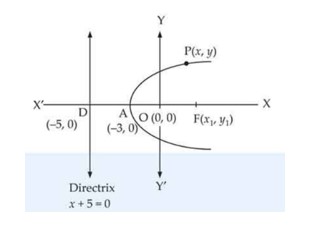
 If the vertex of the parabola is at the point (–3, 0) and the directrix is the line x+5=0 , then its equation is

(a) y 2 = − 8 ( x + 3 )
(b) x 2 = 8 ( y + 3 )
(c) y 2 = 8 ( x + 3 )
(d) y 2 = 8 ( x + 5 )

Read more
A: 

This is an objective Type Questions as classified in NCERT Exemplar

Sol:


Given  that vertex=(−3,0)∴  a=−3  and  directrix  is  x+5=0According  to  the  definition  of  the  parabola,  we  getAF=AD  i.e.,  A  is  the mid  point of  DF∴                    −3=x1−52         ⇒x1=−6+5=−1and                  0=0+y12         ⇒y1=0∴       Focus  F=(−1,0)Now  (x+1)2+(y−0)2=|x+512+02|Squaring  both  sides,  we  get               (x+1)2+(y−0)2=(x+5)2⇒               x2+1+2x+y2=x2+25+10x⇒                                         y2=10x−2x+24         ⇒y2=8x+24⇒                                         y2=8(x+3)Hence,  the  correct  option  is  (a).

Q:  

The equation of the ellipse whose focus is (1, –1), the directrix is the line x−y−3=0 , and the eccentricity is 12 is

(a) 7 x 2 + 2 x y + 7 y 2 − 1 0 x + 1 0 y + 7 = 0
(b) 7 x 2 + 2 x y + 7 y 2 + 7 = 0
(c) 7 x 2 + 2 x y + 7 y 2 + 1 0 x − 1 0 y − 7 = 0
(d) None of these

Read more
A: 

This is an objective Type Questions as classified in NCERT Exemplar

Sol:

Given  that  focus  of  the  ellipse  is(1,−1)  and  the  equation  of  the  directrix  is  x−y−3=0and  e=12.Let  P(x,y)  be  any   point on  the  parabola∴    PF  Distance of  the point   P  from  the  directrix=e⇒      (x−1)2+(y+1)2|x−y−3(1)2+(−1)2|=12⇒2x2+1−2x+y2+1+2y=|x−y−32|Squaring  both  sides,  we  have⇒  4(x2+y2−2x+2y+2)=x2+y2+9−2xy+6y−6x2⇒8x2+8y2−16x+16y+16=x2+y2+9−2xy+6y−6x⇒7x2+7y2+2xy−10x+10y+7=0Hence,  the  correct  option  is  (a).

Q:  

The length of the latus rectum of the ellipse 3x2+y2=12 is

(a) 4
(b) 3
(c) 8 3
(d) 4 3

A: 

This is an objective Type Questions as classified in NCERT Exemplar

Sol:

Equation  of  the  ellipse  is  3x2+y2=12⇒         x24+y212=1Here  a2=4     ⇒a=2             b2=12   ⇒b=23Length  of  the  latusrectum=2a2b=2×423=43Hence,  the  correct  option  is  (d).

Q:  

If e is the eccentricity of the ellipse x2a2+y2b2=1 (where a<b ), then

(a) b 2 = a 2 ( 1 − e 2 )
(b) a 2 = b 2 ( 1 − e 2 )
(c) b 2 = a 2 ( e 2 − 1 )
(d) a 2 = b 2 ( e 2 − 1 )

Read more
A: 

This is an objective Type Questions as classified in NCERT Exemplar

Sol:

Given  equation  is   x2a2+y2b2=1     (a<b)∴    Eccentricity  e=1−a2b2      ⇒e2=1−a2b2⇒         a2b2=(1−e2)      ⇒a2=b2(1−e2)Hence,  the  correct  option  is  (b).

Q:  

The eccentricity of the hyperbola whose latus rectum is 8 and conjugate axis is half the distance between the foci is

(a) 3 2
(b) 2
(c) 3 2
(d)
None of these

Read more
A: 

This is an objective Type Questions as classified in NCERT Exemplar

Sol:

Length  of  the  latusrectum  of  the  hyperbola                  =2b2a=8    ⇒b2=4a                                        …(i)  Distance between  the  foci=2ae                       Transverse  axis=2aand                Conjugate  axis=2b∴  12(2ae)=2b    ⇒ae=2b    ⇒b=ae2                        …(ii)⇒           b2=a2e24    ⇒4a=a2e24      [From  eqn.(i)]⇒           16=ae2      ∴a=16e2Now  b2=a2(e2−1)⇒      4a=a2(e2−1)⇒       4a=e2−1        ⇒416/e2=e2−1⇒     e24=e2−1        ⇒e2−e24=1      ⇒3e24=1⇒     e2=43    ∴e=23Hence,  the  correct  option  is  (c).

Q:  

The distance between the foci of a hyperbola is 16, and its eccentricity is 2. Its equation is

(a) x 2 − y 2 = 3 2
(b) x 2 4 − y 2 9 = 1
(c) 2 x − 3 y 2 = 7
(d)
None of these

Read more
A: 

This is an objective Type Questions as classified in NCERT Exemplar

Sol:

We  know  that   Distance 
between  the  foci=2ae∴                2ae=16    ⇒ae=8Given  that  e=2∴                2a=8    ⇒a=42Now             b2=a2(e2−1)⇒                  b2=32(2−1)     ⇒b2=32So,  the  equation  of  the  hyperbola  is            x2a2−y2b2=1    ⇒x232−y232=1    ⇒x2−y2=32Hence,  the  correct  option  is  (a).

Q:  

The equation of the hyperbola with eccentricity 2 and foci at (±2,0) is

(a) x 2 4 − y 2 4 = 1
(b) x 2 4 − y 2 5 = 1
(c) x 2 9 − y 2 4 = 1
(d)
None of these

Read more
A: 

This is an objective Type Questions as classified in NCERT Exemplar

Sol:

G i v e n     t h a t     e = 3 2 a n d                     f o c i = ( ± a e , 0 ) = ( ± 2 , 0 ) ∴                                         a e = 2         ⇒ a × 3 2 = 2           ⇒ a = 4 3 W e     k n o w     t h a t             b 2 = a 2 ( e 2 − 1 ) ⇒                                                               b 2 = 1 6 9 ( 9 4 − 1 )           ⇒ b 2 = 1 6 9 × 5 4 ⇒                                                               b 2 = 2 0 9 S o ,     t h e     e q u a t i o n     o f     t h e     h y p e r b o l a     i s                         x 2 ( 4 / 3 ) 2 − y 2 2 0 / 9 = 1         ⇒ 9 x 2 1 6 − 9 y 2 2 0 = 1         ⇒ x 2 1 6 − y 2 2 0 = 1 9 ⇒                                         x 2 4 − y 2 5 = 4 9 H e n c e ,     t h e     c o r r e c t     o p t i o n     i s     ( a ) .

Maths NCERT Exemplar Solutions Class 11th Chapter Eleven Logo

JEE_Mains_01 MT

JEE_Mains_01 MT

qna

Maths NCERT Exemplar Solutions Class 11th Chapter Eleven Exam

Student Forum

chatAnything you would want to ask experts?
Write here...