
Gravitation
Get insights from 92 questions on Gravitation, answered by students, alumni, and experts. You may also ask and answer any question you like about Gravitation
- 92
Questions
- 0
Discussions
- 0
Active Users
- 0
Followers
Have a question about Gravitation? Ask our experts
Keep it short & simple. Type complete word. Avoid abusive language.
8.24 A spaceship is stationed on Mars. How much energy must be expended on the spaceship to launch it out of the solar system? Mass of the space ship = 1000 kg; mass of the sun = 2×1030 kg; mass of mars = 6.4×10²³ kg; radius of mars = 3395 km; radius of the orbit of mars = 2.28 ×10⁸ km; G = 6.67×10⁻¹¹ N m2 kg–2.
8.24 A spaceship is stationed on Mars. How much energy must be expended on the spaceship to launch it out of the solar system? Mass of the space ship = 1000 kg; mass of the sun = 2×1030 kg; mass of mars = 6.4×10²³ kg; radius of mars = 3395 km; radius of the orbit of mars = 2.28 ×10⁸ km; G = 6.67×10⁻¹¹ N m2 kg–2.
Mass of the spaceship, = 1000 kg
Mass of the Sun, M = 2 × 1030 kg
Mass of Mars, = 6.4×10²³ kg
Orbital radius of Mars, R = 2.28 ×10⁸ km = 2.28 ×10¹¹ m
Radius of Mars, r = 3395 km = 3.395
Universal Gravitational constant, G = 6.67×10⁻¹¹ N m2 kg–2
Potential energy of the spaceship due
 Upvote

8.23 A star 2.5 times the mass of the sun and collapsed to a size of 12 km rotates with a speed of 1.2 rev. per second. (Extremely compact stars of this kind are known as neutron stars. Certain stellar objects called pulsars belong to this category). Will an object placed on its equator remain stuck to its surface due to gravity? (mass of the sun = 2×1030 kg).
8.23 A star 2.5 times the mass of the sun and collapsed to a size of 12 km rotates with a speed of 1.2 rev. per second. (Extremely compact stars of this kind are known as neutron stars. Certain stellar objects called pulsars belong to this category). Will an object placed on its equator remain stuck to its surface due to gravity? (mass of the sun = 2×1030 kg).
Yes, a body gets stuck to the surface of a star if the inward gravitational force is greater than the outward centrifugal force caused by the rotation of the star.
Gravitational force, = , where M = mass of the star = 2.5 = 5 kg
M = mass of the body, R = rad
Upvote 8.22 As you have learnt in the text, a geostationary satellite orbits the earth at a height of nearly 36,000 km from the surface of the earth. What is the potential due to earth’s gravity at the site of this satellite? (Take the potential energy at infinity to be zero). Mass of the earth = 6.0×1024 kg, radius = 6400 km.
8.22 As you have learnt in the text, a geostationary satellite orbits the earth at a height of nearly 36,000 km from the surface of the earth. What is the potential due to earth’s gravity at the site of this satellite? (Take the potential energy at infinity to be zero). Mass of the earth = 6.0×1024 kg, radius = 6400 km.
Mass of the Earth, M = 6.0 kg
Radius of the Earth, R = 6400 km = 6.4 m
Height of geostationary satellite from the surface of the Earth, h = 36000 km = 3.6 m
Gravitational potential energy due to Earth's gravity at height h:
=
= = = 9
Upvote 8.21 Two heavy spheres each of mass 100 kg and radius 0.10 m are placed 1.0 m apart on a horizontal table. What is the gravitational force and potential at the midpoint of the line joining the centers of the spheres? Is an object placed at that point in equilibrium? If so, is the equilibrium stable or unstable?
8.21 Two heavy spheres each of mass 100 kg and radius 0.10 m are placed 1.0 m apart on a horizontal table. What is the gravitational force and potential at the midpoint of the line joining the centers of the spheres? Is an object placed at that point in equilibrium? If so, is the equilibrium stable or unstable?
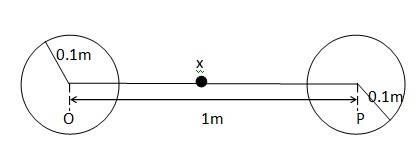
Mass of each sphere, M = 100 kg
Separation between the spheres, r = 1 m
X is the midpoint between the spheres.
Gravitational force at point x will be zero. This is because gravitational force exerted by each spheres will act in opposite directions.
Gravitational potential at point x:
= =
Upvote 8.20 Two stars each of one solar mass (= 2×1030 kg) are approaching each other for a head on collision. When they are a distance 109 km, their speeds are negligible. What is the speed with which they collide? The radius of each star is 104 km. Assume the stars to remain undistorted until they collide. (Use the known value of G).
8.20 Two stars each of one solar mass (= 2×1030 kg) are approaching each other for a head on collision. When they are a distance 109 km, their speeds are negligible. What is the speed with which they collide? The radius of each star is 104 km. Assume the stars to remain undistorted until they collide. (Use the known value of G).
Mass of each star, M = 2 × 1030 kg, Radius of each star, R = 104 km = m
Distance between stars, r = km = m
For negligible speed, v = 0
The total energy of two stars separated at a distance r
= = …….(i)
Now, consider the case when the stars are about to co
Upvote 8.19 A satellite orbits the earth at a height of 400 km above the surface. How much energy must be expended to rocket the satellite out of the earth’s gravitational influence? Mass of the satellite = 200 kg; mass of the earth = 6.0×1024 kg; radius of the earth = 6.4 × 10⁶ m; G = 6.67 × 10⁻¹¹ N m2 kg–2.
8.19 A satellite orbits the earth at a height of 400 km above the surface. How much energy must be expended to rocket the satellite out of the earth’s gravitational influence? Mass of the satellite = 200 kg; mass of the earth = 6.0×1024 kg; radius of the earth = 6.4 × 10⁶ m; G = 6.67 × 10⁻¹¹ N m2 kg–2.
Mass of the Earth, M = 6.0 × 1024 kg
Mass of the satellite, m = 200 kg
Radius of the Earth, = 6.4 ×10⁶ m
Universal gravitational constant, G = 6.67 × 10⁻¹¹ N m2 kg–2
Height of the satellite, h = 400 km = 0.4 m
Total energy of the satellite at height h = + ( )
Orbital
Upvote 8.18 The escape speed of a projectile on the earth’s surface is 11.2 km s–1. A body is projected out with thrice this speed. What is the speed of the body far away from the earth? Ignore the presence of the sun and other planets.
8.18 The escape speed of a projectile on the earth’s surface is 11.2 km s–1. A body is projected out with thrice this speed. What is the speed of the body far away from the earth? Ignore the presence of the sun and other planets.
Escape velocity of the projectile on the Earth’s surface, = 11.2 km/s = 11.2 m/s
Projection velocity of the projectile = 3
Mass of the projectile = m
Velocity of the projectile far away from the Earth =
Total energy of the projectile on the Earth = m &nb
Upvote 8.17 A rocket is fired vertically with a speed of 5 km s-1 from the earth’s surface. How far from the earth does the rocket go before returning to the earth? Mass of the earth = 6.0 × 1024 kg; mean radius of the earth = 6.4 × 10⁶ m; G = 6.67 × 10⁻¹¹ N m2 kg–2.
8.17 A rocket is fired vertically with a speed of 5 km s-1 from the earth’s surface. How far from the earth does the rocket go before returning to the earth? Mass of the earth = 6.0 × 1024 kg; mean radius of the earth = 6.4 × 10⁶ m; G = 6.67 × 10⁻¹¹ N m2 kg–2.
Velocity of the rocket, v = 5 km/s = 5 m/s
Mass of the Earth, = 6.0 × 1024 kg
Radius of the Earth, = 6.4 × 10⁶ m
Height reached by rocket mass, m = h
At the Earth’s surface
Total energy of the rocket = Kinetic energy + Potential energy = m + ( )
At h
Upvote 8.16 Assuming the earth to be a sphere of uniform mass density, how much would a body weigh half way down to the centre of the earth if it weighed 250 N on the surface?
8.16 Assuming the earth to be a sphere of uniform mass density, how much would a body weigh half way down to the centre of the earth if it weighed 250 N on the surface?
Weight of a body of mass m at Earth's surface, W = mg = 250 N
Body of mass m is located at depth, d = , where is radius of the Earth
Acceleration due to gravity at depth g (d) is given by : g' = (1 - )g = (1/2)g
Weight of the body at depth d
W' = mg' = (1/2) mg = (1/2)W
Upvote 8.15 A body weighs 63 N on the surface of the earth. What is the gravitational force on it due to the earth at a height equal to half the radius of the earth?
8.15 A body weighs 63 N on the surface of the earth. What is the gravitational force on it due to the earth at a height equal to half the radius of the earth?
Weight of the body, W = 63 N
Acceleration due to gravity at h from the Earth's surface is given by
g' = where g = acceleration due to gravity on the Earth's surface, = Radius of the Earth. h =
g' = = = (4/9)g
Weight of the body of mass m at a height h i
Upvote