
Physics Alternating Current
Get insights from 90 questions on Physics Alternating Current, answered by students, alumni, and experts. You may also ask and answer any question you like about Physics Alternating Current
- 90
Questions
- 0
Discussions
- 0
Active Users
- 5
Followers
Have a question about Physics Alternating Current? Ask our experts
Keep it short & simple. Type complete word. Avoid abusive language.
An electric bulb and a capacitor are connected in series with an AC source. On increasing the frequency of the source, the brightness of the bulb:
An electric bulb and a capacitor are connected in series with an AC source. On increasing the frequency of the source, the brightness of the bulb:
XC = 1/ ωC
On increasing w; XC decreases so Z decreases, current in circuit increases.
 Upvote

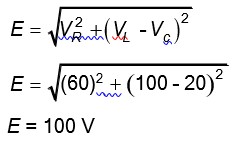
The value of alternating emf (E) in the given circuit will be
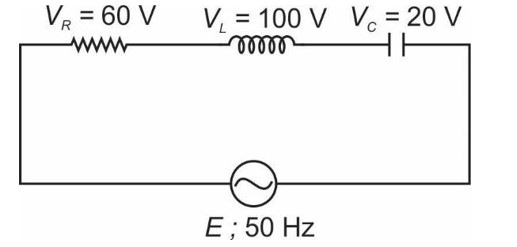
The value of alternating emf (E) in the given circuit will be
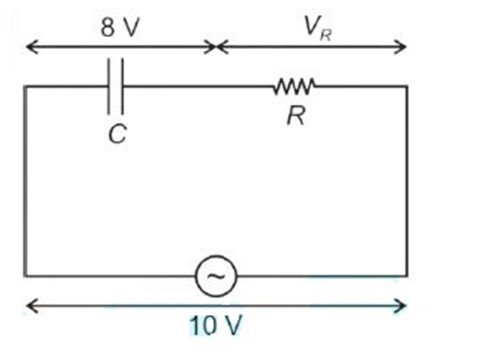
A capacitor is of capacity and reactance . If capacitance and frequency become triple then reactance will be
A capacitor is of capacity and reactance . If capacitance and frequency become triple then reactance will be
An alternating potential V=V0 sin wt is applied across a circuit. As a result the current I=I0 Sin flows in it. The power consumed in the circuit per cycle is
An alternating potential V=V0 sin wt is applied across a circuit. As a result the current I=I0 Sin flows in it. The power consumed in the circuit per cycle is
No power consumed without any resistance.
Upvote An electric bulb and a capacitor are connected in series with an AC source. On increasing the frequency of the source, the brightness of the bulb:
An electric bulb and a capacitor are connected in series with an AC source. On increasing the frequency of the source, the brightness of the bulb:
On increasing XC decreases so Z decreases, current in circuit increases.
Upvote The value of alternating emf (E) in the given circuit will be
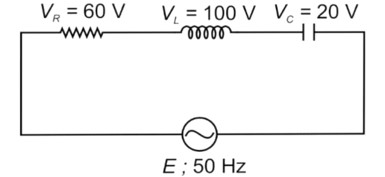
The value of alternating emf (E) in the given circuit will be
Related Tags
0 Followers
0 Followers
0 Followers
0 Followers
0 Followers
0 Followers
0 Followers
0 Followers
0 Followers
0 Followers
Find the peak current and resonant frequency of the following circuit (as shown in figure).

Find the peak current and resonant frequency of the following circuit (as shown in figure).