
Physics Spl
Get insights from 6.8k questions on Physics Spl, answered by students, alumni, and experts. You may also ask and answer any question you like about Physics Spl
- 6.8k
Questions
- 0
Discussions
- 9
Active Users
- 1.6k
Followers
Have a question about Physics Spl? Ask our experts
Keep it short & simple. Type complete word. Avoid abusive language.
What is a wave according to the 11th class physics and how is wave motion different from particle motion?
A disturbance that travels through the space or medium transferring energy without the net movement of particles is called a wave. Rather than moving along with the wave, the particles of the medium only oscillate about their mean position in a wave motion. The wave is fundamentally different as com
 Upvote

How many months of preparation are needed to cover IISER Physics syllabus?
I think 3 months for well preparations and ½ month i.e 15 days for complete revision and 1 month for mock papers and analysis are required to cover IISER Physics syllabus.
Upvote Why are real gases different from ideal gases, and how does kinetic theory address this?
The main difference between the real and ideal gases is with respect to the kinetic theory. The ideal gas follows assumptions of the kinetic theory but the real gases do not follow it, especially when the temperature is low and there is high pressure.
The following points are applicable in the case
Upvote What is the significance of the Maxwell-Boltzmann distribution law according to the kinetic theory of gases class 11?
According to the kinetic theory of gases class 11, the Maxwell-Boltzmann distribution law describes the gas molecules' distribution of speeds (or velocities). All molecules of gas do not move at the same speed, some move fast, some are slow and most move at an average speed. This law provides a math
Upvote How does the kinetic theory of gases class 11 explain pressure exerted by gases?
According to the NCERT Solutions for Class 11 Physics Chapter 12 Kinetic Theory, the pressure is exerted due to gas molecules' collisions with the walls of the container. Each gas molecule has a certain mass and velocity. According to Newton's law, when the molecules collide with a wall, it changes
Upvote How does NCERT Solutions of kinetic theory explain gas laws like Boyles and Charles laws?
The kinetic theory talks about the molecular explanation for the classical gas laws:
Boyle's Law (P? 1/V at constant T): Gas molecules will exert more pressure when the volume of the container reduces as it has less space to move and hence it collides with the walls of the container. However, when t
Upvote What is the root mean square (RMS) speed and how is it derived in kinetic theory?
In a sample, Root mean square (RMS) speed refers to the average of the squares of the speeds of all gas molecules. It helps in measuring the gas particles' speed and takes into account the kinetic energy. Mathematically, it is expressed as:
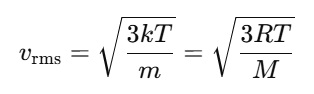
Here, T is the temperature in Kelvin, k is the Boltzmann con
Upvote The official answer key for KCET 2025 Physics (Paper A1) is expected to be released by the Karnataka Examination Authority (KEA) around April 30, 2025. Candidates can download the answer key from the official KEA website at cetonline.karnataka.gov.in. To access the answer key, visit the website, nav
Upvote What are the key assumptions of the kinetic theory of an ideal gas?
The kinetic theory is based on many key assumptions, such as the following:
- The individual gas molecules volume is almost non-existing when compared to the total volume of the gas.
- A gas consists of many small, identical, hard spherical particles.
- The collisions between the gas particles and the contai
Upvote Escape velocity is the least velocity an object needs without any further propulsion to escape the Earth's gravitational field. The escape velocity for the earth is nearly 11.2 km/s. It is derived by using the conservation of energy principle that says for an object to move to an infinite distance,
Upvote