
Chemistry
Get insights from 6.9k questions on Chemistry, answered by students, alumni, and experts. You may also ask and answer any question you like about Chemistry
- 6.9k
Questions
- 0
Discussions
- 19
Active Users
- 0
Followers
Have a question about Chemistry? Ask our experts
Keep it short & simple. Type complete word. Avoid abusive language.
Which is most reactive towards electrophilic aromatic substitution reaction :-
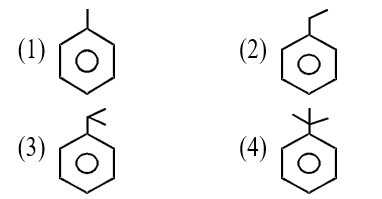
Which is most reactive towards electrophilic aromatic substitution reaction :-
Rate of ESR ∝ No. of α – H (Hyperconjugation)
 Upvote

Which one of the following ions is the most stable in aqueous solution ?
(At. No. Ti = 22, V = 23, Cr = 24, Mn=25)
Which one of the following ions is the most stable in aqueous solution ?
(At. No. Ti = 22, V = 23, Cr = 24, Mn=25)
Cr3+ion is a most stable in aqueous solution due to. t2g half filled configuration
Upvote Which of the following complex is paramagnetic, inner orbital complex and coloured :-
Which of the following complex is paramagnetic, inner orbital complex and coloured :-
(1) [Ni (NH3)6]+2 → Ni+2 → d8, C. No. = 6,
SP3d2, Para
(2) [Co (H2O)6]+2 → Co+2 → d6, C. No. = 6
d2sp3, Dia
(3) [Ti (H2O)6]+3 → Ti+3 → d1, C. No. = 6
d2SP3, Para
(4) [Co (NH3)6]+3 → Co+3 → d5, C. No. = 6
d2sp3, Para
Upvote Which of following is an example of super octet molecule ?
Which of following is an example of super octet molecule ?
In thermodynamics, a process is called reversible when:-
In thermodynamics, a process is called reversible when:-
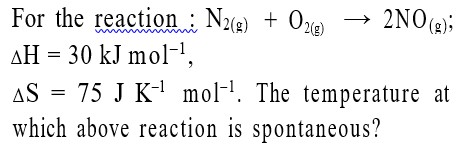
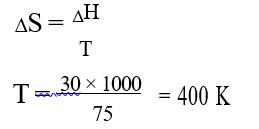
The vapour pressure of a diluted aqueous solution of glucose is 750 mm of mercury at 373 K. The mole fraction of solute is:-
The vapour pressure of a diluted aqueous solution of glucose is 750 mm of mercury at 373 K. The mole fraction of solute is:-
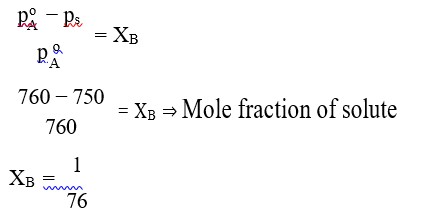
Which of the following is strongest oxidising agent?
Which of the following is strongest oxidising agent?
The number of hydroxide ions in 1 cm3 solution of pH = 13 is :
The number of hydroxide ions in 1 cm3 solution of pH = 13 is :
pH = 13, pOH = 1
[OH–] = 10–1
no. of moles OH– in 1L = 10–1
No. of moles of OH– in 1 ml = 10–4 No. of [OH–] ions = 6.02 × 1023 × 10–4
⇒ 6.02 × 10¹⁹
Upvote