
JK Business School’s Director invited to speak at Oxford University

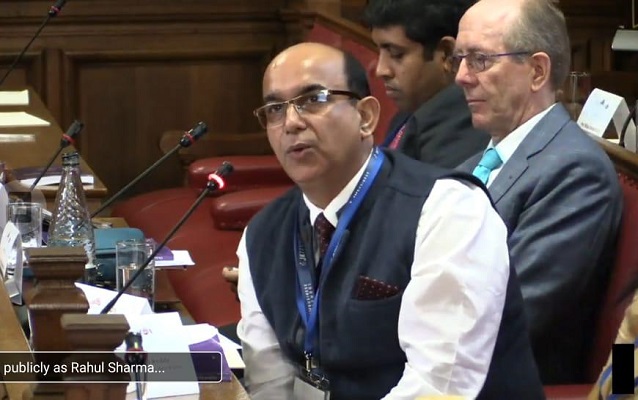
JK Business School Director Prof Dr Sanjiv Marwah was invited to speak at the Oxford Debate at Oxford University on September 27. He spoke on the topic, ‘Does college education help develop practical skills and find a job faster? Should the syllabus be changed drastically?’ The event witnessed participation of eminent personalities from across globe.
In his talk, Dr Marwah said, “Traditionally, college education was expected to impart education that could lead to building a career that, in turn, would lead to a viable economic activity and income generation. Colleges were expected to work closely with the industry and prepare students with the theoretical base of skills that would lead to practical skills of use in the industry.”
Practical skills could be built and modified according to the need and, therefore, were adaptable. It was thought that these acquired skills would help students find jobs faster. Unfortunately, surveys across the world have shown challenges in employment of graduates. A survey by McKinsey Global Institute shows that corporations find only 25 per cent of Indian engineers employable. A key reason for this has been increased acceleration in the obsolescence of jobs and the increased pace of innovation across industries. A second reason has been that the utilisation of skills has started to cover multiple industries or areas of study. Hence, students need additional expertise to find jobs.

The relationship between industry and academia needs to move from ‘Producer-Consumer’ to ‘Collaborative- Interactive’. A dynamic and fast-paced change in industry warrants an adaptive academia that is able to take inputs from the industry in an era where the half-life of skills is falling rapidly.
- Dr Marwah also suggested an updated framework of the syllabus to tackle the issue. The industry and the institution both need to develop a framework to facilitate industry interactions with faculty. Presently, both operate in different worlds. The update is usually an annual or biennial activity but the interface of faculty and industry in the framework provides the requisite inputs for change. The frameworks may vary but the following are the general interaction platforms where sharing of learning experiences takes place:
- Trade journals and magazines
- Live projects
- Summer projects or internships
- Capstone projects
- Research projects
- Academic writing
- Case writing
- Applied research
Dr Marwah cited Indian Institute of Technology Madras (IITM) Research Park as an example of an initiative to promote such harmony. He said, “It helps companies with a research focus to set up a base in the Park and leverage the expertise of IIT Madras. The joint lab of Saint Gobain and IITM is a clear win-win example of such a relationship.” He cited various aspects of this successful initiative:
- Co-teaching sessions.
- Professional associations.
- Conferences / conclaves / seminars.
- Faculty immersion programmes.
- Strategic alliances.
Dr Marwah cited a case study of JPMorgan Chase & Co and Syracuse University that set out to transform the way students are educated, with a focus on better preparing students for technology careers in global organisations. Prior to this time, the two organisations had not worked together. However, from the start there was a shared vision to create a long-term relationship (10+years, JPMC funding of $30 million) that focused on a range of activities, including research, curriculum and internships.
The collaboration has occurred at all levels of both organisations. Involvement and support by senior executives has been crucial to the success of this effort, as has been the involvement of faculty and technologists within JPMC. In fact, the collaboration has engaged hundreds of JPMC employees, hundreds of students (often working as interns) and faculty across all schools within the university.
The collaboration has resulted in joint applied research, many in the domain of IT risk and cybersecurity. These research efforts have reached into Syracuse University classrooms, impacting undergraduate curriculum content and engaged faculty and graduate students in real-world applied research. It has also resulted in the creation of a new domain, Global Enterprise Technology, and related programs. Further the collaboration has led to valuable internships.
To close, Dr Marwah stated, “College education is invaluable as structured knowledge that helps students to find jobs faster and keep them for a longer time. But, as the rate of innovation accelerates across industry, academia needs to keep pace. The driving force behind the academic structure is the syllabus that needs to be regularly updated and managed.”
Note : This article has been published on the basis of a press communication by the college
News & Updates
Photos & Videos


+22
Contact Details
Address
JK Chawk, 1200 meters on Damdama lake road, Off-Sohna Expressway,
Gurgaon ( Haryana)
Get details of Similar Colleges

Student Forum
 Anything you would want to ask experts?
Answered 3 months ago
School of Management Sciences, ASU BBA (H) courses total fee amount is INR 5.03 lakh, approximately. The UG course fee is INR 5.95 lakh. BBA course fee is more economical at SoMS, ASU. Students can consider other factors as well for the college comparison. The mentioned fee information is as per the
P
Contributor-Level 10
Answered 9 months ago
The total BBA fee at Jagannath University is around INR 3.46 L, whereas JK Business School charges about INR 2.37 L. Students who are searching for budget friendly options may find JKBS slightly better in terms of affordability. However fees charged by any university depends on many parameters.
M
Contributor-Level 10
Answered 9 months ago
Both Jagannath University, Haryana and JK Business School offer BBA courses. Both differ in fees and packages they offer. While Jagannath's the highest salary is INR 3.6 LPA, JK Business School packages spiked up to INR 24 LPA.
M
Contributor-Level 10
Answered 10 months ago
Students who want to take a PGDM course can weigh different factors to determine if any institute is better than JK Business School. The options for specialisation, ratings, fee structure, placements, return on investment (ROI), qualifications of teachers, and other defining parameters are all aspec
A
Contributor-Level 10
Answered 10 months ago
JK Business School admissions for PGDM programmes are granted also based on scores achieved in the CAT entrance examination. The CAT cut-off is generally published up to the last round under the General-All India category. Prospective applicants should check the following table for further informati
J
Contributor-Level 10
Answered 10 months ago
The cutoff for the PGDM course at JK Business School depends on the MAT cutoff. Candidates seeking admission to JK Business School can appear for the MAT and meet the MAT cutoff for the PGDM. The JK Business School cutoff for the past three years is tabulated below:
| Section | 2022 | 2023 | 2024 |
|---|---|---|---|
| Overall | 65 | 65 | 65 |
K
Contributor-Level 10
Answered 10 months ago
Yes, students can appear for admission at JK Business School at various entrance exams such as MAT, XAT, CMAT, and others. The institute accepts other national entrance exams. Students must qualify the eligibility criteria set by the institute for the desired course. JK Business School course admiss
U
Contributor-Level 10
Answered 10 months ago
Yes, JK Business School offers a full-time PGDM programme at the postgraduate level. The PGDM programme spans a total of two years. Admission to courses is subject to eligibility and selection criteria, respectively. Candidates can refer to some of the key highlights in the table below:
| Particular | Highlights |
|---|---|
Duration | Two years |
Course Level | PG level |
Mode of Course | Full Time |
Seat breakup | 120 |
Tuition fee | INR 7.99 Lacs to INR 8.39 lakh |
NOTE: The me
K
Contributor-Level 10