
Training on Improvised Plastination Techniques: An Innovative Modern Approach to Cadaveric Preservation

India’s first plastination project, funded by the Indian Council of Medical Research (ICMR)-Department of Health Research (DHR) conducted a 1-month training program.

Department of Anatomy, MGM Medical College, Kamothe, received an ICMR-DHR Funded Project entitled “Training on Improvised Plastination Techniques: An Innovative Modern Approach to Cadaveric Preservation”. A fund of INR 27,66,075 has been sanctioned for the project for the duration of 3 years.
- What is Plastination?
- Plastination Training Program Objectives
- Summary of 1 Month Training Program
- Achievement
- Expected Outcome
What is Plastination?
Plastination is an innovative method of preservation developed in 1978 by Dr Gunther von Hagens. This technique transforms biological specimens into dry, durable, odourless, and non-toxic forms, making them exceptionally well-suited for teaching and learning anatomy.
Plastination Training Program Objectives
- To train Medical and Paramedical faculties in the Plastination Technology
- To provide plastinated specimens to facilitate education for healthcare students
- To minimise the hazardous effect of formaldehyde while handling the biological specimens & by adding more plastinated specimens for small group teaching
- Preservation of organs or specimens with unusual morphology or exhibiting a rare disease
- To enhance research in the form of publications and funded projects.

Summary of 1 Month Training Program
The 1st batch of the ICMR Plastination Training Program was conducted from 1st to 31st March 2025, and the 2nd batch from 15th March to 15th April 2026. A total of 15 delegates from various medical and allied health institutions were successfully trained in the innovative field of cadaveric preservation.
Two weeks, Module 1 - consisted of a 15-day online lecture session, during which experts delivered lectures on key topics, including an introduction to plastination techniques and their applications, reference management tools, biostatistics, the process of research paper publication, ethical and biosafety considerations in plastination, and troubleshooting common issues in plastination techniques. This online module provided a strong theoretical foundation.
Achievement
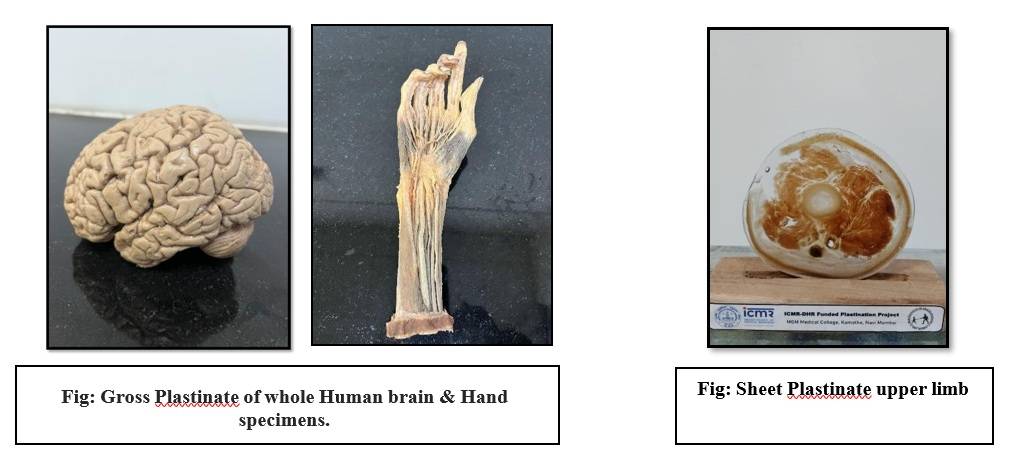
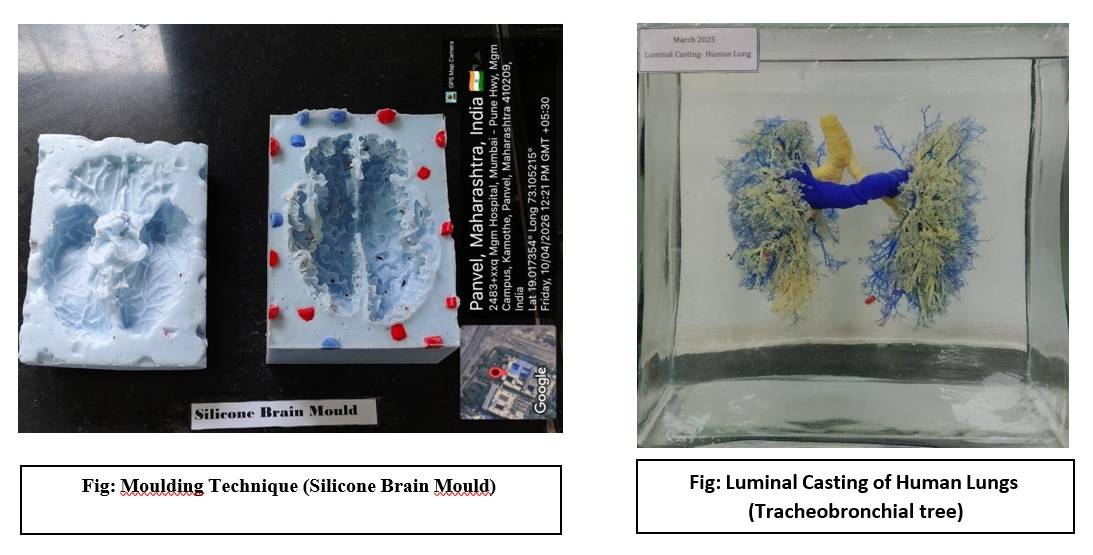
Two weeks, Module 2 focused on hands-on training, enabling delegates to actively engage in each step of the plastination process. Participants gained comprehensive skills in plastination techniques.
Expected Outcome
- The plastination hands-on training program will sensitise medical faculties of various institutions to motivate & to initiate plastination techniques in their parent institution.
- This training program is expected to help the institute faculty to gain confidence to start up with new advanced plastination techniques, which could result in the production of plastinate specimens for teaching with real human specimens & also the biggest aim to minimise the formalin exposure.
- The plastinate specimens are easy to maintain, no gloves required, odourless, long-lasting, flexible, lifelike & aesthetically pleasing.
- Use of more plastinate specimens by institutions is expected to encourage the students who are the stakeholders to handle these real anatomical specimens for effective learning
- Replacing dissected formalin-preserved wet specimens with plastinate specimens & this replacement will also conserve the time & energy of skilled hands production of specimens, thereby allowing focus on other skills development or research.
Note: The views expressed in this article are of MGM School of Biomedical Sciences and do not reflect/represent those of Shiksha.
News & Updates
Photos & Videos




+24
Contact Details
Address
MGM School of Biomedical Sciences, Sector 1,Kamothe, Panvel
Navi Mumbai ( Maharashtra)
Get details of Similar Colleges

Student Forum
 Anything you would want to ask experts?
Answered 3 months ago
The BSc course at MGM School of Biomedical Sciences is a full time 4-year course at the UG level with six semesters of academic training followed by two semesters of mandatory internship. The BSc course is offered in the field of Allied Heath Sciences. The BSc programme total tuition fee ranges in a
a
Contributor-Level 8
Answered 4 months ago
MGM School of Biomedical Sciences has collaborated with various companies and organisations. The college has signed MoUs with various industries and organisations. The below-mentioned are the MGM School of Biomedical Sciences collaborations:
MGM School of Biomedical Sciences Collaborations | ||
|---|---|---|
Heartfulness Education Trust | SRCC Centre of Child Development | Bai Jerbai Wadia Hospital for Children, Parel |
SRL Diagnostics Goregaon | Logical Life Sciences Pvt Ltd, Pune | MGM New Bombay Hospital, Vashi |
Lilac Insights Pvt. Ltd., Mahape, Navi Mumbai | Terna Medical College & Hospital | The Panvel Municipal Corporation |
UDC Satellite Laboratory Pvt Ltd | Hospital Talegaon Maval Pune | Smt Kashibai Navale Medical College and General Hospital, Narhe, Pune |
P
Contributor-Level 9
Answered 5 months ago
| Ph.D. in Clinical Embryology |
| Ph.D. in Nutrition & Dietetics |
| Ph.D. in Hospital Administration |
| Ph.D. in Medical Biotechnology |
| Ph.D. in Dialysis Therapy |
| Ph.D. in Medical Genetics |
| Ph.D. in Medical Radiology and Imaging Technology |
| Ph.D. in Anaesthesia & Operation Theatre Technology |
| Ph.D. in Optometry |
R
Contributor-Level 10
Answered 5 months ago
After completing MSc Medical Physics from MGM School of Biomedical Sciences, MGM Institute of Health Sciences, students can build their career as Radiation Safety Officer, QA / Dosimetry Physicist, Medical Physicist (Radiotherapy), Research Scientist, and as part of medical equipment companies and
S
Contributor-Level 10
Answered 5 months ago
MGM School of Biomedical Sciences Navi Mumbai has been providing good placements to its students from various courses. Check the table below which provides the MGM School of Biomedical Sciences Navi Mumbai placement highlights:
Particulars | Placement Statistics (2023) | Placement Statistics (2024) | Placement Statistics (2025) |
|---|---|---|---|
Placement Rate | 100% | 100% | |
the highest Package | INR 3 LPA | INR 4 LPA | INR 5 LPA |
Average Package | INR 2.50 LPA | INR 3 LPA | INR 4 LPA |
Summer Internship Placements | 100% | 100% |
d
Contributor-Level 10
Answered 6 months ago
Yes, an average student can get admission in MGM School of Biomedical Sciences. The institute offers seats on an entrance basis. Students simply have to clear the MGMCET.
M
Contributor-Level 10
Answered 6 months ago
MGM School of Biomedical Sciences generally does not offer direct admissions. Students need to meet the basic eligibility and clear the selection rounds. Students may connect with the institute to know more.
N
Contributor-Level 10
Answered a year ago
MGM School of Biomedical Sciences admission is entirely entrance-based, followed by GDPI round. To proceed with filling out the application form, candidates must visit the official website of MGM and apply for the desired course. Additionally, applicants must apply and appear for MGMCET. It will be
R
Contributor-Level 9
Role: Content Manager & Editor, Shiksha.com
Education: M.Sc. Biotechnology
Rashmi Karan is an author and editor at Shiksha.com. She develops data-backed content for major colleges and universities in India. Rashmi tr
Read Full Bio