 / Preparation Maths Number System
- Introduction
- Definition
- Real Numbers and Number Line
- Illustrative Examples
- Frequently Asked Questions

Introduction
The number line makes it easy to know which numbers are greater or lesser. It extends on both sides with zero at the middle of the number line. We are aware that the number on the left is always less than the number on the right. The number line is used to add and subtract or perform any arithmetic operations.
Definition
The number refers to the visual representation of all the numbers on a line. Zero is the middle point of the number line. The line extends from both sides horizontally and makes the comparison of numbers easier.
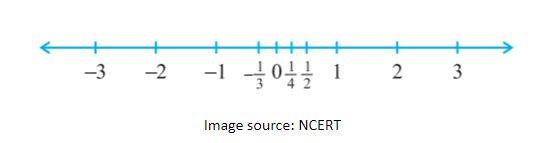
Real Numbers and Number Line
The collection of real numbers is made up of all rational and irrational numbers denoted by ‘R’. A real number can either be rational or irrational. Every real number is represented by a unique point on the number line.
Operations on a Number Line
- The addition of two positive numbers will be a positive number lying on the number line’s right side.
- The addition of two negative numbers will always be a negative number lying on the left side.
- The subtraction of two positive numbers moves to the left, and two negative numbers move to the right as far as the value of the second number.
Weightage and Importance
Number lines are a part of the number system and have a good weightage for class 10th. Approximately 6 mark questions are asked from the chapter on numbers.
Illustrative Examples
- Write the opposites of the following:
(a) Increase in weight (b) 30km north (c) 326 BC (d) Loss of Rs 700 (e) 100 m above sea level
Solution:
(a) Decrease in weight
(b) 30 km south
(c) 326 A.D.
(d) Gain of Rs 700
(e) 100 m below sea level
- In each of the following pairs, which number is to the other’s right on the number line?
(a) 2, 9 (b) − 3, − 8 (c) 0, − 1 (d) − 11, 10 (e) − 6, 6 (f) 1, − 100
Solution:
(a) 9 (9 > 2)
(b) −3 (−3 > −8)
(c) 0 (0 > −1)
(d) 10 (10 > −11)
(e) 6 (6 > −6)
(f) 1 (1 > −100)
- Write all the integers between the given pairs (write them in the increasing order).
(a) 0 and − 7 (b) − 4 and 4 (c) − 8 and − 15 (d) − 30 and − 23
Solution:
(a) −6, −5, −4, −3, −2, −1
(b) −3, −2, −1, 0, 1, 2, 3
(c) −14, −13, −12, −11, −10, −9
(d) −29, −28, −27, −26, −25, −24
Frequently Asked Questions
Q: What is a rational number?
Q: Is every integer a rational number?
Q: What is an irrational number?
Q: What numbers can be represented on the number line?
Q: When and why was the number line invented?
Q: In the number system, on what basis are the numbers classified?

Maths Number System Exam
Student Forum
 Anything you would want to ask experts?
Answered a month ago
CLAT does not publish a fixed count for Number System questions. The UG exam stays largely passage-based. This topic supports calculation inside Quantitative Techniques passages. It does not appear as standalone questions.
S
Contributor-Level 10
Answered a month ago
Number System questions cover many types. These include basic property checks, combined divisibility conditions, HCF and LCM problems, remainder patterns and multi condition reasoning. They test calculation speed and accuracy.
S
Contributor-Level 10
Answered a month ago
Students can improve step by step. Learn divisibility rules. Practise HCF and LCM daily. Work through remainder questions carefully. Regular revision of common traps also builds accuracy and speed.
S
Contributor-Level 10
Answered a month ago
There is no single fixed book for this topic. Students often use standard Class 10 level maths books. Combine these with regular practice sets and previous year papers to build accuracy.
S
Contributor-Level 10
Answered a month ago
Students should start early. Practice Number System alongside other Quantitative Techniques topics. Strong basics make combined divisibility and multi condition questions easier later.
S
Contributor-Level 10
Answered a month ago
Number System is not a separate scored CLAT topic. But the calculation skills help with passage-based Quantitative Techniques questions. Skipping it fully is not wise. Most passages need quick, accurate number work.
S
Contributor-Level 10
Other Class 10th Maths Chapters
Popular Courses After 12th

Exams accepted
CA FoundationExams accepted
ICSI ExamExams accepted
BHU UET | GLAET | GD Goenka TestBachelor of Business Administration & Bachelor of Law
Exams accepted
CLAT | LSAT India | AIBEExams accepted
IPMAT | NMIMS - NPAT | SET
Exams accepted
BHU UET | KUK Entrance Exam | JMI Entrance ExamBachelor of Design in Animation (BDes)
Exams accepted
UCEED | NIFT Entrance Exam | NID Entrance ExamBA LLB (Bachelor of Arts + Bachelor of Laws)
Exams accepted
CLAT | AILET | LSAT IndiaBachelor of Journalism & Mass Communication (BJMC)
Exams accepted
LUACMAT | SRMHCAT | GD Goenka Test
How many questions are asked from Number System in CLAT?