 / Preparation Physics Kinetic Theory
To get your mind around Kinetic Theory in Physics, it’s essential to know what gases are and how they behave when you zoom in at the intermolecular level.
You see, gases are just loads of tiny particles. They fly around everywhere, if not contained. But their movements are patterns we can predict/measure using physics. That’s what scientists define as behaviour of gases.
Now, none of this comes out of thin air.
Some tools you have already covered in previous chapters in Physics Class 11.
Remember the ideal gas equation? That was an opener to understanding the different variables of gas, including pressure, volume, and temperature.
Then you met broader thermodynamic concepts, such as what state variables are.
All these form building blocks for the behaviour of gases.

- What is a Gas?
- What are Behaviours of Gases?
- Types of Gases
- Concepts NCERT Covers on the Behaviour of Gases
- Gas Laws that Determine Behaviours of Gases
- Factors Affecting Behaviours of Gases
- Key Characteristics of Gases
- How the Ideal Gas Equation Determines Behaviours of Gases
- Where Gas Behaviour Principles Show Up
- Class 11 Physics Revision Notes
- Find All NCERT Solutions for Physics Class 11


What is a Gas?
A gas is a state of matter. It never sticks to any shape, unlike solids and liquids.
If you ask why, we need to learn the behaviour of the gas better.
What are Behaviours of Gases?
It’s a homogeneous fluid that has low density and low viscosity. Meaning, it’s evenly spread out and not sticky at all.
It has significant elasticity and compressibility, allowing it to occupy smaller and larger spaces. Put it in a bottle and it takes the bottle’s shape. Put it in a balloon and boom, balloon shape.
There are large intermolecular spaces between the particles of gas. And these particles are constantly moving in random positions.
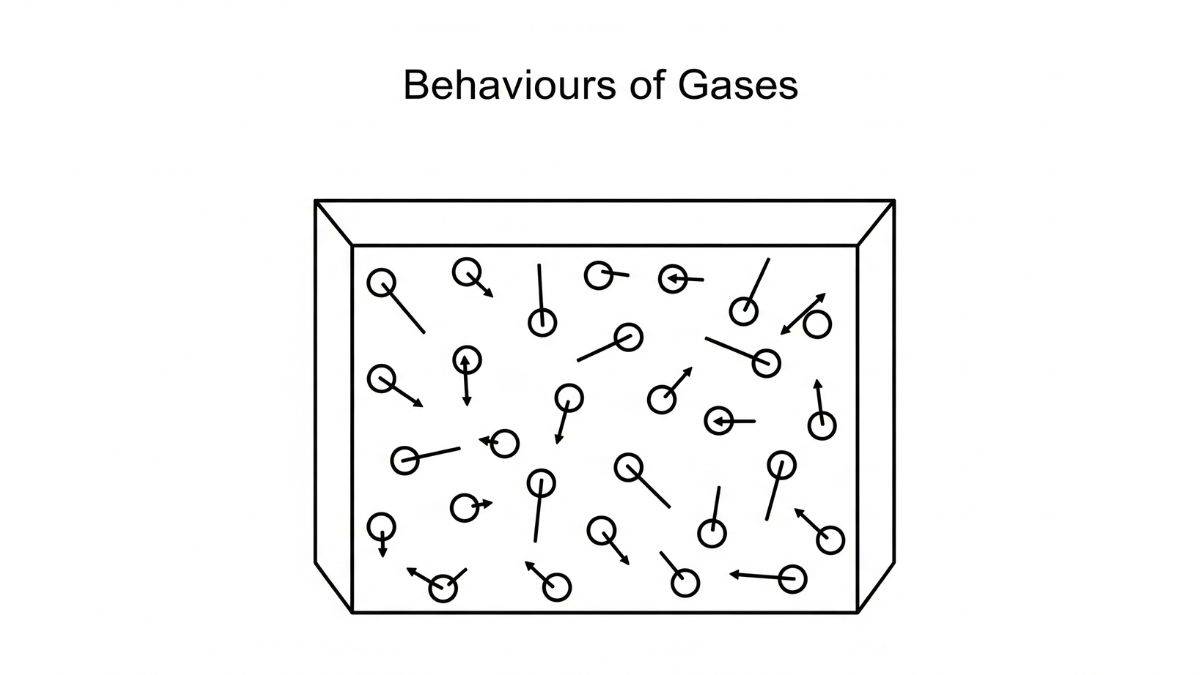
That’s what makes it super stretchy as well, that elastic property concept you will learn about. You can squash it down to a tiny space.
In the same way, it can expand when heated, like bread heated in an oven.
Types of Gases
To understand the behaviours of gases, there are two types you must be aware of.
Ideal gases and real gases are types. We need to know the differences here, because in physics, which you have noticed so far, we always test in ideal or hypothetical scenarios to make sense of the real world.
| Feature |
Ideal Gas |
Real Gas |
| Definition |
This is a perfect imaginary gas that always follows the Ideal Gas Law, no matter what. |
Real gases around us that sometimes break the rules, especially under extreme conditions. |
| Molecular Volume |
It pretends to have molecules are so tiny they don’t take up space |
Molecules actually have size, which matters when they’re squeezed together at high pressure. |
| Forces Between Molecules |
None at all, no push, no pull between molecules |
Molecules in a real gas can attract or repel each other. That, however, depends when it’s really cold or really cramped. |
| Internal Energy |
That totally depends on temperature. |
For a real gas, we see that it depends on temperature, pressure, and density, because of all the interactions happening. |
| Gas Laws |
Obeys Boyle’s, Charles’s, Avogadro’s, and Gay-Lussac’s laws perfectly. |
Follows those laws only approximately. They start to wobble under extreme conditions. |
| Equation |
PV = nRT |
More complex, like the van der Waals equation: (P + a(n/V)²)(V - nb) = nRT |
| Existence |
Doesn’t exist in the real world, it’s just a model. |
Every gas you know, oxygen, nitrogen, carbon dioxide, ammonia, is a real gas. |
| Behaviour at Low Pressure & High Temperature |
Always “ideal” by assumption. |
Acts close to ideal when the pressure is low and the temperature is high. |
| Examples |
No actual examples, purely theoretical. |
Helium and hydrogen are almost ideal, while gases like ammonia or CO₂ deviate more. |
Concepts NCERT Covers on the Behaviour of Gases
When studying Kinetic Theory in Physics in Class 11, you will see how gases behaviours relate with established gas laws and principles.
Empirical Gas Laws for Macroscopic Observation of Gases
You have to be clear with the laws of Robert Boyle, Jacques Charles, Amedeo Avogadro, and Dalton. Their laws describe the relationships of pressure, temperature, and volume. They are foundational to the Ideal Gas Equation.
For the sake of understanding, NCERT introduces a simple equation.
PV = KT
According to NCERT, K is used as a constant for a given gas sample, but not a universal constant. As the ideal gas equation is PV=nRT.
Through that, scientists are able to predict how gases behave in everyday occurrences. For instance, a helium balloon shrinks (volume) in cold weather (temperature) is the Charles’ Law in action.
Understanding the Molecular Connection of Gases
One assumption on Kinetic Theory is important. Gas molecules behave differently when in collision and when not.
NCERT introduces concepts such as Boltzmann constant (k) in the PV = KT equation. Here the sample has an assumed gas constant, K. So, K becomes the macroscopic constant that needs a further expression, K= Nk.
Note that the k is the Boltzmann constant. It’s the conversion factor between temperature and energy at the particle or molecular level. This implies temperature is a measure of the average kinetic energy of particles.
So the ideal gas equation, can also be expressed as PV = NkT
This relationship helps us understand how molecules behave collectively at the intermolecular level.
Note: K in PV=KT is a temporary, sample-specific placeholder. As you move to the molecular description, K is replaced by Nk (Boltzmann constant times number of molecules), giving the standard microscopic ideal gas law PV=NkT.
NCERT also mentions, "At low pressures and high temperatures (above liquefaction), gases follow the ideal gas equation, , where is pressure, is volume, is absolute temperature, and is a constant proportional to the number of molecules . This relation, combined with Avogadro's hypothesis, explains gas behavior under various conditions."
Gas Laws that Determine Behaviours of Gases
The ideal gas equation is derived from empirical gas laws.
1. Boyle's Law: At constant temperature, , or:
Experimental curves align with Boyle's law at high temperatures and low pressures.
2. Charles' Law: At constant pressure, , or:
Verified by curves for
3. Avogadro's Hypothesis: At fixed and , equal volumes of gases contain equal numbers of molecules. The number of molecules in 22.4 liters at STP
(273 K , is .
4. Dalton's Law of Partial Pressures: For a mixture of non-reactive ideal gases, total pressure is the sum of partial pressures
where is the pressure gas would exert alone at the same and .
Factors Affecting Behaviours of Gases
Four factors shape the behaviour of gases.
We have temperature (T), volume (V), pressure (P), and the amount of gas (n).
All of these are connected. Change one, and you’ll see the others shift too.
Temperature (T)
Effect on Volume
When you heat a gas, what you will see is the molecules will begin to speed up. They will spread out randomly. That means the volume increases with temperature. Cool it down, and the gas contracts, so volume decreases.
This is exactly what Charles’s Law describes.
Effect on Pressure
If the gas is in a fixed space, heating it makes molecules push harder on the walls. Which explains pressure increases with temperature. Cooling has the opposite effect. This is what Gay-Lussac’s Law tells us.
Kinetic Energy Connection
If the gas gets hotter, the faster the molecules will move.
Then we can say, the average kinetic energy of gas molecules is directly proportional to absolute temperature.
For an ideal gas, internal energy depends only on temperature, nothing else.
Like, if you look into the mathematics of it, this is how it will look.
- Pressure: Results from molecular collisions with container walls. Pressure number density ( ) and mean square speed.
- Temperature: Proportional to average translational kinetic energy, .
- Volume: Determined by molecular spacing, larger in gases than liquids (e.g., water vapour volume ~ 1670 times liquid water).
Here, Avogadro's hypothesis is justified by equal molecular densities at fixed and , validated by chemical reactions.
Volume (V)
Effect on Pressure
Squeeze a gas into a smaller volume and molecules collide more often, so pressure increases. Give them more space and pressure drops. This inverse relationship between volume and pressure is explained by Boyle’s Law.
Pressure (P)
Effect on Volume
Push harder on the gas and volume decreases (at constant temperature).
Release the pressure and it expands again.
Yes, that’s still Boyle’s Law in action.
Effect on Temperature
In a rigid container, gas pressure rises as temperature rises. That’s Gay-Lussac’s Law working.
Amount of Gas (n)
Effect on Pressure
Pack more gas molecules into the same container and they bump into the walls more often, so pressure increases. Fewer molecules means pressure decreases.
Effect on Volume
At constant pressure and temperature, Avogadro’s Law says the volume of a gas is directly proportional to the number of moles. More gas = more space needed.
Gas Condensation and Liquefaction
Gases don’t always stay gases.
If you lower the temperature enough or crank up the pressure, gases can turn into liquids or even solids.
This is where real gases start to deviate from ideal behaviour.
At high pressure and low temperature, molecular forces and finite size matter. And that’s when condensation into liquid or solid states can happen.
Key Characteristics of Gases
Gases exhibit unique properties due to molecular arrangement.
- Large Intermolecular Distances: Molecules are far apart (average distance ~ 10 times molecular size, ), reducing intermolecular forces.
- Random Motion: Molecules move randomly, colliding elastically with each other and container walls, causing pressure.
- Negligible Volume: Molecular volume is small compared to gas volume (e.g., for oxygen at STP).
- Compressibility: Large intermolecular spaces allow gases to be highly compressible.
- Expandability: Gases expand to fill any container due to free molecular motion.
How the Ideal Gas Equation Determines Behaviours of Gases
Where Gas Behaviour Principles Show Up
Class 11 Physics Revision Notes
Find All NCERT Solutions for Physics Class 11

Commonly asked questions
Why don't gas molecules in a room simply fall to the ground due to gravity?
It's because gas molecules constantly move around at super high speeds. They randomly bump into each other constantly. Gravity does pull on them. The pulling effect is not much, however. When we consider the distance from the floor to the ceiling, gravity's pull is overcome by the molecular kinetic energy. So they just spread out and move from one place to another. They can't settle down.
How does the viscosity of a dilute gas change with temperature, and is this similar to liquids?
Surprisingly, the viscosity of a dilute gas behaves exactly opposite to what you might expect for liquids. Liquid viscosity generally decreases as temperature is lowered. The viscosity of a dilute gas increases as and when you raise its temperature. This counter-intuitive behaviour was clearly established experimentally and is explained by the kinetic theory.
Physics Kinetic Theory Exam
Student Forum
 Anything you would want to ask experts?