
SLAT Exam Pattern 2027: Type of Questions, Exam Timings, Sectional Weightage & Exam Duration
Symbiosis Law Admission Test 2027 ( SLAT )


SLAT Application Form 2027
17 Aug '26 - 4 Dec '26


SLAT Exam Pattern 2027 has been released by Symbiosis International University (SIU). Students can check SLAT paper pattern through the official bulletin. The authority has provided the detailed pattern for students on its official website. SLAT exam pattern PDF 2027 is available at slat-test.org. The SLAT exam will be conducted in two sessions in CBT mode. SLAT Test 1 will be held on December 19, 2026, and Test 2 will be held on December 26, 2026. The exam will be conducted for a duration of 60 minutes.
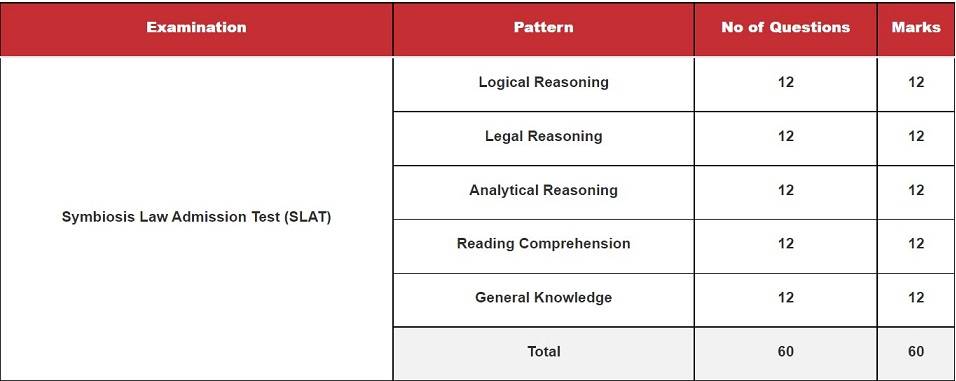
There will be questions from logical reasoning, legal reasoning, analytical reasoning, reading comprehension and general knowledge. Note that there is no negative marking in the exam. The paper is divided into five sections. Each section carries 12 questions. Each question carries one mark. A total of 60 questions carrying 60 marks will be in asked in SLAT question paper 2027. There is no negative marking for wrong answers. The SLAT 2027 exam pattern provides the paper structure, time duration and other important details about the law entrance exam. The online exam will be conducted for admission to BA LLB (Hons.) and BBA LLB (Hons.) offered by SIU campuses such as SLS Pune, SLS Nagpur, SLS Noida and SLS Hyderabad.
- SLAT Exam Pattern Highlights 2027
- SLAT Exam Pattern 2027 - Sectional Weightage
- SLAT 2027 Difficulty Level
- SLAT Exam Syllabus 2027
- About SLAT Exam 2027
- SLAT Exam Pattern FAQs

SLAT Exam Pattern Highlights 2027
The Symbiosis University will conduct the SLAT as a CBT at the designated exam centres. The key features of the SLAT 2027 exam are as follows:
| Exam Features |
Details |
|---|---|
| Exam mode |
Computer-based test mode / Online proctored |
| Exam level |
National-level exam |
| Test duration |
60 minutes |
| Test medium |
English |
| Subjects |
|
| Marking Scheme |
1 mark is awarded for each correct answer No negative marking |
| Type of questions |
Multiple-choice questions |
| Total questions |
60 questions |
| Total marks |
60 marks |
There are no subjective questions in SLAT exam.
Crack SLAT with Expert Preparation Tips
Follow effective preparation techniques and make your SLAT study plan more focused and productive.
Also Read:
SLAT Exam Pattern 2027 - Sectional Weightage
The question paper of SLAT 2027 will carry five sections. Candidates should know the relative importance of every section so that they can formulate a better preparation strategy. Candidates can check the section-wise weightage below.
| SLAT Exam Sections | Questions per section | Marks per section |
|---|---|---|
| Logical Reasoning | 12 questions | 12 marks |
| Legal Reasoning | 12 questions | 12 marks |
| Analytical Reasoning | 12 questions | 12 marks |
| Reading Comprehension | 12 questions | 12 marks |
| General Knowledge | 12 questions | 12 marks |
| Total | 60 questions | 60 marks |
Candidates should give equal focus to every topic, as their weighatage are the same.
Also read:
Students should begin their preparation with the section they find toughest.
SLAT 2027 Difficulty Level
The SLAT 2027 mock test can help candidates prepare for exam day. Some sections are more difficult compared to others. The SLAT exam is expected to have the following difficulty level as per the previous year's trends:
| SLAT Section |
Difficulty Level of Test 1 |
Difficulty Level of Test 2 |
|---|---|---|
| Logical Reasoning |
Easy | Easy to moderate |
| Legal |
Easy | Easy to moderate |
| Analytical |
Moderate | Easy to moderate |
| Reading Comprehension |
Easy | Moderate |
| General Knowledge |
Moderate to difficult | Moderate |
There is no fixed time limit for each section in SLAT.
SLAT Exam Syllabus 2027
The candidates should prepare all the topics mentioned in the SLAT syllabus. The marks secured in the written exam have the highest weightage in the selection process. The Symbiosis Law Admission Test will be conducted to test the aptitude of the aspirant in the following sections:
- Logical Reasoning
- Legal Reasoning
- Analytical Reasoning
- Reading Comprehension
- General Knowledge
After the exam, the university calls shortlisted students for a Personal Interview.
About SLAT Exam 2027
While discussing the SLAT 2027 exam pattern, candidates need to know the components of the SLAT 2027 based on which they will be admitted to a Symbiosis Law School (SLS). SLAT components have been described below:
SLAT
- The computer-based Symbiosis Law Admission Test, or SLAT, is the first component of the SLAT exam.
- The full marks for SLAT are 60. But these marks are scaled up to 70.
- Thus, the weightage of SLAT is 70.
SLAT PI
- SLAT PI stands for SLAT Personal Interview, which is an interview that assesses candidates' aptitude and personality to pursue law education.
- The weightage of SLAT PI is 30.
The combined scores of SLAT and SLAT PI (70+30 = 100) are used for the SLAT selection process for admission to a 5-year LLB course.
Read More:
SLAT Exam Pattern FAQs
Candidates can check important FAQs related to SLAT and its exam pattern below.
The main subjects from which questions are asked in the SLAT exam are Logical Reasoning, Analytical Reasoning, Legal Reasoning Mathematics, General Knowledge, and Current Affairs. The main mathematics topics for SLAT exam are the topics related to the Class 10 Math syllabus. Under the General Knowledge subject, static GK questions related to History, Geography, Indian and International Politics are asked. However, in the Current Affairs subject related to the exam, questions related to recent national and international events are asked. It should be noted that subjects related to the SLAT exam do not refer to the sections in the SLAT question paper. To get more details about the SLAT question paper, click on this link - https://www.shiksha.com/law/slat-exam.
Both the exams, SLAT & CLAT are based on the 10+2 level syllabus and candidates may find both the exams' difficulty on the same level. The syllabus for both the exam also stands on a similar page and the exams consist of questions from Logical and legal reasoning, analytical reasoning, reading comprehension, & General Knowledge. Candidates can appear for both the exams to increase their possibility of admission to the top colleges in India.
Preparing current affairs for SLAT preparation require legal and general knowledge of events happened in recent years. You can refer to the previous year papers to know the kind of questions asked.
The Symbiosis Law Admission Test authority does not provide subtle details about the SLAT syllabus. Thus, the syllabus for SLAT cannot be specified accurately. The exam authority only shares the details associated with the sections related to the SLAT question paper, which are Analytical Reasoning, Legal Reasoning, Logical Reasoning, General English, and General Knowledge. Thus, candidates only study to prepare for relevant sections along with mathematics (of level up to Class 10) and current affairs to prepare for SLAT.
To prepare for SLAT Logical Reasoning, candidates need to understand basic concepts related to the "Logical Reasoning." People who understand the basics of a particular subject thoroughly can also understand the advanced concepts related to it. Thus, to comprehend the problems or questions related to Logical Reasoning in the SLAT question paper, candidates must clear the basic concepts related to Logical Reasoning topics of the SLAT exam. Knowing the basic concepts of Logical Reasoning will help them achieve expertise in the subject. To learn the fundamentals of Logical Reasoning, candidates can refer to the books mentioned below.
1. A Modern Approach to Logical Reasoning 2023-24 by Dr R S Aggarwal
2. Universal’s Guide to Logical Reasoning for CLAT, LSAT, and Other Law Entrance Exams by Jain Prateek
Learning Logical Reasoning tricks and techniques from free social media platforms, such as YouTube can also help SLAT aspirants with the preparation of the Analytical Reasoning section.
Candidates can get admission in four SLS located in Noida, Nagpur, Hyderabad and Pune.
Yes, candidates can crack SLAT by solving previous years’ question papers of the exam because these question papers can help them get familiarised with the SLAT exam pattern and types of questions asked in the exam. But SLAT aspirants need to know that solving previous years’ question papers is not enough to score well in the exam. They need to learn the basic concepts about the topics on which questions are asked in SLAT. Doing so will allow them to solve any questions asked in the SLAT question paper, even if these questions were not asked in previous years’ question papers.
To become a topper of the SLAT exam, a candidate needs to attempt all the questions asked. There is no negative marking in SLAT. Thus, attempt all the questions.
Yes, the question paper of the SLAT exam on each day will be different. However, the pattern of the exam will be the same for each test.
Students can correct the details during the application correction window. They can edit certain fields during that time.
SLAT iss conducted in one slot only, from 9 AM to 10 AM. The slot timing will be found on the admit card. It will also mention the exam day guidelines.
Candidates can prepare for SLAT from Class 11 by practising topics from which questions are asked in the exam. The topics of subjects from which questions are asked in SLAT are Logical Reasoning, Legal Reasoning, Analytical Reasoning, Reading Comprehension (English), and General Knowledge. Under the General Knowledge subject, SLAT aspirants also need to study static GK related to History, Geography, Indian and International Politics, and United Nations Organisation (UNO) and its bodies, and current affairs. To study the mentioned subjects for SLAT preparation from Class 11, candidates can purchase books containing sample papers, practice tests, and mock tests based on the SLAT syllabus and pattern. They can devote 1-2 hours every day to SALT preparation. Preparing for the SLAT from Class 12 can provide aspirants with a competitive edge because they will have more than a year to prepare for the entrance exam effectively.
Mathematics questions are asked under the reasoning section of SLAT. The main topics asked are
- Profit, Loss and Discount
- Time and Work
- Time and Distance
- Simple Interest
- Percentage
- Number System
- Algebra
SLAT cut off varies every year. The expected General category cut-off score out of 60 ranges between 45–50 marks for SLS Pune and 42–47 marks for SLS Noida.
In case you misplace your SLAT score card, it will be easy for you to log in to the Symbiosis International University official portal using your login details and get a new one downloaded as long as the result window stays active in that admission year.
Explore top BA LLB, BBA LLB exams
3 Aug '26 - 31 Oct '26 | CLAT 2027 online registrations... |
Nov '26 | CLAT 2027 Application Correcti... |
7 Oct '26 | AP LAWCET Counselling 2026 Pha... |
7 Oct '26 - 13 Oct '26 | AP LAWCET Counselling 2026 Pha... |
Jan '27 | CUET 2027 Application Process |
Feb '27 | CUET 2027 Correction Window |
6 Oct '26 - 8 Oct '26 | TS LAWCET Spot Round Counselli... |
6 Oct '26 - 14 Oct '26 | TS LAWCET Spot Round Reporting |
7 Aug '26 - 10 Nov '26 | AILET 2027 Registration |
30 Nov '26 | AILET 2027 Admit Card |
31 May '26 | AMU BA LLB Result 2026 |
29 Apr '26 | AMU BA LLB Answer Key 2026 |
7 Oct '26 | Admission Cut Off Date |
3 Oct '26 - 6 Oct '26 | LLB 5-Year CAP Institute Level... |
7 Nov '26 | SAT India Exam (November) Atte... |
5 Dec '26 | SAT India Exam (December) Atte... |
14 Oct '26 - 22 Oct '26 | KLEE 2026 Second Round Stray V... |
1 Oct '26 - 22 Oct '26 | KLEE 2026 Round 1 Option Regis... |
31 Oct '26 | Last Date for submitting Quali... |
6 Jun '26 - 13 Jun '26 | JMI Entrance Exam 2026 Counsel... |
Apr '27 | RULET 2027 Application Process |
May '27 | RULET 2027 Correction Window |
Jul '26 | KALSEE 2026 Application Form E... |
Jul '26 | KALSEE 2026 Exam Dates |
Apr '27 | AIL LET 2027 Application Proce... |
Jun '27 | AIL LET 2027 Application Proce... |
12 Nov '25 | SUAT 2026 Application Form Rel... |
 4.4

 AIBE 22 Registration Date 2026 19 Aug '26 - 27 Oct '26