
CLAT Exam Syllabus 2027 [PDF Available]: Download CLAT UG Subjects List & Important Topics
Common Law Admission Test 2027 ( CLAT )


CLAT 2027 online registrations
3 Aug '26 - 31 Oct '26


CLAT Exam Syllabus 2027: The Common Law Admission Test will be conducted based on the exam syllabus notified in the official portal. Candidates are advised to prepare all the topics mentioned in the official portal. The Consortium has notified only the Macro topics on the website. Candidates are advised to prepare all the associated topics of the macro topics. Candidates must refer to the standard books to get the structure of the topics.
Candidates are advised to make a list of micro and other associated topics which can be asked in CLAT based on previous years' question papers. They should prepare all such topics as the Consortium does not provide the weightage of the topics but can ask questions based on them.
The Consortium released the CLAT exam schedule on its official portal. As per the official communication, the candidates should note that the CLAT 2027 exam date is December 6. The exam will include only passage-based questions. The CLAT exam syllabus topics will be covered through the passages. Candidates must maintain a good reading speed so that they can cover the full CLAT question paper.
The CLAT syllabus topics and weightage define the efforts required to crack the CLAT 2027. Candidates are advised to start exam preparation as not much time is left and the syllabus is vast, especially the Current Affairs section.
⚡ CLAT 2027 Exam Guide
Get all the Details about CLAT, NLUs & college preferences
Consortium of NLUs conducts the CLAT every year to select candidates for the LLB seats offered by the National Law Universities (NLUs). CLAT subjects are given below:
- English Language
- Current Affairs with General Knowledge
- Legal Reasoning
- Logical Reasoning
- Quantitative Techniques
The maximum difficulty level of the CLAT 2027 syllabus is that of Class 12th. Read further to know about the CLAT syllabus PDF, including subject-wise topics, marking scheme, and more.
Also Read:
- CLAT Syllabus Download
- CLAT Subjects List
- CLAT Syllabus for English
- CLAT Syllabus for Current Affairs and General Knowledge
- CLAT Syllabus for Legal Reasoning
- CLAT Syllabus for Logical Reasoning
- CLAT Pattern & Marking Scheme 2027
- CLAT Syllabus for Quantitative Techniques
- Preparation Strategy for CLAT 2027
- CLAT Coachings
- CLAT Syllabus 2027 FAQs


CLAT Syllabus Download
CLAT Syllabus is the most important component of CLAT preparation. We suggest adopting a bottom-up approach in preparing the CLAT subjects, supplemented by solving the topic-based questions of previous years. It will help in deciding the approach of preparing the topic. Candidates are advised to download the CLAT Exam Syllabus 2027 and post it on their study table. They should make a date-wise plan to prepare the topics given in the CLAT Syllabus 2027 and strengthen it with the help of previous year question papers and mock test papers. Candidates must solve the CLAT previous years' question papers to know the frequently asked topics in each section and prepare them on priority. This CLAT syllabus carries section-wise important topics and weightage. You can download the syllabus PDF below to check topics, sub-topics, weightage, etc., and plan your preparation strategy accordingly.
| Download CLAT Syllabus PDF by Shiksha CLAT 2027 syllabus PDF |
Candidates can see the depiction of CLAT syllabus below:
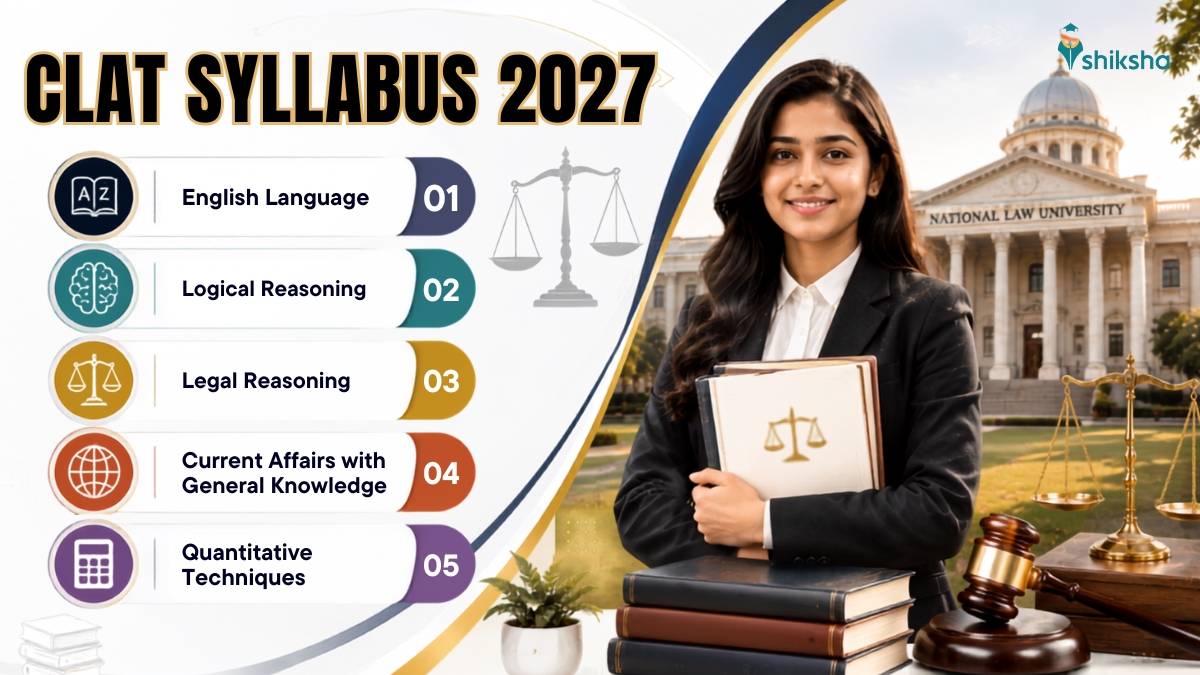
CLAT Syllabus 2027
The syllabus serves as the key to the exam.
CLAT Subjects List
The candidates should note that there are five subjects in the CLAT exam syllabus. The Consortium divide them into sections for the CLAT question paper. The candidates can see the CLAT Subjects below:
- English
- Current Affairs and General Knowledge
- Logical Reasoning
- Legal Reasoning
- Quantitative Techniques.
Candidates can see here the details of the CLAT Subjects.
CLAT Syllabus for English
CLAT English syllabus notifies the topics for the English section of the CLAT exam. Candidates can check all the topics given in the official CLAT examination syllabus. The table below explains the key features of the CLAT English Language Syllabus 2027. This section in CLAT tests the English proficiency of the candidates. The skills tested in this section are useful for other sections too. Check details below
| Particulars | Details |
|---|---|
| Number of questions asked | 24 |
| Weightage | 20 % |
| Type of questions asked | Passage-based questions
|
| Skills tested |
|
| Question areas | May cover various topics, including technical and scientific matters. No prior knowledge is needed. |
| Difficulty level | 12th Standard |
Important topics |
|
| Reference Material |
|
CLAT Syllabus for Current Affairs and General Knowledge
The General Knowledge section covers 27 questions of the overall CLAT syllabus 2027. It includes 4 to 6 passages, each about 450 words long. Before starting CLAT GK Preparation, it is important to understand the CLAT GK and Current Affairs Syllabus 2027. Read further to know more
| Features | Details |
|---|---|
| Number of questions asked | 27 |
| Type of questions asked | Passage-based questions
|
| Skills tested | Awareness of various aspects of current affairs and GK, including
|
| Question areas | - News, journalistic sources, and other non-fiction writing - Intended to test your depth of understanding of issues and events of significance, rather than mere fact or trivia-based knowledge of such issues and events. Questions may ask you to:
While the focus will be on recent and current events, some questions with historical significance may also be asked. These questions will gauge your understanding of the causes of such events. |
CLAT 2027 Reference material for GK & Current Affairs
The CLAT 2027 Current Affairs and GK section, as mentioned above, will require the candidate to read a given passage and find the answers. To prepare for the section, read topics like arts and culture, international affairs, historical and contemporary events, etc. Once you are done reading, try to figure out the nuances, context, and historical significance (if any). Here are some books that can help you prepare for the section.
- Manorama Yearbook
- General Knowledge
- Lucent’s General Knowledge
- Pratiyogita Darpan
- Pearson’s Concise GK Manual
- Competition Review Yearbook
Also Read: CLAT GK Questions With Answers
⚡ CLAT Exam Guide
Get all the Details about CLAT, NLUs & College Preference
CLAT Syllabus for Legal Reasoning
Legal Reasoning is another important section of CLAT examination syllabus. Candidates can check the CLAT 2027 Legal Reasoning Syllabus and exam pattern below. The Legal Aptitude, along with the Current Affairs and GK, carries the maximum 25 per cent weightage. So, there is extra motivation to do well in the section.
| Particulars | Details |
|---|---|
| Number of questions asked | 29 |
| Weightage | 24.17 % |
| Type of questions asked | Passage-based questions
|
| Skills tested |
|
| Question areas | Questions will be based on: - News articles and books associated with topics of law - Certain passages will be created specifically for the exam - the candidate has to find the facts and applicable rules. Until 2019, the proposition and factual context were clearly presented. - The purpose is not to test the knowledge of law but the application of rules to a factual context based on the constraints presented to you. |
| Difficulty level | 12th Standard |
| Important topics |
|
CLAT Reference Material
As mentioned above, you don't need any knowledge of the law to do well in the section. So, you needn't bother much about the legal side of the topics included in the section. Instead, you must work on developing the skill sets required to become a lawyer, i.e., learn how to apply general principles or propositions to the given fact scenarios. Here are a few books that can help you master the CLAT Legal Reasoning Section.
- Legal Awareness and Legal Aptitude by AP Bhardwaj
- LST’s Legal Reasoning Module
- CLAT Guide by Universal
- National dailies - The Hindu, Indian Express, etc.
- In addition, there are also lots of good resources on YouTube and Online.
Also Read: How to prepare for CLAT in one year?
CLAT Syllabus for Logical Reasoning
The CLAT logical reasoning syllabus amounts to 21% weightage in the CLAT syllabus 2027. The section on CLAT logical reasoning checks the candidate's ability to think clearly and logically. It will have arguments and patterns; candidates will have to either draw relationships or apply those arguments in different situations. Check the Logical Reasoning Syllabus For CLAT and Exam Pattern below:
| Particulars | Details |
|---|---|
| Number of questions asked | 25 |
| Type of questions asked | Passage-based questions.
|
| Skills tested |
|
| Question areas | Sources include opinion and editorial pieces from newspapers and magazines, and essays on moral philosophy available online and in various books. Some passages will be created specifically for the exam. Examples of source material include:
|
| Important topics |
|
The only way to master this section is through lots of practice. Simply reading and trying to rote-learn things won't cut it as far as Logical Reasoning is concerned. So, solve as many problems as you can for all the topics included in the section. To help your case, you may refer to previous years' CLAT question papers to find out the types of CLAT Logical Reasoning Questions asked. Here are some reference books for CLAT 2027 Logical Reasoning.
- 501 Challenging Logical Reasoning Practice Book
- Analytical Reasoning (English) by MK Pandey
- A Modern Approach to Logical Reasoning by RS Aggarwal
- Verbal and Non-Verbal Reasoning by RS Aggarwal
Also Read: How to prepare for CLAT along with board?
Check the roadmap above for CLAT preparation.
CLAT Pattern & Marking Scheme 2027
The Consortium has issued the CLAT Exam Pattern 2027 along with the CLAT Notification. The exam is conducted for two hours, i.e 2 pm to 4 pm. The CLAT Question Paper will be offline, in pen-and-paper mode. Check the table below for the latest CLAT exam pattern.
| Feature | Details |
|---|---|
| Mode of Exam | Offline |
| Type of Questions | Multiple Choice Questions |
| Total Number of Questions | CLAT UG 2027: 120 CLAT PG 2027: 120 |
| Marks per Question | 1 mark |
| Language | English |
| Negative Marking | -0.25 marks for each wrong answer |
| Duration of Exam | 2 hours |
| Total Marks | 120 for both UG and PG |
Candidates should internalise the exam pattern and sync it with the CLAT exam syllabus to score better in the exam.
CLAT Syllabus for Quantitative Techniques
Preparation Strategy for CLAT 2027
CLAT Coachings
CLAT Syllabus 2027 FAQs
The Legal Reasoning section in the CLAT exam checks your ability to apply logical legal principle to given situations. Some of the important topics are Law of Torts, Contract and Criminal Law, Legal Maxims, etc. Candidates must include practicing passage based legal cases to apply logic and memorise law related to them.
As per NIRF ranking 2025, NLSIU Bangalore is the No. 1 ranked NLU colleges in India. The table below has other NLUs in India rankwise.
Top NLUs in India | NIRF 2023 | NIRF 2024 | NIRF 2025 |
|---|---|---|---|
1 | 1 | 1 | |
2 | 2 | 2 | |
4 | 4 | 4 | |
7 | 8 | 5 | |
18 | 21 | 27 | |
24 | 22 | 30 | |
30 | 26 | 15 | |
28 | 27 | 35 |
Disclaimer: This information is sourced from official website of the ranking body listed and may vary.
The CLAT cutoff means the minimum rank or score required to get admission into a National Law University (NLU). Candidates must get the cutoff to participate in the counselling process.
While it is not impossible, it is a really challenging task. To score well, you must start preparing for CLAT at least six months before. It is very important to score well if you are looking forward to getting into good NLU. For top 10 NLU, you at least need to score between 100 to 105 as per past trends.
The CLAT Cutoff is decided by following factors
- Exam Difficulty
- Number of Applicants
- Seat Availability
- Reservation Policy
- Domicile Quota
Solving mock test helps candidates to understand the exam pattern and also the sections they are lagging behind. With this they can rework on those section where they are scoring low. CLAT mock test also helps candidates to understand the time based prepration to solve the question paper on exam day.
Though CLAT Preparation takes months of practice, it is still not impossible. You can prepare for the CLAT Exam in one week with a correct and dedicated focus. But you should have at least some understanding of concepts to clear the exam.
According to the CLAT exam pattern, there will be no deduction of marks for unanswered questions. Such questions will not be taken into consideration while calculating the total marks of a candidate. Hence, if candidates are not sure about the answer of a question, it is better to leave it unattempted rather than doing a guess work, to avoid negative marking.
There is no restriction as such for the CLAT exam. Thus, one can give CLAT any number of times they want to. Candidates should not feel bad if they are not able to clear the CLAT exam in first time.
Apart from the other important documents required for CLAT Counselling, the CLAT Scorecard is must. Candidates must ensure to cross check the details mentioned on the scorecard before downloading it. In case of discrepancies, reach out to the consortium before the counselling day.
CLAT 2027 exam will be conducted on December 6, 2026. The exam will be held from 2 pm to 4 pm. Consortium of NLUs has officially announced CLAT Exam Date.
Explore top BA LLB, BCom LLB, BSc LLB, BBA LLB, BSW LLB exams
Jan '27 | CUET 2027 Application Process |
Feb '27 | CUET 2027 Correction Window |
7 Oct '26 | AP LAWCET Counselling 2026 Pha... |
7 Oct '26 - 13 Oct '26 | AP LAWCET Counselling 2026 Pha... |
31 May '26 | AMU BA LLB Result 2026 |
29 Apr '26 | AMU BA LLB Answer Key 2026 |
6 Oct '26 - 8 Oct '26 | TS LAWCET Spot Round Counselli... |
6 Oct '26 - 14 Oct '26 | TS LAWCET Spot Round Reporting |
17 Aug '26 - 4 Dec '26 | SLAT Application Form 2027 |
11 Dec '26 | SLAT 2027 Admit Card for Test ... |
7 Oct '26 | Admission Cut Off Date |
3 Oct '26 - 6 Oct '26 | LLB 5-Year CAP Institute Level... |
7 Aug '26 - 10 Nov '26 | AILET 2027 Registration |
30 Nov '26 | AILET 2027 Admit Card |
31 Oct '26 | Last Date for submitting Quali... |
6 Jun '26 - 13 Jun '26 | JMI Entrance Exam 2026 Counsel... |
14 Oct '26 - 22 Oct '26 | KLEE 2026 Second Round Stray V... |
1 Oct '26 - 22 Oct '26 | KLEE 2026 Round 1 Option Regis... |
7 Nov '26 | SAT India Exam (November) Atte... |
5 Dec '26 | SAT India Exam (December) Atte... |
Apr '27 | RULET 2027 Application Process |
May '27 | RULET 2027 Correction Window |
Jul '26 | KALSEE 2026 Application Form E... |
Jul '26 | KALSEE 2026 Exam Dates |
Apr '27 | AIL LET 2027 Application Proce... |
Jun '27 | AIL LET 2027 Application Proce... |
12 Nov '25 | SUAT 2026 Application Form Rel... |
206 Institutes accepting CLAT
SRM Institute of Science and Technology, Kattankulathur
Kattankulathur, Chennai • Private
- ₹ 15.00 Lakh
- 5 years
- |
- Full Time
 4.5
4.5NLU Kolkata (NUJS) - The West Bengal National Univer...
Salt Lake City, Kolkata • Public

 AIBE 22 Registration Date 2026 19 Aug '26 - 27 Oct '26