 / Preparation Physics Oscillations
Connecting the theory of Simple Harmonic Motion (SHM) to observable real-world systems, such as the simple pendulum, is a struggle for many. Especially when solving conceptual questions based on the equation of the simple pendulum, it may not be very clear. The NCERT Solutions for Oscillations include such exercises to calculate the time period of a simple pendulum, for instance.
When revising, don’t miss out on the factors that influence the to-and-fro motion of physical systems, including the simple pendulum. Mainly, conceptual clarity on topics, including restoring force and the trigonometric role of approximation in physics, is essential here.
- What is a Simple Pendulum?
- How and When Does a Simple Pendulum Exhibit SHM?
- Role of External Conditions in a Simple Pendulum's Time Period
- Time Period of Second's Pendulum
- How is Energy Conserved in a Simple Pendulum?
- What Happens When a Pendulum's Swing Angle is Large?
- Simple Pendulum Class 11 Notes
- Ready for JEE Mains with Simple Pendulum Formula and Concepts?
- Revision Notes Physics Class 11
- NCERT Solutions Physics Class 11


What is a Simple Pendulum?
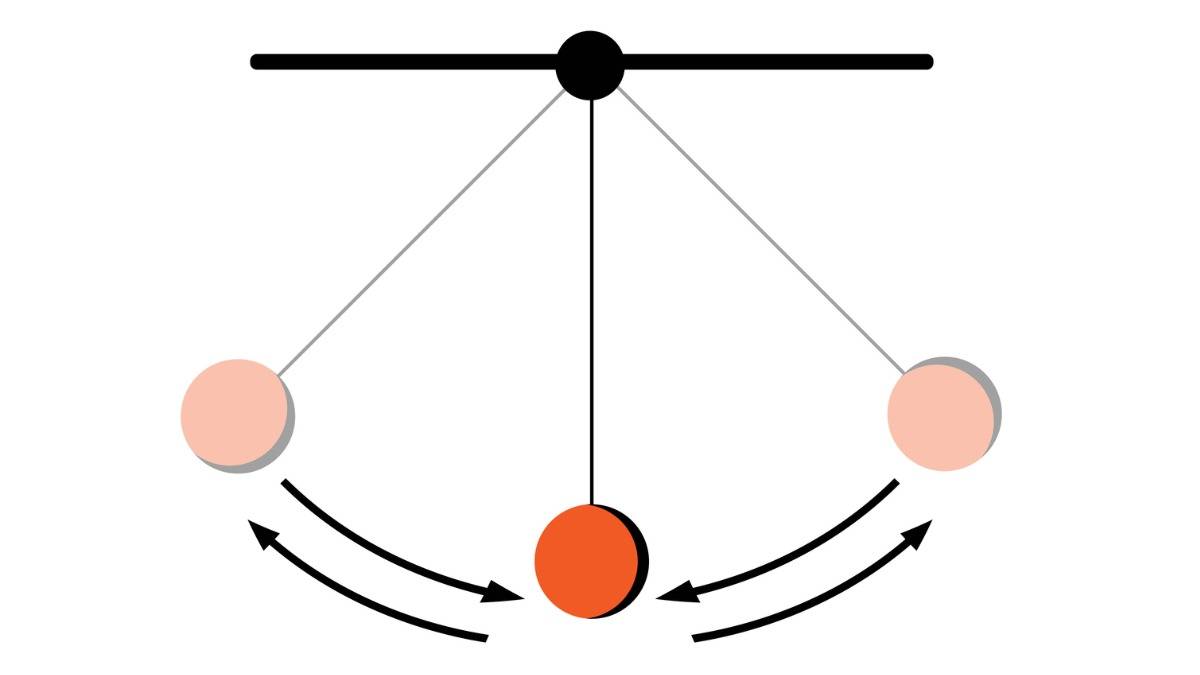
A simple pendulum is simply a weight hanging from a string. It swings back and forth. For small swings, it follows a predictable pattern that demonstrates Simple Harmonic Motion. The time for one complete swing depends only on:
- How long the string is
- How strong gravity is
Main Components of a Simple Pendulum
- A simple pendulum comprises a point mass. We call that a bob.
- It is suspended from a fixed point by a massless, inextensible string.
- The string is attached to a fixed surface.
Ideal vs Real Simple Pendulum
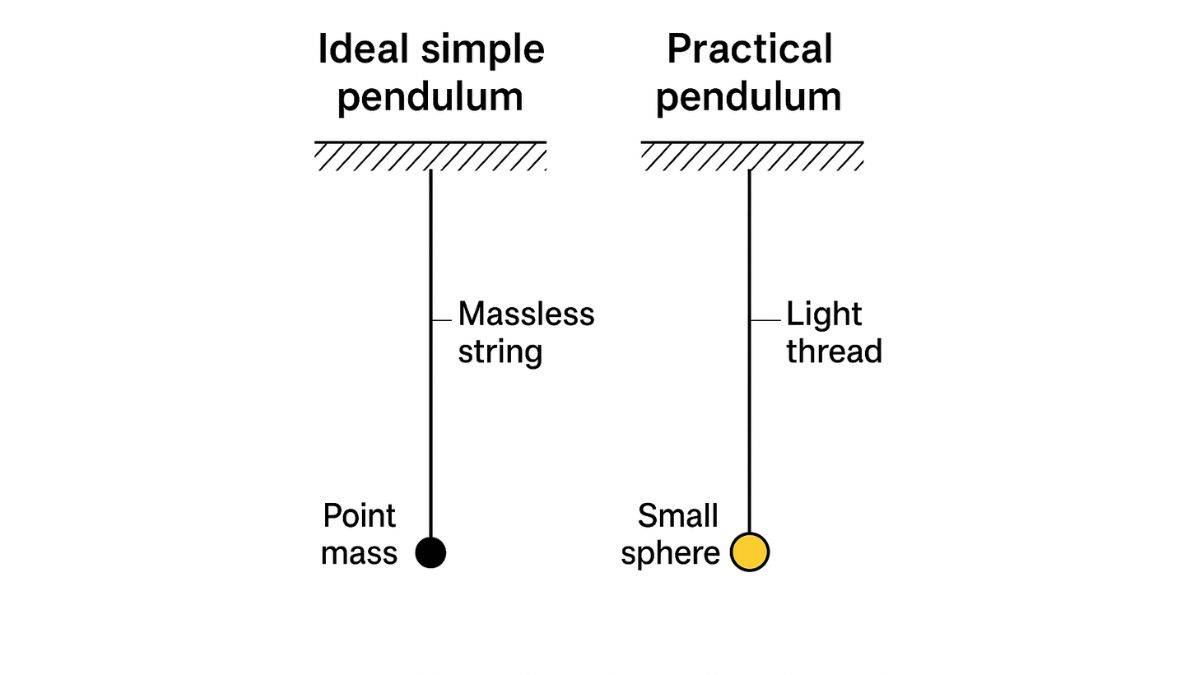
Pendulums are of various types. In the context of simple pendulums taught in Class 11, we can look into two main ones.
- Ideal Simple Pendulum: This is a theoretical model that assumes a point mass with negligible mass and a perfectly flexible, weightless string. The oscillation occurs in a vacuum without air resistance. The NCERT Physics Class 11 textbook focuses on explaining an ideal simple pendulum.
- Practical Simple Pendulum: This is a real-world approximation, such as a small, dense sphere attached to a light thread. This distinction is crucial for understanding the physics of the simple pendulum, as well as the formula.
How and When Does a Simple Pendulum Exhibit SHM?
The simple pendulum is a fundamental concept in physics that serves as a bridge to understanding the principles of simple harmonic motion (SHM). The basic idea behind this periodic motion is that when the string is displaced to a small angle, it swings back and forth under the influence of gravity. Additionally, go through the Gravitation Class 11 Notes.
It’s the restoring force that’s behind the simple pendulum’s motion.
When the bob displaces, gravity, acting along the swing’s arc of movement, pulls it back towards its lowest point. That point is also the equilibrium position, where all common forces acting on it are negligible.
A simple pendulum exhibits simple harmonic motion for small angular displacements.
We can represent that as .
When displaced by an angle , the restoring force is provided by the tangential component of gravity:
But, now, when it comes to small angle approximation (the displacement angle is too small) (expressed in radians), and , where is the arc length and is the pendulum length, we can substitute that into the restoring force as
The force constant (that is based on SHM Force Law) is
And, since the restoring force according to the SHM Force Law is , the motion that is SHM has an angular frequency
What Determines the Time Period of a Simple Pendulum's Swing?
The time period (T) is the time the simple pendulum takes to complete one full back-and-forth swing.
This time period is affected by only two factors.
- Pendulum's length and
- Acceleration due to gravity.
Formula for Time Period in Simple Pendulum
Formula for Frequency in Simple Pendulum
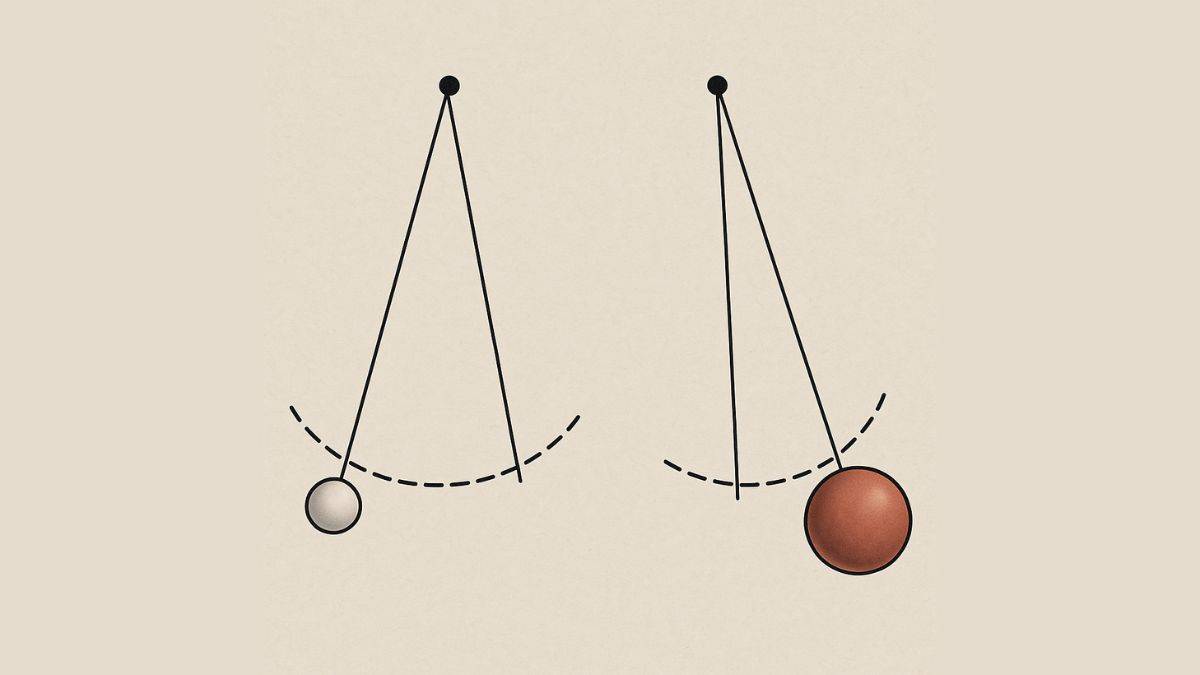
The period depends only on length and acceleration due to gravity , independent of mass and amplitude (for small oscillations).
Role of External Conditions in a Simple Pendulum's Time Period
Remember, we brought up that difference between the ideal and the real simple pendulum earlier?
For an ideal simple pendulum, the time period will always have the expression . But, when considering a simple pendulum, the time period changes under the conditions or scenarios outlined below.
- Length Variation: . If the length increases by a factor of doubles.
- Gravity Variation: . On a planet with increases by .
- Temperature Effect: A wire suspending the bob expands with the temperature, .
The fractional change in period is:
For day.
- Liquid Immersion: If the bob (density ) is immersed in a liquid (density ), effective gravity is:
New period: .
- Electric Field: For a charged bob in a vertical electric field (upward), effective gravity is:
Period:
If is downward, .
- Lift Motion
Lift at rest or constant velocity: .
Lift accelerating upward with .
Lift accelerating downward with .
Free fall , no oscillations
- Horizontal Acceleration: If the suspension point accelerates horizontally with , effective gravity is:
Period:
The string inclines at
- Circular Motion: If the suspension point moves in a circle of radius with speed , effective gravity is:
Period:
Time Period of Second's Pendulum
A pendulum with a period of 2 seconds is a second's pendulum.
On Earth ( ):
On the Moon ( ), .
How is Energy Conserved in a Simple Pendulum?
The total mechanical energy of the simple pendulum is conserved (when you consider there is no air resistance).
But, it's essential to recognise that energy continually transforms between kinetic and potential forms.
The bob's potential energy at angular displacement is:
At the mean position . At the extreme position, , where is the amplitude.
Kinetic energy at the mean position is
Total energy is conserved:
Work done in displacing the pendulum to angle equals the potential energy .
What Happens When a Pendulum's Swing Angle is Large?
For large , and the motion is oscillatory but not SHM. The period increases slightly:
For large amplitudes, numerical methods or series approximations are used.
Simple Pendulum Class 11 Notes
Here are some key aspects to remember about a simple pendulum.
- The Restoring Force is proportional to displacement for small angles. That ensures SHM.
- The time period of a simple pendulum is unaffected by the bob's mass.
- Simple harmonic motion holds only for small angular displacements in a simple pendulum.
Ready for JEE Mains with Simple Pendulum Formula and Concepts?
Revision Notes Physics Class 11
NCERT Solutions Physics Class 11

Commonly asked questions
What is the small-angle approximation for a simple pendulum?
For small displacements, sinθ≈θ (in radians), the small-angle approximation simplifies pendulum motion equations and makes it to approximate simple harmonic motion.
What are the forces acting on a swinging pendulum?
Tension in the string and gravitational force are common forces. These forces are resolved into tangential and radial components.
Is a simple pendulum the same as a simple harmonic motion?
A simple pendulum shows simple harmonic motion only for small angular displacements. Otherwise, its motion is oscillatory but not purely SHM.
Physics Oscillations Exam
Student Forum
 Anything you would want to ask experts?
Other Topics under this Chapter
Other Class 11th Physics Chapters
- Physics Mechanical Properties of Solids
- NCERT Class 11 Physics
- NCERT Class 11 Notes
- NCERT Notes
- Physics Motion in Plane
- Physics Mechanical Properties of Fluids
- Physics Motion in Straight Line
- Physics System of Particles and Rotational Motion
- Physics Oscillations
- Physics Waves
- Physics Thermal Properties of Matter
- Physics Motion
- Physics Gravitation
- Physics Thermodynamics
- Physics Work, Energy and Power
- Physics Units and Measurement
- Physics Laws of Motion