What is IFRS: All About International Financial Reporting Standards

The full form of IFRS is International Financial Reporting Standards. These accounting standards are issued by both the IFRS Foundation and the International Accounting Standards Board (IASB). IFRS constitute a standardised way to describe a company's financial performance. Its aim is to ensure that the financial statements are understandable and comparable anywhere in the world. IFRS is relevant for companies that have publicly listed shares and securities. In the United States, GAAP is still followed.
What are IFRS?
International Financial Reporting Standards (IFRS) are the set of accounting rules used in the financial statements of public companies. By following IFRS, companies can prepare financial statements that are comparable, transparent and consistent.
List of IFRS Standards
The following IFRS standards are stated on the official website and are as mentioned below:
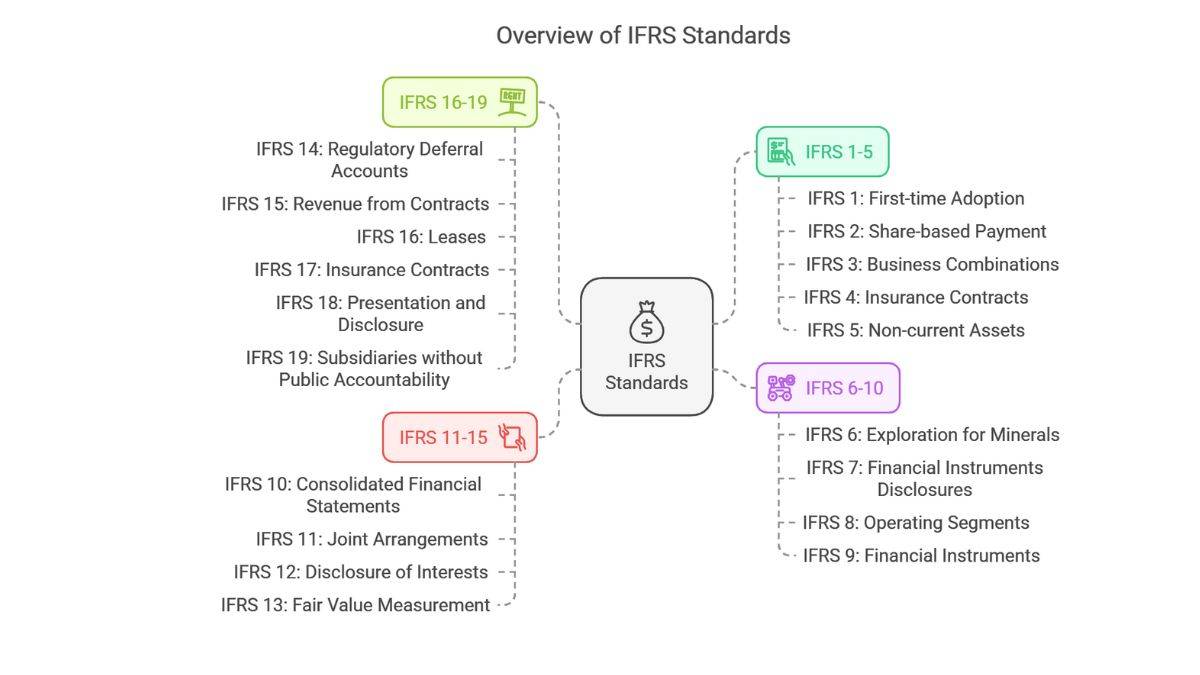
From 1st January 2027, IFRS 18 will supersede IAS 1. This means that IAS 1 will no longer remain effective. For now, IAS 1 is not the same as IFRS.
- What are The Benefits of Learning IFRS Standards?
- Who Can Learn IFRS Standards?
- How To Become Certified in IFRS Standards?
- Online Courses To Learn IFRS Standards in Detail
- Popular IFRS Colleges in India
- Popular Private IFRS Colleges in India
- Popular IFRS Specializations

What are The Benefits of Learning IFRS Standards?
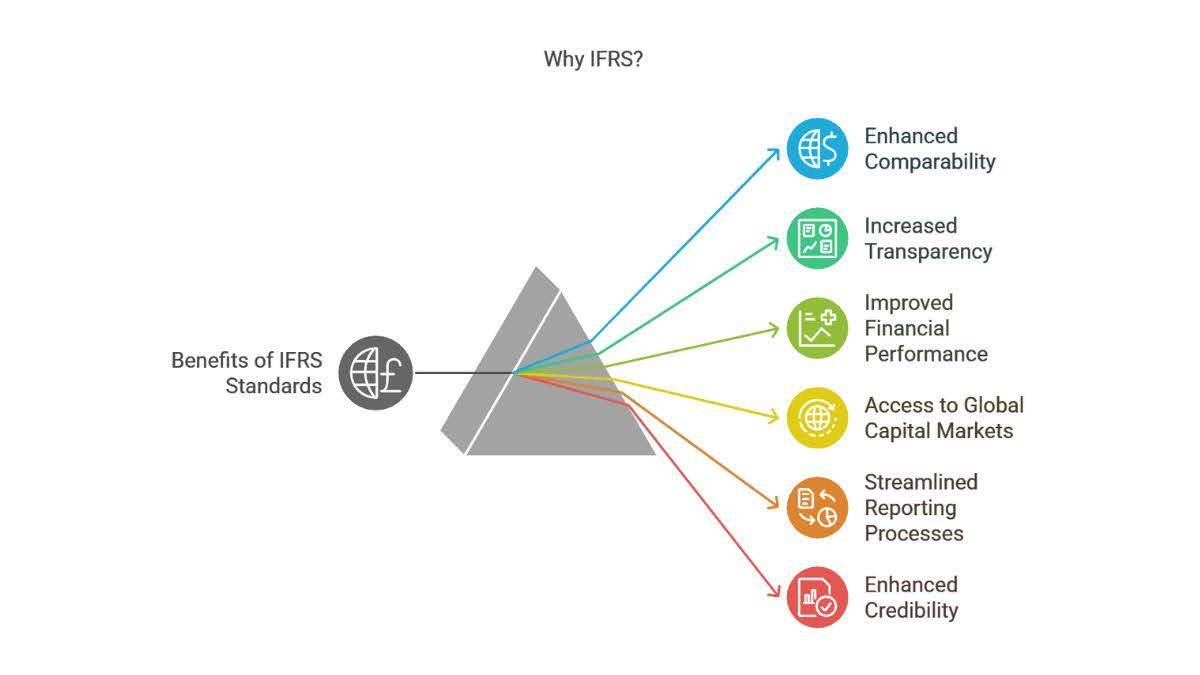
The below mentioned points tell the benefits of IFRS standards:
- Finance professionals who know IFRS can work in foreign countries, as they're accepted and used in over 140 countries globally.
- Those who have the knowledge of IFRS can compare and analyze financial statements from companies worldwide as these standards create a common finance language.
- People who master IFRS standards often have a higher salaries and have access to more senior positions, mostly in multinational companies and international accounting firms where IFRS expertise is highly valued and increasingly necessary.
Knowledge of IFRS is particularly valuable for investment analysts, accountants, and business consultants who need to evaluate companies across different jurisdictions.
Who Can Learn IFRS Standards?
Anyone interested in building a career in the Accounting and Finance domains can learn International Financial Reporting Standards (IFRS). The following people are qualified :
|
Category |
Who Should Learn |
|
Educational Qualification |
|
|
Professional Accountants |
|
|
Industry Practitioners |
|
|
Experience-Based Learners |
|
'Statement of Financial Position' is the balance sheet format used in IFRS. It first presents non-current assets which is followed by current assets, equity, non-current liabilities and at last, it presents current liabilities.
How To Become Certified in IFRS Standards?
Those who want to become certified professionals with the knowledge of IFRS, need to get an FSA credential. By clearing this two-part credential, professionals will be able to integrate sustainability considerations into financial analysis. This will prepare you to lead on disclosure. By getting an FSA credential, a professional will be able to understand how sustainability and financial performance interlink. They will learn to navigate through the complexities of modern business.
1. The FSA Credential Level I exam
This is a 2-hour long exam that consists of 110 MCQs. The following table covers the syllabus of the exam:
|
Part |
Sections |
Topics |
|
Part I: The Need for Sustainability Disclosure Standards |
1. Demand for sustainability information |
|
|
2. The historical basis for disclosure |
|
|
|
3. Materiality: a guiding principle for required disclosure |
|
|
|
4. The limitations of financial disclosure |
|
|
|
Part II: The Sustainability Information Ecosystem |
5. Introduction to the sustainability information value chain and the role of data providers |
|
|
6. The role of standards and frameworks: from fragmentation to cohesion in sustainability disclosure |
|
|
|
7. Materiality: going beyond investors |
|
|
|
8. Sustainability disclosure across jurisdictions |
|
|
|
Part III: Understanding IFRS Sustainability Disclosure Standards |
9. What is useful sustainability-related financial information? |
|
|
10. The IFRS Sustainability Disclosure Standards |
|
|
|
11. Setting IFRS Sustainability Disclosure Standards |
|
|
|
12. How companies disclose sustainability-related financial information |
|
|
|
Part IV: Corporate and Investor Use: Going Beyond Disclosure |
13. A closer look: investor demand for sustainability information |
|
|
14. Considerations for corporate use |
|
|
|
15. Considerations for investor use |
|
2. FSA Credential Level II Exam
The level II FSA credential examination which is 2 hours long and consists of 55 MCQs related to 13 miniature case studies. Those who are sitting for the level II exam need to understand that the exam test the candidate's ability to analyse the sustainability performance of the company using quantitative and qualitative financial and sustainability data. The following table provides the complete syllabus of the exam:
|
Part |
Topic |
|
Part I: Identifying the Sustainability Issues Relevant to Financial Performance |
|
|
How a Company’s Circumstances Influence Material Sustainability Issues |
|
|
Understanding Sustainability Issues |
|
|
Evaluating Sustainability Issues |
|
|
Part II: Evaluating the Comparability of Sustainability Information |
|
|
Normalizing Data for More Effective Comparisons |
|
|
Analyzing the Spread of Industry Performance |
|
|
Considering Company-Specific Context |
|
|
Part III: The Connection Between Sustainability Performance and Valuation |
|
|
Characterizing Financial Impact |
|
|
Using Sustainability Data in Financial Valuation |
|
|
Integrating ESG Beyond DCF |
|
Currently, there are 17 IFRS standards in application. By 1st January 2027, IFRS 18 and 19 will also be in application.
Online Courses To Learn IFRS Standards in Detail
The following online courses are relevant for those who want to learn about IFRS standards in detail:
| Course | About the Course |
| IFRS - International Financial Reporting Standards | In this course, the set of accounting standards IFRS are discussed that govern how different types of transactions and events should be reported in the financial statements. |
| Certificate in IFRS | This course is suitable for finance professionals who want to understand the structure of the IFRS framework. Through this course, the students will learn to apply relevant financial reporting standards to important elements of financial reports. They will also learn to identify and apply disclosure requirement for companies in the financial reports. |
| Diploma in International Financial Reporting (DipIFR) | Professionals who have enrolled in this course will understand the conceptual framework of financial reporting and learn to apply them. They will also learn to prepare group financial statements including subsidiaries, associates and joint arrangements. Group cash flow statements are not included. |
Popular IFRS Colleges in India
#6 India Today
Popular Private IFRS Colleges in India
Accounting & Commerce Applications open. Apply Now
#46 The Week
Accounting & Commerce Applications open till Sep 29, 2026. Apply Now
Popular IFRS Specializations
Popular Specializations
- IFRS
1 College
News & Updates

Student Forum
 Anything you would want to ask experts?
Answered 11 hours ago
Yes. Some colleges in Jaipur offer B.Com with ACCA built into the course. That one costs around INR 4.7 Lacs in total at one college. CA and CS are separate courses, and you can study them with a regular B.Com. Ask the college how they handle exam leave.
T
Contributor-Level 10
Answered 6 days ago
B.Com is an undergraduate (bachelor's) degree, so B.Com graduates cannot apply for admission to another B.Com program (as they already hold that degree), but they are fully eligible to apply for postgraduate courses like an M.Com or MBA.
S
Contributor-Level 10
Answered a week ago
No. The CFA Scholarship only cuts the exam fee paid to CFA Institute. Coaching, books, local taxes and the separate enrolment fee are not covered by it.
S
Contributor-Level 10
Answered a week ago
Marksheets, a personal statement and ID proof are needed for the CFA Scholarship. Teachers also send a university letterhead letter, a CV and job proof with the form.
S
Contributor-Level 10
Answered a week ago
Only one. You must wait for the reply before you apply again. The CFA Scholarship cannot be clubbed with another CFA Institute scholarship for the same exam booking.
S
Contributor-Level 10
Answered a week ago
Yes. Indian students apply for the CFA Scholarship under the same rules as everyone else. There is no India quota. The exam is given at Indian test centres, so you do not have to go abroad.
S
Contributor-Level 10
Answered a week ago
Anyone who meets the CFA Program enrolment rules can apply for the CFA Scholarship, if they have not booked an exam. Access is need based. Student needs a tied-up college. Professor needs full-time teaching
S
Contributor-Level 10
Answered a week ago
The CFA Scholarship brings the exam fee down to USD 400 under the Access Scholarship. It brings the fee down to USD 600 under the Student and Professor scholarships. All three come with the Premium package.
S
Contributor-Level 10
Answered a week ago
Banaras Hindu University (BHU) only offers B.Com. (Hons.) and does not offer a standard B.Com. (General) program at the undergraduate level.
S
Contributor-Level 10
Answered 2 weeks ago
SRCC scholarships are mainly comprised of need-cum-merit based scholarships to BCom (Hons) students as financial assistance. The scholarships offered at the insitute are mostly awarded on the basis of academic performance of the student and in some cases their background also. Some of the SSRC Schol
a
Contributor-Level 7
Answered 2 weeks ago
The starting salary for a Chartered Accountant (CA) abroad generally ranges from USD 45,000 to USD 75,000 per year (approx. INR 38 L to INR 63 L).
R
Contributor-Level 9
Answered 2 weeks ago
There are two ways for Indian students and professionals to be able to practice as a CA abroad - one by leveraging the mutual agreements that India has with other countries - it renders to reduced number of mandatory exams that need to be taken by Indian students. The second one is to go through the
A
Contributor-Level 9
Answered 2 weeks ago
The United Arab Emirates (UAE), Canada and Australia are widely considered the best options for doing a CA abroad.
A
Contributor-Level 9
Answered 3 weeks ago
To take admission in S.S. Jain Subodh Commerce and Arts College BCom course, students should meet the eligibility criteria. Check below selection process:
- For BCom, minimum 45% of aggregate marks are required in last qualifying exam for students from RBSE / CBSE and any other equivalent Board. Minimu
G
Contributor-Level 10
Answered 3 weeks ago
Yes, students can apply offline for BCom admission in S. S. Jain Subodh Commerce and Arts College. For offline process, students can download the offline application form or obtain the form from the college campus. The duly filled application form shall be submitted to the office either by hand or o
G
Contributor-Level 10
Answered 3 weeks ago
Follow the steps given below know to application process of S.S. Jain Subodh Commerce and Arts College for BCom course:
Apply throught the official website.
Choose learning mode, select BCom.
Fill the online application form.
Pay the application fee in preferred method (credit card/ debit card/ UPI).
G
Contributor-Level 10
Answered 3 weeks ago
Yes, BCom admissions for the 2026-27 academic session at S.S. Jain Subodh Commerce and Arts College are currently open for BCom. Students can apply online and offline for admission.
G
Contributor-Level 10
Answered 3 weeks ago
S.S. Jain Subodh Commerce and Arts College BCom admission are based on the scores of Class 12. To be eligible students must pass Class 12 with 45% aggregate. Candidates are required to participate in the merit-based admission process to be considered for the final admission offer.
G
Contributor-Level 10
Answered 3 weeks ago
Yes, students can get direct admission in BCom at S.S. Jain Subodh Commerce and Arts College. Entrance exams are not required for admission in the college. The selection criteria for BCom admission is based on the scores in last qualifying exams.
G
Contributor-Level 10
Answered 3 weeks ago
No, entrance tests are not required for selection in BCom at S.S. Jain Subodh Commerce and Arts College. The selection for BCom course is based on the merit. Students must submit the scores of last qualifying exams for admission.
G
Contributor-Level 10
Answered a month ago
The fee structure of the BCom course is very diverse due to its specialisation offerings. The BCom fee at Mithibai College ranges between INR 92,160 (BCom General) and INR 4,07,000 (BCom in Accounting and Finance).
Contributor-Level 7
Answered a month ago
Aspirants must score a minimum of 48% in BCom or at least 55% aggregate in EAFM/ ABST to apply for MCom programme at S.S. Jain Subodh Girls College. Admission in MCom programme is purely based on merit of the candidates.
N
Guide-Level 15
Answered a month ago
BMS focuses on logical decision-making, corporate strategy and fixing practical management problems.
BBA teaches you foundations of running a company - covering general administration and leadership skills.
BCom is all about numbers - focusing heavily on accounting, taxation, economics and finance.
Particulars | BMS | BCom | BBA |
|---|---|---|---|
Full Name | Bachelor of Management Studies | Bachelor of Commerce | Bachelor's of Business Administration |
Course Level | Undergraduate | Undergraduate | Undergraduate |
Course Eligibility | Class 12 with 50 per cent marks | 10+2 (Studied Commerce and Accountancy) | 3 years |
Entrance Exams | CUET, XET | IPU CET, CUET, Christ University Entrance Test, and DUET | NMIMS NPAT, SET, AIMA UGAT, CUET, IPM Aptitude Test, IPMAT, and IPU CET |
Popular Colleges | IIM Bodh Gaya, Shiv Nadar University, University of Mumbai | SRCC, Ramjas College, Christ University, Hindu College, Hansraj College, etc. | Manipal University, Chandigarh University, IIM Indore, IIM Ranchi, and Loyola College |
Course Fees | INR 3 Lakh - INR 8 Lakh | INR 3000 to INR 60000 | INR 50,000 to INR 6 Lakh and above |
Job Profiles | Sales Executive, Marketing Executive, Human Resource Executive, Finance Manager, etc. | Financial Analyst, Accountant, Tax Consultant, Accounts Manager, etc. | HR Executive, Marketing Executive, Marketing Manager, Sales Executive, Research and Development Manager, etc. |
Top Recruiters | Reliance, TCS, Honda, Accenture, Deloitte, and so on | ICICI, HDFC, SBI, PNB, RBI, LIC, KPMG, etc. | Tata Consultancy Services (TCS), Hindustan Unilever, International Business Machines (IBM) Corp, Ernst & Young (EY), etc. |
Not
M
Contributor-Level 10
Answered a month ago
To be eligible to apply for BCom at S.S. Jain Subodh Commerce and Arts College, students must have minimum 45% of aggregate marks are required in last qualifying exam for students from RBSE / CBSE and any other equivalent Board. Minimum 60% of aggregate marks is required for students, who are not th
G
Contributor-Level 10
Answered a month ago
S.S. Jain Subodh Commerce and Arts College BCom total tuition fee is INR 48200 - INR 65200. Students must pay additional INR 1500 for Geography and INR 500 for Physical Education.
G
Contributor-Level 10
Answered a month ago
Yes, many top colleges here offer BCom with integrated CA, CS, or CMA support. Christ University is particularly known for this combination. It's a smart move if you're serious about clearing CA early while still doing your degree.
T
Contributor-Level 10
Answered a month ago
To become a Chartered Accountant (full form of CA) after class 12th, you need to first register yourself for the CA foundational course through Institute of Chartered Accountants of India (ICAI).
Then, you need to meet the eligibility criteria and clear the foundational and intermediate exam. You als
B
Contributor-Level 9
Answered a month ago
Yes, ICAI runs multiple scholarship schemes for students pursuing CA course. The scholarships are granted on two basis: need based or merit based.
Here is the scholarships offered by ICAI to CA aspirants -
Scholarship Name | Amount Awarded |
Economically Weaker Intermediate Students | INR 1500 per month |
Economically Weaker Final Students | INR 1500 per month |
Merit-Cum-Need Based Scholarship | INR 2000 per month |
Merit Scholarship | INR 2500 per month |
For more details about the CA Scholarship Scheme, students can click here.
B
Contributor-Level 9
Answered a month ago
If you have a UG degree then you don't need to sit for CA Foundation. Having a UG degree gives you an instant pass to sit for CA Intermediate level.
Stage | Eligibility | Duration |
|---|---|---|
Eligibility Check | Must be a graduate/postgraduate with: • Commerce stream – 55% marks • Other streams – 60% marks | Immediately after Graduation |
CA Intermediate Registration | Direct entry into Intermediate level (Foundation exempted) | Immediate |
Orientation + IT Training | Must complete 4 weeks of Integrated Course on Information Technology and Soft Skills (ICITSS) | 1 month |
Articleship (Internship) | Begin after completion of ICITSS | 2 years |
CA Intermediate Exam | Eligible after 8 months of study period post-registration | 8 months study period |
CA Final Preparation | Eligible to appear in Final 6 months before articleship completion | 6–8 months |
CA Final Exam | After completing 2 years of articleship | - |
Total Minimum Duration | From graduation to CA Final result (if cleared in first attempt) | 3.5 to 4 years |
B
Contributor-Level 9
Answered a month ago
It was approximately the annual fees was in the Sharda first grade college 9,200 to 12,200 per annum and it was depending upon the undergraduate courses like BCom BCom computers general MBA.
BA -9,190
B com- 9,200 to 12,200
M
Beginner-Level 2
Taking an Exam? Selecting a College?
Find insights & recommendations on colleges and exams that you won't find anywhere else
On Shiksha, get access to
- 67k Colleges
- 1k Exams
- 717k Reviews
- 1850k Answers
IFRS is the widely accepted set of accounting standards that are implemented in over 140 countries. GAAP is the generally accepted accounting principles that are accepted in the United States for financial reporting.