 / Preparation Maths Trigonometry
Ever noticed the wall clock? The minute and hour hands of the clock make different angles every moment. When the hour needle points to 12 and the minute to 3, then they make an angle of 90 degrees (right angle). Angles play a vital role in making instruments, vehicles, and everyday items. A minor defect while calculating the angle can cause big trouble.
Angles are the basic concept in Math and Physics. They play a crucial role in various fields of geometry, trigonometry, and engineering. The two main ways to measure the angle are degrees and radians. A degree is used in higher mathematics, while an angle is often measured in radians. To convert degrees into radians, the formula is
Radian = Degree * 𝜋/180
Suppose you are building a house, and all pillars of the house must be 90 degrees or any angle that depends on the design and structure of the house. If there is any defect while calculating the angle of the pillar, it will not be able to hold the weight of the structure balanced upon it, and it may collapse.
- Trigonometric Functions
- How to convert a negative degree to radians?
- Weightage of Topic in Respective Class
- Illustrative Examples
- Frequently Asked Questions (FAQs)

Trigonometric Functions
An angle can be measured in both degrees and radians. When an object finishes one revolution from point A to point A in an anticlockwise direction, it can either be denoted by 360 degrees or 2π when measured in radians.
Formula to Convert Degrees to Radians and vice-versa:
- Degree to radian conversion
One radian is equal to 180 degrees. Therefore, to convert the measurement of an angle from degrees to radians, we will multiply it by π/180.
Therefore, the degree to radian formula is given by Degree x π/180.
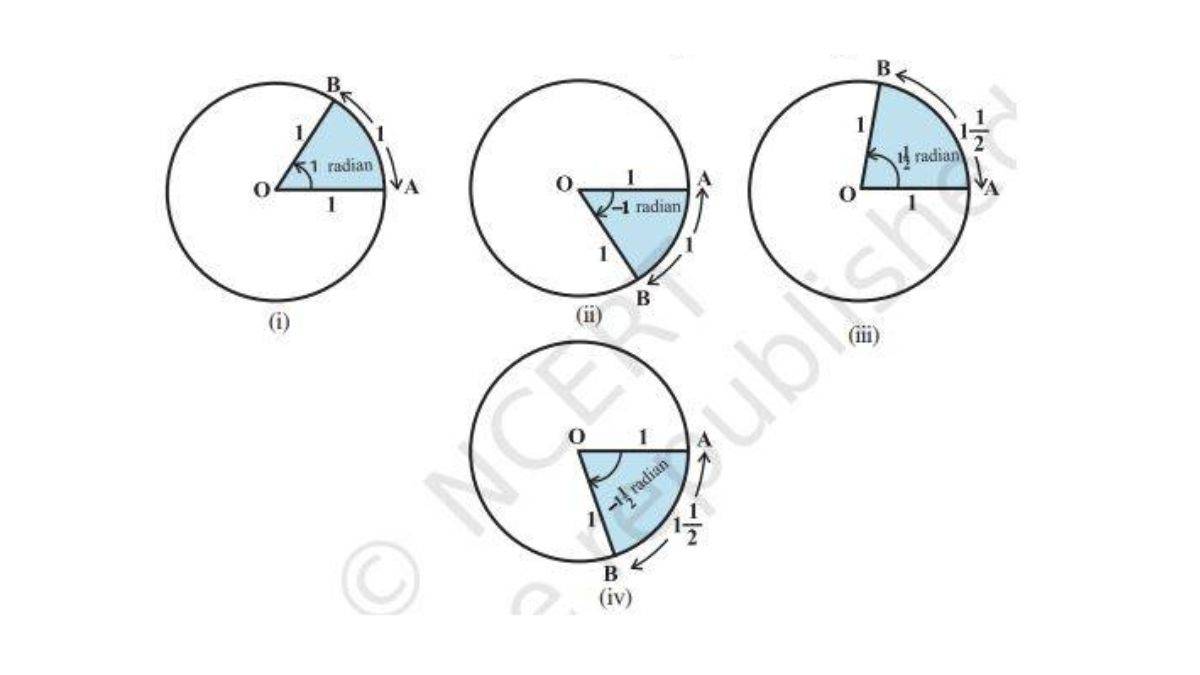
The above image shows a pictorial representation of 1, -1, 1 ½ and -1 ½ radians.
- Radian to degree conversion
Conversely, we can use the following formula while converting the measurement of an angle from radians to degrees:
Radian to degree formula = Radians x 180/π.
How to convert a negative degree to radians?
To convert a negative degree to radians, you need to follow the same formulas as when the degree is positive. However, instead of multiplying the positive degree here, we will multiply π/180 by the degree’s negative value.
Therefore, the formula to convert a negative degree to radians can be given as below:
Degree to Radians (Negative) = π/180 x (-degrees)
Conversion Chart: Degrees to Radians
The table below shows the values of angles in degrees and their corresponding values in radians:
| Degrees |
Radians |
Approximate Value of Radians |
|---|---|---|
| 30° |
π/6 |
0.524 |
| 45° |
π/4 |
0.785 |
| 60° |
π/3 |
1.047 |
| 90° |
π/2 |
1.571 |
| 180° |
π |
3.142 |
| 360° |
2π |
6.283 |
Weightage of Topic in Respective Class
The degree to radian conversion and radian to degree conversion is covered in the topic of Trigonometric functions in Class X. It carries a weightage of 2 to 4 marks as it is a simple conversion.
Illustrative Examples
1. Convert 150 degrees to radians.
Sol: The formula to convert degrees to radians is given below:
Angle in radians = Degrees x π/180 = 150 x π/180 = 5 x π/6
Now, as per the degree to radian conversion chart, π/6 = 0.524
Therefore, angle in radians = 5 x π/6 = 5 x 0.524 = 2.62 radians.
2. Convert 480 degrees into radians.
Sol: As per the formula, Angle in radians = π/180 x degrees = π/180 x 480
= (π/3) x 8
As per the degree to radian conversion chart, π/3 = 1. 047
Therefore, Angle in radians = 1.047 x 8 = 8.376 radians.
3. Convert 10 radians into degrees.
Sol: As per the formula to convert radians to degrees,
Angle in degrees = 180/π x radians = 180/π x 10
Now, the value of π is 3.142 approximately as per the degree to radian conversion table. If we substitute this value for π in the given example, we get
Angle in degrees = 180/3.142 x 10 = 57.29 x 10 = 572.9 degrees approximately.
Frequently Asked Questions (FAQs)
Q: How much is the value of one degree in radians?
Q: How much is the value of one radian in degrees?
Q: Where is the use of radians for angle measurement more convenient in mathematics?
Q: How is a circle represented in radians?
Q: Where did the term radian first appear?

Maths Trigonometry Exam
Student Forum
 Anything you would want to ask experts?
Popular Courses After 12th

Exams accepted
CA FoundationExams accepted
ICSI ExamExams accepted
BHU UET | GLAET | GD Goenka TestBachelor of Business Administration & Bachelor of Law
Exams accepted
CLAT | LSAT India | AIBEExams accepted
IPMAT | NMIMS - NPAT | SET
Exams accepted
BHU UET | KUK Entrance Exam | JMI Entrance ExamBachelor of Design in Animation (BDes)
Exams accepted
UCEED | NIFT Entrance Exam | NID Entrance ExamBA LLB (Bachelor of Arts + Bachelor of Laws)
Exams accepted
CLAT | AILET | LSAT IndiaBachelor of Journalism & Mass Communication (BJMC)
Exams accepted
LUACMAT | SRMHCAT | GD Goenka Test