KMAT MCA Pattern 2025: Know Marking Scheme & Exam Duration

Karnataka Management Aptitude Test 2025 ( KMAT )

This exam is conducted for courses given below:
Saumya Jain
Updated on Feb 11, 2026 22:48 IST

By Saumya Jain, Assistant Manager- Content

KMAT exam pattern 2026 mentions subjects, type of questions, marking scheme, weightage and other important details about the question paper. Karnataka Private Post Graduate Colleges Association (KPPGCA) will conduct the KMAT exam 2026 in a single session, in a home-based remote online proctored test mode. Students will not be required to visit the exam centre to take the exam, they can take the exam from their homes. The KMAT 2026 question paper will have 3 sections. Candidates taking the exam can check the exam pattern of KMAT 2026.

Table of contents
  • KMAT Exam Pattern 2026 Highlights
  • KMAT Exam Pattern 2026 Section-wise Weightage
  • KMAT 2026 Marking Scheme
  • KMAT Exam Difficulty Level
  • KMAT Syllabus 2026: Important Topics
  • Some Important Points for KMAT 2026 Exam Day
  • FAQs Regarding KMAT Exam Pattern
View More
KMAT Logo

KMAT Exam Pattern 2026 Highlights

Look at table below to get an overview of KMAT exam pattern.

Exam structure

Details

Test mode

IBT test mode or home-based remote proctored mode

Number of sections

3 sections

Subjects

  • Verbal & Reading Comprehension
  • Quantitative Aptitude
  • Logical Reasoning

Duration

2 hours

Number of questions

120 MCQs

Total marks

120 marks

Language of paper

English

Number of answer choices

4


Q&A Icon
Commonly asked questions
Q:   What is the duration of the KMAT exam and can I change my exam slot?
A: 

The KMAT exam is held for two hours or 120 minutes. There is only one slot for the KMAT exam. KMAT exam does not have a sectional time limit. This means, that the candidates can solve the question paper with ease without worrying about the sectional timer. However, they must complete the question paper within the overall time limit. Candidates must take care of saving their answers at every step as the moment 120 minutes will get over, the test will automatically stop. There is no provision of changing the exam slot. And there is no provision to apply for the same. Candidates will have to appear for the exam at the time as mentioned on their KMAT Karnataka admit card. Candidates must make sure that they setlled on their seats and have logged in at least 15 minutes prior to the exam time. In case, candidates find any technical difficulty in logging in, they will have the time window to get it resolved. 

Q:   What is the exam mode of KMAT?
A: 

KMAT Karnataka exam will be held in the home-based remote proctored mode. Candidates can now take the exam from the safe environment of their homes. They do not have to choose the exam city and visit any KMAT exam centre in order to take the exams. They can fill the KMAT application form online and take the remote proctored online exam through the link given to the candidates on the exam day or as mentioned in their KMAT admit card.

The KMAT exam was earlier conducted in paper-based test mode. But due to the COVID-19 outbreak, in 2021 and 2022, the exam was conducted in internet-based test mode. 

KMAT Logo

KMAT Exam Pattern 2026 Section-wise Weightage

Check out the table below to understand the sectional weightage in the KMAT Karnataka 2026 exam.
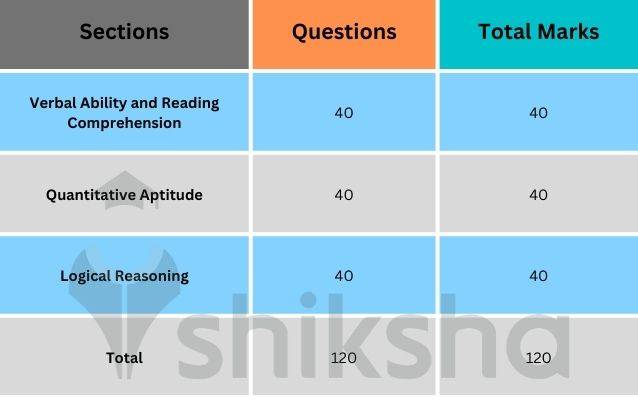
KMAT sectional weightage

KMAT sectional weightage

Sections

Questions

Total Marks

Verbal Ability and Reading Comprehension

40

 40

Quantitative Ability

40

 40

Logical Reasoning

40

 40

Total

120

120

Also Read:
Q&A Icon
Commonly asked questions
Q:   What is the syllabus of KMAT exam?
A: 

KMAT syllabus includes all the important topics of subjects that are relevant for business and general aptitude. For KMAT exam, candidates have to study, Verbal Ability and Reading Comprehension, Quantitative Ability and Logical Reasoning. Given below are the key topics included in the KMAT syllabus: -

The Verbal Ability and Reading Comprehension section of KMAT exam syllabus includes various topics of Grammar, Word Meaning, Vocabulary, Parajumbles, Fill in the Blanks, Sentence Completion, Synonyms and Antonyms, Reading Comprehension, etc.

The Quantitative Aptitude section of KMAT syllabus includes all the topics of Mathematics from Class 9 to 10 such as Arithmetic, Geometry, Algebra Trigonometry Modern Math, Number System and Mensuration.

The Logical Reasoning syllabus of KMAT exam includes topics that require analytical interpretation of data presented in the form of Puzzles, Pie Charts, Venn Diagram, Tables and Bar Graphs.

Q:   What is the marking scheme of KMAT?
A: 

Markign scheme of KMAT exam is as follows:

  • +1 mark for correct answers
  • No negative marking
  • 120 MCQs
Q:   Will the KMAT exam be conducted in double shifts?
A: 

No, the KMAT exam will be conducted only in single shift. Since the COVID-19 pandemic, the KPPGCA, exam conducting authority, has resolved to the remote-proctored mode. Even then, the exam will only be conducted in one shift on a single day. KMAT exam pattern has not changed much since past few years. KMAT exam was conducted in the internet-based test mode in the morning shift on September 7, 2025. The shift timings for both the courses, MBA and MCA will be the same.

KMAT Logo

KMAT 2026 Marking Scheme

Marking scheme for KMAT 2026 is as follows:

Answer type Marks per question
Correct answer +1 mark
Incorrect Answer No negative marking
Unanswered No marks given or deducted


Q&A Icon
Commonly asked questions
Q:   How much time is needed for KMAT preparation?
A: 

Ideally, candidates should dedicate at least six months to prepare for the KMAT exam. This time would help them grasp the concepts which are tested in the KMAT exam, build a solid foundation and still have enough time for revision.
Generally, candidates spend two to six months preparing for the KMAT exam. The syllabus of the KMAT exam is not very difficult. But, one also has to spend ample of time in practice sessions and mock tests to be able to master all types of KMAT questions - easy, moderate and tough.
Students can dedicate at least three to four hours everyday during the course of their KMAT preparation.

Ultimately, the key to successful KMAT preparation is consistency, a well-structured study plan, and regular practice.

Q:   What is the KMAT exam duration?
A: 

The KMAT exam is held for two hours or 120 minutes. There is only one slot for the KMAT exam. KMAT exam does not have any sectional time limit. This means, that the candidates can take the KMAT exam according to their preference and can switch between sections and questions as per their need. There is no provision of changing the exam slot. And there is no provision to apply for the same. Candidates have to take the KMAT exam from the safe environment of their homes as the exam will be conducted in the internet-based test mode and the candidates have to choose their slot for the exam day. 

KMAT Logo

KMAT Exam Difficulty Level

KMAT exam is usually of easy to moderate in terms of the difficulty level. Given below is an analysis of the difficulty level and the number of good attempts based on the previous years’ KMAT exam analysis:

Section KMAT 2026 Difficulty Level (Expected) Good Attempts (Expected)
Quantitative Ability Moderate 29-34
Verbal Ability Easy-Moderate 30-35
Logical Reasoning Moderate 28-32

Also Read: KMAT 2026 Online Proctored Mode Exam Guidelines

Check KMAT cut offs and predict calls from colleges accepting KMAT score for admission. Check Fees, Placement Reviews, Admission, Shortlist Criteria and Eligibility of all KMAT participating colleges by clicking the link below:

Predict KMAT Admission Calls
Q&A Icon
Commonly asked questions
Q:   How much time is needed for KMAT preparation?
A: 

Ideally, candidates should dedicate at least six months to prepare for the KMAT exam. This time would help them grasp the concepts which are tested in the KMAT exam, build a solid foundation and still have enough time for revision.
Generally, candidates spend two to six months preparing for the KMAT exam. The syllabus of the KMAT exam is not very difficult. But, one also has to spend ample of time in practice sessions and mock tests to be able to master all types of KMAT questions - easy, moderate and tough.
Students can dedicate at least three to four hours everyday during the course of their KMAT preparation.

Ultimately, the key to successful KMAT preparation is consistency, a well-structured study plan, and regular practice.

Q:   How many sections are there in KMAT exam?
A: 

The Karnataka Management Aptitude Test (KMAT) question paper will have a total of three sections. These sections are Verbal Ability and Reading Comprehension, Quantitative Ability and Logical Reasoning. Each section in the KMAT question paper carries 40 multiple-choice questions. The candidates will be given a total of 120 minutes to complete the exam. 

Q:   Which are the important topics of the KMAT syllabus?
A: 

Here are some of the important topics for the KMAT syllabus:

SectionImportant Topics
Verbal Ability and Reading ComprehensionReading Comprehension, Grammar, Vocabulary, Sentence Completion, Phrases and Idioms, Para Jumbles, etc.
Quantitative AbilityNumber Systems, Graphs, Arithmetic Equations, Ratio and Proportion, etc.
Logical ReasoningVerbal Reasoning, Analogy, Coding and series, Syllogisms, Assumptions, Venn Diagram, Venn Diagrams, etc


KMAT Logo

KMAT Syllabus 2026: Important Topics

Check the table below to know the important KMAT syllabus topics:

  • Verbal Ability and Reading Comprehension: Reading Comprehension, Grammar, Vocabulary, Sentence Completion, Phrases and Idioms, Para Jumbles, etc.
  • Quantitative Ability: Number Systems, Graphs, Arithmetic Equations, Ratio and Proportion, etc.
  • Logical Reasoning: Verbal Reasoning, Analogy, Coding and series, Syllogisms, Assumptions, Venn Diagram, Venn Diagrams, etc
Q&A Icon
Commonly asked questions
Q:   What is the eligibility criteria to get admission in top MBA colleges accepting KMAT scores in Karnataka?
A: 

General requirements for MBA admission in Karnataka that accept KMAT scores are:

  • Candidates must hold a Bachelor degree or an equivalent in any discipline from a recongised university with a minimum CGPA of 50% or equivalent aggregate
  • Karnataka MBA schools take into account KMAT result; such students must match KMAT cutoff of the participating college
Q:   What are the important topics of the Quantitative Ability section in the KMAT exam?
A: 

Quantitative Aptitude section of the KMAT exam is one of the toughest sections of the three. The QA section tests the candidate's mathematical ablilties. One must be clear on the high school mathematic fundamentals and concepts in order to score well in this section. There will be a total of 40 questions in this section.

The important topics of this section include Numerical Calculations, Algebra, Modern Math, Geometry, Number System, Average, Ratio and Proportion, Percentage, Profit and Loss, Time, Speed and Distance, Mensuration, Quadratic Equation, Probability, Statistics, Pie Chart, Simple Interest, Compound Interest, Common Graphs and Charts, Time and Work, etc. Candidates can use a rough paper for calculations after showing the same to the proctor. Candidates will be required to choose the correct option against the question. 

Consistency, speed and accuracy are the key players if one wishes to ace the Quantitative Aptitude section of the KMAT question paper. Students can refer to books such as Quantitative Aptitude for All Competitive Exams by Abhijit Guha and Pearson Guide to Quantitative Aptitude and Data Interpretation for CAT by Nishit K Sinha. 

KMAT Logo

Some Important Points for KMAT 2026 Exam Day

  • Candidates are not allowed to use any electronic devices such as watches, or cell phones during the KMAT exam.

  • Candidates can use a rough paper during the exam only.

  • The candidate is not allowed to start solving the question paper before the time.

  • It is advisable to be prepared for the KMAT exam at least an hour before the exam starts.

  • Candidates are not allowed to keep anything except their KMAT admit card and photo ID during the exam.

Read More:

Check cut offs of top MBA entrance exams and predict calls from IIMs and other Top MBA Colleges. Check Fees, Placement Reviews, Admission, Shortlist Criteria and eligibility of all MBA Colleges by clicking the link below:

Predict IIM & Non IIM Calls
Q&A Icon
Commonly asked questions
Q:   Can I appear for KMAT on a mobile device or tab?
A: 

No, to appear for the KMAT exam, candidates must have a laptop or a desktop. They must also use a stable internet connection on the device they are using. The exam will be conducted in the online remote proctored mode. It is hence preferred to have the following requirements:

  • Laptop or desktop with a webcam
  • Stable internet connection
  • Compatible browser (Chrome or Firefox)
  • Windows
Q:   What things can I carry to the KMAT exam centre?
A: 

The KMAT exam will be conducted in the internet-based remote home proctored mode. Therefore, there is no need to visit any exam centre to take the exam. The authorities will email the examination link to the candidates who have registered for the exam and paid the application fee. Candidates must however not use any electronic gadgets other than the system they are using to take the exam. Candidates must also keep a printout of the KMAT admit card. Candidates must also not use any unfair means during the exam to avoid cancellation of the exam. 

KMAT Logo

FAQs Regarding KMAT Exam Pattern

Check below the Frequently Asked Question on KMAT exam pattern:

Q&A Icon
Commonly asked questions
Q:   What is the syllabus & exam pattern of KMAT?
A: 
Hello, The KMAT(Karnataka Management Aptitude Test) question pattern is generally Paper-Pen-based test with 120 Multiple Choice Questions divided into three sections (40 each). The exam will have MCQs only. Section wise syllabus for KMAT 2017 is as follows: 1) Verbal Ability & Reading Comprehension: English language ability that would include questions on grammar, vocabulary, sentence completion, synonyms, antonyms, comprehension of passages, etc. 2) Logical and Abstract Reasoning: This section can have questions on verbal reasoning, analogy among others. 3) Quantitative Ability: This section tests the speed and accuracy in math. It may include arithmetic problems involving ratio & proportion, percentage, interest, time & speed, etc. Apart from Arithmetic, the questions may also be based on algebra, geometry, trigonometry, and parts of mathematics. The questions could also assess the quantitative reasoning, interpretation of tables, common graphs & charts.
Q:   What are the important topics of the Logical Reasoning section of the KMAT question paper?
A: 
  1. Syllogisms
  2. Critical Reasoning
  3. Cause and Effect
  4. Statement and Conclusion
  5. Strong and Weak Arguments
  6. Coding and Decoding
  7. Statement and Inference
  8. Data Sufficiency and Interpretation
  9. Arrangements
  10. Blood Relations
  11. Series and Sequences
Q:   How can I crack KMAT in 3 months?
A: 

To crack the KMAT exam in three months, students need to make a KMAT preparation plan which covers the complete KMAT syllabus. They should ensure that they allocate enough time to different topics in the KMAT syllabus based on strengths and weaknesses and still have time for revision. Students should take full length and sectional mock tests for KMAT. This will help them improve their time management skill. To prepare better, students should try to analyse their performance in the mock tests and check the areas where the mistakes have been made. Students can spend more time on improving the weaknesses.

IT & Software exams whose registrations are closing soon

Register now and prepare to increase your chances at top colleges which accept these exams

Registration ends soon
About to start
Exam D-day soon
Registration started
Upcoming registrations
Cut-off released
CUSAT CAT 2026 Application Form

27 Jan '26 - 5 Mar '26

CT SET 2026 Application Form

Feb '26

View allIT & Software exams
qna

KMAT Exam

Student Forum

chatAnything you would want to ask experts?
Write here...

Answered a week ago

Total score of KMAT exam is 120. Each section carries 40 marks. Each question carries one mark.

R

Rashmi Shukla

Contributor-Level 6

Answered a week ago

KMAT is a remote proctored test with a level of difficulty is moderate. Students can gauge difficulty by their understanding of concepts, their level of prep and dedication. 

78438474
Saumya Jain

Contributor-Level 10

Answered a month ago

Rajagiri Business School accepts CAT/ GMAT/ KMAT KERALA/ MAT/ XAT/ CMAT scores for admission to PGDM courses. The admission process also includes GD/ PI and Business Aptitude Test conducted by RBS. 

h

heau mishr

Contributor-Level 10

Answered a month ago

No, KMAT scores are not compulsory for admissions into the MBA course at KSM, Karunya University. There are other scores too, on which school looks upon for selecting the students. Those entrance exams are XAT/CAT/MAT. Thus, students with good scores in any of the following can enroll in the MBA cou

...Read more

I

Indrani Tyagi

Contributor-Level 10

Answered a month ago

KMAT application fee is INR 850, including GST. Students applying for the KMAT exam have to pay the application fee online using online transcation methods. The fee is same for all categories. 

N

Nishtha Shukla

Contributor-Level 6

Answered a month ago

Karunya School of Management accepts KMAT scores for admission to MBA programme. Karunya University conducts KMAT in five phases. The sections in KMAT paper includes:

  • Verbal Ability & Reading Comprehension
  • Data Interpretation & Logical Reasoning
  • Quantitative Ability
  • Indian & Global Business Environment

N

Nishtha Shukla

Guide-Level 15

Answered 2 months ago

General requirements for MBA admission in Karnataka that accept KMAT scores are:

  • Candidates must hold a Bachelor degree or an equivalent in any discipline from a recongised university with a minimum CGPA of 50% or equivalent aggregate
  • Karnataka MBA schools take into account KMAT result; such students

...Read more

R

Rashmi Shukla

Contributor-Level 6

Answered 2 months ago

Yes, the colleges accepting KMAT scores are AICTE approved. Colleges offer MBA/PGDM and MCA courses through KMAT scores. Students can pursue MBA and MCA courses from recognised institutes and get quality education. 


M

Mani Malhotra

Contributor-Level 6

Answered 2 months ago

There is no centralized KMAT counselling process. Students who match the cutoff after the KMAT result announcement will be called  by the participating institutes to take part in the counselling rounds. Students can choose their KMAT institute while filling the KMAT application form. 

R

Rohini Bhatnagar

Contributor-Level 6

Answered 2 months ago

Top specializations offered by top MBA colleges in Karnataka through KMAT scores include:

  • Finance
  • Human Resources
  • Sales and Marketing
  • Business Analytics
  • Operations

N

Nishtha Shukla

Contributor-Level 6

91 Institutes accepting KMAT

    • â‚ı 2.06 Lakh
    • 2 years
    • |
    • Full Time

    Christ University

    Hosur Road, Bangalore • Private

    Christ Uni
    • â‚ı 5.00 Lakh
    • 2 years
    • |
    • Full Time

    Kristu Jayanti University

    Kothanur, Bangalore • Private

    Kristu Jay
    • â‚ı 3.80 Lakh
    • 2 years
    • |
    • Full Time

    Mount Carmel College

    Palace Road, Bangalore • Private

    Mount Carm
    • â‚ı 3.88 Lakh
    • 2 years
    • |
    • Full Time

    Explore more IT & Software exams with upcoming dates

    Last date to apply for March Attempt 27 Feb '26
    CGCUET 2026 Registration 1 Nov '25 - 28 Feb '26
    MAH MCA CET Application Correction Window 26 Feb '26 - 28 Feb '26
    CT SET 2026 Application Form Feb '26
    PTU MCA 2026 Registration, Counselling Fee Payment & Choice Filling Round 1 Jul '26 - Jul '26
    Dates • Cut Off

    News & Updates

    Latest NewsPopular News