 / Preparation English Direct and Indirect Speech
The Rules for Direct and Indirect Speech are an important part of English grammar that help us report a dialogue accurately in writing. Direct speech is when we quote the exact words of a speaker using quotation marks, while indirect speech (or reported speech) conveys the same message without quoting same words. It involves paraphrasing, and making grammatical changes by changing pronouns, verb tenses, and time expressions according to the situation.
Learning the Rules for Direct and Indirect Speech ensures that the original meaning of a statement, question, or command is preserved while adjusting the structure to fit grammatically within a new sentence.
For example:
Direct: She said, "I am cooking dinner."
Indirect: She said she was cooking dinner.
Direct speech: “The cat is sleeping,” he mentioned.
Indirect speech: He mentioned that the cat was sleeping.
How do you change a statement from direct speech to indirect speech?
To change a statement, just change the pronouns, change the tense (hence, “say” to “said, ” or “is” to “was”), and change the time words. E.g., direct: "I am tired," said Emma. Indirect: Emma said she was tired. Remove the quotation marks, use "that" to link the two sentences together, and position yourself in that of the author.
In which case the conversion of direct to indirect speech will remain same?
If the statement is a universal truth or still relevant, verbs won't change typically. For example, the direct speech: "Water boils at 100 degrees," said the professor, and in the indirect speech: The professor said that water boils at 100 degrees. Being a fact, "boils" stays present. This keeps truths that are timeless or current—makes sense.
- What are Rules of Direct and Indirect Speech?
- Rules for Direct and Indirect Speech with examples in English Grammar
- Special Cases & Exceptions for Rules for Direct and Indirect Speech used in English
- Rules for Direct vs Indirect Speech?
- Preparation Tips to Master Rules for Direct and Indirect Speech
- Rules for Direct and Indirect Speech – Common Errors to Avoid
- Rules for Direct and Indirect Speech in Competitive Exams - Importance
- Best Books for Rules for Direct and Indirect Speech in English
- Examples of Rules for Direct and Indirect Speech
- Rules for Direct and Indirect Speech – Practice Exercise with Answers
- Related English Grammar Topics for Preparation
- FAQs on Rules for Direct and Indirect Speech


What are Rules of Direct and Indirect Speech?
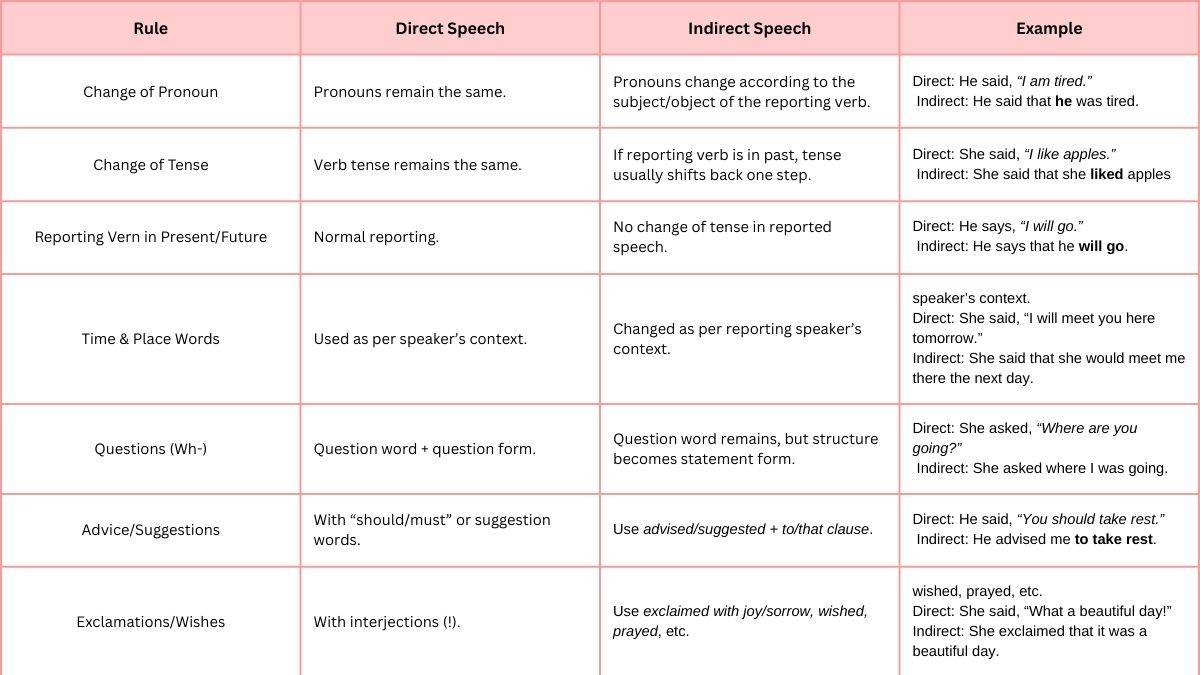
Various factors such as reporting verbs, time, modals, place, pronouns, tenses, punctuations, etc. are considered while changing sentences from direct to indirect ones. Let us discuss each of them below.
Also read: English Nouns
In cases where the verb is in past tense, backshifting is done, which means that the tense is shifted back one step. Thus, words like ‘today’ become ‘that day’, ‘here’ become ‘there’ ,etc.
Questions in indirect form are changed to statements without question marks, using if/whether for yes/no questions and keeping wh-words for information questions.
Let us go through some examples shared below:
- Questions
Direct: He asked, "Where is your office?"
Indirect: He asked where my office was.
- Exclamation
Direct: She said, "Oh no! I missed the plane"
Indirect: She exclaimed with sorrow that she had missed the plane.
- Command/Request
Direct: Saloni said to her, “Please complete it.”
Indirect: Saloni requested her to complete it.
- Question (Y/N)
Direct: They asked, "Do you like basketball?"
Indirect: They asked if I liked basketball.
- Advice
Direct: “Sit down,” she said
Indirect: She told me to sit down.
- Statement
Direct: “I am unwell,” She said.
Indirect: She said that she was unwell.
Also read:

Commonly asked questions
How can I change Direct Speech into Indirect Speech?
To convert Direct Speech to Indirect one must follow the steps given below:
Remove quotation marks.
Use a reporting verb like said or asked.
Change the tense (if necessary).
Example:
Direct: Rohit said, “I will go now.”
Indirect: Rohit said that he would go then.
What are the rules of narration in English grammar?
The direct and indirect speech or narration refers to reporting a speaker's words. Some of the popular key rules include:
Tense shift (present to past)
Changing personal pronouns
Using proper reporting verbs
Adjusting time expressions (e.g., “now”? “then”)
However, these rules differ for assertive, interrogative, imperative, and exclamatory sentences.
What should Class 10 students know about Direct and Indirect Speech?
Class 10 students should have a basic understanding of direct and indirect speech. Some of the common rules are given below:
Basic conversion rules
Sentence types: statements, questions, commands
In order to master the topic applicants are advised to practice through CBSE/ICSE board sample papers
Rules for Direct and Indirect Speech with examples in English Grammar
Students must know that there are certain rules to follow while using Direct and Indirect speech. Let us read about them below:
Rules for Statements
The rules for statements in direct and indirect speech mainly involve changes in pronouns, verb tenses, reporting verbs, and time expressions to ensure the meaning remains the same. In indirect speech, the reporting verb ‘said’ is often followed by the conjunction that, removing the quotation marks. Pronouns are adjusted according to the subject and object of the reporting sentence. If the reporting verb is in the past tense, the verb in the reported speech usually shifts one tense back.
However, universal truths or habitual facts do not undergo tense changes, and if the reporting verb is in present or future tense, the original tense is retained. Time and place expressions like today, tomorrow, or here are also modified. Also, when a statement is addressed directly to someone, ‘said to’ is replaced with ‘told’. By carefully applying these rules, a direct statement can be accurately converted into indirect speech without changing its intended meaning.
For instance:
Direct: Shalini said, "I am happy."
Indirect: Shalini said that she was happy.
Rules of Questions
While applying the rules of questions in direct and indirect speech, the sentence structure changes from a question to a statement. In indirect speech, question marks are removed since the sentence becomes a statement. For yes/no questions, the words if or whether are used to introduce the reported speech. For WH-questions (what, where, why, how, etc.), the question word is retained, but the word order changes to that of a statement rather than a question. Pronouns, tenses, and time/place expressions are also modified according to the standard rules of indirect speech, and 'said to' is replaced with asked or inquired to suit the question format. These adjustments ensure that the meaning of the original question is conveyed clearly while converting into indirect speech.
For example:
Direct: Vikrant asked, "Where are you going?"
Indirect: Vikrant asked where I was going.
Direct: She asked, "Where are you going?"
Indirect: She asked where I was going.
Rules for Commands & Requests
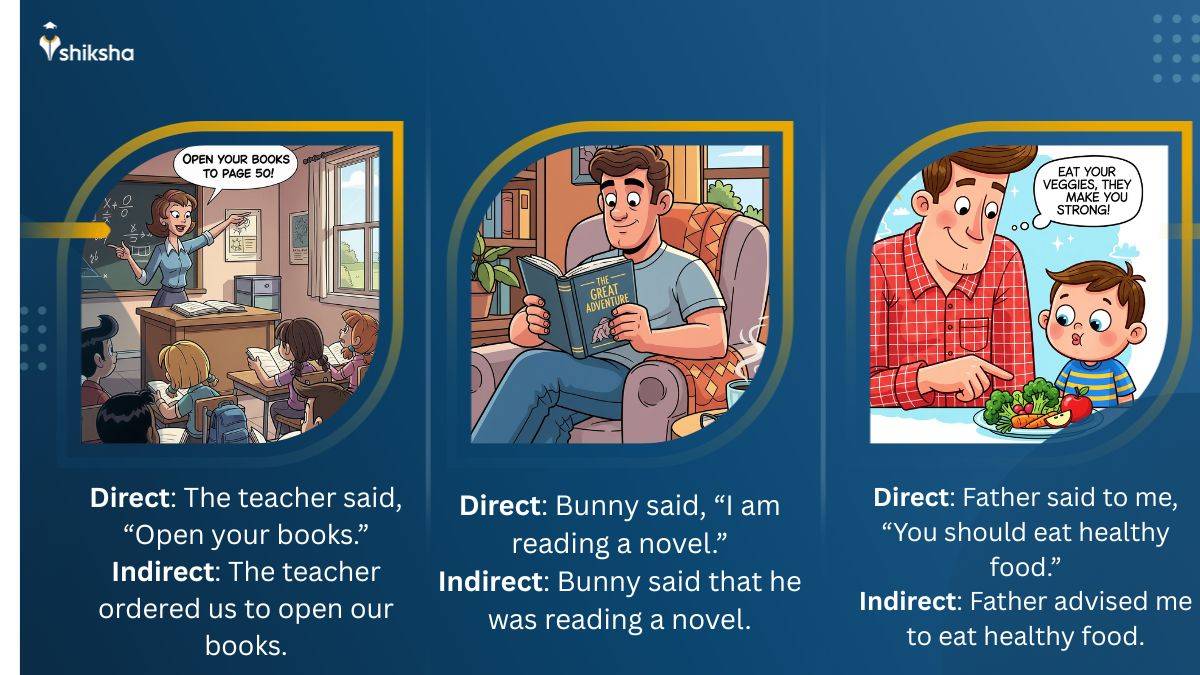
In sentences where the tone is commanding or a request is made, a direct statement is turned to an indirect one by changing the verb to ordered, requested, or asked depending on the speaker’s tone. In case of negative commands, ‘not to’ plus the verb is used.
Examples:
Direct: The judge said, “Hands up."
Indirect: The judge ordered him to get his hands up.
Direct: She said, “Could you please open the window?”
Indirect: She asked him to open the window.
Rules for Advice and Suggestions
When reporting advice or suggestions, verbs like advised, suggested, recommended, or urged are used instead of said. The imperative form of the verb is generally replaced with an infinitive (to + verb), while negative imperatives use not to + verb. Similarly, suggestions are often reported using suggested that + subject + should + verb structure. For instance, She said, 'We should go for a run' changes to She suggested that we should go for a run. In this way, reporting verbs and sentence restructuring help convey the sense of guidance or recommendation from the original speech accurately in indirect form.
Example:
Direct: She said, “You should eat healthy."
Indirect: She advised me to eat healthy.
Rules for Exclamations and Wishes
The rules for exclamations and wishes in direct and indirect speech involve changing the emotional tone of the sentence into a statement while preserving its meaning. Since exclamatory sentences express feelings like joy, sorrow, surprise, or wishes, the reporting verb is usually replaced with words such as exclaimed with joy, exclaimed with sorrow, wished, prayed, or cried out depending on the emotion. Quotation marks and exclamation marks are removed, and the sentence is changed to a statement, often using that.
For wishes and prayers, words like wished or prayed are used. This transformation ensures that the emotional essence of the original sentence is conveyed accurately in indirect speech.
For example:
Direct speech: The man said, “What an intelligent brain he has.”
Indirect speech: The man exclaimed that he had a very intelligent brain.
Rules for Tense Changes (Backshifting)
If a sentence is in past tense, the verb usually shifts a step back while changing it to indirect speech. Sentences in Present Simple change to Past Simple, Present Continuous change to Past continuous and the likes. Future tense sentences also change, for instance ‘will’ becomes ‘would’ etc.
Here are some examples:
Direct: She said, "I like apples."
Indirect: She said that she liked apples.
Direct: Pops said, "I am reading a magazine."
Indirect: Pops said that he was reading amagazine.
Rules for Time & Place Expressions
In Indirect Speech, time and place expressions change to fir the new point of reference. These changes are made only when the reporting verb is in the past tense. If the tense of the verb is in future or present, there is no change usually made in time and place expressions.
For example:
Direct: He said, "It’s raining now."
Indirect: He said it was raining then.
Direct: “I am busy now.”
Indirect: He said he was busy then.
Also Read:
Special Cases & Exceptions for Rules for Direct and Indirect Speech used in English
Let us read about certain special cases and exceptions while using Direct and Indirect Speech.
No Change of Tense with Universal Truths or Facts
The rule of no change of tense with universal truths or facts in direct and indirect speech states that when the statement is always true, a scientific fact, or a general truth, the tense of the verb remains unchanged, even if the verb is in the past tense. This is because universal truths do not depend on time and remain valid irrespective of when they are reported. In such cases, only pronouns or time/place references (if any) are adjusted, but the tense of the main verb is kept the same. This rule helps maintain the accuracy of factual or universally accepted statements while converting them from direct to indirect speech.
For example:
Direct: My grandfather said, “Humans are mammals.”
Indirect: My grandfather said that Humans are mammals.
Direct: Rohit said, ‘We cannot live without water.
Indirect: Rohit said that we cannot live without water.
No Backshift if Verb is in Present/Future Tense
When the verb in a sentence is in the present or future tense, no change is made in the tense of the reported speech. This is because the situation is ongoing or upcoming, so no backshift is required.
Examples include:
Direct speech: She says, "I am learning to make clay pots."
Indirect speech: She says that she is learning to make clay pots.
Direct: Kanishka says, “she is busy."
Indirect: Kanishka says that she is busy.
No Change in Past Perfect Tense
In past perfect tense, there is no change while converting direct sentences to indirect speech sentences, as it already expresses the earliest past action. The verb reported here remains in past perfect irrespective of the its tense.
For example:
Direct speech: He said, "I had already eaten."
Indirect speech: He said that he had already eaten.
Direct: The student said, “I had never seen such a big library.”
Indirect: The student said that he had never seen such a big library.
Modal Verbs Exceptions
In Indirect Speech, some English modal verbs change, while others remain the same. ‘Will’ changes to ‘would’, ‘shall’ to ‘should’, ‘may’ to ‘might’ etc. However, modals like could, should, might, must usually are not changed.
Examples:
Direct: He said, "I can swim."
Indirect: He said that he could swim.
Direct: She said, "I may be sleepy."
Indirect speech: She said that she might be sleepy.
Reporting Questions without Backshift
In Indirect Speech, when reporting questions, no backshift of tense is needed if the reporting verb is in the present or future tense or if the information is still true. The question mark is removed and the sentence is turned into a statement.
For example:
Direct: Smita asks, "Where do you live?"
Indirect: Smita asks where I live.
Direct speech: Rohit will ask, "What day is it?"
Indirect speech: Rohit will ask what day is it.
Mixed Conditionals and Hypotheticals
The rules for mixed conditionals and hypotheticals in direct and indirect speech focus on preserving the sense of imagination, possibility, or unreal situations expressed in the original statement. When reporting such sentences, the tense structure of conditionals is generally maintained because altering them could change the intended meaning. In hypothetical or unreal situations, modal verbs like would, could, might, or should usually remain unchanged. Unlike simple tense backshifts, mixed conditionals and hypotheticals require careful handling to retain their imaginary or contrary-to-fact meaning in indirect speech.
For example:
Direct: Stuti said, "Wish that I were rich."
Indirect: Stuti wished she were rich.
Direct speech: She said, "I may go to Diljit Dosanjh’s concert."
Indirect: She said that she might go to Diljit Dosanjh’s concert.
Also Read: Improve your English vocabulary
Rules for Direct vs Indirect Speech?
Understand the table below to know the clear comparison of Rules for Direct and Indirect speech:
| Particular |
Direct speech |
Indirect speech |
|---|---|---|
| Meaning |
Involves speaker’s exact words quoted within quotes |
Involves reporting speaker’s words without the quotation marks. |
| Quotation marks |
Always used (“ ”). |
Not used |
| Reporting verbs |
Commonly said, asked, told. |
These verbs are changed based on context (said that, asked if, told to, exclaimed with etc.). |
| Pronouns |
Remain the same as spoken. |
Changed according to the perspective of the reporter. |
| Tense |
Stays the same as spoken |
Often backshifted (present to past, past to past perfect), except in exceptions. |
| Time & Place Words |
Used as spoken (now, today, here). |
Changes made to fit context (then, that day, there). |
| Sentence Type |
Remains the same as the original (statement, Q). |
Converted to a statement without question mark or interjections. |
| Example |
She said, “I am busy now.” |
She said that he was busy then. |
Preparation Tips to Master Rules for Direct and Indirect Speech
Mastering the rules for direct and indirect speech requires consistent practice, careful observation, and a strong grasp of grammar fundamentals. The first step is to understand the difference between direct and indirect speech, especially how statements, questions, commands, advice, exclamations, and wishes are transformed. Pay attention to changes in pronouns, verb tenses, and time/place expressions, since these are the most common areas where students make mistakes.
One effective preparation tip is to create a personal chart or table of common tense changes (e.g., present changes to past, past simple to past perfect) and practice rewriting sentences using those rules. Regular exercises on different sentence types will strengthen your understanding, while comparing your answers with correct versions will help identify weak areas. Read and listen to reported speech in newspapers, stories, or conversations as they sharpen your sense of usage. Another useful strategy is to practice converting your own spoken sentences into indirect speech, which reinforces learning in a practical way.
Lastly, focus on special cases such as universal truths, modal verbs, and conditionals, as these often cause confusion. With steady practice, self-checking, and exposure to real examples, you can confidently apply the rules and avoid common errors in exams or writing.
Also Read:
Rules for Direct and Indirect Speech – Common Errors to Avoid
When changing direct speech sentences to indirect ones, students often make common mistakes that can change their meaning. One frequent error is incorrect tense shifting, which implies to forgetting that verbs usually move one step back in time, except when the verb used in statement is in present or future tense or talks about universal truth, such as failing to adjust I, you, we to match and listener and speaker in context.
Mistakes also occur in reporting questions and commands, where students often use direct speech instead of using asked if/whether or ordered/told to.
Careful attention to these details helps ensure accuracy and fluency in reported speech.
Rules for Direct and Indirect Speech in Competitive Exams - Importance
Aspirants of various Government exams, such as SSC, RRB, IBPS, Insurance, etc. should read and practice the rules of direct and indirect speech thoroughly. These exercises test a student’s grammar accuracy and communication skills.
Questions on reported speech often appear in error detection, fill-in-the-blanks and sentence transformation exercises. Students should be careful while answering them as even a minor mistake in tense, pronoun or word order can change the intended meaning of the sentence.
Thorough practice of these rules can help avoid common traps set in exams and ensure clarity in expression, which is essential for both objective and subjective sections.
Also Read:
Best Books for Rules for Direct and Indirect Speech in English
Examples of Rules for Direct and Indirect Speech
Rules for Direct and Indirect Speech – Practice Exercise with Answers
Related English Grammar Topics for Preparation
FAQs on Rules for Direct and Indirect Speech
Commonly asked questions
What does tenses change to in indirect speech?
Tenses tend to backshift in indirect speech; thus, present to past, past to past perfect. Direct: "I eat pizza," says Jack. Indirect: Jack said he had made pizza. This "backshift" is important as it indicates the action came before the speaker. Do not backshift tenses, however, with facts. For example, "the earth is round" remains "the earth is round."
How do I report questions in indirect speech?
To report questions, drop the question word order, if converting yes/no questions, invert using "if" or "whether," as well as changing the tense. Direct: "Are you ready?" asked Mia. Indirect: Mia asked if I was ready. The quotation marks are gone, and the sentence reports like a statement. For "wh-" questions, keep the "wh-" question word. Direct: "Where is it? Indirect: she asked where it was.
What happens to commands in indirect speech?
Commands using the "to" verb structure shift to indirect speech: The direct speech is "Sit down!" shouted Dad. In the indirect speech version: Dad told me to sit down. When converting to indirect speech, the nature of the command softens, quotation marks disappear, and either "told" or "ordered" matches the strength of the command. Requests typically use the same to structure: "Please wait," translates to: He asked me to wait.
Differentiate between direct and indirect speech?
Sentences with Direct speech reports the exact words of the speaker, as spoken by him/her, within quotation marks, while indirect sentences conveys the meaning of the message without quotation marks.
For example:
Direct: She said, "I am happy."
Indirect: She said that she was happy.
How do pronouns change in indirect speech?
In Indirect Speech, pronouns change according to the perspective of the speaker and listener.
Direct: Pinky said to me, "I will help you."
Indirect: Pinky told me that she would help me.
Here, 'I' becomes 'she', and 'you' becomes 'me'.
How are questions reported in indirect speech?
In indirect speech, questions are changed to statements without any question mark. If the question starts with a WH-word, it remains as is. If it is a Yes/No question, we use if or whether.
For example:
Direct: Maya asked, "Where are you going?"
Indirect: Maya asked where I was going.
Direct: Pinto asked, "Do you like coffee?"
Indirect: Pinto asked if I liked coffee.
How are commands and requests reported?
In Indirect speech, commands and requests statement carry words like told, asked, requested, ordered followed by an infinitive.
Direct: The principal said, "Turn off the lights."
Indirect: The principal told us to turn off the lights.
Direct: Reema said, "Please help me."
Indirect: Reema requested me to help her.
English Direct and Indirect Speech Exam
Student Forum
 Anything you would want to ask experts?
Other Topics under this Chapter
Other Class 10th English Chapters
- English Past Tense
- English Idioms
- English Punctuation
- English Analogy
- English Interjections
- English Prefixes
- English Adjectives
- English Future Continuous Tense
- English Letter Writing
- English Suffix
- English Grammar
- English One Word Substitution
- English Mood
- English Direct and Indirect Speech
- English Figures of Speech
- English Composition
- English Para Jumbles
- English Reading Comprehension
- English Sentences
- English Auxiliary and Modal Verbs
- English Formation of Words
- English Precis Writing
- English Nouns
- English Adverbs
- Conjunctions
- English Prepositions
- English Verbs
- English Paraphrasing
- English Articles
- English Subject and Predicate
- English Pronouns
- English Tenses
- English Active and Passive Voice
- English Vocabulary
- English Subject Verb Agreement
- English Phrases
- English Synonyms
- English Etymology and Roots
- English Spelling Rules
- English Parts of Speech
- English Gerunds