Law Colleges in India 2026: Courses, Fees, Admissions, Cutoff, Placements
2157 Law Colleges in India 2026: Courses, Fees, Admissions, Cutoff, Placements
India is home to about 2,000+ best Law colleges in India of which 1,055 colleges are privately owned, 335 colleges are owned by the government and 110 are semi-government owned institutions. MHCET Law, CLAT, CUET, TSLAWCET and APLAWCET are the top entrance exams for admission to top Law colleges in India. National Law School of India University, Bangalore, NLU Delhi, Nalsar University of Law, Symbiosis Law School, NLU Kolkata, and GNLU Gandhinagar are the best among the top 25 Law colleges in India.
LATEST UPDATE:
-
The CLAT 2026 exam for admission to the five-year Integrated LLB (UG) and one-year LLM courses will be held on Dec 7, 2025.
India is home to about 2,000+ best Law colleges in India of which 1,055 colleges are privately owned, 335 colleges are owned by the government and 110 are semi-government owned institutions. MHCET Law, CLAT, CUET, TSLAWCET and APLAWCET are the top entrance exams for admission to top Law colleges in India. National Law School of India University, Bangalore, NLU Delhi, Nalsar University of Law, Symbiosis Law School, NLU Kolkata, and GNLU Gandhinagar are the best among the top 25 Law colleges in India.
LATEST UPDATE:
-
The CLAT 2026 exam for admission to the five-year Integrated LLB (UG) and one-year LLM courses will be held on Dec 7, 2025.
- Top Law Colleges in India: Highlights 2025
- Best Law Colleges in India: NIRF Ranking 2025
- List of Top NLUs in India
- Best Law Colleges in India: Admissions 2025
- 4.1 Best Law Colleges in India Accepting MHCET Law
- 4.2 Best Law Colleges in India Accepting CLAT
- Best Law Colleges in India Accepting CUET
- Types of Top Law Schools in India
- Best Private Law Colleges in India
- Best Government Law Colleges in India
- Best Semi Government Law Colleges in India
- Location-Wise Best Law Colleges in India
- 10.1 Best Law Colleges in Uttar Pradesh
- 10.2 Best Law Colleges in Maharashtra
- 10.3 Best Law Colleges in Delhi/NCR
- Highest Salary Offered by Best Law Colleges in India
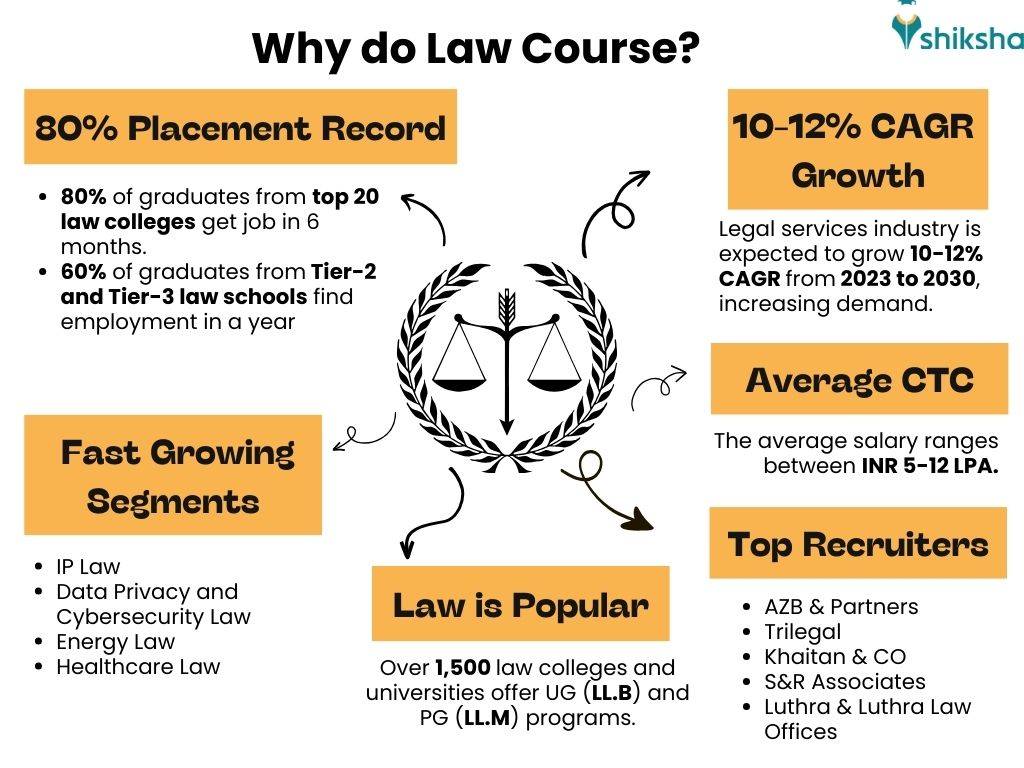
- Top Recruiters for Best Law Colleges in India
- Cost of Studying at Best Law Colleges in India
- Top Specialisations Offered by Best Law Colleges in India
- Best Law Colleges in India: Cut Off 2025
- Best Law Colleges in India: Comparison 2025
Top Law Colleges in India: Highlights 2025
Below are the parameters and statistics for the best law institute in India:
| Parameters |
Statistics |
|---|---|
| No. of Colleges |
2,000+ Colleges |
| Annual Fee |
Free of cost: 22 colleges Less than INR 1 lakh: 696 colleges INR 1-2 lakh: 399 colleges INR 2-3 lakh: 181 colleges INR 3-5 lakh: 218 colleges > INR 5 lakh: 216 colleges |
| Ownership |
Private: 1,055 colleges Government: 335 colleges Semi-Government: 110 colleges |
| Courses |
For UG: For PG: PhD level: |
| Top Colleges |
National Law School of India University, Bangalore, NLU Delhi, Nalsar University of Law, Symbiosis Law School, NLU Kolkata, and GNLU Gandhinagar |
| Specialisations |
Criminal Law, Corporate Law, Intellectual Property Law, Constitutional Law, Human Rights & International Humanitarian Law, Cyber Law, etc. |
| Accepted Entrance Exams |
MHCET Law, CLAT, CUET, TSLAWCET, APLAWCET, TSPGLCET, AP PGLCET, UGC NET, AILET, IPU CET, etc. |
Disclaimer: This information is sourced from official website and may vary.
Best Law Colleges in India: NIRF Ranking 2025
According to NIRF Ranking 2025, these are the top NLUs in India over the past three years:
| Top Law Colleges in India |
NIRF 2023 |
NIRF 2024 |
NIRF 2025 |
|---|---|---|---|
| 1 |
1 | 1 | |
| 2 |
2 | 2 | |
| 3 |
3 | 3 | |
| 4 |
4 | 4 | |
| 7 |
8 | 5 | |
| 9 |
7 | 6 | |
| 6 |
5 | 7 | |
| 5 |
6 | 8 | |
| AMU Ranking | 14 | 12 | 9 |
| 8 |
9 | 10 |
Disclaimer: This information is sourced from official website of the ranking body listed and may vary.
Disclaimer: This information is sourced from official website of the ranking body listed and may vary.
List of Top NLUs in India
NLU stands for National Law University. India is home to 23 National Law Universities (NLUs), which are regarded as some of the top legal schools in the nation. One of the top NLUs, National Law School of India University, Bangalore is ranked No. 1 in law by NIRF 2025.
| NLUs in India |
NIRF Ranking 2024 |
NIRF Ranking 2025 |
|---|---|---|
| 1 |
1 | |
| 2 |
2 | |
| National Academy of Legal Study & Research (NALSAR) University of Law, Hyderabad |
3 |
3 |
| The West Bengal National University of Juridical Sciences, Kolkata |
4 |
4 |
| 8 |
5 | |
| 20 |
21 | |
| 21 |
27 | |
| 22 |
30 |
Disclaimer: This information is sourced from official website of the ranking body listed and may vary.
Best Law Colleges in India: Admissions 2025
The general eligibility criteria for admission to the best Law colleges in India are mentioned below:
- UG: Candidates must have completed their Class 10 and Class 12 from a recognised board with at least 45% marks in aggregate.
- PG:
For LLB: Candidates must have completed their graduation from a recognised board
For LLM: Candidates must possess an LLB or equivalent degree from a recognised university.
Disclaimer: This information is sourced from official website and may vary.
Given below are the various entrance exams for admission to best Law colleges in India:
- MHCET Law: Maharashtra Common Entrance Test for Law is a state-level entrance exam conducted by the State CET Cell, Maharashtra for admissions to law courses offered at participating law colleges in Maharashtra.
- CLAT: Common Law Entrance Test is a national-level entrance exam conducted by the Consortium of NLUs for admission to 5-year integrated LLB (UG) and one-year LLM (PG) courses.
- CUET: Common University Entrance Test is a national-level entrance exam conducted by NTA (National Testing Agency) for admission to various courses at UG and PG level.
- TSLAWCET: Telangana State Law Common Entrance Test for Law is a state-level entrance exam conducted at Osmania University, Hyderabad on behalf of Telangana State Council of Higher Education (TSCHE) Hyderabad for admission to 5 year integrated LLB and 3-year LLB courses offered at Telangana State Level Colleges.
Please refer to the table below for the schedule of popular Law entrance exams for admission to top 10 colleges in India:
| Exam Name |
Exam Name |
Exam Schedule |
|---|---|---|
| over for 2025 |
||
| Over for '25 | ||
| Over for '25 |
||
| Over for '25 |
Disclaimer: This information is sourced from official website of the institute/exam.
Best Law Colleges in India Accepting MHCET Law
MHCET Law scores are accepted by many Law colleges in Maharashtra for admission to undergraduate and postgraduate law programs. Please refer to the table below for the best Law colleges in India that accept MHCET Law scores:
| College Name | Tuition Fee |
|---|---|
| ILS Law College Pune Admission | INR 1.12 lakh - INR 1.89 lakh |
| GLC Churchgate Admission | INR 6,000 - INR 9,000 |
| KC Law College Admission | INR 21,150 |
| Manikchand Pahade Law College Admission | INR 18,040 - INR 29,730 |
| University of Mumbai Admission | INR 1.69 lakh |
Best Law Colleges in India Accepting CLAT
CLAT is a widely accepted Law entrance exam in India. Students can refer below for some of the Law colleges in India accepting CLAT scores:
| College Name | Tuition Fee |
|---|---|
| NLSIU Bangalore Admission | INR 2.69 lakh - INR 13.45 lakh |
| Nalsar University of Law Admission | INR 2.69 lakh - INR 13.45 lakh |
| Nalsar University of Law Admission | INR 65,000 - INR 7.95 lakh |
| NUJS Admission | INR 34,000 - INR 3.66 lakh |
| GNLU Admission | INR 1.2 lakh - INR 6 lakh |
Best Law Colleges in India Accepting CUET
CUET offers a gateway to undergraduate Law programs at various central, state and private universities across India. Listed below are some of them:
| College Name | Tuition Fee |
|---|---|
| NLSIU Bangalore Admission | INR 2.69 lakh - INR 13.45 lakh |
| Nalsar University Admission | INR 65,000 - INR 7.75 lakh |
| NUJS Admission | INR 34,000 - INR 3.66 lakh |
| GNLU Admission | INR 1.2 lakh - INR 6 lakh |
| SOA University Admission | INR 3.4 lakh - INR 8.5 lakh |
Types of Top Law Schools in India
There are mainly two types of law colleges in India:
- National Law Universities (NLUs): Founded by an Act of Parliament of the Indian government, these are public, autonomous universities. There are currently 23 NLUs in India, and they are all recognised as the best legal institutions in the nation. Prominent legal companies and corporations are keen to employ NLU graduates.
- Other Law Colleges: These include government law schools, private law colleges, and universities offering legal programmes. The quality of these colleges varies greatly, with some being quite good. But they are not as esteemed as the NLUs as a whole.
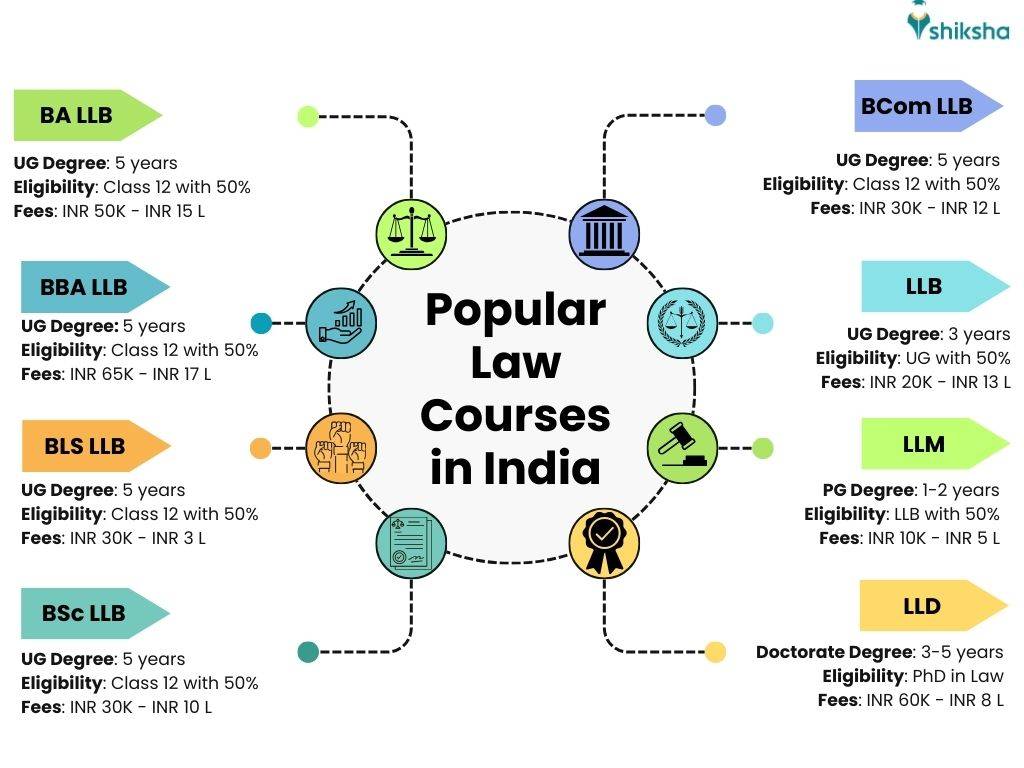
Different kinds of legal degrees are available in India in addition to different law colleges. The three-year Bachelor of Laws (LLB) programme is the most popular undergraduate legal degree. Moreover, there are five-year integrated curricula that combine an undergraduate degree with an LLB. Postgraduate legal degrees include the Master of Laws (LLM) and the Doctor of Philosophy in Law (PhD).
Disclaimer: This information is sourced from official website and may vary.
Disclaimer: This information is sourced from official website and may vary.
Best Private Law Colleges in India
Given below are the best private Law colleges in India out of the top Law colleges in India along with their tuition fees and accepted entrance exam/eligibility criteria:
| Private Colleges |
Tuition Fee |
Eligibility / Exams |
|---|---|---|
| INR 7,000 – INR 22.65 lakh |
MHCET Law, SLAT, etc. |
|
| INR 3.4 lakh – INR 8.5 lakh |
CLAT, SAAT |
|
| INR 1.6 lakh – INR 12 lakh |
CLAT, LPU NEST, etc. |
|
| Saveetha Institute of Medical and Technical Sciences Admission |
INR 1.25 lakh – INR 15 lakh |
Merit-Based |
| INR 1.72 lakh – INR 14.15 lakh |
Christ University Entrance Test (CUET) |
Disclaimer: This information is sourced from official website and may vary.
Best Government Law Colleges in India
Below mentioned are the best government colleges in India for admission to best Law college in India along with their tuition fees and accepted entrance exam/eligibility criteria:
| Public/Govt. Colleges | Tuition Fee |
Eligibility/Exams |
|---|---|---|
| National Law School of India University, Bangalore Admission |
INR 24,800 – INR 13.45 lakh |
CLAT and Merit-Based |
| INR 30,000 – INR 6.75 lakh |
AILET and Merit-Based |
|
| INR 12,000 – INR 7.75 lakh |
CLAT, TSLAWCET, TS PGLCET and Merit-Based |
|
| INR 10,000 – INR 3.66 lakh |
CLAT and Merit-Based |
|
| INR 10,000 – INR 6 lakh |
CLAT and Merit-Based |
Disclaimer: This information is sourced from official website and may vary.
Best Semi Government Law Colleges in India
Given below are the semi-government best Law colleges in India out of the best Law colleges in India afer 12th along with their tuition fees and accepted entrance exam/eligibility criteria
| Semi-Govt. Colleges |
Tuition Fee |
Eligibility / Exams |
|---|---|---|
| MMH College Admission |
INR 11,960 |
Merit-Based |
| Directorate of Distance Education, Kurukshetra University Admission |
INR 5,300 – INR 20,600 |
Merit-Based |
| Shri Nathmal Goenka Law College Admission |
INR 50,000 – INR 52,500 |
MHCET Law |
| INR 60,000 – INR 3.5 lakh |
Merit-Based |
Disclaimer: This information is sourced from official website and may vary.
Location-Wise Best Law Colleges in India
Below mentioned are the state wise distribution for best Law colleges in India:
| State |
No. of Colleges |
|---|---|
| 379 |
|
| 271 |
|
| 209 |
|
| 143 |
|
| 133 |
Best Law Colleges in Uttar Pradesh
Uttar Pradesh is home to about 380+ top Law colleges of which 270+ are private, 30+ are government owned and 20+ are under semi government institutions. Given below are the top Law colleges in Uttar Pradesh:
| College Name |
Tuition Fee |
Eligibility/Exams |
|---|---|---|
| INR 6,000 |
CUET |
|
| INR 5,410 – INR 20,000 |
CUET, BHU PET |
|
| INR 1,400- INR 6.07 lakh |
CLAT and Merit-Based |
|
| INR1.3 lakh – INR 17.75 lakh |
CUET, Merit-Based, etc. |
|
| INR 65,000 – INR 5 lakh |
CLAT, Merit-Based, etc. |
Disclaimer: This information is sourced from official website and may vary.
Best Law Colleges in Maharashtra
Maharashtra is home to about 280+ Law colleges of which 100+ are private, 18 are government owned and the rest 15 are owned by semi-government institutions. Below mentioned are the top Law colleges in Maharashtra:
| College Name |
Tuition Fee |
Eligibility / Exams |
|---|---|---|
| INR 7,000 – INR 20.75 lakh |
MHCET Law, SLAT and Merit-Based |
|
| INR 15,000 – INR 5.25 lakh |
CLAT, MHCET Law and Merit-Based |
|
| INR 3,500 – INR 1.89 lakh |
MHCET Law |
|
| INR 5,000 – INR 3.21 lakh |
CLAT, MHCET Law and Merit-Based |
|
| INR 60,000 – INR 6.98 lakh |
CLAT, MHCET Law and Merit-Based |
Disclaimer: This information is sourced from official website and may vary.
Best Law Colleges in Delhi/NCR
Delhi/NCR is home to about 220+ Law colleges of which 140+ are private, 30+ are government owned and the rest 2 are under semi-government institutions. Please refer to the table below for some of the top Law colleges in Delhi/NCR:
| College Name |
Tuition Fee |
Eligibility/Exams |
|---|---|---|
| INR 30,000 – INR 6.75 lakh |
AILET and Merit-Based |
|
| INR 70,000 – INR 4 lakh |
CLAT, IPU CET |
|
| INR 10,000 – INR 1.38 lakh |
Merit-Based |
|
| INR 78,000 – INR 10.3 lakh |
CUET, GATE, etc. |
|
| INR 1.3 lakh – INR 17.75 lakh |
CUET, GATE, etc. |
Disclaimer: This information is sourced from official website and may vary.
To know more about the best Law colleges in different regions CLICK BELOW:
- Best Law Colleges in Rajasthan
- Best Law Colleges in Gujarat
- Best Law Colleges in West Bengal
- Best Law Colleges in Haryana
Highest Salary Offered by Best Law Colleges in India
Given below are the best Law colleges in India that provides the highest placement package to their students in terms of their tuition fee or in short ROI (Return On Investment):
| College Name |
Tuition Fee |
Annual Median Package |
|---|---|---|
| INR 37,560 - INR 68,900 |
INR 2.5 LPA - INR 27.5 LPA |
|
| INR 10,000 - INR 3.66 lakh |
INR 10 LPA - INR 20 LPA |
|
| Rajiv Gandhi School of Intellectual Property Law IIT Kharagpur Courses |
INR 2.8 lakh |
INR 8 LPA - INR 18.23 LPA |
| INR 5,030 - INR 1.69 lakh |
INR 5 LPA - INR 18 LPA |
|
| INR 22,300 - INR 13.45 lakh |
INR 8.4 LPA - INR 16 LPA |
Disclaimer: This information is sourced from official website/ media reports/ NIRF website and may vary.
Top Recruiters for Best Law Colleges in India
Below mentioned are the best Law colleges in India after 12th that provide the highest placement to their students with their top recruiters:
| College Name |
Annual Median Package |
Top Recruiters |
|---|---|---|
| INR 18 LPA – 84 LPA |
Accenture, Cognizant and Amazon, etc. |
|
| INR 33.67 LPA |
Goldman Sachs, Amazon, Deloitte, Google, Accenture, IBM, etc. |
|
| INR 2.5 LPA – INR 27.5 LPA |
Exceed Management Pvt Ltd, Genpact, HCL, TCS, Infosys, Global Logic, Amazon, etc. |
|
| INR 10 LPA – INR 19 LPA |
Wipro, ICICI Bank, S&B Partners, Trilegal, Bajaj Finance Limited, etc. |
|
| INR 5.5 LPA – INR 18 LPA |
Aditya Birla Group, Airtel, Amarchand Mangaldas, AZB and Partners, BPCL, Deloitte, Goldman Sachs, ICICI Lombard, ICICI, etc. |
Disclaimer: This information is sourced from official website/ media reports/ NIRF website and may vary.
Cost of Studying at Best Law Colleges in India
Please refer to the table below for some of the best Law courses in India in different fee ranges:
| Fee Range |
No. of Colleges |
Popular Colleges |
|---|---|---|
| Less than INR 1 lakh |
696 |
NLSIU Bangalore, NLU Delhi, Nalsar University of Law, etc. |
| INR 1-2 lakh |
399 |
NLUD, Symbiosis Law School, NUJS, GNLU, etc. |
| INR 2-3 lakh |
181 |
NLSIU Bangalore, LPU, KIIT, Amity University Gurugram, etc. |
| INR 3-5 lakh |
218 |
NUJS, SOA University, LPU, etc. |
| > INR 5 lakh |
216 |
Nalsar University of Law, Symbiosis Law School, GNLU, etc. |
Top Specialisations Offered by Best Law Colleges in India
Given below are the various specialisations like Cyber Law, Labor & Employment Law, Business Law, International Trade Law, Commercial Law and many more specialisations offered by best Law colleges in India:
| Specialisation |
No. of Colleges |
Popular Colleges |
|---|---|---|
| 170+ colleges |
Nalsar University of Law, Symbiosis Law School, NUJS, etc. |
|
| 170+ colleges |
Nalsar University of Law, Symbiosis Law School, GNLU, etc. |
|
| 150+ colleges |
NLSIU, Nalsar University of Law, Symbiosis Law School, etc. |
|
| 130+ colleges |
Symbiosis Law School, GNLU, NLIU Bhopal, etc. |
|
| 100+ colleges |
NLSIU, Nalsar University of Law, Symbiosis Law School, etc. |
Best Law Colleges in India: Cut Off 2025
Please refer to the list below for the cut offs of best Law colleges in India:
Disclaimer: This information is sourced from official website/ counselling body and may vary.
Best Law Colleges in India: Comparison 2025
To check the comparison between top Law colleges in India, click the links below:
 All FiltersClear All
- (10)


- (616)
- (544)
- (249)
- (106)
- (87)
- (73)
- (39)
- (16)
- (59)
- (356)
- (456)
Law Colleges in India 2026: Courses, Fees, Admissions, Cutoff, Placements

 Rajasthan - OtherPvt
 MumbaiPvt
 SambalpurGovtAgraPvt
Commonly asked questions On Law Colleges in India 2026: Courses, Fees, Admissions, Cutoff, Placements
Some medical field which offer best work and life balance are shown below -
Dentistry (BDS & MDS) – Fixed clinic hours, fewer emergencies.
Pharmacy (BPharm & MPharm) – Less stress compared to hospital-based jobs.
Physiotherapy (BPT & MPT) – Flexible working hours, minimal emergency calls.
Public Health & Community Medicine – Focus on preventive healthcare rather than emergency treatments.
Clinical Research & Medical Writing – Research-based work with no direct patient responsibilities.
OSOU accepts the Odisha Joint Entrance Examination (OJEE) scores for admission. The OJEE is a state-level entrance exam conducted for admission to various professional courses in the state of Odisha.
Courses like BA, BBA, BCom, BJMC & more are offered for registration. Students who have passed the 12th class grade examination with a 55% mark are eligible to enroll. Also, OSOU provides a variety of specializations for each UG degree course.
| Courses | Eligibility |
|---|---|
| LL.B. | Candidate must have passed graduation from a recognised University/Institute. |
BhilwaraGovtUttar Pradesh - OtherPvtJunagadhPvtKarnataka - OtherPvtPuruliaGovtCommonly asked questions On Law Colleges in India 2026: Courses, Fees, Admissions, Cutoff, Placements
| Courses | Eligibility |
|---|---|
| LL.B. | Candidate must have passed graduation from a recognised University/Institute. |
Both the AP LAWCET and CLAT entrance exam are conducted for admission to the Law schools in India, however, the syllabus for these exams are different on many parameters and candidates should strategise differently for both the exams. AP LAWCET exam has sections including Current Affairs, Legal Aptitude, Contract Law, Constitution, etc. and the CLAT entrance exam sections include English Language, Legal Aptitude, Mathematics, etc. AP LAWCET does not have mathematics subjects, AP LAWCET exam focus more on regional knowledge. CLAT generally covers the deeper aspects of the particular subject.
BidarPPPBhopalPPPYavatmalPPPBangalorePvtCommonly asked questions On Law Colleges in India 2026: Courses, Fees, Admissions, Cutoff, Placements
Both the AP LAWCET and CLAT entrance exam are conducted for admission to the Law schools in India, however, the syllabus for these exams are different on many parameters and candidates should strategise differently for both the exams. AP LAWCET exam has sections including Current Affairs, Legal Aptitude, Contract Law, Constitution, etc. and the CLAT entrance exam sections include English Language, Legal Aptitude, Mathematics, etc. AP LAWCET does not have mathematics subjects, AP LAWCET exam focus more on regional knowledge. CLAT generally covers the deeper aspects of the particular subject.
Both the AP LAWCET and CLAT entrance exam are conducted for admission to the Law schools in India, however, the syllabus for these exams are different on many parameters and candidates should strategise differently for both the exams. AP LAWCET exam has sections including Current Affairs, Legal Aptitude, Contract Law, Constitution, etc. and the CLAT entrance exam sections include English Language, Legal Aptitude, Mathematics, etc. AP LAWCET does not have mathematics subjects, AP LAWCET exam focus more on regional knowledge. CLAT generally covers the deeper aspects of the particular subject.
GulbargaPvtGwaliorGovtHanumangarhPvtImphalPvtAllahabadPvtCommonly asked questions On Law Colleges in India 2026: Courses, Fees, Admissions, Cutoff, Placements
| Courses | Eligibility |
|---|---|
| LL.B. | Candidate must have passed graduation from a recognised University/Institute. |
| Courses | Eligibility |
|---|---|
| B.A. LL.B. | Candidate must have completed 10+2 from any recognised Board/Center. |
| Courses | Eligibility |
|---|---|
| B.A. LL.B. | Candidate must have passed 10+2 from a recognised board. |
PalwalPvtMirzapurAurangabadFatehpurPvtAll over IndiaCommonly asked questions On Law Colleges in India 2026: Courses, Fees, Admissions, Cutoff, Placements
No, you cannot become a lawyer without a Law degree. You mandatorily need to obtain degrees such as BA/BCom/BSc/BBA LLB or LLB in order to be a lawyer in India. To become a lawyer, one must first complete three-year or five-year LLB from a recognised university and possess degree certificate. Then, they must enrol themselves in local Bar Council of the concerned state and enrolled as an advocate. Within two years of the enrolment, they must appear and clear AIBE in order to be eligible to practise anywhere in India.
| Courses | Eligibility |
|---|---|
| LL.B. | Candidates passed graduation or equivalent from recognised university or institution are eligible to apply. |
| Courses | Eligibility |
|---|---|
| B.A. LL.B. | Candidate must have completed 10+2 or equivalent with above mentioned marks in aggregate from any recognised Board/Council. Candidate who have obtained 10+2 Higher Secondary Pass certificate or First Degree Certificate after processing studies in Distance or Correspondence method is eligible. Candidate who have obtained 10+2 through Open University system directly without having any Basic Qualification are not eligible. Candidates who are appearing/appeared for the qualifying examination are also eligible to apply for the Entrance Examination. Such candidate will be eligible for admission only if they produce the provisional/Degree/ certificate of the qualifying examination and the mark lists of all parts/attempts the of qualifying examination at the time of admission. The mentioned marks of SC/ST and OBC is for the candidate belonging to maharashtra State. |
| LL.B. | Candidate must have passed graduation from a recognised University/Institute. |
| Courses | Eligibility |
|---|---|
| B.Sc. LL.B | Candidate must have passed 10+2 with Science (PCM/PCB) stream from a recognised board. |
| B.A. LL.B. | Candidate must have passed 10+2 from a recognised board. |
FutureLearn and Coursera have a similar model of helping learners upskill with the latest courses and university partnerships. Affordability-wise, FutureLearn is better as it costs around INR 1100 per month, while Coursera costs around USD 49 (roughly INR 4500) per month. Another benefit of FutureLearn is that the certificates for its short-term courses online come with CPD credits. That can help freshers and professionals showcase on their LinkedIn profile or while pursuing their college education. While Coursera's certificates are globally known, they do not come with credits.
Maharashtra - OtherJharkhand - OtherPvtRaichurPvt