

JEE 2026 preparation strategy is not just about who studies the most. It is about who studies most efficiently. Know how to select a good preparation resource for JEE preparation 2026 this article.

JEE 2026 Preparation Strategy: Most Trusted Prep Resources & Key Challenges
JEE 2026 Preparation Strategy: With each passing day, lakhs of aspirants are coming closer to the JEE Main and JEE Advanced 2026 exams. Aspirants are now deep into their JEE 2026 preparation phase, and this is the most crucial part of any JEE aspirant’s journey towards their career. But while every student is on the same journey, what is different for each individual is their mode of study, JEE preparation resources, and challenges that they might face.
To better understand how the current batch of JEE 2026 aspirants is preparing, shiksha.com conducted three student polls. The results reveal interesting trends around the most trusted JEE 2026 preparation methods, primary modes of study, and the biggest challenges students face.
These poll results are more than just numbers, as they are a reflection of real struggles and smart choices that JEE 2026 aspirants should be making.
If you are also in the JEE 2026 journey, take hints from the majority and tailor your own JEE Main 2026 and JEE Advanced 2026 preparation strategy based on your unique strengths and weaknesses.
In this article, we break down these insights and offer some JEE 2026 preparation tips that are approved by experts and JEE toppers. These JEE preparation tips revolve around how students can improve their JEE 2026 prep strategy based on the trends we’re seeing among the students nowadays.
| JEE 2026 Preparation: What’s an Ideal Study Environment for Mains and Advanced? |
- Poll 1 Reveals Most Preferred JEE 2026 Preparation Resource: Previous Year Question Papers
- Poll 2 Reveals Primary Mode of JEE 2026 Preparation: Offline Coaching
- Poll 3 Reveals Biggest Challenge in JEE 2026 Prep: Time Management
- What the Three Shiksha Polls Reveal About JEE 2026 Aspirants
- JEE Topper and Expert Tips
Poll 1 Reveals Most Preferred JEE 2026 Preparation Resource: Previous Year Question Papers
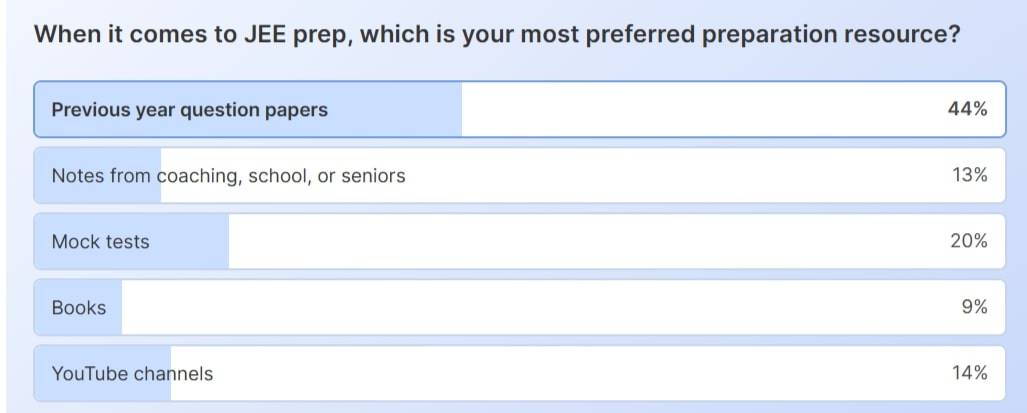
The first poll asked: When it comes to JEE prep, which is your most preferred preparation resource?
The poll revealed the following preferences of the JEE 2026 aspirants:
- Previous year question papers - 44%
- Mock tests - 20%
- YouTube channels - 14%
- Notes from coaching/school/seniors - 13%
- Books - 9%
As it is evident from the poll result, there is an overwhelming preference for previous year question papers (PYQs) to prepare for JEE Mains and JEE Advanced 2026 exams.
When it comes to JEE prep, which is your most preferred preparation resource?
Why JEE Main and JEE Advanced PYQs Matter?
The toppers and experts of IIT JEE Advanced and JEE Mains also vouch for the previous year papers to be the best preparation resources for these highly competitive national-level exams. The reasons for this are:
- Pattern Familiarity: The JEE Main PYQs and the JEE Advanced PYQs help students understand the nature of the question, like difficulty level, framing, and frequently tested topics.
- Time Management: By solving the JEE previous year question papers under timed and mock exam conditions, candidates can build up their exam temperament. This is very helpful for the exam day strategy building. Many toppers use this preparation tip and succeed.
- Smart Revision: PYQs serve as a compact form of syllabus revision and help in identifying high-weightage chapters.
Also Read:
- JEE Main 2026 Chapter Wise Weightage: Physics, Chemistry & Mathematics
- JEE Advanced Chapter Wise Weightage 2026 for Maths, Physics, Chemistry
What You Should Do
- Aspirants can maintain a dedicated file for JEE Mains and Advanced previous year question papers. Preferably, the last 10 years JEE Advanced question papers and the same for JEE Main.
- Start with JEE Main papers from the last 10 years and then move to JEE Advanced once the basics are strong.
- Don’t just solve the JEE PYQS, but also analyse your performance. Keep a log of mistakes and tricky questions to revise regularly.
- Also, note if you are making mistakes in some pattern, like from one particular topic, chapter, or some other hurdle.

Commonly asked questions
Preparation for JEE Advanced begins by knowing exam syllabus. Every student must follow syllabus. Once preparation is done then start solving previous year questions for self-assessment. This will give an overview of your preparation.
You can prepare for all entrance tests at same time. It is a tough task but not impossible. For this a proper strategy is required. Here are some important tips.
- Compare the syllabus: All engineering entrance exams have almost the same syllabus. There might be some additional topics in some exams. The aspirant must study the syllabus for all exams and find out the topics that are extra, and prepare those separately. Almost 90% of the topics will be common for all entrance exams, and hence, syllabus completion for one exam will lead to completion of the syllabus for all the exams.
- Prepare for JEE Mains and incorporate the preparation for all other exams: Apart from JEE Advanced, all the exams are pretty straightforward for a well-prepared candidate. JEE Advanced require a higher level of preparation as the questions are multi-conceptual. However, the state-level entrance exams, and exams like BITSAT, VITEEE, etc., have direct questions. Most of the questions in JEE Mains are also direct and require the application of basic concepts. Hence, the candidates must prepare for one exam, like JEE Mains, that will cover their preparation for all other exams.
- JEE Advanced needs extra effort: For JEE Advanced candidates must focus on time management and building exam day temperament. Learn how to apply multiple concepts to a question.
The bottom line is to prepare for JEE Mains to cover the preparation for all other CETs and exams like BITSAT and VITEEE. For JEE Advanced, work on sharpening your skills of time management, stress handling, multiple concept application, speed and accuracy.
Aspirants must keep in mind that exam difficulty level cannot be determined by organising IIT. JEE Advanced paper is not made by one single IIT; but it is prepared by experts from multiple institutes. Difficulty level of exam is independent of the IIT conducting exam.
Cracking JEE Mains and JEE Advanced is not possible in few days or months, it requires continuous efforts through two long years. If a student is focused and doing the studies regularly, revising the concept on daily basis and solving questions on each topic will definitely going to get success in first attempt.
Poll 2 Reveals Primary Mode of JEE 2026 Preparation: Offline Coaching
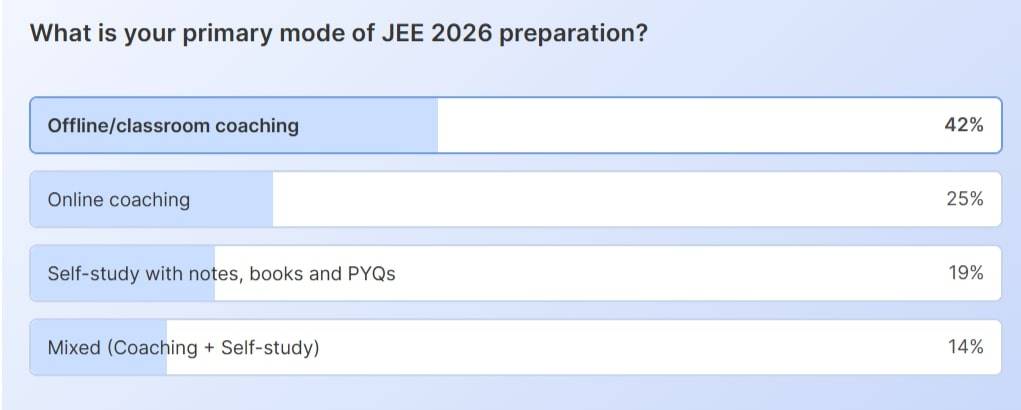
The second poll asked: What is your primary mode of JEE 2026 preparation?
The outcome of this poll was pretty conventional:
- Offline/Classroom coaching - 42%
- Online coaching - 25%
- Self-study with books, notes & PYQs - 19%
- Mixed (Coaching + Self-study) - 14%
Offline or classroom coaching continues to be the most preferred mode, with 42% students choosing it. 25% choose online JEE coaching and 19% of the students rely on complete self-study.
What is your primary mode of JEE 2026 preparation?
Why Offline Coaching Works for JEE Aspirants
- Discipline & Routine: Coaching institutes provide a fixed schedule that keeps students on track.
- Competition Check: It encourages healthy competition and motivation among students.
How to Choose the Right Mode for JEE 2026 Prep?
- Know Yourself: If you are self-disciplined and comfortable studying alone, online, or self-studying might be a better fit.

Poll 3 Reveals Biggest Challenge in JEE 2026 Prep: Time Management
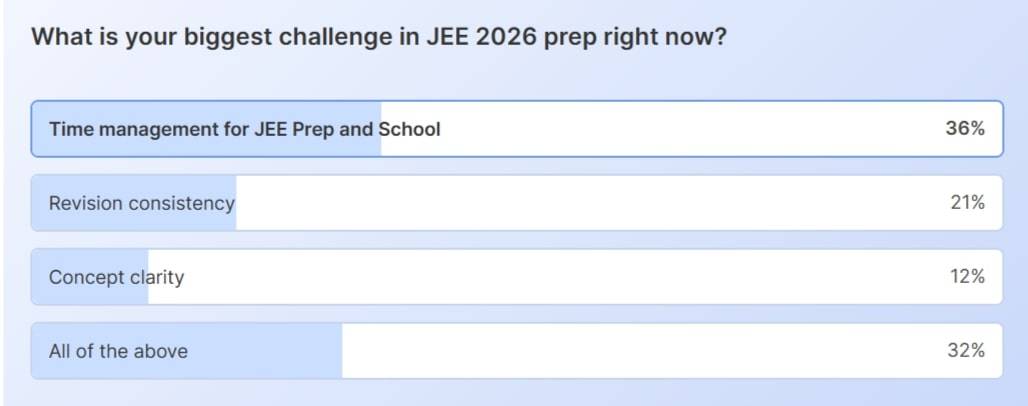
The final poll was: What is your biggest challenge in JEE 2026 prep right now?
A staggering 36% of JEE 2026 aspirants cited that time management is a challenge for them. Especially juggling school exams with JEE prep bothers them the most. While another huge chunk of the respondents, 32%, said they struggle with all three: time, revision, and concept clarity.
Poll Result:
- Time management for JEE + school - 36%
- Revision consistency - 21%
- Concept clarity - 12%
- All of the above - 32%
What is your biggest challenge in JEE 2026 prep right now?
Why is Time Management Hard in JEE Main and Advanced Preparation?
This challenge is faced by many students during JEE preparation because:
- Boards and JEE are both very important exams that a student takes in their academic journey. One cannot prioritise one over the other. Hence, it becomes overwhelming.
- Students have to balance school classes, homework, coaching schedules, and self-study, often leaving little time for breaks or revision.
- The syllabus is vast, and trying to cover everything without a plan can lead to burnout.
Tips to Tackle Time Management in JEE Preparation 2026
Here are some tips to help you with time management in JEE Main preparation 2026 and as well as in JEE Advanced 2026 preparation:
- Make a Weekly Planner: Break down your weekly goals by subject and allocate fixed slots for PYQs, revision, and mock exams.
- Use the 3:2:1 Rule: Spend 3 hours daily on current topics, 2 on previous topics (revision), and 1 hour on mock tests or PYQs.
Also Read: Dropper's Strategy for JEE 2026: IIT JEE Main & Advanced Study Plan
Explore colleges based on JEE Advanced
Want better recommendations?
There is a 90% more chance of getting best college recommendations by sharing preferences.
- Chat with our counselor
- Get your personalised list of colleges & exams matching your preferences
What the Three Shiksha Polls Reveal About JEE 2026 Aspirants
From these polls, it’s clear that today’s aspirants are:
Resource-savvy and seeking familiarity: JEE aspirants today are not wasting time experimenting with random study materials. Most prefer PYQs and mock exams, both of which provide familiarity with the JEE exam pattern, syllabus, and high-weightage topics.
Also Read:
Explore more B.Tech exams with upcoming dates
MET


24 Oct '26
30 Oct '26
1 Jun '26 - 31 Oct '26
31 Oct '26
7 Nov '26
JEE Main
1 Nov '26 - 30 Nov '26
1 Nov '26 - 30 Nov '26
9 Jan '27 - 10 Jan '27
JEE Topper and Expert Tips
Based on the above issues of the JEE 2026 preparation, we have compiled below some expert tips and topper advice.
Integrate Resources Smartly: Don’t try to do everything at once. If PYQs are your focus, make them the centre of your study plan. Use books and YouTube to strengthen weak areas you identify from those questions.
Implement the 60:30:10 Strategy:
- 60% of time - New topics (lectures, coaching, school)
- 30% of time - Practice (mock tests, PYQs)
- 10% of time - Pure revision (notes, formulae, errors)
Do Not Skip Revision Days: Revision is what gives your concepts the needed push and boosts memory retention. Schedule revision sessions weekly, especially for topics you covered one or two months ago.
Also Read: How to Crack JEE Advanced 2026: Get Tips from Past 11 Year Toppers
The conclusion is that you should take inspiration from every tip and advice and use them to make your tailor-made JEE preparation strategy. Be mindful of your strengths and use them as your weapon to beat JEE 2026 and board exams.
All the best to all JEE 2026 aspirants!
Read More:

News & Updates
Explore Other Exams
Oct '26 | JEE Main 2027 Registration Ses... |
Dec '26 | JEE Main 2027 Correction Windo... |
Oct '26 | SRMJEEE 2027 Notification |
Nov '26 | SRMJEEE 2027 Registration Phas... |
Feb '27 | COMEDK Application Form 2027 |
Feb '27 | COMEDK Mock Test Release Date ... |
Oct '26 | MET 2027 application form star... |
Mar '27 | MET 2027 application form star... |
Dec '26 | BITSAT 2027 Application Form S... |
Mar '27 | BITSAT 2027 Form Correction Se... |
19 Aug '26 - 20 Aug '26 | TS EAMCET 2026 MPC Counselling... |
12 Aug '26 - 17 Aug '26 | TS EAMCET 2026 MPC Counselling... |
Student Forum
 Anything you would want to ask experts?
Answered 3 weeks ago
You are not eligible for JEE (Advanced) 2027 because your first appearance for Class 12 was in 2025. For JEE (Advanced) 2027 candidates must have taken their Class 12 (or equivalent) examination for the first time in either 2026 or 2027. Since your first appearance was in 2025 you fall outside this
S
Contributor-Level 10
Answered a month ago
Yes, Indian students can apply for TU Munich Admissions directly after Class 12th, provided they meet the minimum qualifying JEE Advanced score requirement and other program-specific entry requirements.
Students without a JEE Advanced score, will either have to enroll in the Studienkolleg or complete
A
Contributor-Level 10
Answered a month ago
Technical University of Munich generally accepts a JEE Advanced score only for the immediate academic intake to the year the exam was passed (usually within one year).
Universities like TU Munich assess students based on current admission rules, and hence using a scorecard older than admission year i
A
Contributor-Level 10
Answered a month ago
No, the Technical University of Munich does not accept JEE Advanced scores for Master's programs. For entry to PG programs, students need to have completed a UG degree from a recognised Indian college or university, submit relevant documents, and meet the program-specific criteria.
Check TU Munich Ad
A
Contributor-Level 10
Answered a month ago
While evaluating opening and closing rank trends, JEE Advanced cutoffs, and branch allocation dynamics for civil engineering at IIT Bhubaneswar provides a helpful baseline for your academic planning, Lovely Professional University (LPU) serves as an excellent alternative to elevate your engineering
A
Contributor-Level 7
Answered a month ago
The IIT GANDHINAGAR JEE Advanced closing ranksfor the General (open) female only category in 2026 ranked from roughly 5,437 for computer Science and engineering up to 20270 for civil engineering.
m
Beginner-Level 1
Answered a month ago
IIT BHU CSE cutoff 2026 ranged from 1436 in the first round to 1439 in the last round for the General category under the All India quota. Hence, a rank of at least 1439 is needed to qualify for admission to the CSE course. Check the table below to know the overall cutoff range for other categories.
| Category | IIT BHU CSE cutoff 2026 |
|---|---|
| General | 1436 - 1439 |
| OBC | 601 - 601 (R1) |
| SC | 313 - 373 |
| ST | 161 - 170 |
| EWS | 245 - 245 (R1) |
| PWD | 66 - 66 (R1) |
N
Contributor-Level 10
Answered a month ago
IIT BHU JEE Advanced cutoff 2026 ranged from 601 to 7870 in the first round for the OBC AI category. In the last round, the closing cutoff ranged from 601 to 9002 for the aforementioned category. Check the table below to know the Round 1 and last round closing cutoffs for different courses.
| Course | Round 1 Cutoff 2026 | Last Round Cutoff 2026 |
|---|---|---|
| B.Tech. in Computer Science and Engineering | 601 | 601 |
| B.Tech. in Mathematics and Computing | 826 | 845 |
| B.Tech. in Electronics Engineering | 1167 | 1189 |
| B.Tech. in Electrical Engineering | 1497 | 1529 |
| B.Tech. in Mechanical Engineering | 2760 | 3175 |
| B.Tech. in Chemical Engineering | 3394 | 3609 |
| B.Tech. in Engineering Physics | 3490 | 3620 |
| B.Tech. in Civil Engineering | 3834 | 3980 |
| B.Tech. in Materials Science and Technology | 3886 | 4257 |
| B.Tech. in Metallurgical Engineering | 4269 | 4494 |
| B.Tech. in Industrial Chemistry | 4389 | 4681 |
| B.Tech. in Biomedical Engineering | 4798 | 5067 |
| B.Tech. in Biochemical Engineering | 4877 | 5156 |
| B.Tech. in Ceramic Engineering | 4899 | 5245 |
| B.Tech. in Mining Engineering | 5031 | 5329 |
| B.Tech. in Pharmaceutics Engineering and Technology | 5424 | 5776 |
| Bachelor of Architecture (B.Arch.) | 7870 | 9002 |
N
Contributor-Level 10
Answered a month ago
IIT Gandhinagar JEE Advanced cutoff 2026 for the General AI female category ranged from 5437 (CSE) to 20270 (Civil Engineering). Students can check the table below to know the last round cutoff range for other female categories.
| Category | IIT Gandhinagar JEE Advanced cutoff 2026 |
|---|---|
| General | 5437 - 20270 |
| OBC | 2700 - 9008 |
| EWS | 981 - 3973 |
| ST | 369 - 1941 |
| SC | 802 - 4390 |
| PWD | 225 |
N
Contributor-Level 10
Answered a month ago
IIT Bombay cutoff 2026 for the Electrical and Aerospace Engineering courses for the General AI category in the last round was 411 and 2638, respectively. To know the last round closing ranks for other categories, see the table below.
| Category | Electrical Engineering | Aerospace Engineering |
|---|---|---|
| General | 411 | 2638 |
| OBC | 281 | 1546 |
| SC | 130 | 731 |
| ST | 90 | 458 |
| EWS | 110 | 589 |
| PWD | 7 | 103 |
N
Contributor-Level 10
Currently - Deputy Manager, Content
Role - News and Feature Writer, Content Editor
Expertise - Engineering Education and Counselling
Mamona Majumder specialises in news and feature writing and content editing. With
Read Full Bio