


AIBE Exam will be conducted on November 29,2026 in pen paper mode. Candidates are advised to start their preparation at earliest. They can check most repeated topics of AIBE exam below.
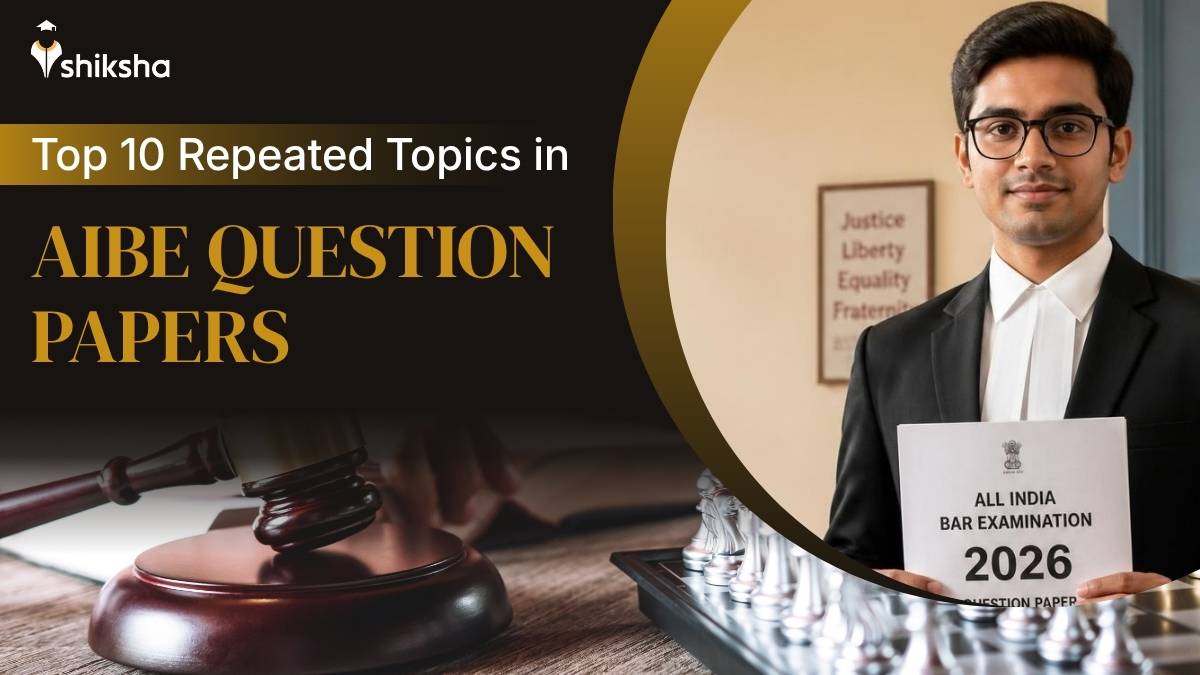
Repeated topics in AIBE Exam
Repeated Topics in AIBE Exam: All India Bar Examination (AIBE) is an exam in which candidates have to mark their answers on an OMR sheet. AIBE question paper does not ask long passage based questions. It directly asks section based and case based questions from bare Acts. This is why knowing most repeated topics can help candidate in AIBE exam preparation.
AIBE 22 will be held on November 29, 2026, in pen and paper mode. After analysing AIBE previous year question papers, we now know that Bar Council of India (BCI) repeats same set of subjects and same kind of provisions every year. Weightage of each subject is already fixed in AIBE syllabus. In those subjects, a few topics come again and again.
Candidates are also advised to go through AIBE previous year question papers to get an idea of AIBE exam pattern and difficulty level.
- Why Prepare Repeated Topics in AIBE Exam?
- AIBE Subject-Wise Weightage
- Top 10 Repeated Topics in AIBE Question Papers
- 4. Indian Penal Code (Bharatiya Nyaya Sanhita)
- Other Scoring Subjects in AIBE Exam
Why Prepare Repeated Topics in AIBE Exam?
Candidates are advised to prepare all nineteen subjects given in AIBE syllabus but after analysing previous years question paper, we can say that some of topics gets repeated and candidates should really give them some extra time while preparing.
Passing percentage in AIBE exam is 45 for General and OBC candidates and 40 percent for SC, ST and PwD candidates. So a candidate only needs around 45 correct answers out of 100. So, if candidate prepares only repeated topics then also there is a chance of them clearing AIBE exam.

Commonly asked questions
The AIBE will be conducted in pen-and-paper mode. The exam is held for three hours thirty minutes. There will be 100 MCQs. Candidates must note that the question paper is from 19 subjects and there is no negative marking.
To check the AIBE Exam Pattern, candidates can visit allindiabarexamination.com. Candidates are advised to check the exam pattern before beginning their preparation journey.
AIBE Exam is held in 22 languages, including English. So, the question paper will be in the language choosen by the candidate while filling the application form.
There is no negative marking in the exam. But one mark is given for every correct answer. In case you leave any questions unanswered, nothing will be deducted.
AIBE Marking Scheme 2026
| Particulars | Details |
|---|---|
| Negative Marking | No |
| Number of questions | 100 |
| Marks per question | 1 |
| Total Marks | 100 |
AIBE Subject-Wise Weightage
Check number of questions asked from each subject as per official AIBE syllabus.
| Subject |
Number of Questions |
|---|---|
| Constitutional Law |
10 |
| Code of Criminal Procedure (CrPC & BNSS) |
10 |
| Code of Civil Procedure (CPC) |
10 |
| Indian Penal Code (IPC & BNS) |
8 |
| Law of Evidence (Evidence Act & BSA) |
8 |
| Family Law |
8 |
| Law of Contract, Specific Relief, Property Law, Special Contract and Negotiable Instruments Act |
8 |
| Law of Torts, Motor Vehicles Act and Consumer Protection Law |
5 |
| Alternative Dispute Resolution, including Arbitration Act |
4 |
| Professional Ethics & Cases of Professional Misconduct |
4 |
| Public Interest Litigation |
4 |
| Labour and Industrial Law |
4 |
| Law related to Taxation |
4 |
| Administrative Law |
3 |
| Company Law |
2 |
| Environmental Law |
2 |
| Cyber Law |
2 |
| Land Acquisition Act |
2 |
| Intellectual Property Laws (IPR) |
2 |
| Total |
100 |
Note: Candidates can cross-check weightage with latest official AIBE notification before starting preparation.

Top 10 Repeated Topics in AIBE Question Papers
In AIBE exam questions are mostly about what a particular section says, which authority has a particular power and which case laid down a particular principle. As figures and facts do not change every year, same kind of topics keep coming back. To know most repeated topics in AIBE Exam, check below.
1. Constitutional Law
Constitutional Law carries highest weightage along with CrPC & CPC. In exam, candidates are not asked full Constitution, but some topics are repeated almost every year like,
- Fundamental Rights (Articles 12 to 35), especially Articles 14, 19, 21 and 32
- Directive Principles of State Policy and Fundamental Duties
- Writ jurisdiction (Articles 32 and 226)
- Centre and State Legislative powers
Candidates should also revise Preamble, Union and State executive and constitutional bodies like Election Commission, CAG, UPSC and Finance Commission.
2. Code of Criminal Procedure (BNSS)
India has replaced Code of Criminal Procedure, 1973 with Bharatiya Nagarik Suraksha Sanhita (BNSS), 2023. Recent AIBE papers ask questions with reference to new law, so candidates must carry updated bare Act. Most asked questions are about
- Arrest Protocols
- Rights of an arrested person
- Bail Provisions
- Classification of Offences
- Powers of Magistrates and hierarchy of criminal courts
- Summons, Warrants and trial procedure
3. Code of Civil Procedure (CPC)
CPC questions are usually straight from sections and orders, which makes them very scoring in AIBE Exam. The frequently asked topics include:
- Jurisdiction of civil courts
- Institution of suits
- Written statement (Order VI/VII)
- Temporary injunction (Order XXXIX) and interlocutory orders
- Execution of decrees
Explore colleges based on AIBE
Based on ,LL.M.,AIBE

- Chat with our counselor
- Get your personalised list of colleges & exams matching your preferences
4. Indian Penal Code (Bharatiya Nyaya Sanhita)
The Indian Penal Code, 1860 has been replaced by Bharatiya Nyaya Sanhita (BNS), 2023. Candidates should prepare concepts rather than memorising every section. The repeated themes are:
- General exceptions
- Common intention
- Offences against the human body (culpable homicide, murder, hurt and grievous hurt)
- Offences against property (theft, extortion, robbery, dacoity and criminal breach of trust)
- Offences against women and children
- Abetment, criminal conspiracy and attempt
5. Law of Evidence (Bharatiya Sakshya Adhiniyam)
The Indian Evidence Act, 1872 has been replaced by Bharatiya Sakshya Adhiniyam (BSA), 2023. The questions repeat around given concepts:
- Facts in issue and relevant facts
- Admission and confession
- Dying declaration
- Presumptions, Burden of Proof
- Oral, documentary and electronic evidence (Section 65B)
6. Law of Contract and Allied Laws
This unit combines Indian Contract Act with Specific Relief, Property Law, special contracts and Negotiable Instruments Act. Most repeated concepts are:
- Offer, acceptance, consideration and a valid contract
- Void, voidable and illegal agreements
- Free consent
- Breach of contract
- Indemnity, guarantee, bailment, pledge and agency
- Cheque dishonour under Section 138 of Negotiable Instruments Act
- Sale, mortgage, lease and gift (Transfer of Property Act)
7. Family Law
Family Law questions come from both Hindu law and Muslim law, and examiner usually repeats basics of marriage and succession:
- Hindu Marriage Act Provisions (Section 5,7,13,13B)
- Grounds of divorce and judicial separation
- Maintenance, including wife and children
- Adoption and guardianship
- Muslim law - nikah, dower (mahr), talaq and iddat
8. Professional Ethics and Professional Misconduct
This is most AIBE specific subject of whole paper, and it is repeated in every edition of AIBE exam. Questions are asked from Advocates Act, 1961 and BCI Rules, along with landmark cases. Candidates must prepare about:
- Advocate Duties
- Professional misconduct
- Punishment for misconduct and the role of the Disciplinary Committee
- Powers and functions of Bar Council of India and State Bar Councils
- Right to practise, enrolment and the Certificate of Practice
- Contempt of Courts Act
9. Law of Torts, Motor Vehicles Act and Consumer Protection
Tort questions in AIBE are mostly based on landmark judgements and basic principles rather than a bare Act. Most commonly repeated themes are:
- Essentials of tort
- Vicarious liability
- Strict and absolute liability
- Negligence, nuisance, defamation and trespass
- No-fault liability and compensation claims (Motor Vehicles Act)
- Consumer Protection Act, 2019
10. Alternative Dispute Resolution and Arbitration
ADR carries a small number of questions, but they are highly predictable and almost always come from Arbitration and Conciliation Act, 1996. Prepare:
- Arbitration agreement and its essentials
- Appointment, powers and removal of arbitrators
- Arbitral award and grounds for setting aside an award
- Difference between arbitration, conciliation, mediation and negotiation
- Lok Adalat and Section 89 of CPC
Explore more Law exams with upcoming date

28 Oct '26 - 30 Oct '26
Other Scoring Subjects in AIBE Exam
Remaining subjects carry two to four questions each, but together they add up to more than 20 marks. Candidates should not leave them completely. Most commonly repeated points are Public Interest Litigation, lay-off, retrenchment and industrial dispute under Labour Law. Basic concepts of income tax and GST under taxation. Principles of natural justice and writs under Administrative Law. Incorporation and types of companies under Company Law. Environment Protection Act and the polluter pays principle. Offences and penalties under Information Technology Act. And compensation under the Land Acquisition Act.
The above topics are taken out after analysing AIBE question papers of previous years. Candidates are still advised to keep checking allindiabarexamination.com for latest notification and syllabus.
To download full AIBE 22 syllabus for reference, click here

News & Updates
Explore Other Exams
Oct '26 | TS PGLCET 2026 Counselling Reg... |
Oct '26 | TS PGLCET 2026 Display of veri... |
18 May '26 | AP PGLCET Results Release |
9 May '26 | AP PGLCET Last date for receiv... |
May '26 | ILICAT 2026 Result |
May '26 | ILICAT 2026 Exam Day |
3 Aug '26 - 31 Oct '26 | CLAT 2027 online registrations... |
Nov '26 | CLAT 2027 Application Correcti... |
7 Aug '26 - 10 Nov '26 | AILET 2027 Registration |
30 Nov '26 | AILET 2027 Admit Card |
15 Sep '26 - 29 Sep '26 | TS LAWCET Phase 3 Counselling ... |
19 Sep '26 - 21 Sep '26 | TS LAWCET Phase 3 Counselling ... |
Student Forum
 Anything you would want to ask experts?
Answered 3 weeks ago
The last date to apply online for the AIBE 22 Application correction is October 30.
S
Contributor-Level 7
Answered 3 weeks ago
The candidates who are in their last year of Law Degree Course and the candidates who have passed the degree course but not registered in the State Bar Council will be required to submit the AIBE undertaking form with their application form.
R
Contributor-Level 6
Answered 4 weeks ago
The AIBE 22 registrations were started at allindiabarexamination.com on August 19. The candidates must fill the application before October 27. The candidates who failed in AIBE 21 and 20 can reuse their existing registration IDs and do not need to re-register.
M
Contributor-Level 7
Answered a month ago
No, one cannot get a CoP without having passed the AIBE if one completed his or her education with an LLB degree in or after 2009-2010. Passing the AIBE is mandatory for those who want to practice law on their own after completing an LLB degree from any recognised institution.
A
Contributor-Level 9
Answered a month ago
Candidates who do not meet AIBE passing criteria will not receive the Certificate of Practice. They will have to appear for the exam in the next cycle.
A
Contributor-Level 9
Answered a month ago
AIBE cut-off mark is usually set according to the lowest qualifying marks or percentage required by the examining authority. There might be changes in qualifying requirements as per the examining authority. Candidates are advised to check the latest notification of AIBE.
A
Contributor-Level 9
Answered a month ago
Yes. The qualifying conditions for AIBE vary from one category to another. The cutoff is usually higher for General category candidates compared to SC, ST, and other reserved categories.
A
Contributor-Level 9
Answered a month ago
AIBE Cut-off refers to the lowest percentage of marks required by candidates to qualify for exam. The cut-off is different for every category. Candidates satisfying cut-off criteria are awarded Certificate of Practice.
A
Contributor-Level 9
Answered a month ago
The failure rate for the All India Bar Examination (AIBE) changes every year. It generally ranges between 23% and 51%, varying significantly by session.
A
Contributor-Level 9
Answered a month ago
All India Bar Examination (AIBE) is usually regarded as medium to tough in nature. There is no negative marking at all. The exam comprises questions requiring analysis, and updated criminal law provisions (BNS, BNSS, BSA) have been introduced in it.
A
Contributor-Level 9
Sneha Singh is a digital content professional with a strong foundation in news journalism. Her areas of interest include education, national affairs, business and exam news, with a track record of writing SEO-driven
Read Full Bio