

Every JEE aspirant has heard these words - "In JEE, it is important to have a strong hold of the concepts and basics". But how to get a strong hold of concepts and basics of all the chapters in the JEE syllabus? The one answer to this is - NCERT books. Know how below.

Role of NCERT Books in JEE Main and JEE Advanced Preparation
Role of NCERT Books in JEE Main and JEE Advanced Preparation: NCERT books are often underestimated by the IIT JEE aspirants. But there is a reason why all the experts and the JEE toppers recommend NCERT books for JEE Main and JEE Advanced preparation. The reasons are: NCERT books have a language that easily explains the concepts of each topic, and the NCERT books have examples explaining the concepts. Various chapter examples and solved questions help the students understand the basics of all the topics. Also, the NCERT books are most aligned to the IIT JEE Mains and Advanced syllabus. The JEE exam has various questions that are derived from the concepts in the NCERT books. Especially in Chemistry, where questions are directly asked from the NCERT books.
LIVE Now: NTA JEE Main Final Keys 2026
With JEE Main being the initial stage and JEE Advanced as the final gateway to the IITs, the competition is fierce, and the syllabus is huge. The NCERT books play a crucial role in laying the foundation and developing conceptual clarity, which is essential for JEE Advanced. JEE Advanced may not have direct and easy questions, but the solutions to these tough questions often lie in the application of simple and basic concepts that can only be learned from the NCERT books.
- Importance of NCERT in JEE Preparation
- Subject-wise Role of NCERT Books in JEE Main and JEE Advanced Preparation
- Role of NCERT in JEE Main vs JEE Advanced
- Limitations of NCERT Books in JEE Preparation
- How to Use NCERT Effectively for JEE Main and JEE Advanced Preparation
- Expert & Toppers’ Opinions on Role of NCERT in JEE Prep
Importance of NCERT in JEE Preparation
NCERT textbooks of classes 11 and 12 cover the CBSE syllabus, and since the JEE syllabus is pretty much aligned with the CBSE syllabus, NCERT books naturally cover a huge portion of the JEE syllabus.
- The base of any topic, or you can say the groundwork for any concepts, is built by studying the NCERT books.
- NCERT book questions sometimes come as it is in the JEE Mains exam. Every year, at least one or two questions in JEE Chemistry are directly from the NCERT books.
- NCERT provides clear definitions, formulas, and conceptual explanations that help build a foundation for JEE Main 2026 and JEE Advanced level problem solving.

Commonly asked questions
- Arihant Problem Book in Mathematics for IIT JEE by SK Goyal
- NCERT Maths Class 11 and 12
- Cengage Maths by G TIWANI
- Comprehensive Mathematics for JEE Advanced by Tata McGraw Hill publications
- Problems Plus in IIT Mathematics by A Das Gupta
- Organic Chemistry by Morrison and Boyd for Organic Chemistry
- Concise Inorganic Chemistry by J. D. Lee for Inorganic Chemistry
- Modern Approach to Chemical Calculations by RC Mukherjee
- NCERT Chemistry Class 11 and 12
- Problems in Physical Chemistry for JEE (Main & Advanced) by Narendra Awasthi
Subject-wise Role of NCERT Books in JEE Main and JEE Advanced Preparation
Check below the role of the NCERT books in JEE Main and Advanced preparation:
| Maths | Physics | Chemistry |
|---|---|---|
| NCET Maths textbooks are particularly good for revising formulas and solving basic problems. | NCERT Physics textbooks have clear definitions, formulas, and conceptual explanations. | NCERT Chemistry shine in JEE. Almost all chemistry questions in JEE Mains are heavily inspired by NCERT, and many questions are directly lifted from NCERT. |
| Especially helps in building the groundwork for algebra, trigonometry, calculus, and coordinate geometry. | Especially useful in building the foundation for mechanics, electricity, and modern physics. | Especially the named reactions, mechanisms, and standard examples from NCERT frequently appear in JEE exams. |
| The disadvantage here is that the NCERT Maths textbook problems are too basic for the JEE level. Excellent for fundamentals, but not enough for cracking JEE. | The only disadvantage of the NCERT Physics books is that they lack JEE-level questions | No disadvantages here. NCERT Chemistry is indispensable for JEE Mains and Advanced. |

Role of NCERT in JEE Main vs JEE Advanced
Although NCERT is equally important for JEE Mains and Advanced preparation, the extent of usefulness of the textbooks varies for both. Check the comparison below:
| Role of NCERT in JEE Main Prep | Role of NCERT in JEE Advanced Prep |
|---|---|
| NCERT is extremely important for JEE Main. For JEE Main aspirants, the NCERT books should be revised multiple times before the exam. | NCERT will give a base to the candidates for the concepts, but for JEE Advanced level preparation, it is insufficient. |
| In the Maths and Physics of JEE Main, most questions directly need the application of NCERT concepts. | In JEE Advanced Maths and Physics, candidates need to learn the concepts for NCERT, but candidates have to practice the application of multiple concepts to a single JEE Advanced level question. This is what makes JEE Advanced level questions trickier. |
| The chemistry section is often dominated by direct NCERT-based questions. 60% to 70% of JEE Main Chemistry is directly NCERT-based. | In Chemistry, especially in Inorganic, NCERT continues to be the holy grail. |
Hence, from the above comparison, it is clear that NCERT is the Bible for JEE Mains, but for JEE Advanced preparation, NCERT is never enough.
Also Read:
Explore colleges based on JEE Advanced
Want better recommendations?
There is a 90% more chance of getting best college recommendations by sharing preferences.
- Chat with our counselor
- Get your personalised list of colleges & exams matching your preferences
Limitations of NCERT Books in JEE Preparation
NCERT books must not be ignored, but they should not be relied on solely. Candidates should accompany the NCERT books with other advanced level books with JEE level questions for practice. NCERT books can have some limitations in JEE preparation like:
- There are not many questions that require multiple concept applications to solve.
- NCERT books do not cover the deeper concepts of the JEE Advanced level.
- Questions are limited.
How to Use NCERT Effectively for JEE Main and JEE Advanced Preparation
Here are some tips on how to use the NCERT books for JEE 2026 preparation:
- NCERT books must be used for the understanding of the basics and concepts:
- Start with NCERT and then move to the reference books.
- NCERT books should be used to get hold of the definitions, formulas, derivation and reactions in the Chemistry subject.
- Keep revising NCERT, especially for JEE Advanced chemistry preparations.
- Reise NCERT books once in the final months before the JEE Main and JEE Advanced exams.
- Complete solving each and every question in the NCERT books, even the examples.
Explore more B.Tech exams with upcoming dates
MET


1 Jun '26 - 30 Sep '26
30 Sep '26
3 Oct '26
VITEEE
SRMJEEE
JEE Main
1 Nov '26 - 30 Nov '26
18 Dec '26
10 Nov '26
Expert & Toppers’ Opinions on Role of NCERT in JEE Prep
Experts and toppers swear by the fact that NCERT books are important to get hold of the basics. Especially when it comes to Chemistry, in JEE Mains, questions come directly from the textbooks. In recent JEE Main papers, direct questions from NCERT have included bond angles, reaction products, and periodic trends; all word-to-word from the NCERT textbook.
Rajit Gupta, the JEE Advanced 2025 topper, said that "For Chemistry, I also referred to NCERT books. I avoided too many external resources to stay focused and reduce distractions."
Prakhar Jain, JEE Advanced 2023 AIR 21, said: "The first books to refer to are always NCERT, after the class notes given by my teachers. They form the base of the subject. For JEE Advanced, NCERT is necessary but not sufficient..."
Also Read: How to Crack JEE Advanced 2026: Get Preparation Tips from Past Years' Toppers
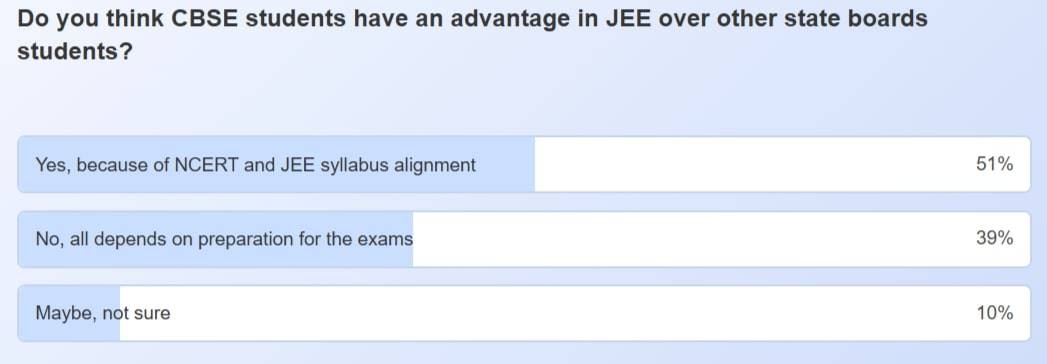
📊 Shiksha Poll: Do CBSE students get an Advantage in JEEShiksha.com ran a poll asking the JEE community, "Do you think CBSE students have an advantage in JEE over other state board students?"
|
As a final takeaway, the JEE candidates should not take the NCERT books for granted in JEE preparation. NCERT books align with the syllabus of JEE and help build a strong foundation.
Read More:

News & Updates
Explore Other Exams
Oct '26 | JEE Main 2027 Registration Ses... |
Dec '26 | JEE Main 2027 Correction Windo... |
Oct '26 | SRMJEEE 2027 Notification |
Nov '26 | SRMJEEE 2027 Registration Phas... |
1 Sep '26 | COMEDK 2026 Counselling: Round... |
1 Sep '26 - 3 Sep '26 | COMEDK 2026 Counselling: Round... |
Sep '26 | MET 2027 application form - Ph... |
Mar '27 | MET 2027 application form star... |
29 Aug '26 | BITSAT 2026 Iteration-IX fee p... |
28 Aug '26 | BITSAT 2026 Iteration-IX Annou... |
19 Aug '26 - 20 Aug '26 | TS EAMCET 2026 MPC Counselling... |
12 Aug '26 - 17 Aug '26 | TS EAMCET 2026 MPC Counselling... |
Student Forum
 Anything you would want to ask experts?
Answered a week ago
Yes, Indian students can apply for TU Munich Admissions directly after Class 12th, provided they meet the minimum qualifying JEE Advanced score requirement and other program-specific entry requirements.
Students without a JEE Advanced score, will either have to enroll in the Studienkolleg or complete
A
Contributor-Level 10
Answered a week ago
Technical University of Munich generally accepts a JEE Advanced score only for the immediate academic intake to the year the exam was passed (usually within one year).
Universities like TU Munich assess students based on current admission rules, and hence using a scorecard older than admission year i
A
Contributor-Level 10
Answered a week ago
No, the Technical University of Munich does not accept JEE Advanced scores for Master's programs. For entry to PG programs, students need to have completed a UG degree from a recognised Indian college or university, submit relevant documents, and meet the program-specific criteria.
Check TU Munich Ad
A
Contributor-Level 10
Answered a week ago
While evaluating opening and closing rank trends, JEE Advanced cutoffs, and branch allocation dynamics for civil engineering at IIT Bhubaneswar provides a helpful baseline for your academic planning, Lovely Professional University (LPU) serves as an excellent alternative to elevate your engineering
A
Contributor-Level 7
Answered 2 weeks ago
The IIT GANDHINAGAR JEE Advanced closing ranksfor the General (open) female only category in 2026 ranked from roughly 5,437 for computer Science and engineering up to 20270 for civil engineering.
m
Beginner-Level 1
Answered 3 weeks ago
IIT BHU CSE cutoff 2026 ranged from 1436 in the first round to 1439 in the last round for the General category under the All India quota. Hence, a rank of at least 1439 is needed to qualify for admission to the CSE course. Check the table below to know the overall cutoff range for other categories.
| Category | IIT BHU CSE cutoff 2026 |
|---|---|
| General | 1436 - 1439 |
| OBC | 601 - 601 (R1) |
| SC | 313 - 373 |
| ST | 161 - 170 |
| EWS | 245 - 245 (R1) |
| PWD | 66 - 66 (R1) |
N
Contributor-Level 10
Answered 3 weeks ago
IIT BHU JEE Advanced cutoff 2026 ranged from 601 to 7870 in the first round for the OBC AI category. In the last round, the closing cutoff ranged from 601 to 9002 for the aforementioned category. Check the table below to know the Round 1 and last round closing cutoffs for different courses.
| Course | Round 1 Cutoff 2026 | Last Round Cutoff 2026 |
|---|---|---|
| B.Tech. in Computer Science and Engineering | 601 | 601 |
| B.Tech. in Mathematics and Computing | 826 | 845 |
| B.Tech. in Electronics Engineering | 1167 | 1189 |
| B.Tech. in Electrical Engineering | 1497 | 1529 |
| B.Tech. in Mechanical Engineering | 2760 | 3175 |
| B.Tech. in Chemical Engineering | 3394 | 3609 |
| B.Tech. in Engineering Physics | 3490 | 3620 |
| B.Tech. in Civil Engineering | 3834 | 3980 |
| B.Tech. in Materials Science and Technology | 3886 | 4257 |
| B.Tech. in Metallurgical Engineering | 4269 | 4494 |
| B.Tech. in Industrial Chemistry | 4389 | 4681 |
| B.Tech. in Biomedical Engineering | 4798 | 5067 |
| B.Tech. in Biochemical Engineering | 4877 | 5156 |
| B.Tech. in Ceramic Engineering | 4899 | 5245 |
| B.Tech. in Mining Engineering | 5031 | 5329 |
| B.Tech. in Pharmaceutics Engineering and Technology | 5424 | 5776 |
| Bachelor of Architecture (B.Arch.) | 7870 | 9002 |
N
Contributor-Level 10
Answered 3 weeks ago
IIT Gandhinagar JEE Advanced cutoff 2026 for the General AI female category ranged from 5437 (CSE) to 20270 (Civil Engineering). Students can check the table below to know the last round cutoff range for other female categories.
| Category | IIT Gandhinagar JEE Advanced cutoff 2026 |
|---|---|
| General | 5437 - 20270 |
| OBC | 2700 - 9008 |
| EWS | 981 - 3973 |
| ST | 369 - 1941 |
| SC | 802 - 4390 |
| PWD | 225 |
N
Contributor-Level 10
Answered 3 weeks ago
IIT Bombay cutoff 2026 for the Electrical and Aerospace Engineering courses for the General AI category in the last round was 411 and 2638, respectively. To know the last round closing ranks for other categories, see the table below.
| Category | Electrical Engineering | Aerospace Engineering |
|---|---|---|
| General | 411 | 2638 |
| OBC | 281 | 1546 |
| SC | 130 | 731 |
| ST | 90 | 458 |
| EWS | 110 | 589 |
| PWD | 7 | 103 |
N
Contributor-Level 10
Answered 3 weeks ago
EWS AI category students need a rank of at least 696 to be qualified for admission to the CSE course. Students can check the table below to know the round-wise IIT Bhubaneswar CSE cutoff 2026 for the EWS AI category.
| Round Number | IIT Bhubaneswar CSE cutoff 2026 (Closing Rank) |
|---|---|
| 1 | 643 |
| 2 | 643 |
| 3 | 643 |
| 4 | 643 |
| 5 | 696 |
N
Contributor-Level 10
Currently - Deputy Manager, Content
Role - News and Feature Writer, Content Editor
Expertise - Engineering Education and Counselling
Mamona Majumder specialises in news and feature writing and content editing. With
Read Full Bio