


We have provided the previous year JEE Advanced Chemistry question paper. Also, you will find the 14 most difficult questions asked in the past JEE Advanced exam. Check the complete article.

JEE Advanced Chemistry Questions
JEE Advanced Chemistry Questions with Solutions PDF: Chemistry is considered to be most easy paper in JEE Advanced. But sometime tricky questions are asked which might be time consuming. Majority of question in JEE Advanced chemistry paper is from Organic, p-block, Chemical bonding, Coordination compounds, Electrochemistry, Ionic & Chemical Equilibrium, Electrochemistry & Surface Chemistry, Aldehyde & Ketones, Polymers, and Biomolecules.
To master the question based on these topic and secure good marks in JEE Advanced exam, intense practice is required. Students must solve JEE Advanced previous year question paper for this. In this article we have provided past year JEE Advanced Chemistry questions. Also some tricky questions are provided here which will be helpful for upcoming JEE Advanced 2027.
JEE Advanced Chapterwise PYQ PDF for Chemistry
Check JEE Advanced previous year questions of Chemistry for the last 5 years. Candidates can use JEE Adv PYQ PDF download from the table below to get the questions for free.
| Chapters |
PDF Download |
| Surface Tension |
|
| Surface Chemistry |
|
| Solid State |
|
| Polymers |
|
| p-Block |
|
| s-Block |
|
| Inorganic Chemistry |
|
| Organic Chemistry |
|
| Coordination Compound |
|
| Chemical Bonding |
|
| Nuclear Chemistry |
|
| Atomic Structure |
|
| Biomolecules |
|
| Chemical Kinetics |
|
| Collision |
|
| Electrochemistry |
|
| Ionic Equilibrium |
|
| Metallurgy |
|
| Periodic Table |
|
| Redox Reactions |
|
| Solutions |
|
| States of Matter |
|
| Stoichiometry |
|
| Thermochemistry |
- 15 Most Difficult JEE Advanced Chemistry Questions Asked in Previous 10 Years
- All JEE Advanced Chemistry Questions From Previous Years
- JEE Advanced Chemistry Section Overview
15 Most Difficult JEE Advanced Chemistry Questions Asked in Previous 10 Years
Check below the most difficult questions in JEE Advanced chemistry in the past 10 years as analysed by the experts:
Q1: The option(s) with only amphoteric oxides is (are) (JEE Advanced 2020)
- NO, B2O, PbO, SnO2
- Cr2O3, CrO, SnO, PbO
- Cr2O3, BeO, SnO, SnO2
- ZnO, Al2O3, PbO, PbO2
Ans: C and D
Q2: The 1st, 2nd and 3rd ionization enthalpies I1, I2 and I3, of four atoms with atomic numbers n, n + 1, n + 2 and n + 3 where n < 10 are tabulated below. What is the value of n? (JEE Advanced 2020)
| Atomic Number | Ionization Enthalpies (kJ/mol) | ||
|---|---|---|---|
| I1 | I2 | I3 | |
| n | 1681 | 3374 | 6050 |
| n+1 | 2081 | 3952 | 6122 |
| n+2 | 496 | 4562 | 6910 |
| n+3 | 738 | 1451 | 7733 |
Ans: n=9
Q3: Identify the least stable ion among the following: (JEE Advanced 2022)
- Li-
- Be-
- B-
- C-
Ans: B
Q4: identify the correct order of acidic strength of CO2, CuO, CaO, H2O (JEE Advanced 2022)
- CaO < CuO < H2O < CO2
- H2O < CuO < CaO < CO2
- CaO < H2O < CuO < CO2
- H2O < CO2 < CaO < CuO
Ans: A
Q5: Among the following, the number of elements showing only one non-zero oxidation state is: (JEE Advanced 2010)
O, Cl, F, N, P, Sn, Tl, Na, Ti
Ans: 2
Q6: Assuming 2s - 2p mixing is not operative, the paramagnetic species among the following is: (JEE Advanced 2014)
- Be2
- B2
- C2
- N2
Ans: C
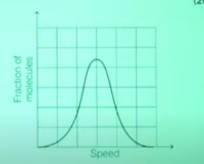
Q7: If the distribution of the molecular speed of a gas is as per the figure shown below, then the ratio of the most probable, the average and the root mean square speeds, respectively, is: (JEE Advanced 2020)
- 1 : 1 : 1
- 1 : 1 : 1.224
- 1 : 1.128 : 1.224
- 1 : 1.128 : 1
Ans: B
Q8: 1 mol of a monoatomic real gas satisfies the equation p(V-b) = RT where, b is a constant. The relationship of interatomic potential V(r) and interatomic distance for as is given by: (JEE Advanced 2015)
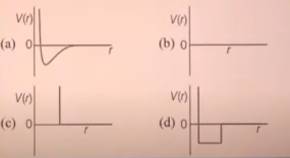
Ans: C
Q9: The treatment of an aqueous solution of 3.74 g of Cu(NO3)2 with excess Kl results in a brown solution along with the formation of a precipitate. Passing H2S through this brown solution gives another precipitate X. The amount of X (in g) is ______________ ? (JEE Advanced 2022, paper 1)
[Given: Atomic mass of H = 1, N=14, O = 16, S = 32, K = 39, Cu = 63, I = 127]
Ans: 0.32
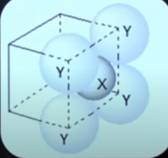
Q10: For the given close packed structure of a salt made of cation X and anion Y shown below (ions of only one face are shown for clarity), the packing fraction is approximately: (JEE Advanced 2021, paper 1)
(packing fraction = packing efficiency ÷ 100)
- 0.74
- 0.63
- 0.52
- 0.48
Ans: 0.63
Q11: The boiling point of water in a 0.1 molal silver nitrate solution (solution A) is x°C. To this solution A, an equal volume of 0.1 molal aqueous barium chloride solution is added to make a new solution B. The difference in the boiling points of water in the two solutions A and B is y x 10-2 °C.
(Assume: Densities of the solutions A and B are the same as that of water and the soluble salts dissociate completely. Use: Molal elevation constant (Ebullioscopic Constant), K = 0.5 K kg mol-1; Boiling point of pure water as 100°C).
The value of lyl is__________ (JEE Advanced 2021, paper 1)
Ans: 2.5
Q12: In a bimolecular reaction, the steric factor P was experimentally determined to be 4.5. The correct option(s) among the following is(are) (JEE Advanced 2017, paper 2)
- The activation energy of the reaction is unaffected by the value of the steric factor
- Experimentally determined value of frequency factor is higher than that predicted by Arrhenius equation
- Since P= 4.5, the reaction will not proceed unless an effective catalyst is used
- The value of the frequency factor predicted by the Arrhenius equation is higher than that determined experimentally
Ans: A and B
Q13: The decomposition reaction 2N2O5 (g) → 2N2O4 (g) + O2(g) is started in a closed cylinder under Isothermal isochoric condition at an initial pressure of 1 atm. After Y x 103 s, the pressure inside the cylinder is found to be 1.45 atm. If the rate constant of the reaction is 5 x 10⁻⁴ S-1, assuming ideal gas behaviour, the value of Y is___________ (JEE Advanced 2019, paper 2)
Ans: 2.30
Q14: Consider a Helium (He) atom that absorbs a photon of wavelength 330 nm. The change in velocity (in cm s-1) of the He atom after the photon absorption is ______________
(Assume momentum is conserved when photon is absorbed. Use Planck constant = 6.5 X 10⁻¹³ J s, Avogadro number = 6 X 10²³ mol-1, Molar mass of He = 4 m mol-1) (JEE Advanced 2021)
Ans: 30 cm/s
Q15: The atomic masses of He and Ne are 4 and 20 a.m.u., respectively. The value of the de Broglie wavelength of He gas at -73°C is "M" times that of the de Broglie wavelength of Ne at 727°C. M is - (JEE Advanced 2013)
Ans: 5
Also Read:

Commonly asked questions
Preparation for JEE Advanced begins by knowing exam syllabus. Every student must follow syllabus. Once preparation is done then start solving previous year questions for self-assessment. This will give an overview of your preparation.
You can prepare for all entrance tests at same time. It is a tough task but not impossible. For this a proper strategy is required. Here are some important tips.
- Compare the syllabus: All engineering entrance exams have almost the same syllabus. There might be some additional topics in some exams. The aspirant must study the syllabus for all exams and find out the topics that are extra, and prepare those separately. Almost 90% of the topics will be common for all entrance exams, and hence, syllabus completion for one exam will lead to completion of the syllabus for all the exams.
- Prepare for JEE Mains and incorporate the preparation for all other exams: Apart from JEE Advanced, all the exams are pretty straightforward for a well-prepared candidate. JEE Advanced require a higher level of preparation as the questions are multi-conceptual. However, the state-level entrance exams, and exams like BITSAT, VITEEE, etc., have direct questions. Most of the questions in JEE Mains are also direct and require the application of basic concepts. Hence, the candidates must prepare for one exam, like JEE Mains, that will cover their preparation for all other exams.
- JEE Advanced needs extra effort: For JEE Advanced candidates must focus on time management and building exam day temperament. Learn how to apply multiple concepts to a question.
The bottom line is to prepare for JEE Mains to cover the preparation for all other CETs and exams like BITSAT and VITEEE. For JEE Advanced, work on sharpening your skills of time management, stress handling, multiple concept application, speed and accuracy.
Aspirants must keep in mind that exam difficulty level cannot be determined by organising IIT. JEE Advanced paper is not made by one single IIT; but it is prepared by experts from multiple institutes. Difficulty level of exam is independent of the IIT conducting exam.
Kalpit Veerwal, the JEE Advanced 2017 AIR 1 scored 360 out of 360, the only person in the history of IIT JEE to score full marks.
Another student Ved Lahot scored 355 in JEE Advanced 2024 exam and secured AIR 1.
All JEE Advanced Chemistry Questions From Previous Years
Above we curated and provided you the most difficult questions in JEE Advanced Chemistry over the past 10 years. However, candidates who wish to have all the previous year JEE Advanced Chemistry questions for practice, can download the PDF files below. Solving JEE Advanced question paper is a must for every application to ensure scoring good marks.
JEE Advanced Chemistry Questions with Solutions 2024 to 2019:
Check below the JEE Advanced Chemistry questions with solutions PDF:
| Year |
JEE Advanced Chemistry questions with solutions |
|---|---|
| 2024 |
Paper 1 - Download here Paper 2 - Download here |
| 2023 |
Paper 1 - Download here Paper 2 - Download here |
| 2022 |
Paper 1 - Download here Paper 2 - Download here |
| 2021 |
Paper 1 - Download here Paper 2 - Download here |
| 2020 |
Paper 1 - Download here Paper 2 - Download here |
| 2019 |
Paper 1 - Download here Paper 2 - Download here |
Also Check:
| JEE Advanced Physics Questions | JEE Advanced Maths Questions |

Explore more B.Tech exams with upcoming dates
MET


24 Oct '26
30 Oct '26
1 Jun '26 - 31 Oct '26
31 Oct '26
7 Nov '26
JEE Main
1 Nov '26 - 30 Nov '26
1 Nov '26 - 30 Nov '26
9 Jan '27 - 10 Jan '27
JEE Advanced Chemistry Section Overview
Check below the details regarding the JEE Advanced Chemistry section in JEE Advanced question paper followed in the past 2 years:
Total Marks in JEE Advanced Chemistry section: 120
- 60 marks in JEE Advanced paper 1
- 60 marks in JEE Advanced paper 2
In each paper of JEE Advanced, the Chemistry section has the following sections:
- Sec-I (Max. marks-12)
- Sec-II (Max. Marks-12)
- Sec-III (Max. marks-24)
- Sec-IV (Max. marks-12)
Number of questions and marks distribution in each of the sections is as follows:
| Section |
Number of questions and total marks |
Marking Scheme |
|---|---|---|
| 1 |
4 questions of 12 marks |
|
| 2 |
3 questions of 12 marks |
|
| 3 |
6 questions of 24 marks |
|
| 4 |
4 questions of 12 marks |
|
Read More:
News & Updates
Explore Other Exams
Oct '26 | JEE Main 2027 Registration Ses... |
Dec '26 | JEE Main 2027 Correction Windo... |
Oct '26 | SRMJEEE 2027 Notification |
Nov '26 | SRMJEEE 2027 Registration Phas... |
Feb '27 | COMEDK Application Form 2027 |
Feb '27 | COMEDK Mock Test Release Date ... |
Oct '26 | MET 2027 application form star... |
Mar '27 | MET 2027 application form star... |
Dec '26 | BITSAT 2027 Application Form S... |
Mar '27 | BITSAT 2027 Form Correction Se... |
19 Aug '26 - 20 Aug '26 | TS EAMCET 2026 MPC Counselling... |
12 Aug '26 - 17 Aug '26 | TS EAMCET 2026 MPC Counselling... |
Student Forum
 Anything you would want to ask experts?
Answered 3 weeks ago
You are not eligible for JEE (Advanced) 2027 because your first appearance for Class 12 was in 2025. For JEE (Advanced) 2027 candidates must have taken their Class 12 (or equivalent) examination for the first time in either 2026 or 2027. Since your first appearance was in 2025 you fall outside this
S
Contributor-Level 10
Answered a month ago
Yes, Indian students can apply for TU Munich Admissions directly after Class 12th, provided they meet the minimum qualifying JEE Advanced score requirement and other program-specific entry requirements.
Students without a JEE Advanced score, will either have to enroll in the Studienkolleg or complete
A
Contributor-Level 10
Answered a month ago
Technical University of Munich generally accepts a JEE Advanced score only for the immediate academic intake to the year the exam was passed (usually within one year).
Universities like TU Munich assess students based on current admission rules, and hence using a scorecard older than admission year i
A
Contributor-Level 10
Answered a month ago
No, the Technical University of Munich does not accept JEE Advanced scores for Master's programs. For entry to PG programs, students need to have completed a UG degree from a recognised Indian college or university, submit relevant documents, and meet the program-specific criteria.
Check TU Munich Ad
A
Contributor-Level 10
Answered a month ago
While evaluating opening and closing rank trends, JEE Advanced cutoffs, and branch allocation dynamics for civil engineering at IIT Bhubaneswar provides a helpful baseline for your academic planning, Lovely Professional University (LPU) serves as an excellent alternative to elevate your engineering
A
Contributor-Level 7
Answered a month ago
The IIT GANDHINAGAR JEE Advanced closing ranksfor the General (open) female only category in 2026 ranked from roughly 5,437 for computer Science and engineering up to 20270 for civil engineering.
m
Beginner-Level 1
Answered a month ago
IIT BHU CSE cutoff 2026 ranged from 1436 in the first round to 1439 in the last round for the General category under the All India quota. Hence, a rank of at least 1439 is needed to qualify for admission to the CSE course. Check the table below to know the overall cutoff range for other categories.
| Category | IIT BHU CSE cutoff 2026 |
|---|---|
| General | 1436 - 1439 |
| OBC | 601 - 601 (R1) |
| SC | 313 - 373 |
| ST | 161 - 170 |
| EWS | 245 - 245 (R1) |
| PWD | 66 - 66 (R1) |
N
Contributor-Level 10
Answered a month ago
IIT BHU JEE Advanced cutoff 2026 ranged from 601 to 7870 in the first round for the OBC AI category. In the last round, the closing cutoff ranged from 601 to 9002 for the aforementioned category. Check the table below to know the Round 1 and last round closing cutoffs for different courses.
| Course | Round 1 Cutoff 2026 | Last Round Cutoff 2026 |
|---|---|---|
| B.Tech. in Computer Science and Engineering | 601 | 601 |
| B.Tech. in Mathematics and Computing | 826 | 845 |
| B.Tech. in Electronics Engineering | 1167 | 1189 |
| B.Tech. in Electrical Engineering | 1497 | 1529 |
| B.Tech. in Mechanical Engineering | 2760 | 3175 |
| B.Tech. in Chemical Engineering | 3394 | 3609 |
| B.Tech. in Engineering Physics | 3490 | 3620 |
| B.Tech. in Civil Engineering | 3834 | 3980 |
| B.Tech. in Materials Science and Technology | 3886 | 4257 |
| B.Tech. in Metallurgical Engineering | 4269 | 4494 |
| B.Tech. in Industrial Chemistry | 4389 | 4681 |
| B.Tech. in Biomedical Engineering | 4798 | 5067 |
| B.Tech. in Biochemical Engineering | 4877 | 5156 |
| B.Tech. in Ceramic Engineering | 4899 | 5245 |
| B.Tech. in Mining Engineering | 5031 | 5329 |
| B.Tech. in Pharmaceutics Engineering and Technology | 5424 | 5776 |
| Bachelor of Architecture (B.Arch.) | 7870 | 9002 |
N
Contributor-Level 10
Answered a month ago
IIT Gandhinagar JEE Advanced cutoff 2026 for the General AI female category ranged from 5437 (CSE) to 20270 (Civil Engineering). Students can check the table below to know the last round cutoff range for other female categories.
| Category | IIT Gandhinagar JEE Advanced cutoff 2026 |
|---|---|
| General | 5437 - 20270 |
| OBC | 2700 - 9008 |
| EWS | 981 - 3973 |
| ST | 369 - 1941 |
| SC | 802 - 4390 |
| PWD | 225 |
N
Contributor-Level 10
Answered a month ago
IIT Bombay cutoff 2026 for the Electrical and Aerospace Engineering courses for the General AI category in the last round was 411 and 2638, respectively. To know the last round closing ranks for other categories, see the table below.
| Category | Electrical Engineering | Aerospace Engineering |
|---|---|---|
| General | 411 | 2638 |
| OBC | 281 | 1546 |
| SC | 130 | 731 |
| ST | 90 | 458 |
| EWS | 110 | 589 |
| PWD | 7 | 103 |
N
Contributor-Level 10
Engineering Education & Entrance Exam Expert
Role: Senior News Writer & Content Editor, Shiksha.com
Education: B.Tech in Mechanical Engineering [IET], MA Education Philosophy
Satyendra Singh is an Engineering gradua
Read Full Bio