


We have curated here all the previous JEE Advanced physics questions year wise and also separately provided 20 most difficult JEE Advanced Physics questions asked over the past 10 years. Scroll down for all details.

JEE Advanced Physics Questions
JEE Advanced Physics Questions: Physics is the most trickiest section in the JEE Advanced exam. Although Maths is still considered the toughest by many, the Physics section questions are lengthy with multi-concept complicated numerical questions. JEE Advanced physics questions require conceptual understanding of the application of as well as ability to solve questions in a timed manner.
The physics section of the JEE Advanced exam includes a total of 34 questions (17 each from paper 1 and 2), which together are around 120 marks. It's important to note that marks and the importance of each question can change from year to year. On the day of the exam, candidates receive specific guidelines and information about the JEE Advanced exam pattern along with the JEE Advanced question paper.
JEE Advanced physics high weightage topics include motion (Kinematics), heat and energy (Thermodynamics), Modern Physics, electric components (Capacitors and Current Electricity), the force of attraction (Gravitation), light (Optics), and electric forces (Electrostatics). While preparing, candidates must pay special attention to high weightage topics and solve JEE Advanced chapterwise PYQ to get the best score.
On this page, aspirants of JEE Advanced exam can find year-wise JEE Advanced physics questions with solutions PDF and also 20 most difficult JEE Advanced Physics questions asked over the past 10 years.
- JEE Advanced Physics PYQ PDF Chapterwise
- 20 Most Difficult JEE Advanced Physics Questions Asked in Previous 10 Years
- JEE Advanced Physics Section Overview
JEE Advanced Physics PYQ PDF Chapterwise
Candidates are provided here JEE Advanced previous year questions of Physics for the last 5 years. Solving these JEE Advanced Physics questions with solutions PDF will help prepare better for the exam. As Physics is the most difficult subject among three, candidates must have a clear understanding of JEE Advanced Topicwise Weightage Last 10 Year to get extra edge in preparation.
| Chapters |
PDF Download |
| Alternating Current |
|
| Electromagnetic Induction |
|
| Electrostatics |
|
| Fluid Mechanics |
|
| Gravitation |
|
| Kinematics |
|
| Modern Physics |
|
| Nuclear Physics |
|
| Electrostatics |
|
| Optics |
|
| Rotational Mechanics |
|
| SHM |
|
| Thermal Physics |
|
| Waves |
|
| Electromagnetic Waves |
|
| Electromagnetism |
|
| Geometrical Optics |
|
| Heat Transfer |
|
| KTG |
|
| Magnetism |
|
| Measurement |
|
| Projectile Motion |
|
| Units and Dimension |
20 Most Difficult JEE Advanced Physics Questions Asked in Previous 10 Years
Check below the most difficult questions in JEE Advanced physics in the past 10 years as analysed by the experts. These questions have been taken from the actual JEE Advanced previous year question papers.
Q1: Three very large plates of the same area are kept parallel and close to each other. They are considered as ideal black surfaces and have very high thermal conductivity. The first and third plates are maintained at temperatures 2T and 3T respectively. The temperature of the middle (i.e. second) plate under steady state condition is: (JEE Advanced 2012, Paper 1)
Ans: C
Q2: The electrostatic energy of Z protons uniformly distributed throughout a spherical nucleus of radius R is given by:
The measured masses of the neutron H, N, and O are 1.008665 u, 1.007825 u, 15.000109 u, and 15.003065 u, respectively. Given that the radii of both the N and O nuclei are the same, 1 u = 931.5 MeV/c² (c is the speed of light) and e2/(4πε0)=1.44 MeV fm. Assuming the difference between the binding energies of N and O is purely due to electrostatic energy, the radius of either of the nuclei is: (JEE Advanced 2016, Paper 2)
(Take 1 fm = 10-15m)
- 2.85 fm
- 3.03 fm
- 3.42 fm
- 3.80 fm
Ans: C
Q3: Two thin circular discs of mass m and 4m, having radii of a and 2a, respectively, are rigidly fixed by a massless, rigid rod of length l =√24a through their centers. This assembly is laid on a firm and flat surface, and set rolling without slipping on the surface so that the angular speed about the axis of the rod is a. The angular momentum of the entire assembly about the point 'O' is L→ (see the figure). Which of the following statement(s) is (are) true? (JEE Advanced 2016, Paper 2)
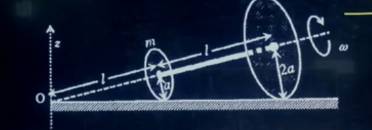
- The center of mass of the assembly rotates about the z-axis with an angular speed of ω/5
- The magnitude of angular momentum of the center of mass of the assembly about the point O is 81 ma²ω
- The magnitude of angular momentum of the assembly about its center of mass is 17 ma² ω/2
- The magnitude of the z-component of is 55 ma²ω
Ans: A or A and C
Q4: One mole of a monatomic ideal gas undergoes four thermodynamic processes as shown schematically in the PV-diagram below.
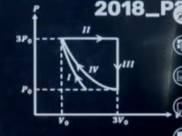
Among these four processes, one is isobaric, one is isochoric, one is isothermal and one is adiabatic. Match the processes mentioned in List-1 with the corresponding statements in List-II. (JEE Advanced 2018, Paper 2)
| LIST - I |
LIST - II |
|---|---|
| P. In process I |
1. Work done by the gas is zero |
| Q. In process II |
2. Temperature of the gas remains unchanged |
| R. In process III |
3. No heat is exchanged between the gas and its surroundings |
| S. In process IV |
4. Work done by the gas is 6PoVo |
- P - 4; Q - 3; R - 1; S - 2
- P - 1; Q - 3; R - 2; S - 4
- P - 3; Q - 4; R - 1; S - 2
- P - 3; Q - 4; R - 2; S - 1
Ans: C
Q5: A cylindrical tube, with its base as shown in the figure, is filled with water. It is moving down with a constant acceleration a along a fixed inclined plane with angle θ = 45°. P1 and P2 are pressures at points 1 and 2, respectively, located at the base of the tube. Let ẞ= (P1-P2)/(pgd), where p is the density of water, d is the inner diameter of the tube and g is the acceleration due to gravity. Which of the following statement(s) is (are) correct? (JEE Advanced 2021, Paper 1)
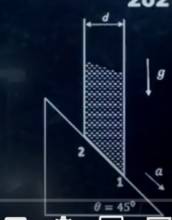
- ẞ = 0 when a = g/√2
- ẞ > 0 when a = 9/√2
- B = √2-1 when a = 9/2
- B = 1/√2 when a = g/2
Ans: A
Q6: For a prism of prism angle θ = 60°, the refractive indices of the left half and the right half are, respectively, n₁ and n₂ (n ≥ n₁) as shown in the figure. The angle of incidence i is chosen such that the incident light rays will have minimum deviation if n₁ = n2 = n = 1.5. For the case of unequal refractive indices, n₁ = n and n₂ = n + Δn (where Δn « n), the angle of emergence e = i + Δe. Which of the following statement(s) is (are) correct? (JEE Advanced 2021, Paper 2)
- The value of Δe (in radians) is greater than that of Δn
- Ae is proportional to Δn
- Δe lies between 2.0 and 3.0 milliradians, if Δn = 2.8 × 10⁻³
- Δe lies between 1.0 and 1.6 milliradians, if Δn = 2.8 × 10⁻³
Ans: B, C
Q7: A train with cross-sectional area St is moving with speed vt inside a long tunnel of cross-sectional area S0 (S0=4St). Assume that almost all the air (density p) in front of the train flows back between its sides and the walls of the tunnel. Also, the air flow with respect to the train is steady and laminar. Take the ambient pressure and that inside the train to be p0. If the pressure in the region between the sides of the train and the tunnel walls is p, then p0 - p = (7/2N)pvt2.The value of N is ________ (JEE Advanced 2020, Paper 2)
Ans: 9
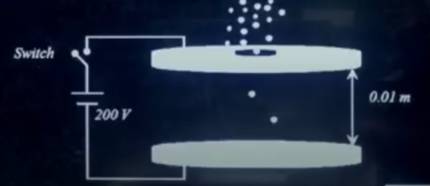
Q8: Two large circular discs separated by a distance of 0.01 m are connected to a battery via a switch as shown in the figure. Charged oil drops of density 900 kg m-3 are released through a tiny hole at the center of the top disc. Once some oil drops achieve terminal velocity, the switch is closed to apply voltage of 200 V across the discs. As a result, an oil drop of radius 8 × 10⁻⁷ m stops moving vertically and floats between the discs. The number of electrons present in this oil drop is (neglect the buoyancy force, take acceleration due to gravity = 10 ms-2 and charge on an electron (e) = 1.6×10⁻¹⁹ C). (JEE Advanced 2020, Paper 2)
Ans: 9
Q9: A hot air balloon is carrying some passengers, and a few sandbags of mass 1 kg each so that its total mass is 480 kg. Its effective volume giving the balloon its buoyancy is V. The balloon is floating at an equilibrium height of 100 m. When N number of sandbags are thrown out, the balloon rises to a new equilibrium height close to 150 m with its volume V remaining unchanged. If the variation of the density of air with height h from the ground is p(h) = p0e -h/h0, where p0 = 1.25 kg m-3 and h0 = 6000 m, the value of N is __ (JEE Advanced 2020, Paper 2)
Ans: 4
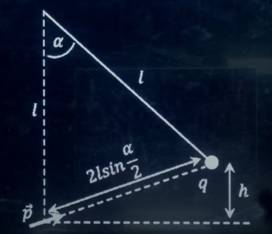
Q10: A point charge q of mass m is suspended vertically by a string of length l. A point dipole of dipole moment p→ is now brought towards q from infinity so that the charge moves away. The final equilibrium position of the system including the direction of the dipole, the angles and distances is shown in the figure below. If the work done in bringing the dipole to this position is N x (mgh), where g is the acceleration due to gravity, then the value of N is ________ (Note that for three coplanar forces keeping a point mass in equilibrium, F/sinθ is the same for all forces, where F is any one of the forces and θ is the angle between the other two forces) (JEE Advanced 2020, Paper 2)
Ans: 2
Q11: A projectile is fired from the horizontal ground with speed and projection angle θ. When the acceleration due to gravity is g, the range of the projectile is d. If at the highest point in its trajectory, the projectile enters a different region where the effective acceleration due to gravity is g' = g/0.81 then the new range is d' = nd. The value of n is ___________ (JEE Advanced 2022, Paper 1)
Ans: 0.95
Q12: The minimum kinetic energy needed by an alpha particle to cause the nuclear reaction 16N7 + 4He2 → 1H1+1908 in a laboratory frame is n (in MeV). Assume that 16N7 is at rest in the laboratory frame. The masses of 16N7, 4He2, 1H1 and 1908 can be taken to be 16.006 u, 4.003, 1.008 and 19.003 u, respectively, where 1 u = 930 MeVc-2. The value of n is _________ (JEE Advanced 2022, Paper 1)
Ans: 2.33
Q13: A solid sphere of mass 1 kg and radius 1 m rolls without slipping on a fixed inclined plane with an angle of inclination -30° from the horizontal. Two forces of magnitude 1 N each, parallel to the incline, act on the sphere, both at distance r = 0.5 m from the center of the sphere, as shown in the figure. The acceleration of the sphere down the plane is ms-2. (Take g = 10 ms-2). (JEE Advanced 2022, Paper 1)
Ans: 2.86
Q14: A particle of mass 1 kg is subjected to a force which depends on the position as F→ = -k(xi+yj) kg ms-2 with k=1kgs-2. At time t= 0, the particle's position r→ = (1/√2i+√2j) m and its velocity v→= (-√2i + √2j+2/πk)m-1. Let vx and vy denote the x and y components of the particle's velocity, respectively. Ignore gravity. When z = 0.5 m, then the value of (xvy - yvx) is ________ m2s-1 (JEE Advanced 2022, Paper 2)
Ans: 3
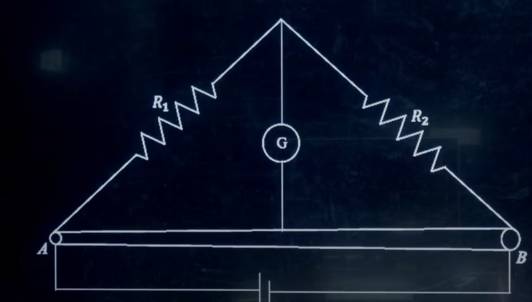
Q15: Two resistances R₁ = XΩ and R₂ = 1Ω are connected to a wire AB of uniform resistivity, as hown in the figure. The radius of the wire varies linearly along its axis from 0.2 mm at A to 1 mm at B. A galvanometer (G) connected to the center of the wire, 50 cm from each end along its axis, shows zero deflection when A and B are connected to a battery. The value of X is______ (JEE Advanced 2022, Paper 2)
Ans: 5
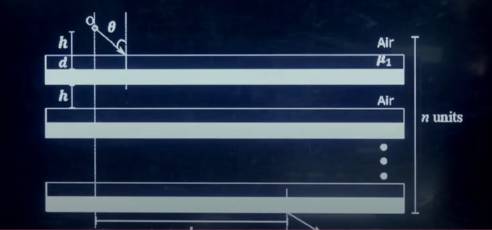
Q16: Consider a configuration of n identical units, each consisting of three layers. The first layer is a blumn of air of height h = 1/3cm, and the second and third layers are of equal thickness d = (√3-1)/2 cm and refractive indices µ1=√3/2 and µ2=√3, respectively. A light source O is placed on top of the first unit, as shown in the figure. A ray of light from O is incident on the second layer of the first unit at an angle of θ = 60° to the normal. For a specific value of n, the ray of light emerges from the bottom of the configuration at a distance l = 8/√3 cm, as shown in the figure. The value of n is_ (JEE Advanced 2022, Paper 2)
Ans: 4
Q17: On a frictionless horizontal plane, a bob of mass m = 0.1 kg is attached to a spring with natural length l0 = 0.1 m. The spring constant is k₁ = 0.009 Nm-¹ when the length of the spring l > l0 and is k₂=0.016 Nm-¹ when l < l0. Initially the bob is released from l = 0.15 m. Assume that Hooke's law remains valid throughout the motion. If the period of the full oscillation is T = (nπ) s, then the integer closest to n is __________ (JEE Advanced 2022, Paper 2)
Ans: 6
Q18: An object and a concave mirror of focal length f = 10 cm both move along the principal axis of the mirror with constant speeds. The object moves with speed Vo 15 cm s-¹ towards the mirror with respect to a laboratory frame. The distance between the object and the mirror at a given moment is denoted by u. When u = 30 cm, the speed of the mirror Vm is such that the image is instantaneously at rest with respect to the laboratory frame, and the object forms a real image. The magnitude of Vm is ___________ cms-1. (JEE Advanced 2022, Paper 2)
Ans: 3
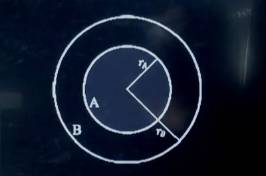
Q19: In the figure, the inner (shaded) region A represents a sphere of radius rA = 1, within which the electrostatic charge density varies with the radial distance r from the center as pA = kr, where k is positive. In the spherical shell B of outer radius rB, the electrostatic charge density varies as pB = 2k/r. Assume that dimensions are taken care of. All physical quantities are in their SI units. (JEE Advanced 2022, Paper 2)
Which of the following statement(s) is (are) correct?
- If rB = √(3/2), then the electric field is zero everywhere outside B.
- If rB = (3/2), then the electric potential just outside B is k/ε0.
- If rB = 2, then the total charge of the configuration is 15πk
- If rB = (5/2), then the magnitude of electric field just outside B is (13πk)/ε0
Ans: B
Also Read:
- JEE Advanced Syllabus for Chemistry
- JEE Advanced Syllabus for Physics
- JEE Advanced Syllabus for Mathematics
Also Check:
| JEE Advanced Chemistry Questions | JEE Advanced Maths Questions |

JEE Advanced Physics Section Overview
Check below the details regarding the JEE Advanced physics section in the JEE Advanced question paper, followed in the past 2 years. It will help in better preparation of JEE Advanced physics section.
Total Marks in JEE Advanced Physics section: 120
- 60 marks in JEE Advanced paper 1
- 60 marks in JEE Advanced paper 2
In each paper of JEE Advanced, the Physics section has the following sections:
- Sec-I (Max. marks-12)
- Sec-II (Max. Marks-12)
- Sec-III (Max. marks-24)
- Sec-IV (Max. marks-12)
Explore more B.Tech exams with upcoming dates
MET


24 Oct '26
30 Oct '26
1 Jun '26 - 31 Oct '26
31 Oct '26
7 Nov '26
JEE Main
1 Nov '26 - 30 Nov '26
1 Nov '26 - 30 Nov '26
9 Jan '27 - 10 Jan '27
Number of questions and marks distribution in each of the sections is as follows:
| Section |
Number of questions and total marks |
Marking Scheme |
|---|---|---|
| 1 |
4 questions of 12 marks |
|
| 2 |
3 questions of 12 marks |
|
| 3 |
6 questions of 24 marks |
|
| 4 |
4 questions of 12 marks |
|
Read More:

Commonly asked questions
Preparation for JEE Advanced begins by knowing exam syllabus. Every student must follow syllabus. Once preparation is done then start solving previous year questions for self-assessment. This will give an overview of your preparation.
You can prepare for all entrance tests at same time. It is a tough task but not impossible. For this a proper strategy is required. Here are some important tips.
- Compare the syllabus: All engineering entrance exams have almost the same syllabus. There might be some additional topics in some exams. The aspirant must study the syllabus for all exams and find out the topics that are extra, and prepare those separately. Almost 90% of the topics will be common for all entrance exams, and hence, syllabus completion for one exam will lead to completion of the syllabus for all the exams.
- Prepare for JEE Mains and incorporate the preparation for all other exams: Apart from JEE Advanced, all the exams are pretty straightforward for a well-prepared candidate. JEE Advanced require a higher level of preparation as the questions are multi-conceptual. However, the state-level entrance exams, and exams like BITSAT, VITEEE, etc., have direct questions. Most of the questions in JEE Mains are also direct and require the application of basic concepts. Hence, the candidates must prepare for one exam, like JEE Mains, that will cover their preparation for all other exams.
- JEE Advanced needs extra effort: For JEE Advanced candidates must focus on time management and building exam day temperament. Learn how to apply multiple concepts to a question.
The bottom line is to prepare for JEE Mains to cover the preparation for all other CETs and exams like BITSAT and VITEEE. For JEE Advanced, work on sharpening your skills of time management, stress handling, multiple concept application, speed and accuracy.
Aspirants must keep in mind that exam difficulty level cannot be determined by organising IIT. JEE Advanced paper is not made by one single IIT; but it is prepared by experts from multiple institutes. Difficulty level of exam is independent of the IIT conducting exam.
Kalpit Veerwal, the JEE Advanced 2017 AIR 1 scored 360 out of 360, the only person in the history of IIT JEE to score full marks.
Another student Ved Lahot scored 355 in JEE Advanced 2024 exam and secured AIR 1.
News & Updates
Explore Other Exams
Oct '26 | JEE Main 2027 Registration Ses... |
Dec '26 | JEE Main 2027 Correction Windo... |
Oct '26 | SRMJEEE 2027 Notification |
Nov '26 | SRMJEEE 2027 Registration Phas... |
Feb '27 | COMEDK Application Form 2027 |
Feb '27 | COMEDK Mock Test Release Date ... |
Oct '26 | MET 2027 application form star... |
Mar '27 | MET 2027 application form star... |
Dec '26 | BITSAT 2027 Application Form S... |
Mar '27 | BITSAT 2027 Form Correction Se... |
19 Aug '26 - 20 Aug '26 | TS EAMCET 2026 MPC Counselling... |
12 Aug '26 - 17 Aug '26 | TS EAMCET 2026 MPC Counselling... |
Student Forum
 Anything you would want to ask experts?
Answered 3 weeks ago
You are not eligible for JEE (Advanced) 2027 because your first appearance for Class 12 was in 2025. For JEE (Advanced) 2027 candidates must have taken their Class 12 (or equivalent) examination for the first time in either 2026 or 2027. Since your first appearance was in 2025 you fall outside this
S
Contributor-Level 10
Answered a month ago
Yes, Indian students can apply for TU Munich Admissions directly after Class 12th, provided they meet the minimum qualifying JEE Advanced score requirement and other program-specific entry requirements.
Students without a JEE Advanced score, will either have to enroll in the Studienkolleg or complete
A
Contributor-Level 10
Answered a month ago
Technical University of Munich generally accepts a JEE Advanced score only for the immediate academic intake to the year the exam was passed (usually within one year).
Universities like TU Munich assess students based on current admission rules, and hence using a scorecard older than admission year i
A
Contributor-Level 10
Answered a month ago
No, the Technical University of Munich does not accept JEE Advanced scores for Master's programs. For entry to PG programs, students need to have completed a UG degree from a recognised Indian college or university, submit relevant documents, and meet the program-specific criteria.
Check TU Munich Ad
A
Contributor-Level 10
Answered a month ago
While evaluating opening and closing rank trends, JEE Advanced cutoffs, and branch allocation dynamics for civil engineering at IIT Bhubaneswar provides a helpful baseline for your academic planning, Lovely Professional University (LPU) serves as an excellent alternative to elevate your engineering
A
Contributor-Level 7
Answered a month ago
The IIT GANDHINAGAR JEE Advanced closing ranksfor the General (open) female only category in 2026 ranked from roughly 5,437 for computer Science and engineering up to 20270 for civil engineering.
m
Beginner-Level 1
Answered a month ago
IIT BHU CSE cutoff 2026 ranged from 1436 in the first round to 1439 in the last round for the General category under the All India quota. Hence, a rank of at least 1439 is needed to qualify for admission to the CSE course. Check the table below to know the overall cutoff range for other categories.
| Category | IIT BHU CSE cutoff 2026 |
|---|---|
| General | 1436 - 1439 |
| OBC | 601 - 601 (R1) |
| SC | 313 - 373 |
| ST | 161 - 170 |
| EWS | 245 - 245 (R1) |
| PWD | 66 - 66 (R1) |
N
Contributor-Level 10
Answered a month ago
IIT BHU JEE Advanced cutoff 2026 ranged from 601 to 7870 in the first round for the OBC AI category. In the last round, the closing cutoff ranged from 601 to 9002 for the aforementioned category. Check the table below to know the Round 1 and last round closing cutoffs for different courses.
| Course | Round 1 Cutoff 2026 | Last Round Cutoff 2026 |
|---|---|---|
| B.Tech. in Computer Science and Engineering | 601 | 601 |
| B.Tech. in Mathematics and Computing | 826 | 845 |
| B.Tech. in Electronics Engineering | 1167 | 1189 |
| B.Tech. in Electrical Engineering | 1497 | 1529 |
| B.Tech. in Mechanical Engineering | 2760 | 3175 |
| B.Tech. in Chemical Engineering | 3394 | 3609 |
| B.Tech. in Engineering Physics | 3490 | 3620 |
| B.Tech. in Civil Engineering | 3834 | 3980 |
| B.Tech. in Materials Science and Technology | 3886 | 4257 |
| B.Tech. in Metallurgical Engineering | 4269 | 4494 |
| B.Tech. in Industrial Chemistry | 4389 | 4681 |
| B.Tech. in Biomedical Engineering | 4798 | 5067 |
| B.Tech. in Biochemical Engineering | 4877 | 5156 |
| B.Tech. in Ceramic Engineering | 4899 | 5245 |
| B.Tech. in Mining Engineering | 5031 | 5329 |
| B.Tech. in Pharmaceutics Engineering and Technology | 5424 | 5776 |
| Bachelor of Architecture (B.Arch.) | 7870 | 9002 |
N
Contributor-Level 10
Answered a month ago
IIT Gandhinagar JEE Advanced cutoff 2026 for the General AI female category ranged from 5437 (CSE) to 20270 (Civil Engineering). Students can check the table below to know the last round cutoff range for other female categories.
| Category | IIT Gandhinagar JEE Advanced cutoff 2026 |
|---|---|
| General | 5437 - 20270 |
| OBC | 2700 - 9008 |
| EWS | 981 - 3973 |
| ST | 369 - 1941 |
| SC | 802 - 4390 |
| PWD | 225 |
N
Contributor-Level 10
Answered a month ago
IIT Bombay cutoff 2026 for the Electrical and Aerospace Engineering courses for the General AI category in the last round was 411 and 2638, respectively. To know the last round closing ranks for other categories, see the table below.
| Category | Electrical Engineering | Aerospace Engineering |
|---|---|---|
| General | 411 | 2638 |
| OBC | 281 | 1546 |
| SC | 130 | 731 |
| ST | 90 | 458 |
| EWS | 110 | 589 |
| PWD | 7 | 103 |
N
Contributor-Level 10
Engineering Education & Entrance Exam Expert
Role: Senior News Writer & Content Editor, Shiksha.com
Education: B.Tech in Mechanical Engineering [IET], MA Education Philosophy
Satyendra Singh is an Engineering gradua
Read Full Bio