
CAT 2026 Exam Pattern: Marking Scheme, Sections, Exam Duration, No. of Questions, Total Marks
Common Admission Test 2026 ( CAT )


CAT 2026 admit card download
4 Nov '26 - 29 Nov '26


CAT 2026 exam pattern has not changed compared to the previous term. CAT 2026 exam has three sections with a 120-minute exam duration. Based on the CAT paper pattern followed in the last two years, the sections in the CAT question paper will be as follows:
- Verbal Ability & Reading Comprehension (VARC)
- Data Interpretation & Logical Reasoning (DILR)
- Quantitative Aptitude (QA)
As per the past CAT paper pattern, VARC will have 24 questions (including 16 RC), whereas the remaining two sections of the CAT exam had 22 questions each. CAT 2026 will have three slots to be conducted in a single day. Scroll down to know in detail the test pattern of the CAT exam.
- CAT Pattern 2026: Key Highlights
- What Is CAT Exam Pattern 2026?
- CAT 2026 Exam Pattern: Questions & Marks Distribution
- CAT Sections and Important Topics 2026
- CAT 2026: Sectional Time Limit
- CAT Marking Scheme 2026
- How to Attempt Questions in CAT Exam?
- CAT Exam Pattern 2026: Previous Year Trends
- FAQs Related to CAT Exam Pattern 2026


CAT Pattern 2026: Key Highlights
CAT exam is designed to test a management aspirant's communication, quantitative, and logical skills. The questions in the CAT exam have varied difficulty levels. To be able to complete the test with maximum accuracy and efficiency, candidates must understand the paper pattern. Here are a few details of the CAT exam pattern 2026:
- CAT VARC has 24 questions and 72 marks
- CAT DILR has 22 questions and 66 marks
- CAT Quantitative Aptitude has 22 questions and is of 66 marks
- Every MCQ has 4 answer options to choose the right answer from
- Candidates can use an on-screen calculator for solving Math-based questions
- It is not mandatory to attempt all the questions
- Candidates should attempt only those questions which they are sure about, to avoid negative marking

Check out Shiksha's exclusive and free CAT Mock Test to understand the question paper pattern and difficulty level.
| CAT Mock Test by Shiksha | Direct Link for CAT Mock Test |
|---|---|
| Mock Test 1 | Practice CAT Mock Test |
| Mock Test 2 | Practice CAT Mock Test |
| Mock Test 3 | Practice CAT Mock Test |

Commonly asked questions
India's premiere b-schools accept CAT for MBA admissions. More than 2.5 lakh candidates fighting for limited seats at these institutes make the exam tough to crack.
The Quantitative Aptitude section of CAT is the third and the last section of the question paper. It has 22 questions and the total marks is 66. This section of the CAT exam is usually dominated by Arithmetic and Algebra. Most of the questions out of 22 are asked from these two topics. There are about 7-9 Algebra questions and 7-9 Arithmetic questions (the exact number varied for all three slots). Apart from these two topics, there are questions from Mensuration Modern Math and Number System in the Quantitative Aptitude section CAT. Some of the important sub topics in this section include: Arithmetic topics: Ratio and Proportion, Simple and Compound Interest, Profit and Loss Mixtures and Allegations Averages, Percentages, Mean Median Mode, Time and Work, Time Speed and Distance Algebra topics: Basics Algebraic Formulae, Number of integer solutions, Quadratic Equations, Finding out roots, Maxima and Minimal, Higher Degree Equations, Linear Equations, Problems on ages, Descartes Rule of Signs, Inequalities, Logarithm, Functions, Modifications of Graphs, The smallest Value in a Maximum Function Number System topics: Finding Out Last Two Digits, Number of Trailing Zeroes, Finding out Remainders based on, Basic Divisibility Rules, Binomial Theorem, Simplifying the Dividend (Single and/or Multiple Divisors), Basics of Numbers, Properties of Numbers, Divisibility Rules, Divisibility and Factors, the highest Common Factor and the lowest Common Multiple, Finding Out the Last Digit, Fermat's Theorem, Euler's Theorem, Pattern Recognition and Cyclicity of Remainders, Wilson's Theorem, Base Systems, Conversion of Bases, Addition/Subtraction/ Multiplication in different bases Geometry Topics: Lines and Angles, Triangles Basic Concepts, Area, Angles, Similar Triangles Polygons, Circles, Solids / Mensuration 3D Geometry, Coordinate Geometry, Trigonometry Modern Math topics: Sequence and Series Binomial Theorem, Set Theory, Permutation and Combination, Probability.
As per the latest CAT exam pattern, there will be 68 questions. The format will be MCQ and non-MCQ. VARC will have 24 questions, DILR will have 22 questions and QA will have 22 questions. Each question will carry 3 marks and there will be negative marking of -1 for incorrect answer. Sectional time limit will be 40 minutes.
What Is CAT Exam Pattern 2026?
The CAT 2026 exam pattern indicates the structure of the Common Admission Test, including the number of questions, type of questions, and section-wise weightage, along with the marking scheme and sectional overview. The CAT paper pattern has three sections with a total of 68 questions.
IIM Indore, the conducting body of CAT 2026, has not notified any change in the exam structure as of now. The CAT 2026 exam pattern is based on the structure that has been followed for the past two years.
Candidates who have appeared for the CAT exam before may have a better understanding of the paper pattern compared to new aspirants. Both repeaters and new aspirants must use the CAT exam pattern to fine-tune their exam preparation.
CAT 2026 Exam Pattern: Questions & Marks Distribution
The number of MCQs to TITA questions is not fixed in the CAT exam pattern. Refer to this section for section-wise number of MCQ vs TITA questions, along with the difference between marking, and more.
Difference between MCQ and TITA in CAT Pattern
Know the primary differences between CAT MCQ and TITA questions:
| Feature | MCQ (Multiple Choice) | TITA (Type In The Answer) |
|---|---|---|
| Answer Format | Select 1 of 4 options (mouse click) | Type numeric answer via keyboard |
| Options Shown | Yes - 4 choices displayed | No - blank text field |
| Correct Answer | +3 marks | +3 marks |
| Wrong Answer | -1 mark (negative marking) | 0 marks (no penalty) |
| Unattempted | 0 marks | 0 marks |
| Guess Strategy | Only if 2+ options eliminated | Always attempt - no risk |
Section-wise Breakdown of MCQ vs. TITA Questions
Check the table below for the section-wise breakdown of MCQ vs. TITA questions in the CAT exam:
| Section | Total Questions | MCQ Count | TITA Count |
|---|---|---|---|
| VARC | 24 | 20 - 22 | 2 - 4 |
| DILR | 22 | 11 - 15 | 7 - 11 |
| QA | 22 | 14 - 16 | 6 - 8 |
| Total | 68 | 45 - 53 | 15 - 23 |
NOTE: As per past trends, an indicative ratio of questions in the CAT exam is 48 MCQs to 20 TITA questions.

CAT Sections and Important Topics 2026
The CAT paper pattern includes three sections. All three CAT exam sections have a distinct structure, with the number of questions, types of questions, and more. Check the section-wise CAT exam pattern below.
CAT VARC Exam Pattern 2026
The CAT VARC 2026 pattern did not bring any shift in the exam structure. Important details of the CAT VARC pattern 2026 are as follows:
| Exam Parameter | Structure & Format Details |
|---|---|
| Total Questions | 24 Questions |
| RC vs VA Split | 16 RC Questions + 8 VA Questions |
| Reading Comprehension (RC) | 4 Passages, 4 questions per passage, 600 – 700 words per passage |
| Verbal Ability (VA) | 8 Questions (Para Jumbles, Para Summary, Odd Sentence Out, Para Completion) |
| Marking Scheme | +3 for correct, -1 for incorrect MCQs, 0 for incorrect TITA |
CAT DILR Exam Pattern 2026
The CAT DILR 2026 pattern did not bring any shift in the exam structure. Important details of the CAT DILR pattern 2026 are as follows:
| Exam Parameter | Structure & Format Details |
|---|---|
| Total Questions | 22 Questions |
| Sectional Split | 14–16 DILR Questions based on Data Interpretation + 6–8 questions based on Logical Reasoning |
| Data Interpretation (DI) | Questions based on tables, charts, graphs, caselets, and other data-based sets |
| Logical Reasoning (LR) | Questions based on arrangements, games and tournaments, networks, routes, rankings, and other logical reasoning sets |
| Marking Scheme | +3 for correct, -1 for incorrect MCQs, 0 for incorrect TITA |
CAT QA Exam Pattern 2026
The CAT Quant 2026 pattern did not bring any shift in the exam structure. Important details of the CAT Quantitative Aptitude pattern 2026 are as follows:
| Exam Parameter | Structure & Format Details |
|---|---|
| Total Questions | 22 Questions |
| Sectional Split | Questions from Arithmetic, Algebra, Geometry, Number System, and Modern Mathematics |
| Arithmetic | Questions from percentages, profit and loss, ratio and proportion, averages, time, speed and distance, time and work, mixtures, and other arithmetic topics |
| Algebra & Other Topics | Questions from algebra, geometry, mensuration, number system, and modern mathematics |
| Marking Scheme | +3 for correct, -1 for incorrect MCQs, 0 for incorrect TITA |
CAT Study Material: Free PDFs
- CAT DILR questions with solutions for practice PDFs
- CAT Quantitative Aptitude questions with solutions for practice PDFs
- CAT VARC questions with solutions for practice PDFs
Commonly asked questions
Yes, you can crack CAT through self study but it will require a lot of discipline and consistency on daily basis. You will need the most recommended books, best mock test series and online practice sessions. Join YouTube channels for online tutorial. Give yourself 9 months and study for 8 hours daily.
Yes, you can crack CAT exam even if you haven't studied Maths in class 12. CAT Quant and DI have Mathematical questions of advance level, from the topics studied in Class 9 and 10. You will only need to brush up the basic and practice advance level questions.
Yes CAT syllabus is difficult to crack if you do not have enough time. There are three subjects in CAT- VARC, DILR and Quantitative Aptitude. Most of candidates find RC passages tough to crack. In Quants, Arithmetic, Algebra and Geometry pose significant challenge during preparation. In DILR, Reasoning questions often turnout to be tricky and confusion.
CAT 2026: Sectional Time Limit
Aspirants have to complete every section in 40 minutes. After the stipulated 40 minutes are over, the test screen will automatically move to the next section. No changes, corrections, or submissions will be allowed after that. PwD candidates will get extra time. Check the table below for the category-wise time limit for CAT 2026.
| CAT Exam Sections |
Time Limit |
Time Limit for PwD Students |
|---|---|---|
| 40 minutes |
53.20 minutes |
|
| 40 minutes |
53.20 minutes |
|
| 40 minutes |
53.20 minutes |
|
| Total |
120 minutes |
160 minutes |
Also Read:
Commonly asked questions
CAT is a speed-based test of analytical aptitude, logical reasoning skills, data interpretation and English comprehension. Now, it may sound tough, but these are the skills which we are taught in school so there is nothing new to learn. What is required is to learn these subjects at advanced level. If you are an average student but have studied Science or Commerce in Class-12 and graduation, you will find a lot of familiar topics in Data Interpretation, Quantitative Aptitude and Logical Reasoning. All you will need is brush up the basics and practice the concepts on advanced-level problems.
However, since the competition is so high in CAT and less than 95 percentile can break your dream of joining a top college like IIM, the preparation for CAT requires a lot of focus, dedication, discipline and diligence. If you can do that, despite being an average student, you can crack the CAT exam.
Hope it was helpful!!!
Yes, you can crack CAT exam even if you haven't studied Maths in class 12. CAT Quant and DI have Mathematical questions of advance level, from the topics studied in Class 9 and 10. You will only need to brush up the basic and practice advance level questions.
CAT books by Arun Sharma, Nishit Sinha, RS Agarwal and Abhijit Guha are good and exhaustive, but you should refer to more study material like sample test papers and mock tests for a complete preparation.
CAT Marking Scheme 2026
CAT has negative marking, so candidates must mark answers carefully. They should mark an answer only if they are sure of it; otherwise, they should skip it to prevent negative marking. However, in TITA questions, they can do guesswork if they nearly know the answer, as there is no negative marking for them. Candidates must try to attempt two-thirds of the total questions in every section for a decent overall score.
| CAT Sections |
Number of Questions |
Marks Per Question |
CAT Negative Marking (Only MCQ) |
|---|---|---|---|
| VARC |
24 |
3 |
-1 |
| DILR |
22 |
3 |
-1 |
| Quantitative Aptitude |
22 |
3 |
-1 |
Commonly asked questions
Difficulty level in CAT exam is not specific to any of the three slots. The difficulty level across slots may vary every year. Know how the CAT scores are normalised: https://www.shiksha.com/mba/articles/understanding-cat-normalization-process-blogId-9386.
While it is advised to dedicate at least 9 months to CAT preparation, six months of dedicated study can also help you crack the exam. You will need daily, weekly and monthly plan for syllabus coverage. Practice a good number of mock tests and study for about 8 hours daily.
How to Attempt Questions in CAT Exam?
Candidates have to take the test on a computer system at a designated test centre. They have to use only the computer mouse to select an answer option. For TITA questions, they can use the keyboard. There are three options to mark the answer:
- Save and Next
- Clear Response
- Mark for Review and Next
Key Points About Marking Answers in the CAT Exam
- If a candidate chooses 'Save and Next', they can still return to change their answer anytime before the section ends.
- If they have marked an option but want to clear it, they can click on 'Clear Response'.
- In case they are not sure of the answer, they should exercise the 'Mark for Review and Next' option.
Candidates must go back to the questions marked for review before the 40 minutes for that section get over and click on 'Save and Next'. If they haven't saved their final answer, it will be reported as unanswered, and 0 marks will be awarded. (Note: If an answer is selected and marked for review, it will be evaluated automatically, even if not re-saved.)
How to Use the CAT Onscreen Calculator?
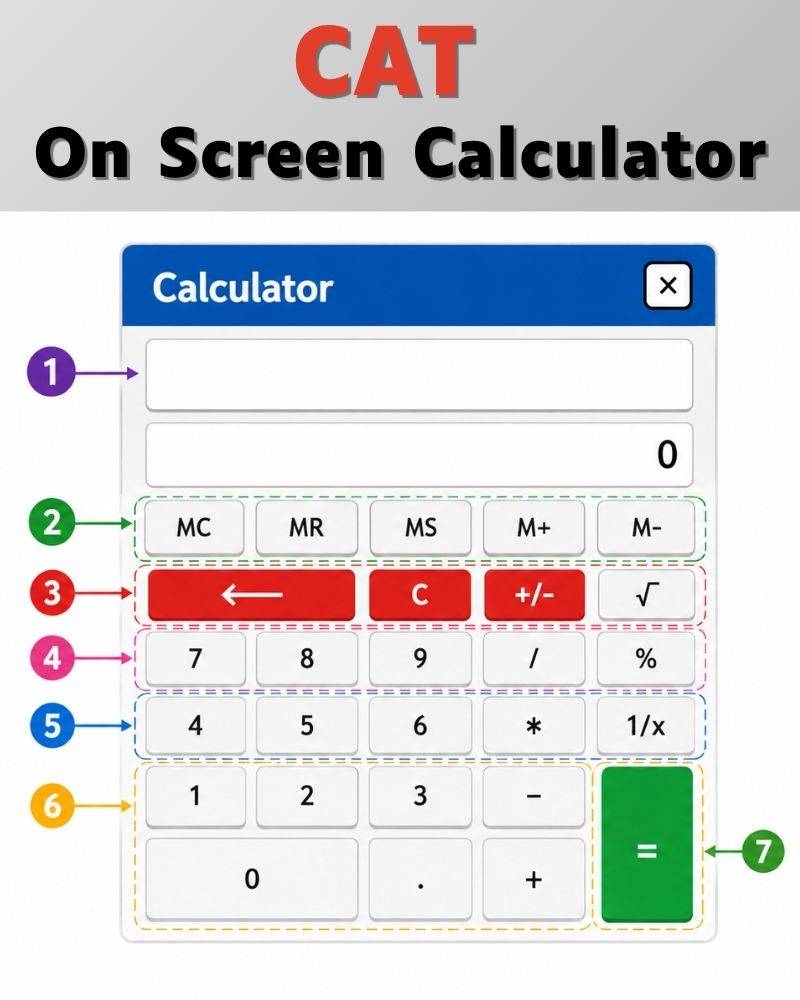
The CAT onscreen calculator helps candidates perform basic math calculations. While attempting the CAT exam, using the onscreen calculator can be time-consuming; therefore, candidates must use it for complex data interpretation numbers, long decimal arithmetic, or square roots. One must avoid using it for simple mental math since clicking every digit with a mouse takes extra time. Candidates must practice using mock test interfaces that have an onscreen calculator similar to the CAT exam to build speed and familiarity.
Candidates will find the following buttons on the CAT onscreen calculator:
- Memory Plus (M+): Adds the current number to the memory.
- Memory Minus (M-): Subtracts the current number from the memory.
- Memory Recall (MR): Shows the number saved in memory.
- Memory Clear (MC): Clears the memory.
This is how the CAT onscreen calculator looks:
CAT On Screen Calculator
CAT 2026: Answer Marking Strategy & Scoring Tips
Choosing the right question may help in achieving a better score in the CAT exam. Check a worked example for attempting fewer questions with higher accuracy, compared to attempting more questions with lower accuracy:
| Scenario A - Controlled Risk | Scenario B - High Risk | |
|---|---|---|
| Total Attempted | 45 questions | 60 questions |
| Correct Answers | 40 | 40 |
| Wrong MCQs | 3 | 18 |
| Wrong TITA | 2 (no penalty) | 2 (no penalty) |
| Correct Marks | 40 × 3 = +120 | 40 × 3 = +120 |
| MCQ Penalties | 3 × (-1) = -3 | 18 × (-1) = -18 |
| FINAL SCORE | 120 – 3 = 117 marks | 120 – 18 = 102 marks |
NOTE:
- The exam terminal automatically locks a section the moment its 40-minute timer expires, transitioning you to the next section immediately. Any unsaved answers are permanently recorded as unattempted.
- The three sections are in a fixed sequential order and cannot be skipped or rearranged.
- A strict automated 40-minute (53:20 for PwD) cutoff per section is enforced by the system.
- Set selection is the single most critical skill in DILR. Spending 12+ minutes on a deceptively complex set can derail your entire section. Scan all sets in the first 3–5 minutes and commit only to 3 high-yield sets.
- On TITA questions, ALWAYS attempt them-there is zero risk. Even a calculated guess is better than leaving a question blank. On MCQs, attempt only when you are reasonably confident, as random guessing can significantly lower your raw score.
Also Read:
Commonly asked questions
Yes, CAT exam is MCQ type, meaning there are no subjective type questions wherein you have to write a lot. In CAT every question is to be answered in one word or option. However, all questions don't have MCQ options, some are Type In The Answer (TITA) questions.
Maximum marks in CAT is 204. There are 68 questions each carrying 3 marks. VARC is of 72 marks and DILR and Quants are of 66 marks each.
CAT exam is of 120 minutes. Each section is of 40 minutes. PwD candidates get extra time of 53 minutes and 20 seconds per section.
CAT Exam Pattern 2026: Previous Year Trends
FAQs Related to CAT Exam Pattern 2026
CAT has 68 questions. Each question carries three marks. There is negative marking of minus one for incorrect attempts. There is no deduction of marks for unanswered questions. Total marks in 204.
CAT has three sections – Verbal Ability and Reading Comprehension, Data Interpretation and Logical Reasoning and Quantitative Aptitude. XAT has four sections – Verbal and Logical Ability, Quantitative Ability & Data Interpretation, Decision Making and General Knowledge. While CAT is Quant heavy, XAT is more tilted towards Reasoning.
CAT syllabus includes all the important topics of subjects that are relevant for business aptitude. For CAT exam, candidates have to study, Verbal Ability and Reading Comprehension VARC Data Interpretation and Logical Reasoning DILR and Quantitative Aptitude. Given below are the key topics included in the CAT syllabus.
- VARC topics: Parajumbles, Paracompletion, Parasummary, Verbal Reasoning and Reading Comprehension.
- Quantitative Aptitude topics: Arithmetic, Geometry, Algebra Trigonometry Modern Math, Number System and Mensuration.
- DILR topics: Puzzles, Pie Charts, Venn Diagram, Tables and Bar Graphs, etc.
CAT question papers are released within a week of the exam in the form of a PDF as a response sheet and answer key. Response sheet hosts CAT exam questions and answers.
CAT exam is conducted in computer based test mode. Candidates have to visit a designated test centre to give the exam on a computer system. They have to login their answers with the help of computer mouse.
In CAT 2025, the following changes were seen:
- The fee amount increased from INR 2,500 to INR 2,600 for General category candidates and from INR 1,250 to INR 1300 for Reserved category candidates.
- In DILR section, number of questions increased from 20 to 22.
- Total marks of CAT DILR section increased from 60 to 66.
- Total marks of CAT exam increased from 198 to 204.
- Candidates can select five cities instead of six.
IIM does not conduct official CAT mock tests for candidates, but it does release a mock guide which can be viewed as official CAT mock test. It is essentially a walk through of what the CAT test form will be for that year. It has section wise questions marking scheme, time limit, etc. just like the actual CAT exam. Candidates must use take the official CAT mock test at least once before the exam.
CAT exam conducted only once a year in the month of November. It is conducted in three shifts on a single day.
CAT lays a lot of emphasis on analytical skills so the questions are asked mostly from those topics which require deep learning and practice. The three sections of CAT question paper are designed in such a way that candidates have to use their ability of minute observation and fast calculation. Shared below are the section wise main topics from which questions are asked in CAT. Verbal Ability: Parajumbles, Parasummary, Sentence Completion and Inferences
- Reading Comprehension: Questions based on passages, Para meaning, Order of sentences
- Data Interpretation: Tables, Graphs, Pie Charts, Venn Diagram, Data Sufficiency
- Logical Reasoning: Blood Relation, Seating Arrangement, Syllogism, Coding-Decoding, Sets and Caselets, Family Tree, Assumptions
- Quantitative Aptitude: Geometry, Algebra Number System Modern Math, Arithmetic, Mensuration
The difficulty level of CAT questions is usually moderate to high. Only a few questions are easy and quick to solve. To crack the CAT exam, one needs to pay attention to the abovementioned topics.
MBA exams you must check out
Exams which are to be conducted soon

Apr '27
CAT Exam
Student Forum
 Anything you would want to ask experts?
Answered 2 days ago
IIM Indore will release CAT admit card 2026 on November 4. Candidates will be able to download the admit card of CAT exam 2026 until the exam date, i.e. November 29.
R
Contributor-Level 7
Answered 2 days ago
Candidates can edit the following details during the CAT form correction process:
- Photograph uploaded
- Signature uploaded
- Test city preferences
Personal details like name, date of birth, gender, nationality, or any other information, besides those above mentioned, cannot be changed using CAT correction w
N
Contributor-Level 7
Answered 2 days ago
CAT application form correction window is facilited for candidates to edit a few details. IIM Indore opens CAT form correction window inside login dashboard on the official website. Candidates have to login to change details during the form correction period (ranging from 2-3 days). There is no proc
D
Contributor-Level 7
Answered 3 days ago
Yes there are ways to improve a CAT score if the result is not as expected. The main thing is to first check which section needs more attention and then work on accuracy time management and question selection. Regular mock tests can help identify repeated mistakes. For students considering LPU its i
S
Beginner-Level 1
Answered 4 days ago
You cannot see a score or result for the practice mock test taken on the official CAT website because the official IIM mock portal is only designed to familiarize you with the exam interface and structure and it does not generate or save scores.
S
Contributor-Level 10
Answered 4 days ago
Yes 75 percent attendance is mandatory at RKDF University Ranchi. As per the official university guidelines and UGC norms students are expected to maintain regular attendance to remain eligible for mid semester and end semester examinations.
S
Contributor-Level 10
Answered a week ago
To choose the best CAT coaching institute in Siliguri, evaluate centers based on faculty expertise, mock test quality, batch flexibility, and physical location convenience.
S
Contributor-Level 10
Answered 2 weeks ago
As of September 2026, IIM Indore has not announced the CAT form correction dates. Past trends indicate that the application form correction window opens a few weeks after the registration window is closed.
Check: CAT Correction Window 2026
B
Contributor-Level 7
Answered 2 weeks ago
Yes, candidates are facilitated with a window to edit exam form once the CAT registration concludes. However, candidates will only be able to edit photo, signature, and test city preference using CAT correction window. IIM Indore will announce the dates for CAT form correction window once the regist
J
Contributor-Level 7
Answered 2 weeks ago
IIM Indore has not announced the last date extension for CAT 2026 yet. However, past trends indicate CAT registration extends by a few days. If CAT 2026 registration is extended, candidates will find an update on the official website.
S
Contributor-Level 7
1738 Institutes accepting CAT
 4.6
4.6
Explore more MBA exams with upcoming dates
KIITEE MBA 2027 Registrations 25 Sep '26 - 4 Jan '27
What is CAT 2026 admti card release date?