

CAT Data Interpretation cannot be mastered without practice. And the key is to practice questions of varied difficulty levels. Shiksha brings to you solved CAT Data Interpretation questions with solutions PDFs for practice to help you prepare well for CAT 2026.

CAT Data Interpretation questions are of moderate to high difficulty level. And require a lot of practice. The questions are all about analyzing of the data in the form of charts, graphs, tables, venn diagram, symbols, etc. Even though DI questions are clubbed together with LR questions in CAT, you need to study extensively as the DI types are varied.
For cracking CAT Data Interpretation, you need to have a strong base is Mathematics as all the questions are calculation based. However, to be able to make accurate calculation, you need to read the data correctly. This can be achieve only with practice. There are 10-11 DI questions in CAT, that you need to address in less than 20 minutes. Even if you do not attempt all CAT DI sets, you will still need to be fast in reading the table/chart, understand the questions and solve the problem.
So, if you plan to appear for CAT 2026, you will need to practice a lot of DI questions. You should solve sample questions as well as previous years’ CAT DI questions.
CAT DI mock tests are also a must do. In this article, we have shared a few CAT Data Interpretation questions with solutions for practice. You can solve these now as the more you practice the better you get at handling questions from this section.
Also Read: CAT 2026 syllabus
- CAT Data Interpretation Questions for Practice
- CAT Data Interpretation Questions for Practice Set 2
- CAT DI Questions for Practice with Solutions PDFs
- CAT Data Interpretation Questions for Practice
CAT Data Interpretation Questions for Practice
Directions for questions 1 to 4: Refer to the following information on prices and production of crude oil for the period 1973-80 and answer the questions given below. In the first graph, the lines show the prices of crude oil per barrel for domestic production and imports while the bars show the domestic price as a percentage of the import price. In the second graph, the bars show average production of barrels per day in the US and Non-OPEC countries, while the line shows the consumption of oil in the US.


1. In 1979, if the US imported crude oil in order to meet demands, what is the total cost of imported crude oil?
1) USD 455,800/day 2) USD 296,800/day 3) USD 376,300/day 4) USD 251,550/day
2. What is the difference between the total cost of domestic production of crude oil in the US in 1975 and the total cost of crude oil imported by the US in order to meet demands in this year?
1) USD 49,500/day 2) USD 96,750/day 3) USD 53,625/day 4) USD 65,625/day
3. Which of the following statements is/are true?
1) The percentage change in the price of imported crude oil in 1974 is approximately 120%.
2) In 1977, the absolute difference between the percentage change in the price of domestic oil and the percentage change in the price of imported oil is approximately 2.
3) The percentage change in the consumption of oil by the US from 1973 to 1979 is -80%.
4) In 1977, the ratio of production of oil by non-OPEC countries to that by the US is 4.25.
1. I only 2. II only 3. III only 4. II and III
Also Read:
- CAT 2026 DILR strategy to score 26 marks and get 95+ percentile
- CAT exam: Which section has the highest weightage?
4. What is the difference between the percentage change in the price of imported oil and the price of domestic oil in 1976?
1) 2.55 2) -9.95 3) -19 4) 1.25
Directions for questions 5 to 8: Table A shows the number of hits scored by leading male actors of the Bollywood film industry in the past 5 years. Table B gives data on who were leading ladies in each of these hit films. The data for the four established actresses is given separately, while the hits of all the other heroines are clubbed under the head “Others”.
| Table A | Year | ||||
|---|---|---|---|---|---|
| Actors |
2000 |
2001 |
2002 |
2003 |
2004 |
| SRK |
1 |
0 |
2 |
1 |
1 |
| VO |
1 |
2 |
0 |
0 |
1 |
| AK |
0 |
0 |
1 |
1 |
0 |
| HR |
0 |
1 |
1 |
0 |
1 |
| SK |
1 |
0 |
1 |
0 |
1 |
| Table B | Year | ||||
|---|---|---|---|---|---|
| Actresses |
2000 |
2001 |
2002 |
2003 |
2004 |
| AR |
2 |
0 |
1 |
0 |
1 |
| RM |
1 |
1 |
0 |
1 |
0 |
| PZ |
0 |
1 |
1 |
1 |
0 |
| MD |
0 |
1 |
0 |
0 |
1 |
| Others |
0 |
0 |
3 |
0 |
2 |
Note:
- AR and SK have vowed never to work together in a film. Also PZ has not yet worked with VO.
- Among the four established actresses, AK only works with RM.
- All of SRK’s hits in the past 5 years have been with only two actresses.
- VO only works with established actresses.
5. In 2002, SRK’s two hits have been with
1) AR & PZ 2) AR & others 3) PZ & others 4) RM & MD
6. MD’s two hits in the past 5 years have been with
1) VO and SK 2) VO only 3) VO and SRK 4) VO and HR
7. HR’s hits have been with
1) RM & AR 2) RM & PZ 3) Others & PZ 4) MD & AR
8. Which actor/actors had the highest number of hits with “other” actresses?
1) AK 2) HR 3) HR & SK 4) SK
CHECK OUT
- CAT Verbal Ability (VA) solved questions with solutions PDFs for practice
- CAT Logical Reasoning (LR) questions with solutions PDFs for practice
- CAT Quantitative Aptitude (QA) questions with solutions PDFs for practice
- CAT Parajumble questions with solutions PDFs for practice
Directions for questions 9 to 12: Refer to the following information and answer the CAT DI questions given below.
The table below shows the financial performance of business houses for a particular year. Study the table and answer the questions based on the information contained in the table.
| Business House |
Total Assets (TA) |
Net Worth (NW) |
Total Borrowings |
Net Sales (NS) |
Op. Profits(OP) |
|---|---|---|---|---|---|
| Tata |
2,671,163 |
963,496 |
1018,262 |
1,934,490 |
341,976 |
| Birla |
2,039,079 |
969,612 |
792,092 |
1,280,812 |
324,145 |
| Reliance |
1,152,904 |
719,265 |
249,749 |
549,367 |
145,801 |
| ESSAR |
1,054,419 |
342,532 |
458,843 |
155,391 |
91,092 |
| RPG |
658,631 |
286,670 |
264,555 |
289,391 |
62,580 |
| JK |
490,622 |
196,010 |
197,141 |
285,150 |
45,964 |
| Thapar |
443,936 |
207,870 |
121,217 |
357,406 |
54,782 |
| L & T |
411,672 |
211,810 |
65,605 |
305,442 |
51,689 |
| ITC |
324,964 |
125,544 |
120,442 |
313,948 |
72,257 |
| Mafatlal |
183,733 |
62,600 |
783,754 |
1,611,263 |
26,485 |
| Business House |
Gross Profit |
Net Profits (NP) |
GP/NS (%) |
GP/TA (%) |
NP/NW (%) |
|---|---|---|---|---|---|
| Tata |
248,422 |
156,487 |
12.8 |
9.3 |
16.2 |
| Birla |
226,078 |
145,544 |
17.7 |
11.1 |
15.0 |
| Reliance |
134,369 |
106,485 |
24.5 |
11.6 |
14.8 |
| ESSAR |
70,907 |
57,438 |
45.5 |
6.7 |
16.8 |
| RPG |
28,671 |
14,738 |
9.9 |
4.4 |
5.1 |
| JK |
27,690 |
12,660 |
9.7 |
5.6 |
6.5 |
| Thapar |
33,867 |
22,412 |
9.5 |
7.6 |
10.8 |
| L & T |
44,002 |
27,736 |
14.4 |
10.7 |
13.1 |
| ITC |
54,721 |
33,362 |
17.4 |
16.8 |
26.6 |
| Mafatlal |
16,336 |
8,905 |
10.1 |
8.9 |
14.2 |
9. If NP/NW ratio is considered to be an index of performance, which of the business houses is the best performer?
1) Tata 2) ITC 3) Birla 4) Reliance
10. If executive compensation is a function of operating profit on sales, which organisation would be the most remunerative for an executive?
1) Birla 2) Mafatlal 3) RPG 4) ESSAR
11. If dividends are a function of net profit over net worth, which company should a person invest in?
1) Tata 2) ESSAR 3) ITC 4) RPG
12. As compared to the JK group, which one of the groups could be termed as lean, i.e., having total assets £ those of JK, and thin, i.e., having borrowings £ those of JK as well as performing better, i.e., better in sales and net profits than JK?
1) ESSAR 2) Mafatlal 3) Reliance 4) ITC
Here are the Solved Answers to Questions 1-12:
Q.1 – Ans. 4
The total consumption of crude oil in the US in 1979 is 21,200 barrels per day while the total domestic production of crude oil is 9,500 barrels per day.
This means that the US has to import 11,700 barrels of crude oil per day.
In 1979, the cost of imported crude oil was $ 21.5 per barrel.
So the total cost of imported oil is 11700 ? 21.5
= $ 251,550 per day.
Q2 – Ans. 4
In 1975, the domestic production of crude oil in the US was 8250 barrels per day while the consumption was 18000 barrels per day.
This means that the US had to import 9750 barrels per day.
The price of domestic and imported oil in 1975 was $ 8 and $ 13.5 per barrel respectively.
So the total cost of domestic oil was $ 66,000 / day while the cost of imported oil was $ 131,625 per day.
Thus the required difference is $ 65,625 per day.
Q 3 – Ans. 2
The percentage change in the price of imported crude oil in 1974 is (12.5 – 4.5)/4.5 ? 177%.
So statement I is false.
The percentage change in the price of domestic crude oil is (9 - 8.5)/8.5 ? 5.88% while the percentage change in the price of imported crude oil is
(14 – 13)/13 = 7.69%.
The difference is 5.88 - 7.69 = -1.81.
So statement II is true.
The consumption of crude oil by the US has changed by (21200 – 19000)/ 19000 ? 11.57%.
So statement III is false.
The production of crude oil by non-OPEC countries and the US in 1977 is 28,000 and 9,000 respectively. The required ratio is 3.11. So statement IV is false.
Q4 – Ans. 2
The price of imported oil has changed by
(13 - 13.5)/13.5 = -3.7%, while the change in the price of domestic oil is (8.5 – 8)/8 = 6.25%.
The difference between these values is difference
= – 3.7 – 6.25= – 9.95.
Q5 – Ans. 1
If AK only works with RM, then 2003 hit of AK is with RM.
Hence SRK in 2003 combined with PZ to give a hit. If AR and SK do not work together, then AR’s two hits in 2000 are with SRK and VO.
Hence SK’s hit in 2000 is with RM.
SRK has had hits with PZ and AR in 2003 and 2000 respectively. So SRK’s hits in 2002 are with PZ and AR. Also SRK’s in 2004 is with AR. VO’s 2004 hit is with MD.
As VO has had 2 hits in 2001, at least one of them is with MD. Given that PZ has not worked with VO, then VO’s 2nd hit in 2001 is with RM. Hence in 2001, PZ has a hit with HR. So in 2002, SRK’s two hits are with PZ and AR.
Hence 1st option.
Q 6 – Ans. 2
MD’s both hits have been with VO.
Hence 2.
Q7 – Ans. 3
HR’s hits have been with PZ in 2001 and others in 2002 and 2004. Hence 3.
Q8 – Ans. 3
The 2 hits of others in 2004 are with HR and SK, and the three hits in 2002 are with AK, HR and SK.
Q9 – Ans. 2
By observing table II, we can see that NP/NW ratio is maximum for ITC.
Hence it is the best performer.
Q10 – Ans. 4
Operating Profit/Sales for Birla
= 324145/1280812 = 0.253.
Operating Profit/Sales for Mafatlal
= 26485/1611263 = 0.016.
Operating profit/Sales for RPG
= 62580/289391 = 0.216.
Operating profit/Sales for ESSAR
= 91092/155391 = 0.586.
Thus ESSAR is the best choice.
Q11 – Ans. 3
Net Profit / Net Worth is highest for ITC.
Hence a person should invest in ITC.
Q12 – Ans. 4
JK’s total assets, borrowings, sales and net profits are 490,622, 197,141, 285,150 and 12,660 respectively.
Of the given choices, ITC satisfies all the given conditions since its total assets, borrowings, sales and net profits are 324,964, 120,442, 313,948 and 33,362 respectively.
CAT Data Interpretation Questions for Practice Set 2
DIRECTIONS for questions 1 to 3: Refer to the data below and answer the CAT questions that follow.
Given below is the data for the number of Motor Vehicles in three countries X, Y and Z as on December 31, 2001 and December 31, 2011.
|
|
Number of Motor Vehicles |
|||
|---|---|---|---|---|
| As on Dec 31, 2001 |
As on Dec 31, 2001 |
|||
| COUNTRY |
Per square mile |
Per 1000 population |
Per square kilometer |
Per 1000 population |
| X |
108.6 |
181 |
48 |
208 |
| Y |
60 |
240 |
25 |
270 |
| Z |
54 |
120 |
30 |
156 |
1 square mile = 2.6 square kilometers
1. Which of the following countries witnessed a decline in its population during the given period?
1] X 2] Y 3] Both X & Z 4] Both Y & Z
2. What is the percentage change in the population of Country Z from December 31, 2001 to December 31, 2011?
1] 10% 2] –10% 3] 11.11% 4] –11.11%
3. If the area of Country X is somewhere between 95000-100000 square miles, then its population on December 31, 2011, could have been somewhere in between:
1] 15-20 million 2] 35-40 million 3] 55-60 million 4] Cannot be determined
Directions for questions 4 to 6: Refer to the data below and answer the questions that follow:
Given below is the percentage break up of 3600 students across various streams in Thakur College of Arts, Commerce and Science:

Also given below is a table indicating the percentage break up of male students and female students across the various streams:
| Stream |
Male |
Female |
|---|---|---|
| Arts |
50% |
a% |
| Science |
20% |
b% |
| Commerce |
30% |
a% |
In the above table, ‘a’ and ‘b’ are positive real numbers and 2a is the product of 2 and ‘a’.
4. For the commerce stream, what is the ratio of the number of male students to female students ?
1] 9 : 4 2] 2 : 1 3] 5 : 3 4] Cannot be determined
5. What is the difference between the number of female students studying Arts and female students studying Science ?
1] 144 2] 216 3] 288 4] None of these
6. What is the percentage of female students in Thakur College?
1] 60% 2] 40% 3] 50% 4] Cannot be determined
DIRECTIONS for questions 7 to 9: Refer to the data below and answer the questions that follow.
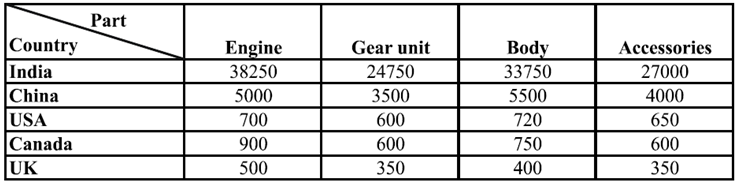
An Indian car manufacturing company ‘Wheelz’ gets its spare parts from different vendors in different countries. The above table gives the prices of these parts in each country, in terms of the currency of that country. Apart from the cost of spare parts, an additional cost of INR 20,000 is required to produce each car. There is no other additional cost involved in manufacturing a car.
In the table given below the Exchange rates of different currencies against the US dollar are given:
| Country |
Currency |
1 US Dollar equivalent |
|---|---|---|
| India |
INR |
45 |
| China |
Yuan |
6.428 |
| Canada |
Canadian Dollar |
1.071 |
| UK |
Pound |
0.5625 |
7. If Wheelz wants to manufacture a car at the least cost then what would be the expenditure in INR?
1] Rs. 132700 2] Rs. 144200 3] Rs. 131600 4] Rs. 142500
8. If Wheelz wants to buy all its spare parts from one country, then from which country should it buy the parts so that the cost is minimum?
1] India 2] China 3] Canada 4] USA
9. Wheelz sets up a new plant in the UK. It considers buying all spare parts either from China or from the UK itself. What will be the difference in cost (in pounds) in the two cases?
1] 50 2] 500 3] 250 4] 25

Commonly asked questions
Difficulty level in CAT exam is not specific to any of the three slots. The difficulty level across slots may vary every year. Know how the CAT scores are normalised: https://www.shiksha.com/mba/articles/understanding-cat-normalization-process-blogId-9386.
CAT question papers are released within a week of the exam in the form of a PDF as a response sheet and answer key. Response sheet hosts CAT exam questions and answers.
CAT has 68 questions. Each question carries three marks. There is negative marking of minus one for incorrect attempts. There is no deduction of marks for unanswered questions. Total marks in 204.
In CAT exam, each candidate gets 120 minutes to solve the paper. There are three sections in CAT Verbal Ability and Reading Comprehension, Data Interpretation and Logical Reasoning and Quantitative Aptitude. For each section 40 minutes are allotted as sectional time limit. For PwD candidates, the sectional time limit is 53.20 minutes per section. Candidates have to complete each section within the given time limit. Since the CAT is an online mode exam, the test screen will move from first section to the next section automatically as soon as the time limit gets over. Thus candidates have to be mindful of the on-screen timer and pre-decide the number of questions to solve in each section. The Verbal Ability and Reading Comprehension section of CAT has 24 questions, Data Interpretation and Logical Reasoning section has 22 questions and Quantitative Aptitude section has 22 questions. It is not mandatory to solve all the questions in CAT so candidates can devise a strategy to use 40 minutes per section as per their strength and weakness.
DIRECTIONS for questions 10 to 12: Answer the questions on the basis of the table given below.
The table gives the sales figures of a fruit vendor for three consecutive days:

Some more information is available about the total sales on three days, which is as follows:
1) The number of Apples sold is half the number of Bananas sold.
2) The number of Oranges sold is 15 more than the number of Papayas sold.
3) The number of Chikus sold is equal to the number of Jackfruits sold.
4) The difference in the number of Oranges and Apples sold is one-third the difference in the number of Strawberries and Blackberries sold.
10. Over the three days, how much did the fruit vendor earn on an average by selling one Papaya?
1] Rs.14 2] Rs.15 3] Rs.12 4] Rs.10
11. At what average selling price is one Apple sold over the three given days?
1] Rs.31.2 2] Rs.32.1 3] Rs.33.6 4] Rs.34.7
12. Find the selling price of each Jackfruit on Tuesday.
1] Rs.30 2] Rs.35 3] Rs.40 4] Rs.45

CAT DI Questions for Practice with Solutions PDFs
Check below and download free PDFs of Data Interpretation CAT questions. Solve these CAT Data Interpretation Sets to gain command on every type of DI questiona that can possibly be asked in CAT 2025.
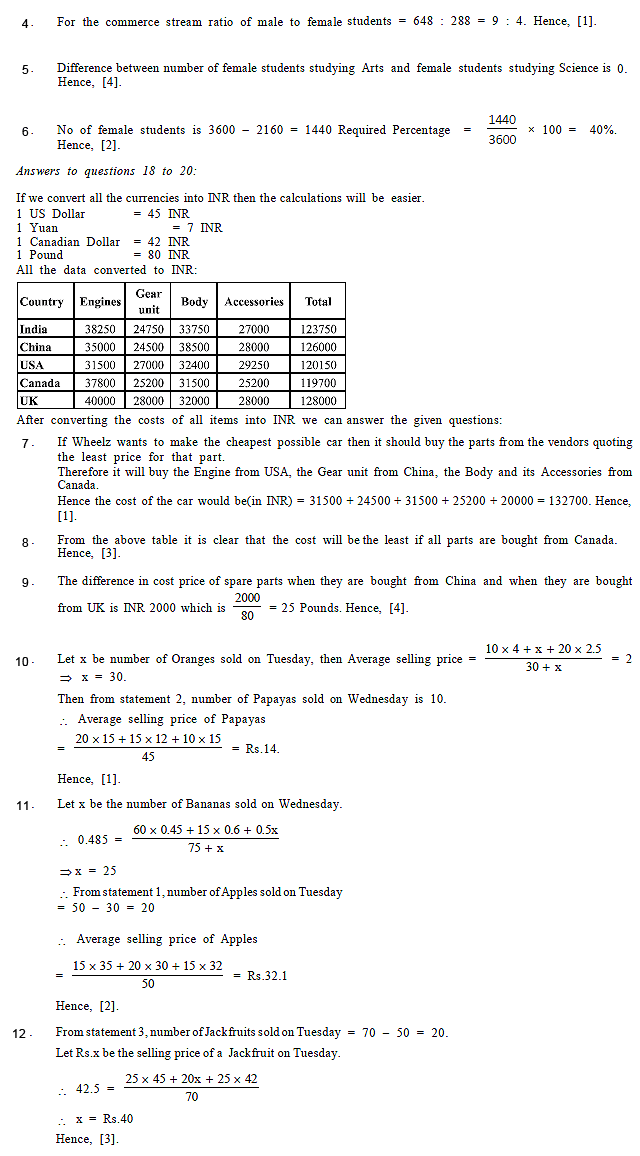
ANSWERS to all the above questions are given below:

Download:
- Download CAT 2017 Question Paper PDF
- Download CAT 2018 Question Paper PDF
- Download CAT 2019 Question Paper PDF
- Download CAT 2020 Question Paper PDF
- Download CAT 2021 Question Paper PDF
- Download CAT 2022 Question Paper PDF Slot 1
- Download CAT 2022 Question Paper PDF Slot 3
- Download CAT 2023 Question Paper PDF Slot 1
- Download CAT 2023 Question Paper PDF Slot 3
- Download CAT 2024 Question Paper PDF Slot 3
- Download CAT 2024 Question Paper PDF Slot 2
- Download CAT 2025 Question Paper PDF Slot 1
- Download CAT 2025 Question Paper PDF Slot 2
Content courtesy:
Atul Gopal, CEO of a coaching institute that trains students for MBA entrance exams like CAT and GMAT, and also provides training for GRE.
Explore colleges based on CAT
Want better recommendations?
There is a 90% more chance of getting best college recommendations by sharing preferences.
- Chat with our counselor
- Get your personalised list of colleges & exams matching your preferences
CAT Data Interpretation Questions for Practice
Data Interpretation for CAT is all about practice. Shiksha has collated CAT DI questions for aspirants to practice and strengthen their grip on the subject. Download free DI sets for CAT here.
| CAT DI Test Easy Set 1 | CAT DI Test Easy Set 1 Solutions |
| CAT DI Test Medium Set 1 | CAT DI Test Medium Set 1 Solutions |
| CAT DI Test Difficult Set 1 | CAT DI Test Difficult Set 1 Solutions |
| CAT DITest Easy Set 2 | CAT DI Test Easy Set 2 Solutions |
| CAT DI Test MediumSet 2 | CAT DI Test Medium Set 2 Solutions |
| CAT DI Test Difficult Set 2 | CAT DI Test Difficult Set 2 Solutions |
| CAT DI Easy Questions Set 3 | CAT DI Test Easy Set 3 Solutions |
| CAT DI Medium Questions Set 3 | CAT DI Test Medium Set 3 Solutions |
| CAT DI Dificult Questions Set 3 | CAT DI Test Difficult Set 3 Solutions |
| CAT DI Easy Questions Set 4 | CAT DI Test Easy Set 4 Solutions |
| CAT DI Medium Questions Set 4 | CAT DI Test Medium Set 4 Solutions |
| CAT DI Diffcult Questions Set 4 | CAT DI Test Diffcult Set 4 Solutions |
Explore more MBA exams with upcoming dates

27 Jun '26
28 Jun '26
1 Dec '25 - 30 Jun '26
30 Aug '26
27 May '26 - 26 Jun '26
13 Jun '26 - 28 Jun '26
28 Jun '26
2 Jan '26 - 30 Jun '26
30 Jun '26
20 Aug '26
Here are some CAT preparation articles you may find useful for preparation Data Interpretation and Logical Reasoning section.
Commonly asked questions
In CAT 2025, the following changes were seen:
- The fee amount increased from INR 2,500 to INR 2,600 for General category candidates and from INR 1,250 to INR 1300 for Reserved category candidates.
- In DILR section, number of questions increased from 20 to 22.
- Total marks of CAT DILR section increased from 60 to 66.
- Total marks of CAT exam increased from 198 to 204.
- Candidates can select five cities instead of six.
Candidates should practice CAT mock test during the day. Once, CAT admit card is released, they should practice CAT mocks at the same time as their exam slot. This will help them align their mind and body to 2 hours of rigorous test so that they can utilize their time in the CAT exam well. For example, CAT exam starts are early as 8:30 am. So, those who are not used to studying early morning will face difficulty in performing optimally if they get morning slot.

News & Updates
Explore Other Exams
Jul '26 | XAT 2027 registration dates |
Sep '26 | XAT 2027 mock test |
Aug '26 | SNAP 2026 Registration Process |
Nov '26 | SNAP 2026 admit card session 1... |
Aug '26 | NMAT 2026 Registration Window |
Aug '26 | NMAT 2026 Scheduling Window |
17 Oct '24 - 5 Dec '24 | IIFT 2025 registration and app... |
22 Jun '26 - 7 Sep '26 | MAT September 2026 Registratio... |
22 Jun '26 - 14 Sep '26 | MAT September 2026 Registratio... |
Dec '26 | IBSAT 2026 Exam Date |
18 Jun '26 | IBSAT 2026 Registration Start |
Oct '26 | CMAT 2027 registration and app... |
Jan '27 | CMAT 2027 exam |
12 Jun '26 | MAH MBA CET 2026 Result (Secon... |
30 May '26 | MAH MBA CET 2026 Result (First... |
4 Jun '26 - 30 Jun '26 | TANCET counselling registratio... |
15 Jul '26 | Release of TANCET rank list fo... |
Mar '25 | IRMASAT 2025 Final Result Anno... |
Feb '25 | IRMASAT Personal Interviews |
Student Forum
 Anything you would want to ask experts?
Answered 16 hours ago
The CAT 2026 cutoff has not been released yet. However, as per the 2025 cutoff, for admission to PGDM International Business at FORE School of Management, the last round cutoff percentile stood at 75 for the General AI category.
Additionally, the XAT cutoff 2026 for the same course also stood at 75
Contributor-Level 10
Answered 19 hours ago
No, CAT is not compulsory to get admission in Justice K S Hegde Institute of Management. The college offers admission into MBA bvased on NUCAT scores. Other entrance exams accepted by the college include: CAT, MAT, CMAT, or KMAT.
R
Contributor-Level 10
Answered 20 hours ago
No, you cannot use the CAT exam result for direct admission to the MBA course at DBS Global University.
Students with a percentile of at least 60 are shortlisted for the selection process, which involves group discussion and a personal interview. Those who clear this process are considered qualified
N
Contributor-Level 10
Answered Yesterday
CAT is compulsory to take admission in MBA and MBA IB courses offered by the Institute of Management Studies of BHU (formerly known as FMS BHU). Admission to these courses is based on candidates' performance in CAT, GD-PI and past academic records.
However, candidates seeking admission to the MBA cou
H
Contributor-Level 10
Answered 2 days ago
No, CAT is not compulsorily required to get admission in RV University. The university considers score of nationally approved admission test (such as CAT, GMAT, NMAT, XAT), with high scores in English & numerical ability for admission into MBA.
R
Contributor-Level 10
Answered a week ago
Dear reader,
Lovely Professional University (LPU) is a great substitute for Delhi University, which offers a good and prestigious platform for management education. With an industry-aligned curriculum, broad global exposure, and an exceptional track record of high-package placements with top interna
A
Contributor-Level 10
Answered a week ago
Dear reader,
Lovely Professional University (LPU) is a great substitute for Virohan: Vivekananda Global University, which offers a good platform for specialised study. With an industry-focused curriculum, extensive international exposure, and an exceptional track record of high-package placements wi
A
Contributor-Level 10
Answered 2 weeks ago
Yes. IIMB does require the CAT exam, but the rest of the top B-schools in Bangalore also take in candidates through the state-level CET, ie, the Karnataka PGCET exam, or through MAT or CMAT.
Top B-schools in Bangalore without CAT | Cutoffs Required |
|---|---|
26690 | |
29592 |
Note: All info. is from official sites and can change.
S
Contributor-Level 10
Answered 2 weeks ago
IIM Calcutta has only mentioned accepting GMAT score for admission into EMBA courses.
However, CAT is commonly accepted by other similar institutes for both MBA and MBAEx courses. Thus, candidates are advised to ask admission desk for confirmation on this question.
S
Contributor-Level 10
Answered 2 weeks ago
It is not possible to determine a candidate's admission in IIM Calcutta MBA course through CAT score alone. In Stage 1, a score 85% in CAT will be enough for a general category candidate to be selected for PI+WAT admission stage.
Final admission cutoffs are based on many factors other than CAT score.
S
Contributor-Level 10
Vipra Shrivastava is MA in English Literature from Delhi University with extensive experience in content writing of over 14 years. She has been handling content for Management, Accounting and Commerce streams for 8
Read Full Bio