
OJEE MPharma Books 2026: Check best books for exam preparation
Odisha Joint Entrance Examination 2026 ( OJEE )


OJEE 2027 registrations
To be notified


OJEE books: For scoring well in any entrance exam like OJEE, it is very important to practice with the help of proper study material and books. Having the right set of books helps students to practice for the exam and understand each topic, the exam pattern, and the OJEE syllabus.
Some of the best books for OJEE preparation are:
- Quantitative Aptitude by RS Aggarwal
- Objective Reasoning, Analytical Reasoning by Arun Sharma
In May 2027, the OJEE 2027 exam is likely to be conducted across all OJEE exam centres. The OJEE exam will be held in a CBT format. The list of the best books for OJEE exam preparation is provided below.
- Best Books for OJEE 2027
- Section-wise Best Books for OJEE
- How to Choose the Best Books for OJEE 2027?
- OJEE 2027 Books: Important Topics to Look For
- FAQs on OJEE Preparation Books

Best Books for OJEE 2027
Those who want to appear for the OJEE 2027 exam are advised to practice well through OJEE exam books. Having the right set of books is very important to ace the exam. Plenty of online and offline study material is available; students should choose the best source of syllabus for themselves and study with the help of it. Proper exam preparation can really help them score well in the examination. To know more about the section wise books for OJEE; scroll down.
Also Read:
Section-wise Best Books for OJEE
The section wise books for the OJEE exam is tabulated below:
Best Books for Verbal Reasoning and Comprehension Section
This section of the OJEE question paper comprises of topics such as Grammar, Vocabulary, Sentence Completion, Reading Comprehension, Phrases and Idioms, Para Jumbles, etc. Look at the table below to know the important books for Verbal Reasoning and Comprehension section.
| Book Name |
Author/ Publisher |
|---|---|
| The Pearson Guide to Verbal Ability and Logical Reasoning |
Nishit K. Sinha |
| High School English Grammar and Composition Key |
Wren and Martin |
| How to Prepare for Verbal Ability and Reading Comprehension for CAT |
Arun Sharma and Meenakshi Upadhyay |
| Word Power Made Easy |
Norman Lewis |
Best Books for Quantitative Techniques Section
Check below to know the best books for the Quantitative Techniques section of the OJEE question paper. It includes topics such as Time and Distance, Number systems, Graphs, Arithmetic Equations, Ratio and Proportion, etc.
| Book name |
Author/ Publisher |
|---|---|
| Pearson Guide to Quantitative Aptitude and Data Interpretation for CAT |
Nishit Sinha |
| Quantitative Aptitude for All Competitive Examinations |
Abhijit Guha |
| Quantitative Aptitude |
R.S Aggarwal |
| How to Prepare for Quantitative Aptitude for CAT |
Arun Sharma |
Best Books for Analytical and Logical Reasoning Section
This section of the OJEE question paper comprises of topics such as Assumptions, Arguments, Verbal Reasoning, Analogy, Coding and series, Syllogisms, Venn Diagram, etc. Check out the best books for this section in the table below.
| Book Name |
Author/ Publisher |
|---|---|
| Analytical and Logical Reasoning for CAT & Other Management Exams |
Peeyush Bharadwaj |
| A Modern Approach to Logical Reasoning |
R.S. Aggarwal |
| Logical Reasoning and Data Interpretation for the CAT |
Nishit K. Sinha |
| How to Prepare for Logical Reasoning for the CAT |
Arun Sharma |
Best Books for General Awareness and Business Fundamentals Section
This section has topics related to Current Affairs, Awards, Latest Trends, Sports, Events, etc. The best study material for this section would be newspapers such as The Hindu, Economic Times, etc. and magazines such as India Today, Business Today, etc. Candidates should also be updated with the latest trends. For static GK candidates can refer to the Manorama Year Book.
Read More:
| OJEE cutoff | OJEE exam pattern |
| OJEE counselling | Colleges accepting OJEE score |

Commonly asked questions
Quantitative Techniques section of OJEE question paper is toughest sections. Important topics of this section include
- Arithmetic
- Geometry
- Average
- Percentage
- Number Systems
- Profit and Loss
- Ratio and Proportion
- Time, Speed and Distance
- Mensuration
- Trigonometry
- Probability, etc. .
The Verbal Reasoning and Comprehension section of the OJEE question paper tests the candidates language skills, vocabulary, grammar, and reading comprehension. Focus on improving your reading speed, comprehension abilities, and vocabulary. Practice reading passages and answering questions based on the passage content. Some of the important topics of this section include:
- Reading Comprehension Passages
- Synonyms
- Antonyms
- Error Spotting
- Prepositions
- Vocabulary
- Grammar
- Sentence Completion
- Idioms and Phrases
- Para Jumbles
The VARC section of the OJEE exam cannot be mastered overnight and requires a good preparation strategy by developing English comprehension by reading books and journals, understanding the fundamentals of English grammar and consistent practice of the language. Candidates should read daily in order to ace the section and follow the study plan whilst keeping an eye on time management.
The Analytical and Logical Reasoning section of the OJEE question paper evaluates ability to analyze and evaluate arguments, identify patterns and make logical conclusions. Important topics are
- Syllogisms
- Critical Reasoning
- Cause and Effect
- Statement and Conclusion
- Assumptions and Conclusions
- Strong and Weak Arguments
- Coding and Decoding
- Statement and Inference
- Data Sufficiency
- Data Interpretation
- Arrangements
- Blood Relations
- Course of Action
- Series and Sequences
How to Choose the Best Books for OJEE 2027?
Take a look at points which must be kept in mind before choosing best books for OJEE.
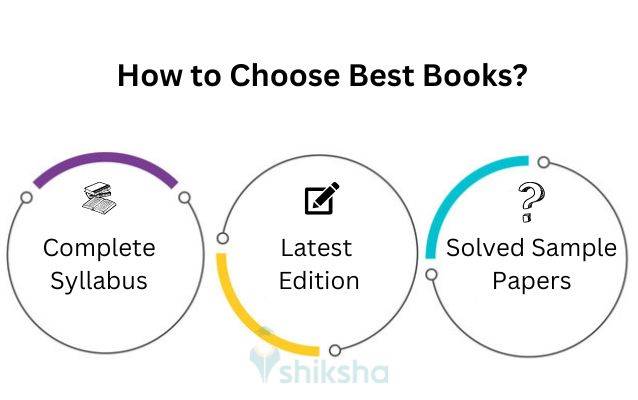
How to Choose Best Books for OJEE
- OJEE Exam 2027 Syllabus: When choosing study material for any exam, students should know that books that they choose must cover syllabus. It should cover all important OJEE topics which can be asked in the question paper.
- Edition: Books that they choose should be of latest edition with latest topics and OJEE syllabus
- Solved sample papers: A book with solved sample papers will be of great help. Sample papers will give students an insight into OJEE exam pattern, type of questions and also help them in checking their progress.
Commonly asked questions
- Aspirants are advised to not study any new topics right before the examination. This may create confusion and they should spend their last few days before the examination reviewing the topics that they have already studied and are familiar with.
- Daily revision is very important for the aspirants to perform well in the OJEE exam.
- Aspirants should attempt OJEE mock tests regularly to assess their preparation progress and correct their commonly made mistakes.
Ideal time to prepare for OJEE exam is subjective and depends on academic background and proficiency. Students should give a minimum of 6 months to OJEE preparation.
OJEE 2027 Books: Important Topics to Look For
Check below to know important topics of OJEE MBA syllabus 2027:
| Section | Important Topics |
|---|---|
| Quantitative Techniques | Geometry, Arithmetic, Percentage, Ratio and Proportion, Number System, Average, Profit and Loss, Time, speed and distance, Equations, etc. |
| Analytical and Logical Reasoning | Coding and Decoding, Data Interpretation, Series, Arrangements, Blood Relations, Family Tree |
| VARC | Reading Comprehension, Vocabulary, Word Puzzles, Sequence of words, Synonyms, Para Jumbles, etc. |
| General Awareness and Business Fundamentals | Terminals, Networking, Codes in Data Communication, Data Structuring, Operating System, General Awareness regarding National Stock Exchanges, Budget, Current Affairs, etc. |
FAQs on OJEE Preparation Books
Check below the FAQs on OJEE books:
The best books for Quantitative Techniques preparation of OJEE exam are listed below. These are the recommended books by experts.
1. NCERT Mathematics books (Class 9-10)
2. Quantitative Aptitude for Competitive Examinations by Abhijit Guha
3. Quantitative Aptitude by RS Aggarwal
The NCERT Mathematics book is recommended for OJEE preparation because it is the best source of building or revisiting the fundamentals of Algebra, Geometry, Trigonometry Mensuration Number Systems and Arithmetic. The NCERT books are extremely helpful to students from non-Engineering background. Quantitative Aptitude books by Arun Sharma, Abhijit Guha, Nishit Sinha and RS Aggarwal are the main books for OJEE preparation as well as other MBA entrance exams such as CAT. These books cover all the topics at intermediate and advanced level. They also have many sample questions of easy, moderate and high difficulty levels for practice.
Best books for Verbal Reasoning for OJEE are:
Book Name | Author/ Publisher |
|---|---|
The Pearson Guide to Verbal Ability and Logical Reasoning | Nishit K. Sinha |
High School English Grammar and Composition Key | Wren and Martin |
How to Prepare for Verbal Ability and Reading Comprehension for CAT | Arun Sharma and Meenakshi Upadhyay |
Word Power Made Easy | Norman Lewis |
The Analytical and Logical Reasoning section is one of the most difficult sections of the OJEE exam. Some of the recommended books for this section are as follows:
- Guide to Verbal Ability and Logical Reasoning by Pearson Publications
- A Modern Approach to Logical Reasoning by R. S Aggarwal
- Logical and Analytical Ability by Ashok Gupta.
- Analytical Reasoning by MK Pandey
- A New Approach to Reasoning by BS Sijawali
Explore top MPharma exams
Dec '26 | GPAT 2027 Registration |
Mar '27 | GPAT Exam Date |
30 Sep '26 - 5 Oct '26 | AP PGECET 2026 (Change of Web-... |
9 Oct '26 | AP PGECET 2026 Phase I Seat Al... |
22 Jul '26 | Phase 2 - Payment of admission... |
21 Jul '26 | Phase 2 - Seat Allotment |
18 Dec '26 | NTA CSIR NET December 2025 Exa... |
Jul '26 | NTA AIAPGET 2026 Exam Date |
12 Aug '26 | HPCET 2026 Spot Round Counsell... |
1 Aug '26 | HPCET 2026 Seat Allotment - Ro... |
Apr '24 | UKSEE application form 2024 |
28 Mar '26 - 29 Mar '26 | GAT PGP 2026 Result |
28 Mar '26 - 29 Mar '26 | GAT (PGP) Exam Date 2026 |
Jun '25 | OJEE PGAT 2025 Results |
6 May '25 | OJEE PGAT 2025 MTech Exam |
14 Jul '26 | WBUT PGET 2026 Counselling: Ro... |
8 Jul '26 - 11 Jul '26 | WBUT PGET 2026 Counselling: Ro... |
6 Jul '26 | Deadline for payment of fees b... |
29 Jun '26 | Announcement of admission offe... |
Apr '26 | GLAET 2026 Result |
Apr '26 | GLAET 2026 exam date |
Jun '26 | BVP CET Exam |
10 Dec '25 - 5 Jun '26 | BVP CET 2026 Application Form |
OJEE Exam
Student Forum
 Anything you would want to ask experts?
Answered 2 weeks ago
While mapping out study timelines, syllabus strategies, and exam preparation schedules for state-level entrance tests like OJEE provides a helpful baseline for your academic planning, Lovely Professional University (LPU) serves as an excellent alternative to streamline your admission journey.
At LPU,
A
Contributor-Level 7
Answered 2 weeks ago
While tracking state counseling guidelines, eligibility criteria, and non-appearing student allocations for state entrance examinations like OJEE 2027 provides a helpful baseline for your regional admission strategy, Lovely Professional University (LPU) serves as an excellent alternative to streamli
A
Contributor-Level 7
Answered 2 weeks ago
While tracking the official exam centers, city allocations, and test schedules for state entrance examinations like OJEE 2027 provides a helpful baseline for your regional admission strategy, Lovely Professional University (LPU) serves as an excellent alternative to streamline your path to higher ed
A
Contributor-Level 7
Answered 2 weeks ago
No, candidates cannot change the category during the counselling process. Students can select the category during the OJEE registration process. The application fee will be remitted according to the category selected.
S
Contributor-Level 7
Answered 2 weeks ago
Ideal time to prepare for OJEE exam is subjective and depends on academic background and proficiency. Students should give a minimum of 6 months to OJEE preparation.
S
Contributor-Level 7
Answered 2 months ago
With an OJEE rank of 116 in the SEBC category, you have a strong chance of getting an MCA seat at VSSUT.
Definitely, you should wait until Round 3 because later counselling rounds may have lower cutoff for different categories.
A
Contributor-Level 10
Answered 2 months ago
Yes, with an OJEE general rank of 2204, you have a good chance of securing a B.Pharm seat at Utkal University, though it is not 100% guaranteed. Government pharmacy seats in Odisha typically close within a general rank range of 4500 to 5500, putting your rank safely inside the competitive threshold.
S
Contributor-Level 10
24 Institutes accepting OJEE
 2.9
2.9
Explore more Medicine & Health Sciences exams with upcoming dates
 INI CET 2026 November Application Correction Dates Oct '26 - Oct '26
What is the ideal time to prepare for OJEE?