
GSEB HSC Arts Exam Pattern 2026: Know Marking Scheme & Exam Duration
Gujarat Secondary and Higher Secondary Education Board 12th 2026 ( GSEB HSC )


Conduct of GSEB HSC exams 2027
24 Feb '27 - 19 Mar '27

GSEB HSC Exam Pattern 2027: The Gujarat Secondary and Higher Secondary Education Board (GSEB) publishes the STD 12 blueprint 2027 Gujarat Board. The board releases the GSEB HSC question paper pattern 2027 on its official website. The GSEB publishes the GSEB 12th Science & General blueprint 2027 on the official website - gsebeservice.com. Students can also download www gseb org blueprint 2027 std 12 Science is available on this page . We have uploaded the GSEB HSC pattern 2027 PDF here.
Students can visit the official website and download the Std 12 Science blueprint 2027 Gujarat Board. It gives an idea of the exam paper style of 12th Science GSEB 2027. The maximum marks a student can secure in GSEB HSC exam 2027 is 100 marks.
The GSEB STD 12 exams 2027 are expected to be conducted in February and March 2027 in offline mode.
- Gujarat Board HSC pattern 2027 - Overview
- GSEB HSC Exam Pattern 2027-Subject-wise Weightage
- GSEB HSC Exam Pattern 2027 - Total Marks & Marking Scheme Blueprint PDF Download
- GSEB STD 12th Exam Pattern 2027: Exam sections and important topics
- FAQs on GSEB HSC Exam Pattern 2027

Gujarat Board HSC pattern 2027 - Overview
There are six subjects in the GSEB 12th exam. The grand total marks is 600. Students should understand the GSEB HSC exam pattern. This helps to know the marking scheme of the GSEB HSC exam. Students can check the table below to know the GSEB HSC exam pattern 2027.
| Particulars |
Details |
|---|---|
| Conducting Body |
Gujarat Secondary and Higher Secondary Education Board (GSEB) |
| Exam Mode |
Offline (Pen-and-Paper) |
| Exam Duration |
3 Hours |
| Maximum Marks |
100 Marks per subject |
| Passing Marks |
Minimum 33% |
| Question Paper Structure |
Part A (50 Marks) + Part B (50 Marks) |
| Question Types |
MCQs, Short Answer, and Long Answer Questions |
| Streams Covered |
Science, Commerce, and Arts |
| Practical Subjects |
Theory + Practical/Internal Assessment (subject-specific) |

Commonly asked questions
If a student is not able to attend a GSEB 12th board exam, he will be given zero marks in the subject.
The student will have to appear for the GSEB HSC supplementary exam. Hence students are advised not to skip the board exam.
To score 100 percent in GSEB HSC board exams, you must complete all the topics mentioned in the syllabus and be thorough with the concepts. You can follow the points below that will help you score cent per cent-
- Finish the Syllabus on Time.
- Manage Time for Revision.
- Solve sample paper
- Identify Mistakes and Rectify Them
- Note Important Topics
- Write neatly
- Stay healthy
GSEB HSC Exam Pattern 2027-Subject-wise Weightage
GSEB HSC Exam Pattern Mathematics
We have provided a screenshot of the GSEB 12th Blueprint Mathematics below.

GSEB 12th Exam Pattern Physics
We have given a screenshot of the GSEB 12th Physics question paper format and structure of question paper below.


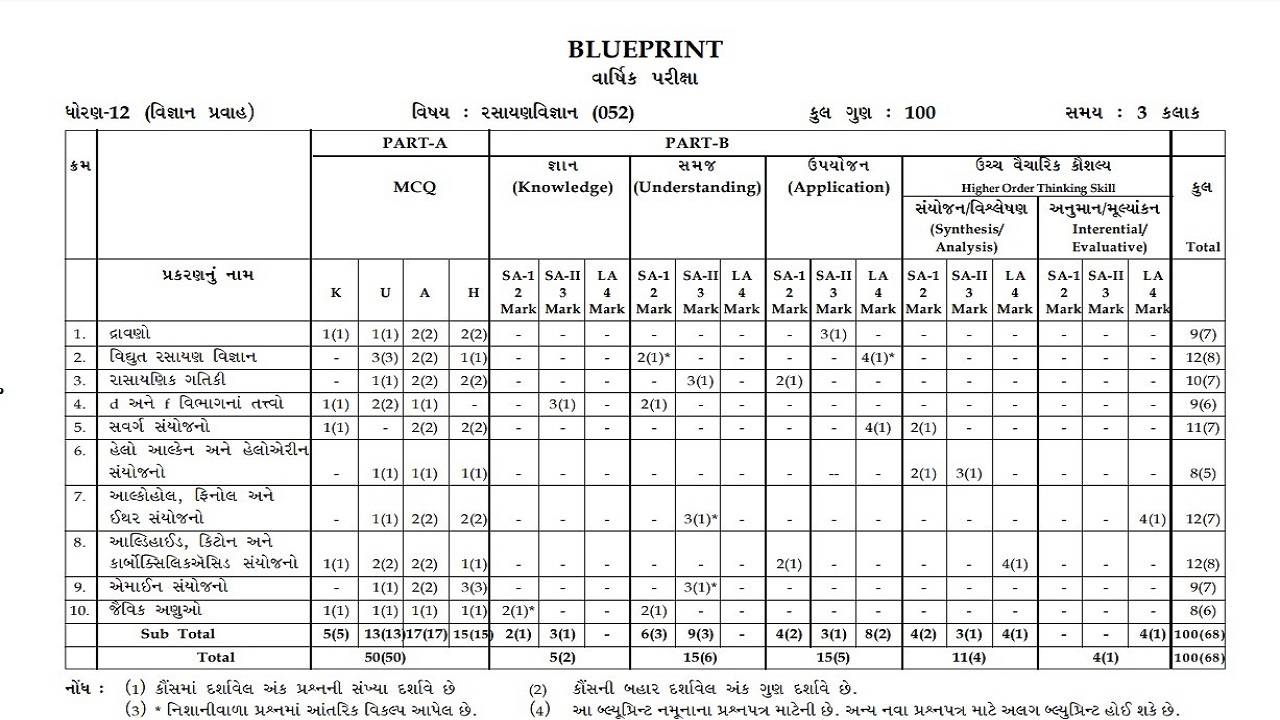
GSEB HSC Exam Pattern Chemistry
We have given a screenshot of the GSEB 12th blueprint Chemistry below.
GSEB HSC Exam Pattern English
We have given a screenshot of the GSEB HSC blueprint English below.

GSEB 12th English Question paper format is given below.

Commonly asked questions
The total marks in each subject is 100. There are six subjects in the GSEB 12th exam. The grant total marks is 600. Students should understand the GSEB HSC exam pattern. This helps to know the marking scheme of the GSEB HSC exam.
A minimum of 33% passing marks are required in each subject and an aggregate for the students to be declared as pass in GSEB Class 12 exams. Any student failing to score the 33% marks will have to appear for GSEB HSC supplementary examination. An aggregate mark of 33% is mandatory to clear the GSEB HSC examination. Students must obtain minimum of grade ‘D’ in all subjects to clear GSEB HSC board exam.
GSEB HSC Exam Pattern 2027 - Total Marks & Marking Scheme Blueprint PDF Download
Students preparing for the GSEB 12th examinations must go through the GSEB exam pattern as well as the GSEB HSC Syllabus, which mentions all the important topics that need to be covered for better preparations of the examinations. They must familiarise themselves with the pattern for better preparation. Std 12 blueprint 2027 Gujarat board. Check the GSEB HSC Question Paper format below. Students can download the last year's stream-wise GSEB HSC marking scheme blue print in the table below.
| Subject | Download Link |
|---|---|
| GSEB HSC Blueprint and Question Paper format 2026 - General stream | Download PDF |
| GSEB HSC Blueprint and Question Paper format 2026 - Science stream | Download PDF |
Commonly asked questions
Gujarat Board will release the GSEB HSC Pattern 2025. The students are advised to go through the GSEB HSC exam pattern. It helps them to know the marking scheme and weightage of topics. Thus they can prepare for the GSEB 12th board exam accordingly. They can download the GSEB HSC pattern 2025 from the official website in PDF format.
Yes, GSEB HSC exams 2026 will be based on 100% syllabus. Students can check the GSEB 12th syllabus 2026 once it is released. Students must finish with their syllabus and know the exam pattern well at least a month prior to the exam. This way they'll be better prepared for the exams.
Students can easily clear the GSEB 12th board exam 2026 with proper preparation. They should learn as per the syllabus. They should also practice the old question papers. They should concentrate more on the weaker topics. They should make notes of important formulas.
GSEB STD 12th Exam Pattern 2027: Exam sections and important topics
We have also provided the GSEB HSC Exam Sections and Important Topics in the table below:
| Subject |
Exam Sections |
Important Topics |
|---|---|---|
| English |
Reading, Writing, Grammar, Literature |
Reading Comprehension, Vocabulary, Grammar, Letter Writing, Essays, Prose and Poetry Chapters |
| Physics |
Electrostatics, Current Electricity, Magnetism, Electromagnetic Induction, Optics, Modern Physics |
Electric Charges & Fields, Current Electricity, Electromagnetic Induction, Alternating Current, Ray Optics, Wave Optics, Atoms, Nuclei, Semiconductor Electronics |
| Chemistry |
Physical, Inorganic, and Organic Chemistry |
Solutions, Electrochemistry, Chemical Kinetics, Coordination Compounds, p-Block Elements, Haloalkanes & Haloarenes, Alcohols, Aldehydes & Ketones, Biomolecules, Polymers |
| Biology |
Reproduction, Genetics, Biotechnology, Ecology |
Reproduction in Organisms, Human Reproduction, Genetics & Evolution, Biotechnology and Its Applications, Ecology and Environment |
| Mathematics |
Algebra, Calculus, Vectors & Probability |
Matrices, Determinants, Continuity & Differentiability, Applications of Derivatives, Integrals, Differential Equations, Vectors, Probability |
| Economics |
Macroeconomics and Indian Economy |
National Income, Money and Banking, Government Budget, Balance of Payments, Economic Reforms, Development Issues |
| Accountancy |
Accounting for Partnership Firms and Companies |
Partnership Accounts, Share Capital, Debentures, Financial Statements, Ratio Analysis, Cash Flow Statement |
| Business Studies |
Principles and Functions of Management |
Planning, Organising, Staffing, Directing, Marketing Management, Financial Management, Consumer Protection |
Commonly asked questions
GSEB HSC previous year question papers helps students to know the pattern and type of questions asked in the GSEB 12th board exam. Solving the GSEB HSC previous year question papers will help them to improve confidence, know difficulty level and manage time.
Students should not paste money on answer sheets. Pasting money on answer paper will be considered as cheating. If a student does cheating during GSEB HSC exam, they will be barred from writing the exam.
FAQs on GSEB HSC Exam Pattern 2027
Check FAQs on GSEB HSC pattern 2027.
The Gujarat Board is expected to conduct GSEB HSC Exam 2027 in February and March 2027. The Gujarat board released the GSEB HSC time table 2027 on the official website - gseb.org.
GSEB HSC previous year question papers helps students to know the pattern and type of questions asked in the GSEB 12th board exam. Solving the GSEB HSC previous year question papers will help them to improve confidence, know difficulty level and manage time.
Yes, the Gujarat Secondary and Higher Secondary Education Board (GSEB) releases the GSEB HSC previous year question papers for the students. They can download the question papers in PDF format for free. Solving these question papers help students to understand the difficulty level and exam pattern. Students are recommended to solve and practice GSEB HSC previous year question papers so that they can improve their scores. It will also boost the confidence of the students.
Explore top Arts exams
19 Aug '26 - 20 Aug '26 | TS EAMCET 2026 MPC Counselling... |
GSEB HSC Exam
Student Forum
 Anything you would want to ask experts?
Popular Courses After 12th

Exams accepted
CA FoundationExams accepted
ICSI ExamExams accepted
BHU UET | GLAET | GD Goenka TestBachelor of Business Administration & Bachelor of Law
Exams accepted
CLAT | LSAT India | AIBEExams accepted
IPMAT | NMIMS - NPAT | SET
Exams accepted
BHU UET | KUK Entrance Exam | JMI Entrance ExamBachelor of Design in Animation (BDes)
Exams accepted
UCEED | NIFT Entrance Exam | NID Entrance ExamBA LLB (Bachelor of Arts + Bachelor of Laws)
Exams accepted
CLAT | AILET | LSAT IndiaBachelor of Journalism & Mass Communication (BJMC)
Exams accepted
LUACMAT | SRMHCAT | GD Goenka Test