CLAT 2027 Logical Reasoning Syllabus PDF Download: Preparation Tips, Important Topics, Books
Common Law Admission Test 2027 ( CLAT )


CLAT 2027 online registrations
3 Aug '26 - 31 Oct '26


Candidates who want to crack CLAT 2027 exam scheduled for December 6, 2026, must study all important topics from Logical Reasoning section. This section in CLAT accounts for around 20% weightage. Candidates can check CLAT Logical Reasoning Syllabus 2027 on this page.

CLAT 2027 Logical Reasoning Syllabus continues to be amongst the highest-scoring but the toughest section in the Common Law Admission Test. This section makes up around 20% of marks with 22-26 questions being set based on short passages of around 400-500 words each. The Consortium of NLUs will conduct the Common Law Admission Test (CLAT) for admission to 26 National Law Universities across the country. The CLAT 2027 Exam Date is December 6, 2026. Candidates need to score good marks in Logical Reasoning to ensure they get admission in a top NLU.
CLAT Logical Reasoning section tests students on their skill at identifying arguments, premises, and conclusions. Candidates need not have prior knowledge of law or formulas to score well in this subject. Logical Reasoning part of CLAT consists of questions from two types of reasoning domains: Critical Reasoning & Analytical Reasoning. Students need to practice all types of topics present in CLAT Logical Reasoning Syllabus to master this subject. Before beginning the preparation, it is important to understand syllabus, topics, exam pattern and strategy to score well in the exam.
- CLAT Logical Reasoning Syllabus 2027: Overview
- CLAT Logical Reasoning Exam Pattern 2027
- CLAT UG Logical Reasoning Syllabus: Important Topics
- Official CLAT Logical Reasoning Syllabus 2027 PDF- Free
- CLAT Logical Reasoning Preparation Strategy
- High-Weightage Topics in CLAT UG Logical Reasoning Syllabus 2027
- Best Books for Logical Reasoning Syllabus of CLAT

CLAT Logical Reasoning Syllabus 2027: Overview
The CLAT UG 2027 Logical Reasoning syllabus consists of questions that test critical thinking as well as analytical skills. Students will be required to solve questions of following types in this section:
- Be able to recognise arguments and distinguish between the premises and conclusions of those arguments;
- Identify the arguments presented in the passage.
- Analyse patterns of reasoning and determine how conclusions may hinge on particular premises or facts and whether they can be made stronger or weaker because of changes in premises or evidence.
- Determine the implications of the passage and make use of these implications in other situations.
- Identify similarities and analogies, inconsistencies and equivalences, and the effectiveness of arguments.

Commonly asked questions
Though CLAT Preparation takes months of practice, it is still not impossible. You can prepare for the CLAT Exam in one week with a correct and dedicated focus. But you should have at least some understanding of concepts to clear the exam.
Yes, CLAT is considered one of the most difficult law entrance exams. Candidates must note that the CLAT Exam is conducted for admission to NLUs across the country except NLU Delhi. Hence, the level of difficulty of CLAT Exam is tough.
In CLAT Exam there will be 120 questions. The exam paper will be in MCQ format. Candidates will get 120 minutes to complete the paper. Since there is a negative marking candidates must attempt carefully.
The CLAT cutoff means the minimum rank or score required to get admission into a National Law University (NLU). Candidates must get the cutoff to participate in the counselling process.
CLAT Logical Reasoning Exam Pattern 2027
As per the latest CLAT Exam Pattern 2027, the logical reasoning section will have only multiple-choice questions. There will be passage-based questions. Check the complete pattern below.
| Particulars | Details |
|---|---|
| Type of questions | Multiple-choice questions |
| Total questions | 22-26 |
| Marks | 22-26 |
| Weightage | 20% |
| Marking Scheme | +1 for a correct attempt, -0.25 for incorrect ones |
CLAT 2027 Exam Beginner's Guide
Get complete details about CLAT exam syllabus, paper pattern, preparation tips, study plan, recommended books, etc.

CLAT UG Logical Reasoning Syllabus: Important Topics
Candidates can check the CLAT Syllabus here to plan their preparation journey. Knowing the syllabus will also help you to know which topics you need to cover first and what can be covered at a later stage.
| Topics |
|---|
| Arguments and Conclusions |
| Assumptions |
| Inferences |
| Strengthening and Weakening Arguments |
| Cause and Effect Relationships |
| Analogies |
| Logical Sequences and Patterns |
| Statement and Conclusion |
| Syllogisms |
Candidates who practice consistently and read articles from multiple sources have a greater chance of getting good marks in this section.
Commonly asked questions
As per NIRF ranking 2025, NLSIU Bangalore is the No. 1 ranked NLU colleges in India. The table below has other NLUs in India rankwise.
Top NLUs in India | NIRF 2023 | NIRF 2024 | NIRF 2025 |
|---|---|---|---|
1 | 1 | 1 | |
2 | 2 | 2 | |
4 | 4 | 4 | |
7 | 8 | 5 | |
18 | 21 | 27 | |
24 | 22 | 30 | |
30 | 26 | 15 | |
28 | 27 | 35 |
Disclaimer: This information is sourced from official website of the ranking body listed and may vary.
The CLAT 2027 UG syllabus includes five subjects:
- English Language,
- Current Affairs & GK,
- Legal Reasoning,
- Logical Reasoning
- Quantitative Techniques.
The exam will consist of 120 MCQs. Candidates will get 2 hours to complete the exam.
The CLAT Syllabus is published by the Consortium. The syllabus has been announced. Candidates who are preparing for the exam must note that there are no changes made in the syllabus so far. Candidates can check the syllabus by visiting the official website. You can only download the PDF from website.
While it is not impossible, it is a really challenging task. To score well, you must start preparing for CLAT at least six months before. It is very important to score well if you are looking forward to getting into good NLU. For top 10 NLU, you at least need to score between 100 to 105 as per past trends.
Explore colleges based on CLAT
Want better recommendations?
There is a 90% more chance of getting best college recommendations by sharing preferences.
- Chat with our counselor
- Get your personalised list of colleges & exams matching your preferences
Official CLAT Logical Reasoning Syllabus 2027 PDF- Free
Candidates can check the syllabus in the PDF provided below. Candidates must note that the CLAT Logical Reasoning Syllabus is comparatively tough than other sections.
| CLAT 2027 Logical Reasoning Syllabus PDF Free Download Link | Download Here |
Candidates should download this syllabus PDF and begin their preparation as soon as possible.
Also Read: CLAT Selection Process
CLAT Logical Reasoning Preparation Strategy
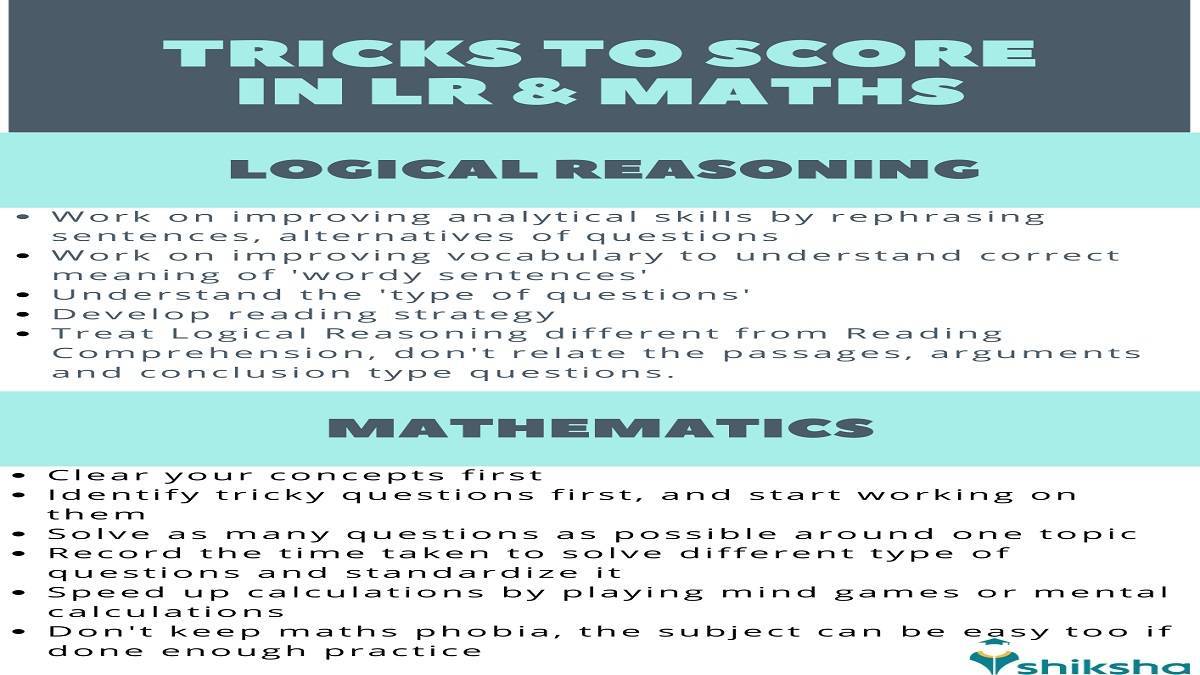
Some important tips to keep in mind while preparing for CLAT Logical Reasoning section are:
Commonly asked questions
For the CLAT 2027 Quantitative Techniques section, candidates must focus on the 10th-grade data interpretation and arithmetic.
CLAT is not directly based on the NCERT curriculum, but NCERT books act as a strong foundational resource for Quantitative Techniques and basic static GK. Candidates appearing for board exams can prepare for CLAT side by side.
Candidates can access the CLAT 2027 syllabus on consortiumofnlus.ac.in. The Consortium released the CLAT notification on its official portal. There are five sections in the CLAT syllabus.
No, the Consortium has not made any changes to the CLAT Syllabus for 2027 exam. It further clarified that the exam pattern has also not been modified this year.
High-Weightage Topics in CLAT UG Logical Reasoning Syllabus 2027
Candidates can check concepts on which they should focus more below.
- Assumptions and Inferences
- Strengthening and Weakening Arguments
- Critical Reasoning
- Statement and Conclusion
- Cause and Effect
- Syllogisms
- Fact, Opinion and Judgment
- Principles and Application Questions
These high-weightage topics help students score more marks in a short time.
Also Read:
Explore more Law exams with upcoming dates

15 Oct '26
7 Nov '26
7 Aug '26 - 10 Nov '26
13 Nov '26
17 Aug '26 - 4 Dec '26
1 Sep '26 - 4 Dec '26
8 Oct '26 - 12 Oct '26
10 Oct '26 - 12 Oct '26
Best Books for Logical Reasoning Syllabus of CLAT
Candidates should study from standard books to enhance their analytical skills for Logical reasoning. Study from following books for best results in this section:
- Verbal and Non-Verbal Reasoning by R.S. Aggarwal
- Logical and Analytical Reasoning by A.K. Gupta
Read More: What is a good score in CLAT 2027? How to get a high rank?

News & Updates
Explore Other Exams
7 Aug '26 - 10 Nov '26 | AILET 2027 Registration |
30 Nov '26 | AILET 2027 Admit Card |
12 Sep '26 - 30 Sep '26 | ULSAT 2026 Phase 6 Exam |
10 Sep '26 | ULSAT 2026 Application Last Da... |
17 Aug '26 - 4 Dec '26 | SLAT Application Form 2027 |
11 Dec '26 | SLAT 2027 Admit Card for Test ... |
26 Jul '26 | RULET 2026 First Merit List |
9 Jul '26 | RULET 2026 Third Merit List |
7 Oct '26 | Admission Cut Off Date |
3 Oct '26 - 6 Oct '26 | LLB 5-Year CAP Institute Level... |
Student Forum
 Anything you would want to ask experts?
Answered 5 hours ago
BA LLB is also a good course for future after complete the class 12th.Quantum University is one of the good university who provide the BA LLB and BBA LLB course with affordable with affordable fees as comparison to other university.Quantum University is a UGC, BCI, and PCI approved university.The pl
Contributor-Level 7
Answered 4 days ago
No you don't need to memorise every section. Focus on important concepts key provisions definitions and CLAT style application questions. Understanding legal principles is more important than memorising section numbers.
D
Contributor-Level 8
Answered 5 days ago
No, both are different exams, but both are conducted nationwide. CUET LLB will be conducted by NTA, while CLAT 2027 will be conducted by the Consortium of National Law Universities.
A
Contributor-Level 6
Answered 2 weeks ago
No, CLAT is generally considered more difficult than CUET as CLAT exam requires more intense reading and preparation. It also involves intense time pressure as candidates are required to read around 15,000 words across 30 passages before answering the questions.
A
Contributor-Level 6
Answered 3 weeks ago
Choose Commerce if you want an early foundation in business and finance for corporate law, or Arts (Humanities) if you prefer subjects that align closely with reading comprehension and current affairs for the CLAT exam.
Both streams make you fully eligible for the Common Law Admission Test (CLAT) and
S
Contributor-Level 10
Answered 4 weeks ago
Ministry of Education can release the NLUs NIRF Ranking soon on its official website. There is no time line announced by the ministry in this regard.
A
Contributor-Level 7
Answered 4 weeks ago
NLSIU Bengaluru, which has held the top spot in the Law category every year since NIRF introduced it in 2018.
R
Contributor-Level 7
Answered 4 weeks ago
No, the NIRF Law Ranking 2026 will be released soon by the Minsitry of Education on its official website.
V
Contributor-Level 7
Answered a month ago
S
Contributor-Level 10
Answered a month ago
Yes, the Consortium removed two Test Cities from the CLAT 2027. The removed test cities are Vellore and Tiruvarur. CLAT 2027 exam date is December 6.
N
Contributor-Level 7