GSEB HSC Exam Pattern 2026 (Released): Know Marking Scheme & Exam Duration

Gujarat Secondary and Higher Secondary Education Board 12th 2026 ( GSEB HSC )

This exam is conducted for courses given below:
Salviya Antony
Updated on Dec 25, 2025 17:33 IST

By Salviya Antony, Senior Executive - Content

GSEB HSC exam pattern 2026: The Gujarat Secondary and Higher Secondary Education Board (GSEB) has published the STD 12 blueprint 2026 Gujarat board. The GSEB HSC question paper pattern 2026 is available on the official website. www gseb org blueprint 2026 std 12 Science is available on this page . We have uploaded the GSEB HSC pattern 2026 PDF here. The GSEB released the GSEB 12th Science blueprint 2026 on the official website - gsebeservice.com.

Students can visit the official website and download the Std 12 Science blueprint 2026 Gujarat board. It gives and idea of the exam paper style of 12th Science GSEB 2026. The Gujarat Secondary and Higher Secondary Education Board (GSEB) has released the GSEB HSC time table 2026. GSEB HSC exam 2026 will be held from February 26, 2026 to March 16, 2026. The maximum marks a student can secure in GSEB HSC exams is 100 marks. 

Table of contents
  • GSEB HSC Exam Pattern 2026 - Gujarat STD-12 Blueprint 2025-26 Pdf Download
  • GSEB HSC Exam Pattern 2026
  • GSEB HSC Passing Criteria
  • Gujarat Board HSC pattern 2026 - Mathematics
  • FAQs on GSEB HSC Exam Pattern 2026
GSEB HSC Logo

GSEB HSC Exam Pattern 2026 - Gujarat STD-12 Blueprint 2025-26 Pdf Download

Students preparing for the GSEB 12th examinations must go through the GSEB exam pattern as well as GSEB HSC Syllabus which mentions all the important topics that need to be covered for better preparations of the examinations. They must familiarise themselves with the pattern for better preparation. Std 12 blueprint 2026 Gujarat board

Check GSEB HSC Question Paper format 2026 below. Students can download the GSEB HSC 2026 blue print stream wise in the table below. 

Subject Download Link
GSEB HSC Blueprint and Question Paper format 2026 - General stream  Download PDF
GSEB HSC Blueprint and Question Paper format 2026 - Science stream Download PDF

The GSEB HSC sample question papers 2026 as per the reduced NCERT syllabus was released along with the GSEB HSC blue print 2026. We have provided Std 12 Science blueprint 2025-26 Gujarat Board on this page. Students can now check GSEB HSC pattern 2026 in this page.  

The GSEB 12th Exam Pattern would also give the students an insight into the type of questions asked as well as the marking scheme. GSEB HSC sample question papers are also provided in the PDFs given on this page.  

Subject-wise GSEB HSC Exam Patterns screenshots have been provided below: 

Q&A Icon
Commonly asked questions
Q:   Will GSEB HSC board exam 2026 based on 100% GSEB HSC syllabus?
A: 

Yes, GSEB HSC exams 2026 will be based on 100% syllabus. Students can check the GSEB 12th syllabus 2026 once it is released.  Students must finish with their syllabus and know the exam pattern well at least a month prior to the exam. This way they'll be better prepared for the exams. 

Q:   Is it necessary to know the GSEB HSC exam pattern?
A: 

Gujarat Board will release the GSEB HSC Pattern 2025. The students are advised to go through the GSEB HSC exam pattern. It helps them to know the marking scheme and weightage of topics. Thus they can prepare for the GSEB 12th board exam accordingly. They can download the GSEB HSC pattern 2025 from the official website in PDF format. 

GSEB HSC Logo

GSEB HSC Exam Pattern 2026

GSEB HSC Exam Pattern Mathematics

We have provided a screenshot of the GSEB 12th Blueprint Mathematics below.

GSEB 12th Maths Blue Print 2024

GSEB 12th Exam Pattern Physics

We have given a screenshot of the GSEB 12th Physics question paper format and structure of question paper below.

GSEB 12th Physics Question paper format
Check the structure of GSEB 12th Physics Question paper below.
GSEB HSC Physics Question paper structure

GSEB HSC Exam Pattern Chemistry

We have given a screenshot of the GSEB 12th blueprint Chemistry below.
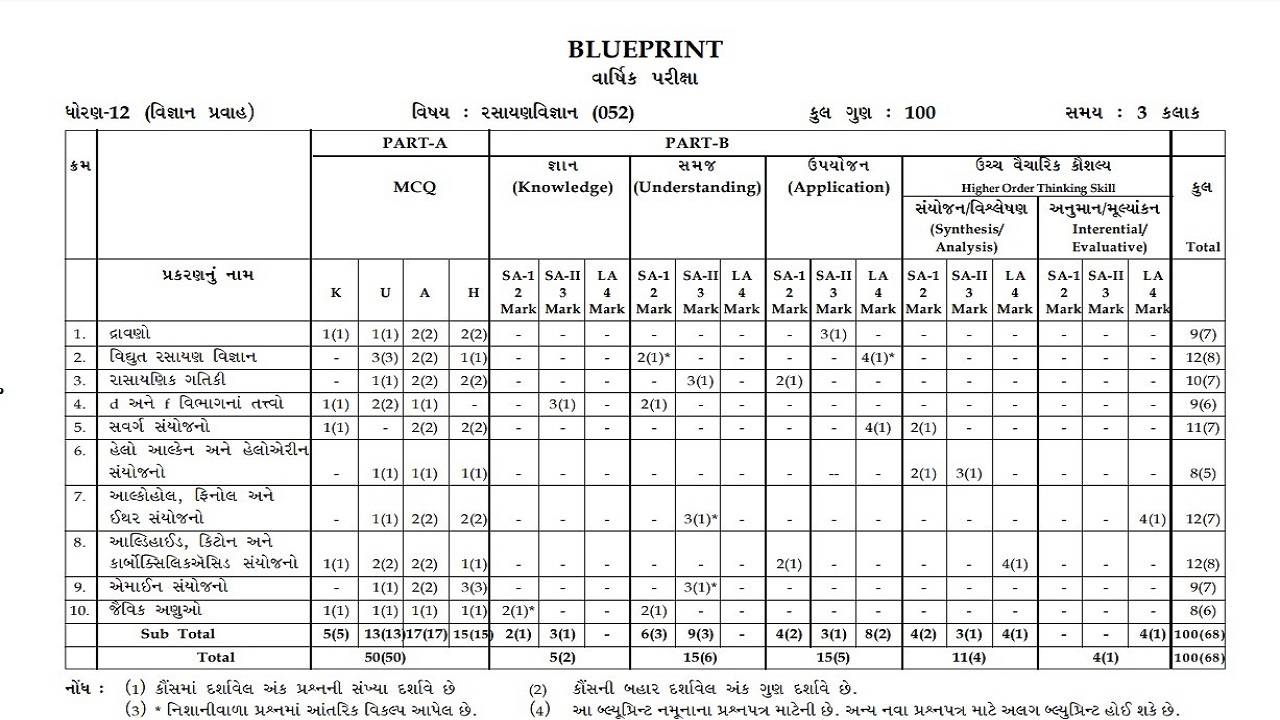
GSEB 12th Chemistry Blue print 2024

GSEB HSC Exam Pattern English

We have given a screenshot of the GSEB HSC blueprint English below.

GSEB 12th English Blue print

GSEB 12th English Question paper format is given below.

GSEB 12th English Format


Q&A Icon
Commonly asked questions
Q:   What are the total marks of the GSEB 12th exam?
A: 

The total marks in each subject is 100. There are six subjects in the GSEB 12th exam. The grant total marks is 600. Students should understand the GSEB HSC exam pattern. This helps to know the marking scheme of the GSEB HSC exam. 

Q:   What is the passing criteria of GSEB 12th result?
A: 

A minimum of 33% passing marks are required in each subject and an aggregate for the students to be declared as pass in GSEB Class 12 exams. Any student failing to score the 33% marks will have to appear for GSEB HSC supplementary examination. An aggregate mark of 33% is mandatory to clear the GSEB HSC examination. Students must obtain minimum of grade ‘D’ in all subjects to clear GSEB HSC board exam. 

GSEB HSC Logo

GSEB HSC Passing Criteria

The pass mark for a subject is 33% and aggregate marks shall also be 33%. There will be no change in the minimum passing marks for any subject. It is not necessary to secure 33% separately in the practical and written examination. As per the Gujarat Board Class 12 exam pattern, the duration of each exam is 3 hours. Those who fail in the GSEB HSC Exam 2026 will have to appear for the GSEB Supplementary exam 2026. The board will release GSEB HSC supplementary dates 2026 in May 2026 after the release of GSEB HSC results 2026.

Q&A Icon
Commonly asked questions
Q:   Is it mandatory to practice the previous year GSEB HSC question papers?
A: 

GSEB HSC previous year question papers helps students to know the pattern and type of questions asked in the GSEB 12th board exam. Solving the GSEB HSC previous year question papers will help them to improve confidence, know difficulty level and manage time.

GSEB HSC Logo

Gujarat Board HSC pattern 2026 - Mathematics

Check the table below to know the GSEB HSC mathematics pattern 2026.

Section No of questions Marks  Total marks
A - MCQ 15 1 15
B - Short answer 15 1 15
C 10 2 20
D 10 3 30
E 5 5 20
Total - - 100

The total marks in each subject is 100. There are six subjects in the GSEB 12th exam. The grant total marks is 600. Students should understand the GSEB HSC exam pattern. This helps to know the marking scheme of the GSEB HSC exam.  

Q&A Icon
Commonly asked questions
Q:   What happens if you take leave in GSEB 12th board exam?
A: 

If a student is not able to attend a GSEB 12th board exam, he will be given zero marks in the subject. 

The student will have to appear for the GSEB HSC supplementary exam. Hence students are advised not to skip the board exam.

GSEB HSC Logo

FAQs on GSEB HSC Exam Pattern 2026

Check FAQs on GSEB HSC pattern 2026.

Q&A Icon
Commonly asked questions
Q:   Is it mandatory to practice the previous year GSEB HSC question papers?
A: 

GSEB HSC previous year question papers helps students to know the pattern and type of questions asked in the GSEB 12th board exam. Solving the GSEB HSC previous year question papers will help them to improve confidence, know difficulty level and manage time.

Q:   When will the GSEB HSC exams 2026 be held?
A: 

The Gujarat Board conducted GSEB HSC Exam 2026 from February 26, 2026 to March 18, 2026. The Gujarat board released the GSEB HSC time table 2026 on the official website - gseb.org. Students can download the GSEB 12th time table 2026 online. The GSEB HSC exam 2025 was held from February 27 to March 17, 2025.

Q:   Does GSEB release the past years question papers for the GSEB HSC students?
A: 

Yes, the Gujarat Secondary and Higher Secondary Education Board (GSEB) releases the GSEB HSC previous year question papers for the students. They can download the question papers in PDF format for free. Solving these question papers help students to understand the difficulty level and exam pattern. Students are recommended to solve and practice GSEB HSC previous year question papers so that they can improve their scores. It will also boost the confidence of the students.

Explore subject-wise topics asked in GSEB HSC

Select your preferred subject

Complement of a SetEqual SetsUniversal SetFinite and Infinite SetEmpty SetSets and their RepresentationsRelations and FunctionsCartesian Products of SetsFunctionsRelationsBinomial TheoremBinomial Theorem for Positive Integral IndexComposition of Functions and Invertible FunctionTypes of FunctionsTypes of RelationsProperties of Inverse Trigonometric FunctionsInverse Trigonometric FunctionsBasic Concepts of Inverse Trigonometric FunctionsTypes of MatrixTranspose of a MatrixSymmetric and Skew Symmetric MatricesInvertible MatricesOperations on MatricesDeterminantsDeterminantsIntegration as Inverse Process of DifferentiationDifferentiationStandard DeviationAssumed Mean MethodCorrelation and RegressionZ Score TableCube and CuboidComplement of a SetEqual SetsUniversal SetFinite and Infinite SetEmpty SetSets and their RepresentationsRelations and FunctionsCartesian Products of SetsFunctionsRelationsBinomial TheoremBinomial Theorem for Positive Integral IndexComposition of Functions and Invertible FunctionTypes of FunctionsTypes of RelationsProperties of Inverse Trigonometric FunctionsInverse Trigonometric FunctionsBasic Concepts of Inverse Trigonometric FunctionsTypes of MatrixTranspose of a MatrixSymmetric and Skew Symmetric MatricesInvertible MatricesOperations on MatricesDeterminantsDeterminantsIntegration as Inverse Process of DifferentiationDifferentiationStandard DeviationAssumed Mean MethodCorrelation and RegressionZ Score TableCube and CuboidOverviewDIMENSIONS OF PHYSICAL QUANTITIESDIMENSIONAL FORMULAESignificant FiguresDIMENSIONAL ANALYSIS AND ITS APPLICATIONSINTERNATIONAL SYSTEM OF UNITSOverviewChange of StateIdeal Gas Equation and Absolute TemperatureThermal ExpansionHeat TransferSpecific HeatCalorimetryTemperature and HeatMeasurement of TemperatureThermodynamic ProcessCarnot EngineReversible and Irreversible ProcessThermal EquilibriumThermodynamic State Variables Equation of StateOverviewFirst Law of ThermodynamicsSecond Law of ThermodynamicsBehaviour of GasesKinetic Theory of Ideal GasOverviewPeriodic and Oscillatory MotionSimple PendulumSimple Harmonic MotionOverviewSpeed of a Travelling WaveDisplacement Relation in a Progressive WaveSuperposition PrincipleBeatsReflection of WavesKinematic Equation Uniformly of Accelerated MotionInstantaneous Velocity and SpeedOverviewAccelerationResolution of VectorsVector Addition by Analytical MethodScalars and VectorsMultiplication of Vectors by Real NumbersAddition and Subtraction of VectorsOverviewProjectile MotionMotion in a PlaneConservation of MomentumEquilibrium of a ParticleCircular MotionCommon Forces in MechanicsSolving Problems in MechanicsConservation of Mechanical EnergyPotential Energy of SpringPowerKinetic EnergyCollisionWorkConcept of Potential EnergyMoment of InertiaOverviewCentre of MassVector Product of Two VectorsTorque and Angular MomentumMotion of Centre of MassEquilibrium of a Rigid BodyOverviewAngular Velocity and Relation with Linear VelocityDynamics of Rotational Motion About a Fixed AxisKinematics of Rotational Motion About a Fixed AxisAngular Momentum of Rotation About a Fixed AxisKeplers LawOverviewEscape SpeedEarth SatellitesEnergy of an Orbiting SatelliteStress Strain CurveElastic ModuliApplications of Elastic Behaviour of MaterialsSurface TensionBernoulli PrinciplePressure in FluidsViscosityStreamline FlowForces between Multiple ChargesConductors and InsulatorsBasic Properties of Electric ChargeElectric ChargeElectric Charge and FieldElectric FluxElectric Charge and FieldElectric Field LinesContinuous Charge DistributionInterference Light Waves Youngs ExperimentRefraction Reflection Plane Wave Huygens PrincipleRefraction Reflection Plane Wave Huygens PrincipleEinstein Photoelectric TheoryPhotoelectric Effect Wave Theory LightPhotoelectric EffectElectron EmissionOverviewBohr Model of Hydrogen AtomRadioactivityPhysics Nuclei OverviewSize of NucleusBinding EnergyNuclear EnergySemiconductor Devices OverviewSemiconductor Devices OverviewSemiconductor DiodeDiode as RectifierIntrinsic SemiconductorExtrinsic SemiconductorOverviewPotential Due to Point ChargeCombination of CapacitorsElectrostatic PotentialEnergy Stored in a CapacitorCapacitors and CapacitanceEffect of Dielectric on CapacitanceElectrostatics of ConductorsPotential Energy of a System of ChargesPotential due to a System of ChargesElectric CurrentOverviewElectrical Energy and PowerTemperature Dependence of ResistivityWheatstone BridgeOverviewOhms LawKirchhoffs LawDrift of Electrons and the Origin of ResistivityTorque on Current Loop Magnetic DipoleMotion in Magnetic FieldSolenoidMagnetic Field due to a Current ElementMagnetic Field on Axis of Circular Current LoopAmpere Circuital LawMagnetic ForceOverviewMoving Coil GalvanometerMagnetism and MatterMagnetic Properties of MaterialsMagnetisation and Magnetic IntensityBar MagnetElectromagnetismMotional Electromotive ForceExperiments of Faraday and HenryAlternating Current OverviewTransformerAC Voltage Applied to a ResistorAC Voltage Applied to an InductorAC Voltage applied to a CapacitorAC Voltage applied to a Series LCR circuitRepresentation of AC Current and Voltage by VectorElectromagnetic SpectrumElectromagnetic WavesDisplacement CurrentTotal Internal ReflectionRefraction through a PrismOptical InstrumentsDerivation of Lens FormulaReflection of Light by Spherical MirrorsRefraction at Spherical Surface and by LensesDerive Equation of Motion by Calculus methodAlternating Current OverviewMole Concept and Molar MassSTOICHIOMETRY AND STOICHIOMETRIC CALCULATIONSPercentage CompositionLaws of Chemical CombinationAtomic and Molecular MassesProperties of Matter and their MeasurementImportance of ChemistryOverviewOverviewAtomic ModelsDiscovery of Sub Atomic ParticlesTowards Quantum Mechanical Model of AtomQuantum Mechanical Model of AtomElectronic Configuration Types of ElementsPeriodic Table Electronic Configuration of ElementPeriodic Trends in Properties of ElementsGenesis of Periodic ClassificationNomenclature of Elements with Atomic NumbersPresent Form of Periodic TableChemical Bonding and Molecular StructureHybridizationValence Bond TheoryMolecular Orbital TheoryHydrogen BondingIonic or Electrovalent BondKossel-Lewis Approach to Chemical BondingBond ParametersBonding in Homonuclear Diatomic MoleculesVSEPR TheoryApplications of Chemical BondingEquilibrium ProcessesHomogeneous EquilibriaFactors Affecting EquilibriaApplications of Equilibrium ConstantIonization of Acids and BasesIonic Equilibrium in SolutionEquilibrium in Chemical ProcessesSolubility Equilibria of Sparingly Soluble SaltsHeter Heterogeneous EquilibriaOxidation NumberClassification of Organic CompoundsIsomerismNomenclature of Organic CompoundsQuantitative AnalysisQualitative Analysis of Organic CompoundsOverviewStructural Representations of Organic CompoundsFundamental Concepts in Organic Reaction MechanismTetravalence of Carbon Shapes of Organic CompoundsMethods of Purification of Organic CompoundsClassificationAlkanesAlkenesAlkynesAromatic HydrocarbonCarcinogenicity and ToxicityAbnormal Molar MassColligative Properties and Molar MassSolubilityProteinsVitaminsCarbohydratesEnzymesHormonesNucleic AcidsElectrolytic Cells and ElectrolysisCorrosionGalvanic CellFuel CellsNernst EquationElectrochemical CellsBatteriesRate of ReactionIntegrated Rate EquationsCollision Theory of Chemical ReactionsTemperature Dependence of the Rate of a ReactionFactors Influencing Rate of a ReactionBonding in Metal CarbonylsDifference between Glucose and Fructose

Explore top HSC exams

Mar '26

JEE Main 2026 Admit Card Sessi...

Apr '26

CUET UG 2026 Intimation Slip

6 Apr '26 -

2 May '26

JEE Advanced 2026 registration...

3 May '26

NEET 2026 Exam Date

29 Oct '25 -

15 Apr '26

AEEE 2026 Phase 2 Registration

10 Nov '25 -

8 Apr '26

KIITEE 2026 Registration - Pha...

Apr '26

MHT CET 2026 Admit Card

21 Mar '26 -

22 Mar '26

BITSAT 2026 Form Correction Se...

26 May '26 -

3 Jun '26

NIFT Stage 2: M.Des and M.F.M ...

2 Feb '26 -

31 Mar '26

IPU CET 2026 Application Form...

1 Aug '26 -

31 Oct '26

CLAT 2027 online registrations...

3 Feb '26 -

23 Mar '26

COMEDK Application Form 2026 (...

24 Oct '25 -

31 Mar '26

VITEEE 2026 application form

10 Mar '26 -

5 Apr '26

WBJEE 2026 application form

5 Mar '26 -

13 Apr '26

IISER Aptitude Test 2026 Regis...

14 Mar '26 -

10 Apr '26

B.Des Application

24 Feb '26 -

30 Mar '26

KCET Application Correction Wi...

23 Mar '26 -

24 Mar '26

IPMAT 2026 Form Correction Win...

19 Feb '26 -

4 Apr '26

TS EAMCET Application Form 202...

The list of exams are recommended based on what other exams do the students in your area show interest in
qna

GSEB HSC Exam

Student Forum

chatAnything you would want to ask experts?
Write here...

Answered 3 weeks ago

Students who failed in GSEB HSC exam can appear for the GSEB HSC supplementary exam which will be held in July/August. They can study well and appear for the compartment exam.

S

Salviya Antony

Contributor-Level 10

Answered 3 weeks ago

Students need not worry even if they fail in GSEB HSC exam. They can appear for the supplementary exams. The dates of the GSEB HSC supplementary exam will be released after the release of the GSEB 12th result.

S

Salviya Antony

Contributor-Level 10

Answered 3 weeks ago

Students have to collect their marksheet from their schools after the HSC GSEB result. They can pursue an undergraduate course after 12th as per their choice after the GSEB HSC Result 2026 is declared. 

S

Salviya Antony

Contributor-Level 10

Answered 3 weeks ago

There is no negative marking in GSEB HSC board exam. Students have to score 33% marks to clear the GSEB HSC board exam.

S

Salviya Antony

Contributor-Level 10

Answered 3 weeks ago

You can appear for GSEB HSC exam only once in a year. Those who do not clear the GSEB HSC board exam can appear for the compartment exam which will be held in June/July. 

S

Salviya Antony

Contributor-Level 10

Answered 3 weeks ago

Students become eligible for higher studies after qualifying GSEB 12th board exam. They can join for degree courses after the GSEB HSC exam 2026. Without clearing GSEB 12th exam, students will not be able to do higher studies. 

S

Salviya Antony

Contributor-Level 10

Answered 3 weeks ago

More than 5 Lacs students appear for GSEB HSC exam every year. In 2025, for Class 12, 1.11 Lacs students appeared for Science stream and 4.23 Lacs for the General stream. 93.07% of students successfully passed the GSEB Class 12 board exam 2025.

S

Salviya Antony

Contributor-Level 10

Answered 3 weeks ago

Gujarat board does not sent any individual notification regarding the declaration of the GSBE HSC result. Students need to keep a track of the same online. Once announced, the GSEB HSC results can be checked by logging with the required credentials.

S

Salviya Antony

Contributor-Level 10

Answered 3 weeks ago

Students have to score a minimum of 33% passing marks in each subject and an aggregate of 33% is needed to be declared as pass in GSEB Class 12 HSC exams. Students must obtain minimum of grade 'D' in all subjects to clear GSEB HSC exam. Differently abled students need to score 20% to clear GSEB Exam

...Read more

S

Salviya Antony

Contributor-Level 10

Answered a month ago

 The Gujarat Secondary and Higher Secondary Education Board (GSEB) distribute the GSEB HSC text books via schools. Students are advised to learn from the text books provided by the Gujarat board only. 

S

Salviya Antony

Contributor-Level 10

News & Updates

Latest NewsPopular News