

In this article, we have provided the 10 most important high scoring Maths chapters for the JEE Advanced aspirants. These chapters have been carrying high weightage in the past 11 years and are the do-or-die chapters for the JEE Advanced Maths section. Focusing on these chapters will fetch good marks in the exam. Check the complete analysis of the JEE Advanced Maths high weightage chapters below.

Top 10 Maths Chapters to Clear JEE Advanced 2026 - Past 11 Year Analysis
JEE Advanced Maths High Scoring Chapters 2026: Maths is one of the most difficult sections in JEE Advanced. It is known to be a section that differentiates the toppers from the rest. The JEE Advanced maths questions require an application of multiple concepts and are very lengthy. This section consumes most of the time of the candidates in the exam. The candidates need to work on their concepts, improve speed and accuracy to attempt this section with good marks.
The JEE Advanced maths section can be tough, but it yields the highest marks if attempted accurately. In this article, we have discussed the top 10 high scoring chapters that are asked in JEE Advanced Maths. A detailed analysis has been provided of the top 10 most important do-or-die Maths chapters for the JEE Advanced exam based on the past 11 years. These are the chapters that can help you crack the JEE Advanced Maths section with high scores if you master them.
- Top 10 JEE Advanced Maths High Scoring Chapters - Past 11 Years Analysis
- Most Consistently High-Weightage Topics for JEE Advanced Maths
- Topics with Fluctuating Weightage in JEE Advanced Maths
- Yearly Patterns & Observations of JEE Advanced High Weightage Maths Chapters
- Key Takeaways from the Past 11 Year Analysis of JEE Advanced Maths High Weightage Chapters
Top 10 JEE Advanced Maths High Scoring Chapters - Past 11 Years Analysis
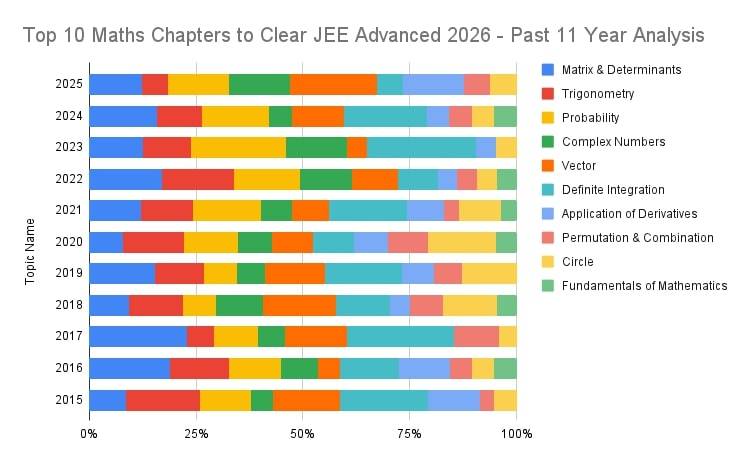
In the table below, candidates can check the analysis of JEE Advanced high-weightage chapters in Maths. Note that candidates must prepare all topics in the JEE Advanced Maths syllabus, with more detailed attention to the following important chapters.
| Topic Name | 2025 | 2024 | 2023 | 2022 | 2021 | 2020 | 2019 | 2018 | 2017 | 2016 | 2015 |
|---|---|---|---|---|---|---|---|---|---|---|---|
| Matrix & Determinants | 6% | 9% | 8% | 11% | 10% | 5% | 12% | 6% | 11% | 11% | 5% |
| Trigonometry | 3% | 6% | 7% | 11% | 10% | 9% | 9% | 8% | 3% | 8% | 10% |
| Probability | 7% | 9% | 14% | 10% | 13% | 8% | 6% | 5% | 5% | 7% | 7% |
| Complex Numbers | 7% | 3% | 9% | 8% | 6% | 5% | 5% | 7% | 3% | 5% | 3% |
| Vector | 10% | 7% | 3% | 7% | 7% | 6% | 11% | 11% | 7% | 3% | 9% |
| Definite Integration | 3% | 11% | 16% | 6% | 15% | 6% | 14% | 8% | 12% | 8% | 12% |
| Application of Derivatives | 7% | 3% | 3% | 3% | 7% | 5% | 6% | 3% | 0% | 7% | 7% |
| Permutation & Combination | 3% | 3% | 0% | 3% | 3% | 6% | 5% | 5% | 5% | 3% | 2% |
| Circle | 3% | 3% | 3% | 3% | 8% | 10% | 10% | 8% | 2% | 3% | 3% |
| Fundamentals of Mathematics | 0% | 3% | 0% | 3% | 3% | 3% | 0% | 3% | 0% | 3% | 0% |
Top 10 Maths Chapters to Clear JEE Advanced 2026 - Past 11 Year Analysis

Commonly asked questions
There has been no update on any changes in the JEE Advanced 2026 attempt limits. If any changes are to be made in the attempt limit, the same will be officially notified at jeeadv.ac.in. Currently, the JEE Advanced attempt limit is twice in two consecutive years.
The JEE Advanced marking scheme changes every year. Uauallt there are questions carrying 1 marks, 2 marks, 3 marks and 4 marks. There are partial negative marking and complete negative marking format. The exact marking scheme is notified to the candidates on the exam day.
The changing pattern of the JEE Advanced exam can be due to various reasons:
- One of the reason can be to check how the students perform under pressure and how weel they adapt.
- To check how the students can deal with problems and unfamiliar formats.
- To eliminate the candidates who rote learn.
JEE Advanced is on the toughest exam for selection to the most premiere colleges of the nation - IITs. Therefore to add to the difficulty level, the pattern is kept undiclosed until the exam day.
The JEE Advanced exam pattern is dynamic. It changes every year. The only known aspect of the JEE Advanced exam pattern are:
- The number of papers: There are two papers - paper 1 and paper 2.
- The exam mode: The JEE Advanced exam is held in computer based test mode.
- Duration: The exam is held for 6 hours. Each paper is of 3 hours.
- Subjects: Each question papers has questions from three sections - Maths, Physics and Chemistry
JEE Advanced pattern will change every year in terms of making scheme and the kinds of questions asked (MCQs, match the following, paragraph type, numerical answer type.)
Most Consistently High-Weightage Topics for JEE Advanced Maths
These are the chapters that are the holy grail of JEE Advanced Maths sections. The most important and high-weightage chapters in JEE Advanced Maths, as per the analysis of the above data, are:
- Definite Integration
- Probability
- Matrix & Determinants
- Complex Numbers
- Vector Algebra

Topics with Fluctuating Weightage in JEE Advanced Maths
These are the topics that are difficult to monitor and thus seem more dangerous. These topics carry high weightage in some years but might lower their weightage share in the next one. Hence, to be on the safe side, candidates must never skip these chapters.
- Trigonometry
- Circle
- Application of Derivatives (AOD)
- Permutation & Combination
Explore colleges based on JEE Advanced
Want better recommendations?
There is a 90% more chance of getting best college recommendations by sharing preferences.
- Chat with our counselor
- Get your personalised list of colleges & exams matching your preferences
Yearly Patterns & Observations of JEE Advanced High Weightage Maths Chapters
Check below the year-wise trend of high-weightage chapters in JEE Advanced Maths.
- Matrix & Determinants, Probability, Complex Numbers and Vectors are the topics that have been carrying high weightage in the recent years (2024 and 2025)
- In the past few years (2023, 2022 and 2021), Definite Integration and Probability were trending. Trigonometry and matrices were also given high weightage.
Therefore, candidates can check the shift in trends. Gradually, over the years, Matrix & Determinants, Probability, Complex Numbers and Vectors have emerged as the most important and highly weighted chapters in JEE Advanced maths.
Explore more B.Tech exams with upcoming dates
MET


1 Jun '26 - 30 Sep '26
30 Sep '26
3 Oct '26
VITEEE
SRMJEEE
JEE Main
1 Nov '26 - 30 Nov '26
18 Dec '26
10 Nov '26
Key Takeaways from the Past 11 Year Analysis of JEE Advanced Maths High Weightage Chapters
Here is what the aspirants of the JEE Advanced exam should decipher from the above analysis:
Definite Integration, Probability, and Matrix & Determinants: Do not skip these chapters, and make sure to complete them first. These chapters must be revised regularly.
Vector and Trigonometry: Keep them as a second priority, but make sure to practice them and get a strong hold of concepts and basics in these chapters.
Complex Numbers, Circle, and AOD: These have unpredictable weightage, but make sure to have a strong hold of these chapters too. Trends in JEE Advanced can shift.
Permutation & Combination: Revise them at the end, but do not skip them.
Finally, from the above analysis, candidates must make sure to follow a strategic preparation where they can balance the JEE Advanced Maths chapters with unpredictable weightage and the chapters that always carry high weightage in the exam.
Read More:

News & Updates
Explore Other Exams
Oct '26 | JEE Main 2027 Registration Ses... |
Dec '26 | JEE Main 2027 Correction Windo... |
Oct '26 | SRMJEEE 2027 Notification |
Nov '26 | SRMJEEE 2027 Registration Phas... |
1 Sep '26 | COMEDK 2026 Counselling: Round... |
1 Sep '26 - 3 Sep '26 | COMEDK 2026 Counselling: Round... |
Sep '26 | MET 2027 application form - Ph... |
Mar '27 | MET 2027 application form star... |
29 Aug '26 | BITSAT 2026 Iteration-IX fee p... |
28 Aug '26 | BITSAT 2026 Iteration-IX Annou... |
19 Aug '26 - 20 Aug '26 | TS EAMCET 2026 MPC Counselling... |
12 Aug '26 - 17 Aug '26 | TS EAMCET 2026 MPC Counselling... |
Student Forum
 Anything you would want to ask experts?
Answered a week ago
Yes, Indian students can apply for TU Munich Admissions directly after Class 12th, provided they meet the minimum qualifying JEE Advanced score requirement and other program-specific entry requirements.
Students without a JEE Advanced score, will either have to enroll in the Studienkolleg or complete
A
Contributor-Level 10
Answered a week ago
Technical University of Munich generally accepts a JEE Advanced score only for the immediate academic intake to the year the exam was passed (usually within one year).
Universities like TU Munich assess students based on current admission rules, and hence using a scorecard older than admission year i
A
Contributor-Level 10
Answered a week ago
No, the Technical University of Munich does not accept JEE Advanced scores for Master's programs. For entry to PG programs, students need to have completed a UG degree from a recognised Indian college or university, submit relevant documents, and meet the program-specific criteria.
Check TU Munich Ad
A
Contributor-Level 10
Answered a week ago
While evaluating opening and closing rank trends, JEE Advanced cutoffs, and branch allocation dynamics for civil engineering at IIT Bhubaneswar provides a helpful baseline for your academic planning, Lovely Professional University (LPU) serves as an excellent alternative to elevate your engineering
A
Contributor-Level 7
Answered 2 weeks ago
The IIT GANDHINAGAR JEE Advanced closing ranksfor the General (open) female only category in 2026 ranked from roughly 5,437 for computer Science and engineering up to 20270 for civil engineering.
m
Beginner-Level 1
Answered 2 weeks ago
IIT BHU CSE cutoff 2026 ranged from 1436 in the first round to 1439 in the last round for the General category under the All India quota. Hence, a rank of at least 1439 is needed to qualify for admission to the CSE course. Check the table below to know the overall cutoff range for other categories.
| Category | IIT BHU CSE cutoff 2026 |
|---|---|
| General | 1436 - 1439 |
| OBC | 601 - 601 (R1) |
| SC | 313 - 373 |
| ST | 161 - 170 |
| EWS | 245 - 245 (R1) |
| PWD | 66 - 66 (R1) |
N
Contributor-Level 10
Answered 2 weeks ago
IIT BHU JEE Advanced cutoff 2026 ranged from 601 to 7870 in the first round for the OBC AI category. In the last round, the closing cutoff ranged from 601 to 9002 for the aforementioned category. Check the table below to know the Round 1 and last round closing cutoffs for different courses.
| Course | Round 1 Cutoff 2026 | Last Round Cutoff 2026 |
|---|---|---|
| B.Tech. in Computer Science and Engineering | 601 | 601 |
| B.Tech. in Mathematics and Computing | 826 | 845 |
| B.Tech. in Electronics Engineering | 1167 | 1189 |
| B.Tech. in Electrical Engineering | 1497 | 1529 |
| B.Tech. in Mechanical Engineering | 2760 | 3175 |
| B.Tech. in Chemical Engineering | 3394 | 3609 |
| B.Tech. in Engineering Physics | 3490 | 3620 |
| B.Tech. in Civil Engineering | 3834 | 3980 |
| B.Tech. in Materials Science and Technology | 3886 | 4257 |
| B.Tech. in Metallurgical Engineering | 4269 | 4494 |
| B.Tech. in Industrial Chemistry | 4389 | 4681 |
| B.Tech. in Biomedical Engineering | 4798 | 5067 |
| B.Tech. in Biochemical Engineering | 4877 | 5156 |
| B.Tech. in Ceramic Engineering | 4899 | 5245 |
| B.Tech. in Mining Engineering | 5031 | 5329 |
| B.Tech. in Pharmaceutics Engineering and Technology | 5424 | 5776 |
| Bachelor of Architecture (B.Arch.) | 7870 | 9002 |
N
Contributor-Level 10
Answered 3 weeks ago
IIT Gandhinagar JEE Advanced cutoff 2026 for the General AI female category ranged from 5437 (CSE) to 20270 (Civil Engineering). Students can check the table below to know the last round cutoff range for other female categories.
| Category | IIT Gandhinagar JEE Advanced cutoff 2026 |
|---|---|
| General | 5437 - 20270 |
| OBC | 2700 - 9008 |
| EWS | 981 - 3973 |
| ST | 369 - 1941 |
| SC | 802 - 4390 |
| PWD | 225 |
N
Contributor-Level 10
Answered 3 weeks ago
IIT Bombay cutoff 2026 for the Electrical and Aerospace Engineering courses for the General AI category in the last round was 411 and 2638, respectively. To know the last round closing ranks for other categories, see the table below.
| Category | Electrical Engineering | Aerospace Engineering |
|---|---|---|
| General | 411 | 2638 |
| OBC | 281 | 1546 |
| SC | 130 | 731 |
| ST | 90 | 458 |
| EWS | 110 | 589 |
| PWD | 7 | 103 |
N
Contributor-Level 10
Answered 3 weeks ago
EWS AI category students need a rank of at least 696 to be qualified for admission to the CSE course. Students can check the table below to know the round-wise IIT Bhubaneswar CSE cutoff 2026 for the EWS AI category.
| Round Number | IIT Bhubaneswar CSE cutoff 2026 (Closing Rank) |
|---|---|
| 1 | 643 |
| 2 | 643 |
| 3 | 643 |
| 4 | 643 |
| 5 | 696 |
N
Contributor-Level 10
Currently - Deputy Manager, Content
Role - News and Feature Writer, Content Editor
Expertise - Engineering Education and Counselling
Mamona Majumder specialises in news and feature writing and content editing. With
Read Full Bio