

It is expected that IIT Roorkee will hold the JEE Advanced 2026 exam. Aspirants gearing up for the JEE Advanced 2026 exam might be wondering about what will be difficulty level of the JEE Advanced exam to be conducted by IIT Roorkee. In this article, we will examine the expected difficulty level of the JEE Advanced 2026 exam and what can be expected from the JEE Advanced exam this year.

JEE Advanced 2026 Difficulty Level
JEE Advanced 2026 Difficulty Level: Every year, JEE Advanced tests the conceptual thinking, speed, and accuracy of the candidates. Being one of the toughest exams, this exam challenges you by testing your patience, critical thinking and how you perform under pressure. IIT Roorkee is expected to conduct the JEE Advanced 2026 exam, and candidates are asking the same question: What will be the exam difficulty level, and will IIT Roorkee set a tougher paper than in previous years? One thing that is to be kept in mind by the candidates while preparing for the JEE Advanced 2026 exam is that the exam difficulty level cannot be predicted by the conducting IIT. The organising IIT does not govern the questions included in the JEE Advanced question paper.
- JEE Advanced 2026 Difficulty Level - How IIT Roorkee will Conduct the Exam?
- Shikha Poll: What do you think will be the difficulty level of JEE Advanced 2026?
- What to Expect for JEE Advanced 2026 Difficulty Level
JEE Advanced 2026 Difficulty Level - How IIT Roorkee will Conduct the Exam?
IIT Roorkee will not be deciding the questions that go into the JEE Advanced 2026 question paper. One single IIT is not responsible for the exam pattern, difficulty level or the question selection for the exam.
The Joint Admission Board (JAB) governs the JEE Advanced paper structure, syllabus and marking scheme. Therefore no major surprises in the JEE Advanced exam pattern year after year. However, there can be some microvariations like:
- Some years can be dominated by questions with lengthy calculations; on the other hand, some years can have multi-concept-based questions.
- Also, the kinds of questions asked in the exam change from year to year. Like some years can have match the following type of questions, while some years may have paragraph-based questions.
- Usually, there are some topics from Maths, Physics, and Chemistry that have dominated the JEE Advanced question paper year after year. However, the trends can shift drastically in one year. Therefore, candidates are advised to complete the JEE Advanced 2026 syllabus, covering all the topics included in the syllabus.
Therefore, the final word is that - do not rely on the trends for JEE Advanced preparation. You can consider the trends for a strategic preparation process, but the candidate who is aiming for top ranks must complete the syllabus and leave no page unturned in JEE Advanced preparation.
Shikha Poll: What do you think will be the difficulty level of JEE Advanced 2026?As per the recent poll conducted by shiksha.com, candidates have expressed what they feel about the JEE Advanced 2026 exam difficulty level.
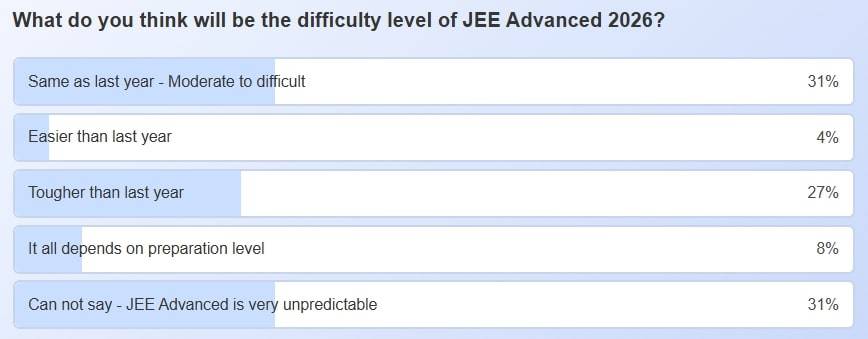
Shiksha Poll: What do you think will be the difficulty level of JEE Advanced 2026? |
JEE Advanced 2026 difficulty level over the past few years has witnessed the following trends. Candidates can read all about the trends; however, make sure to prepare yourself for a shift in exam trends anytime.
Difficulty level differs for paper 1 and paper 2: In recent years (2024, 2025), it has been noted that paper 1 and paper 2 of JEE Advanced have seen a split in difficulty level. While one paper is usually of moderate difficulty, the second one stands out to be tougher. For example, in 2025, paper 2 of the exam was tougher than paper 1. Paper 2 has lengthy calculations and was thus time-consuming.
Subject-wise difficulty level:
- Maths has always been the most difficult of all three subjects. These subjects, year after year, have troubled the candidates with the time-consuming calculations.
- Physics has been swinging between moderate of difficult in the JEE Advaced difficulty level trends. This subject has a mix of easy questions and tough ones. Some questions require the application of multiple concepts to solve. Some years have witnessed Physics to be calculation-heavy and conceptually challenging. Hence, this comes out to be one of the most challenging sections in terms of predicting its nature.
- Chemistry is a sigh of relief for the candidates every year. Every year, this section gets rated as the easiest one out of the three. There can be some exceptions as some questions may require the application of multiple concepts. However, most of the questions need the application of basic NCERT concepts.
Types of questions in the exam: In recent years of the JEE Advanced exam, the numerical value type questions have been trending. On the other hand, assertion and reasoning-type questions are very dominant in physics and chemistry. MCQs are the most common type of questions and are the core type of questions in the JEE Advanced exam pattern.

Commonly asked questions
Preparation for JEE Advanced begins by knowing exam syllabus. Every student must follow syllabus. Once preparation is done then start solving previous year questions for self-assessment. This will give an overview of your preparation.
You can prepare for all entrance tests at same time. It is a tough task but not impossible. For this a proper strategy is required. Here are some important tips.
- Compare the syllabus: All engineering entrance exams have almost the same syllabus. There might be some additional topics in some exams. The aspirant must study the syllabus for all exams and find out the topics that are extra, and prepare those separately. Almost 90% of the topics will be common for all entrance exams, and hence, syllabus completion for one exam will lead to completion of the syllabus for all the exams.
- Prepare for JEE Mains and incorporate the preparation for all other exams: Apart from JEE Advanced, all the exams are pretty straightforward for a well-prepared candidate. JEE Advanced require a higher level of preparation as the questions are multi-conceptual. However, the state-level entrance exams, and exams like BITSAT, VITEEE, etc., have direct questions. Most of the questions in JEE Mains are also direct and require the application of basic concepts. Hence, the candidates must prepare for one exam, like JEE Mains, that will cover their preparation for all other exams.
- JEE Advanced needs extra effort: For JEE Advanced candidates must focus on time management and building exam day temperament. Learn how to apply multiple concepts to a question.
The bottom line is to prepare for JEE Mains to cover the preparation for all other CETs and exams like BITSAT and VITEEE. For JEE Advanced, work on sharpening your skills of time management, stress handling, multiple concept application, speed and accuracy.
Aspirants must keep in mind that exam difficulty level cannot be determined by organising IIT. JEE Advanced paper is not made by one single IIT; but it is prepared by experts from multiple institutes. Difficulty level of exam is independent of the IIT conducting exam.
Cracking JEE Mains and JEE Advanced is not possible in few days or months, it requires continuous efforts through two long years. If a student is focused and doing the studies regularly, revising the concept on daily basis and solving questions on each topic will definitely going to get success in first attempt.
Explore more B.Tech exams with upcoming dates

1 Jun '26 - 30 Sep '26
30 Sep '26
3 Oct '26
MET

24 Oct '26
30 Oct '26
JEE Main
1 Nov '26 - 30 Nov '26
1 Nov '26 - 30 Nov '26
21 Sep '26 - 2 Dec '26
What to Expect for JEE Advanced 2026 Difficulty Level
In terms of JEE Advanced 2026 difficulty level, here is what the candidates can look out for:
| Maths | Physics | Chemistry |
|---|---|---|
| Maths can be the toughest section out of the three. | Physics will be moderate for you if you have a strong hold of concepts and problem-solving. | Chemistry will be easy if all the basics are covered. |
| Expect questions with lengthy calculations. | Expect questions requiring multiple concept applications to solve. | Expect some tricky questions; however, most of the questions will need the application of basic concepts. |
| This section will consume most of your time. | Some numericals will take time to solve | This section will give you relaxation in time management. |
| Candidates need to approach this section with speed and accuracy | This section should be approached with a deeper conceptual understanding and a knack for problem-solving | Approach this section with promptness. |
| High weightage topics - Probability, algebra, and coordinate geometry | High weightage topics - mechanics, electricity, and modern physics | High weightage topics - balanced, mostly all topics are covered |
Read More:
- JEE Advanced Chapter Wise Weightage 2026 for Maths, Physics, Chemistry
- JEE Advanced Marks vs Ranks: Check Category Wise Qualifying Marks, Previous Year Rank v/s Marks
- Minimum Marks Required in JEE Advanced 2026 for IIT: Check for General, OBC, SC, ST and all Categories
- Difference Between JEE Main 2026 and JEE Advanced 2026 Syllabus

News & Updates
Explore Other Exams
Oct '26 | JEE Main 2027 Registration Ses... |
Dec '26 | JEE Main 2027 Correction Windo... |
Oct '26 | SRMJEEE 2027 Notification |
Nov '26 | SRMJEEE 2027 Registration Phas... |
Feb '27 | COMEDK Application Form 2027 |
Feb '27 | COMEDK Mock Test Release Date ... |
Oct '26 | MET 2027 application form - Ph... |
Mar '27 | MET 2027 application form star... |
29 Aug '26 | BITSAT 2026 Iteration-IX fee p... |
28 Aug '26 | BITSAT 2026 Iteration-IX Annou... |
19 Aug '26 - 20 Aug '26 | TS EAMCET 2026 MPC Counselling... |
12 Aug '26 - 17 Aug '26 | TS EAMCET 2026 MPC Counselling... |
Student Forum
 Anything you would want to ask experts?
Answered a week ago
You are not eligible for JEE (Advanced) 2027 because your first appearance for Class 12 was in 2025. For JEE (Advanced) 2027 candidates must have taken their Class 12 (or equivalent) examination for the first time in either 2026 or 2027. Since your first appearance was in 2025 you fall outside this
S
Contributor-Level 10
Answered 3 weeks ago
Yes, Indian students can apply for TU Munich Admissions directly after Class 12th, provided they meet the minimum qualifying JEE Advanced score requirement and other program-specific entry requirements.
Students without a JEE Advanced score, will either have to enroll in the Studienkolleg or complete
A
Contributor-Level 10
Answered 3 weeks ago
Technical University of Munich generally accepts a JEE Advanced score only for the immediate academic intake to the year the exam was passed (usually within one year).
Universities like TU Munich assess students based on current admission rules, and hence using a scorecard older than admission year i
A
Contributor-Level 10
Answered 3 weeks ago
No, the Technical University of Munich does not accept JEE Advanced scores for Master's programs. For entry to PG programs, students need to have completed a UG degree from a recognised Indian college or university, submit relevant documents, and meet the program-specific criteria.
Check TU Munich Ad
A
Contributor-Level 10
Answered 4 weeks ago
While evaluating opening and closing rank trends, JEE Advanced cutoffs, and branch allocation dynamics for civil engineering at IIT Bhubaneswar provides a helpful baseline for your academic planning, Lovely Professional University (LPU) serves as an excellent alternative to elevate your engineering
A
Contributor-Level 7
Answered a month ago
The IIT GANDHINAGAR JEE Advanced closing ranksfor the General (open) female only category in 2026 ranked from roughly 5,437 for computer Science and engineering up to 20270 for civil engineering.
m
Beginner-Level 1
Answered a month ago
IIT BHU CSE cutoff 2026 ranged from 1436 in the first round to 1439 in the last round for the General category under the All India quota. Hence, a rank of at least 1439 is needed to qualify for admission to the CSE course. Check the table below to know the overall cutoff range for other categories.
| Category | IIT BHU CSE cutoff 2026 |
|---|---|
| General | 1436 - 1439 |
| OBC | 601 - 601 (R1) |
| SC | 313 - 373 |
| ST | 161 - 170 |
| EWS | 245 - 245 (R1) |
| PWD | 66 - 66 (R1) |
N
Contributor-Level 10
Answered a month ago
IIT BHU JEE Advanced cutoff 2026 ranged from 601 to 7870 in the first round for the OBC AI category. In the last round, the closing cutoff ranged from 601 to 9002 for the aforementioned category. Check the table below to know the Round 1 and last round closing cutoffs for different courses.
| Course | Round 1 Cutoff 2026 | Last Round Cutoff 2026 |
|---|---|---|
| B.Tech. in Computer Science and Engineering | 601 | 601 |
| B.Tech. in Mathematics and Computing | 826 | 845 |
| B.Tech. in Electronics Engineering | 1167 | 1189 |
| B.Tech. in Electrical Engineering | 1497 | 1529 |
| B.Tech. in Mechanical Engineering | 2760 | 3175 |
| B.Tech. in Chemical Engineering | 3394 | 3609 |
| B.Tech. in Engineering Physics | 3490 | 3620 |
| B.Tech. in Civil Engineering | 3834 | 3980 |
| B.Tech. in Materials Science and Technology | 3886 | 4257 |
| B.Tech. in Metallurgical Engineering | 4269 | 4494 |
| B.Tech. in Industrial Chemistry | 4389 | 4681 |
| B.Tech. in Biomedical Engineering | 4798 | 5067 |
| B.Tech. in Biochemical Engineering | 4877 | 5156 |
| B.Tech. in Ceramic Engineering | 4899 | 5245 |
| B.Tech. in Mining Engineering | 5031 | 5329 |
| B.Tech. in Pharmaceutics Engineering and Technology | 5424 | 5776 |
| Bachelor of Architecture (B.Arch.) | 7870 | 9002 |
N
Contributor-Level 10
Answered a month ago
IIT Gandhinagar JEE Advanced cutoff 2026 for the General AI female category ranged from 5437 (CSE) to 20270 (Civil Engineering). Students can check the table below to know the last round cutoff range for other female categories.
| Category | IIT Gandhinagar JEE Advanced cutoff 2026 |
|---|---|
| General | 5437 - 20270 |
| OBC | 2700 - 9008 |
| EWS | 981 - 3973 |
| ST | 369 - 1941 |
| SC | 802 - 4390 |
| PWD | 225 |
N
Contributor-Level 10
Answered a month ago
IIT Bombay cutoff 2026 for the Electrical and Aerospace Engineering courses for the General AI category in the last round was 411 and 2638, respectively. To know the last round closing ranks for other categories, see the table below.
| Category | Electrical Engineering | Aerospace Engineering |
|---|---|---|
| General | 411 | 2638 |
| OBC | 281 | 1546 |
| SC | 130 | 731 |
| ST | 90 | 458 |
| EWS | 110 | 589 |
| PWD | 7 | 103 |
N
Contributor-Level 10
Currently - Deputy Manager, Content
Role - News and Feature Writer, Content Editor
Expertise - Engineering Education and Counselling
Mamona Majumder specialises in news and feature writing and content editing. With
Read Full Bio