How to Prepare CLAT 2027 Quantitative Techniques (Maths): Check Syllabus, Tips, Mocks, Books
Common Law Admission Test 2027 ( CLAT )


CLAT 2027 online registrations
3 Aug '26 - 31 Oct '26


Quantitative Techniques is the smallest section of the CLAT exam paper. The Consortium of NLUs will ask around 11 questions of Quantitative Techniques in the paper. But this section can give an advantage to candidates who can solve these questions correctly. Candidates are advised not to ignore the Quantitative (Maths) section in CLAT exam because it can break the dream of getting into the dream NLU. Let us see the more about the Quantitative Aptitude topic for the CLAT exam. on this page.

How to Prepare Quant for CLAT 2027
How to Prepare Quantitative Techniques for CLAT 2027: The Consortium of National Law Universities will conduct the Common Law Admission Test (CLAT) in offline mode nationwide. The Consortium released the CLAT 2027 exam date in its official notification. The Consortium notified its exam format on its official portal. As per the official format, the Consortium will ask around 11 questions in the Quantitative Techniques section. Though it makes up around 10 per cent of the CLAT exam, it can be the path to your dream NLU.
Candidates who solve all the questions can get an advantage in the CLAT 2027. Scoring maximum marks in the Quantitative Techniques (Maths) section matters because most candidates score well here, as the questions are doable and mostly at Class X level. Candidates cannot afford to score less in this section because it will make a heavy dent in their CLAT result.
Also Read: CLAT Subjects
The candidates are advised to prepare all the topics mentioned in the CLAT exam Syllabus so that they can score maximum marks in the CLAT paper.
- CLAT 2027 Quantitative Techniques: Syllabus & Pattern
- CLAT 2027 Preparation Tips for Quantitative Techniques
- CLAT Sample Questions for Quantitative Techniques
- CLAT 2027 Quantitative Techniques: Important Topics
- Important CLAT 2027 Quantitative Techniques Books
- Section-Wise CLAT 2027 Preparation Tips
- CLAT Free Mock Test 2027 by Shiksha

CLAT 2027 Quantitative Techniques: Syllabus & Pattern
Before starting preparation, candidates should understand the exam pattern and CLAT Maths Syllabus as described below:
| Particulars |
CLAT Quantitative Techniques Pattern |
|---|---|
| Type of questions |
Passages followed by MCQs |
| Number of reading passages |
3-4 comprehensions of 300 words each |
| Total questions |
10-11 |
| Total marks |
10-11 |
| Marking |
One mark for each correct answer |
| Negative marking |
-0.25 for incorrect answer |
| Approximate weightage in CLAT exam |
10% |
We suggest preparing all topics of the CLAT Maths syllabus.

Commonly asked questions
For the CLAT 2027 Quantitative Techniques section, candidates must focus on the 10th-grade data interpretation and arithmetic.
CLAT is not directly based on the NCERT curriculum, but NCERT books act as a strong foundational resource for Quantitative Techniques and basic static GK. Candidates appearing for board exams can prepare for CLAT side by side.
Candidates can access the CLAT 2027 syllabus on consortiumofnlus.ac.in. The Consortium released the CLAT notification on its official portal. There are five sections in the CLAT syllabus.
While it is not impossible, it is a really challenging task. To score well, you must start preparing for CLAT at least six months before. It is very important to score well if you are looking forward to getting into good NLU. For top 10 NLU, you at least need to score between 100 to 105 as per past trends.
CLAT 2027 Preparation Tips for Quantitative Techniques
Check out important tips necessary for the preparation of the Quantitative Techniques section below:
- Clear your basics: To attempt questions from the Quantitative Techniques section, candidates need to work on their basics. If candidates feel that they do not have conceptual clarity on some topics, they must refer to their Class 8 NCERT books and clear their basics.
- Regular practice: Regular practice is the key to success in the Quantitative Techniques section. Candidates should devote at least an hour every day to solving Quantitative Techniques questions of Class 10 difficulty level.
- CLAT question papers: Once candidates are over with practicing enough questions from each topic of Quantitative Techniques, they should attempt previous years’ CLAT question papers and sample papers. Candidates are advised to solve them to get themselves acquainted with the CLAT exam pattern.
- Learn shortcuts: When it comes to Mathematics, learning shortcuts to solve questions and calculations becomes extremely important. By using shortcuts, candidates will be able to solve the questions much more quickly than before, thereby, saving ample time to attempt other sections.
- Focus on accuracy: Candidates must ensure that all the calculations they do in the exam are 100 per cent accurate. Since there is negative marking of 0.25 marks, making silly calculation errors can cost a lot.
⚡ Check CLAT 2027 Exam Beginner's Guide
Get complete details about CLAT exam syllabus, paper pattern, preparation tips, study plan, recommended books, etc.

CLAT Sample Questions for Quantitative Techniques
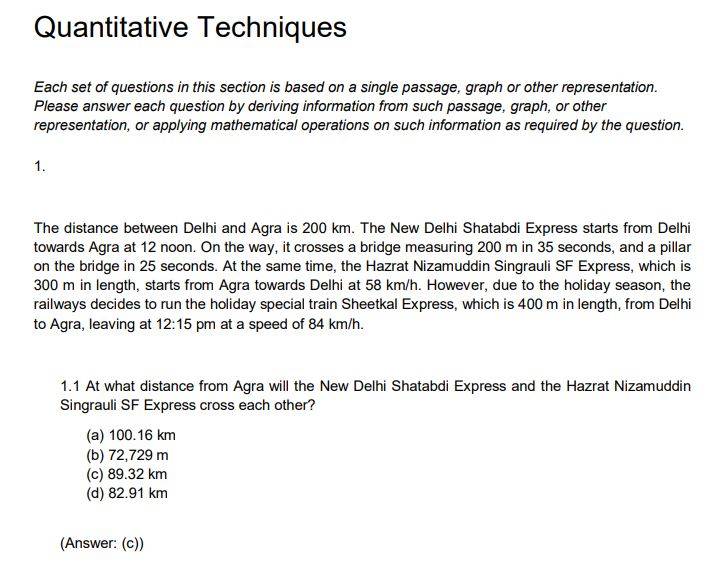
The CLAT Quantitative Techniques questions will be preceded by short sets of facts, propositions, graphs, or other textual/pictorial/diagrammatic representations of numerical information. Candidates will have to thoroughly go through the given passage/information, derive information from it, apply mathematical operations and then answer the subsequent questions. Check an example of the Quantitative Techniques questions as given in CLAT question papers:
How candidates should attempt CLAT Quantitative Techniques questions:
Now, for the question given above, the following tricks should be applied:
The correct answer is (c).
Solving the question: Length of the bridge = 200 m
Let the length of the New Delhi Shatabdi Express be ‘L’ and its speed be ‘S’.
L 200 = 35 x S
S = (L 200) / 35
L = 25 x S
S = L / 25
L / 25 = (L 200) / 35
35L = 25L 5000
10L = 5000
L = 500 m
Therefore, speed S = 500 / 25 = 20 m/s
(20m/s x 18) / 5 = 72 km/h
Distance between the 2 cities = 200 km
Speed of New Delhi Shatabdi Express = 72 km/h
Speed of Hazrat Nizamuddin Singrauli SF Express = 58 km/h
Since, the trains are moving towards each other the speed of the trains will be added up to compute the time taken for the trains to cross each other.
Therefore, Total Speed = 72 58 = 130 km/h
Distance = Speed x time
200 = 130 x time
Time it will take for the two trains to meet = 200/130 = 1.54 hours. Therefore, the trains will meet 1.54 hours after starting from their respective locations.
Distance from Agra = 1.54 hours x speed of Hazrat Nizamuddin Singrauli SF Express (Starts from Agra) = 1.54 x 58 = 89.32 km
Distance from Delhi = 1.4 x New Delhi Shatabdi Express = 1.54 x 72 = 110.88 km
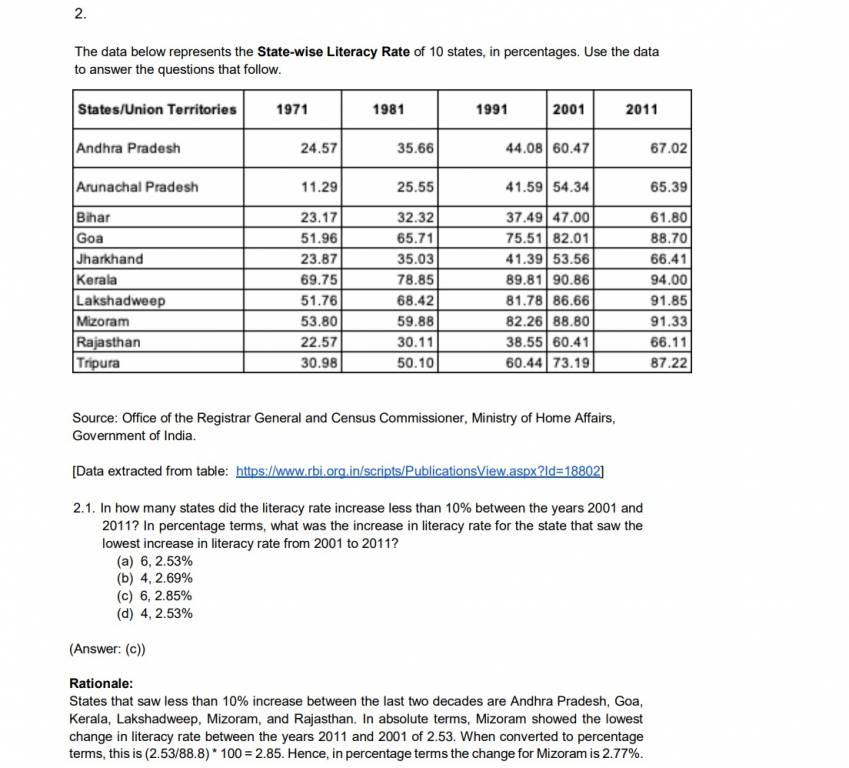
Another example of CLAT 2025 Quantitative Techniques questions is as under:
Commonly asked questions
The CLAT Syllabus is published by the Consortium. The syllabus has been announced. Candidates who are preparing for the exam must note that there are no changes made in the syllabus so far. Candidates can check the syllabus by visiting the official website. You can only download the PDF from website.
The CLAT 2027 UG syllabus includes five subjects:
- English Language,
- Current Affairs & GK,
- Legal Reasoning,
- Logical Reasoning
- Quantitative Techniques.
The exam will consist of 120 MCQs. Candidates will get 2 hours to complete the exam.
No, the Consortium has not made any changes to the CLAT Syllabus for 2027 exam. It further clarified that the exam pattern has also not been modified this year.
Candidates should prioritise understanding legal principles and their application to factual situations. Extensive memorisation of section numbers is generally less useful than understanding the underlying concepts.
Explore colleges based on CLAT
Want better recommendations?
There is a 90% more chance of getting best college recommendations by sharing preferences.
- Chat with our counselor
- Get your personalised list of colleges & exams matching your preferences
CLAT 2027 Quantitative Techniques: Important Topics
Some of the important CLAT topics that candidates should prepare for the Quantitative Techniques section include:
| Important Topics for CLAT Quantitative Techniques Section |
|
|---|---|
| Ratios and Proportions |
Basic Algebra |
| Mensuration |
Statistics |
| Profit and Loss |
Time, Distance and Work |
Important CLAT 2027 Quantitative Techniques Books
Important CLAT books that candidates can refer to prepare for the Quantitative Techniques section include:
- Fast Track Objective Arithmetic by Arihant Publications
- 30 days wonder for Maths by S Chand
- Quantitative Aptitude for Competitive Examinations by Pearson
Commonly asked questions
Candidates can access the CLAT 2027 syllabus on consortiumofnlus.ac.in. The Consortium has not released the CLAT Notification yet. Once it is published, the syllabus will also be announced.
Section-Wise CLAT 2027 Preparation Tips
Click on the links below to know how to prepare for different sections of the CLAT 2027 exam below:
Explore more Law exams with upcoming dates

15 Oct '26
7 Nov '26
7 Aug '26 - 10 Nov '26
13 Nov '26
17 Aug '26 - 4 Dec '26
1 Sep '26 - 4 Dec '26
8 Oct '26 - 12 Oct '26
10 Oct '26 - 12 Oct '26
CLAT Free Mock Test 2027 by Shiksha
Check the table below to access Shiksha’s free CLAT Mocks for practice:
The candidates should practice as much as they can as it will boost their confidence for the exam.

News & Updates
Explore Other Exams
7 Aug '26 - 10 Nov '26 | AILET 2027 Registration |
30 Nov '26 | AILET 2027 Admit Card |
12 Sep '26 - 30 Sep '26 | ULSAT 2026 Phase 6 Exam |
10 Sep '26 | ULSAT 2026 Application Last Da... |
17 Aug '26 - 4 Dec '26 | SLAT Application Form 2027 |
11 Dec '26 | SLAT 2027 Admit Card for Test ... |
26 Jul '26 | RULET 2026 First Merit List |
9 Jul '26 | RULET 2026 Third Merit List |
7 Oct '26 | Admission Cut Off Date |
3 Oct '26 - 6 Oct '26 | LLB 5-Year CAP Institute Level... |
Student Forum
 Anything you would want to ask experts?
Answered 2 days ago
No you don't need to memorise every section. Focus on important concepts key provisions definitions and CLAT style application questions. Understanding legal principles is more important than memorising section numbers.
D
Contributor-Level 8
Answered 4 days ago
No, both are different exams, but both are conducted nationwide. CUET LLB will be conducted by NTA, while CLAT 2027 will be conducted by the Consortium of National Law Universities.
A
Contributor-Level 6
Answered 2 weeks ago
No, CLAT is generally considered more difficult than CUET as CLAT exam requires more intense reading and preparation. It also involves intense time pressure as candidates are required to read around 15,000 words across 30 passages before answering the questions.
A
Contributor-Level 6
Answered 3 weeks ago
Choose Commerce if you want an early foundation in business and finance for corporate law, or Arts (Humanities) if you prefer subjects that align closely with reading comprehension and current affairs for the CLAT exam.
Both streams make you fully eligible for the Common Law Admission Test (CLAT) and
S
Contributor-Level 10
Answered 3 weeks ago
Ministry of Education can release the NLUs NIRF Ranking soon on its official website. There is no time line announced by the ministry in this regard.
A
Contributor-Level 7
Answered 3 weeks ago
NLSIU Bengaluru, which has held the top spot in the Law category every year since NIRF introduced it in 2018.
R
Contributor-Level 7
Answered 3 weeks ago
No, the NIRF Law Ranking 2026 will be released soon by the Minsitry of Education on its official website.
V
Contributor-Level 7
Answered a month ago
S
Contributor-Level 10
Answered a month ago
Yes, the Consortium removed two Test Cities from the CLAT 2027. The removed test cities are Vellore and Tiruvarur. CLAT 2027 exam date is December 6.
N
Contributor-Level 7
Answered a month ago
Candidates are required to pay the CLAT Registration/Form fee as per their category. The Consortium prescribed the category-wise form fee. Without submitting the CLAT form fee, the registration will not be completed.
M
Contributor-Level 7