Quantitative Techniques for CLAT 2027: Syllabus, Topics, Marking Scheme, Books, Important Questions
Common Law Admission Test 2027 ( CLAT )


CLAT 2027 online registrations
3 Aug '26 - 31 Oct '26


Concerned about how to crack the Quantitative Techniques section of the CLAT 2027 exam? Check important CLAT preparation tips, books, topics and more to ace the Quantitative Techniques section of the exam.

The Quantitative Techniques section carries only 10 per cent weightage in the CLAT exam, yet it can prove to be a deciding factor for those aiming for law admissions at the prestigious National Law Universities (NLUs). A candidate cannot risk losing marks in CLAT exam by not preparing the Quantitative Techniques section.
CLAT Quantitative Techniques preparation can be easy with a strategy that aims to cover the syllabus, as well as has sufficient mock test practice. The section seems like the easiest of the five sections of CLAT 202, however, as the questions are based on Class 10 standard, candidates will have to relearn all the tricks if Mathematics was not a subject they opted for in Class 12. With consistent efforts, candidates will be able to overcome any gap in their preparation for the CLAT Quantitative Techniques section to score well.
- CLAT 2027 Quantitative Techniques: Syllabus & Pattern
- CLAT 2027 Preparation Tips for Quantitative Techniques
- CLAT Sample Questions for Quantitative Techniques
- CLAT 2027 Quantitative Techniques: Important Topics
- Important CLAT 2027 Quantitative Techniques Books
- Section-Wise CLAT 2027 Preparation Tips
- CLAT Free Mock Test 2027 by Shiksha

CLAT 2027 Quantitative Techniques: Syllabus & Pattern
Before starting preparation, candidates should understand the exam pattern and CLAT Maths Syllabus as described below:
| Particulars |
CLAT Quantitative Techniques Pattern |
|---|---|
| Type of questions |
Passages followed by MCQs |
| Number of reading passages |
3-4 comprehensions of 300 words each |
| Total questions |
13-17 |
| Total marks |
13-17 |
| Marking |
One mark for each correct answer |
| Negative marking |
-0.25 for incorrect answer |
| Approximate weightage in CLAT exam |
10% |
Also Read:

Commonly asked questions
For the CLAT 2027 Quantitative Techniques section, candidates must focus on the 10th-grade data interpretation and arithmetic.
CLAT is not directly based on the NCERT curriculum, but NCERT books act as a strong foundational resource for Quantitative Techniques and basic static GK. Candidates appearing for board exams can prepare for CLAT side by side.
Candidates can access the CLAT 2027 syllabus on consortiumofnlus.ac.in. The Consortium released the CLAT notification on its official portal. There are five sections in the CLAT syllabus.
While it is not impossible, it is a really challenging task. To score well, you must start preparing for CLAT at least six months before. It is very important to score well if you are looking forward to getting into good NLU. For top 10 NLU, you at least need to score between 100 to 105 as per past trends.
CLAT 2027 Preparation Tips for Quantitative Techniques
Check out important tips necessary for the preparation of the Quantitative Techniques section below:
- Clear your basics: To attempt questions from the Quantitative Techniques section, candidates need to work on their basics. If candidates feel that they do not have conceptual clarity on some topics, they must refer to their Class 8 NCERT books and clear their basics.
- Regular practice: Regular practice is the key to success in the Quantitative Techniques section. Candidates should devote at least an hour every day to solving Quantitative Techniques questions of Class 10 difficulty level.
- CLAT question papers: Once candidates are over with practicing enough questions from each topic of Quantitative Techniques, they should attempt previous years’ CLAT question papers and sample papers. Candidates are advised to solve them to get themselves acquainted with the CLAT exam pattern.
- Learn shortcuts: When it comes to Mathematics, learning shortcuts to solve questions and calculations becomes extremely important. By using shortcuts, candidates will be able to solve the questions much more quickly than before, thereby, saving ample time to attempt other sections.
- Focus on accuracy: Candidates must ensure that all the calculations they do in the exam are 100 per cent accurate. Since there is negative marking of 0.25 marks, making silly calculation errors can cost a lot.
CLAT 2027 Exam Beginner's Guide
Get complete details about CLAT exam syllabus, paper pattern, preparation tips, study plan, recommended books, etc.

CLAT Sample Questions for Quantitative Techniques
The CLAT Quantitative Techniques questions will be preceded by short sets of facts, propositions, graphs, or other textual/pictorial/diagrammatic representations of numerical information. Candidates will have to thoroughly go through the given passage/information, derive information from it, apply mathematical operations and then answer the subsequent questions. Check an example of the Quantitative Techniques questions as given in CLAT sample papers:
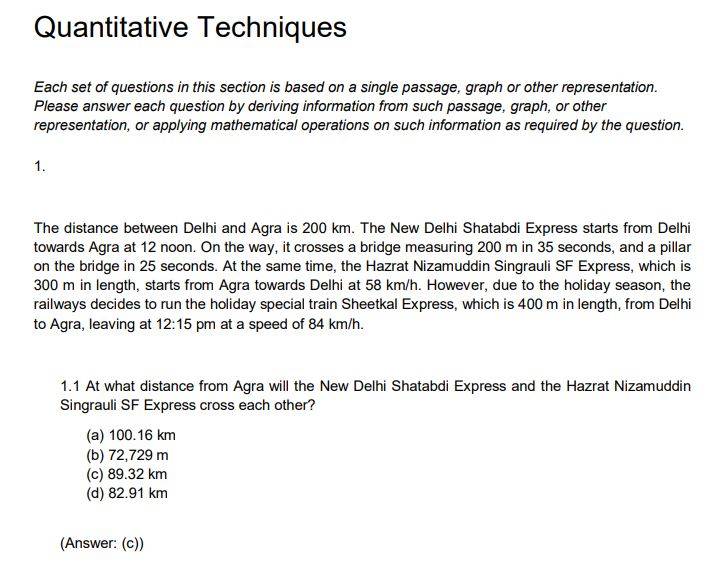
How candidates should attempt CLAT Quantitative Techniques questions:
Now, for the question given above, the following tricks should be applied:
The correct answer is (c).
Solving the question: Length of the bridge = 200 m
Let the length of the New Delhi Shatabdi Express be ‘L’ and its speed be ‘S’.
L 200 = 35 x S
S = (L 200) / 35
L = 25 x S
S = L / 25
L / 25 = (L 200) / 35
35L = 25L 5000
10L = 5000
L = 500 m
Therefore, speed S = 500 / 25 = 20 m/s
(20m/s x 18) / 5 = 72 km/h
Distance between the 2 cities = 200 km
Speed of New Delhi Shatabdi Express = 72 km/h
Speed of Hazrat Nizamuddin Singrauli SF Express = 58 km/h
Since, the trains are moving towards each other the speed of the trains will be added up to compute the time taken for the trains to cross each other.
Therefore, Total Speed = 72 58 = 130 km/h
Distance = Speed x time
200 = 130 x time
Time it will take for the two trains to meet = 200/130 = 1.54 hours. Therefore, the trains will meet 1.54 hours after starting from their respective locations.
Distance from Agra = 1.54 hours x speed of Hazrat Nizamuddin Singrauli SF Express (Starts from Agra) = 1.54 x 58 = 89.32 km
Distance from Delhi = 1.4 x New Delhi Shatabdi Express = 1.54 x 72 = 110.88 km
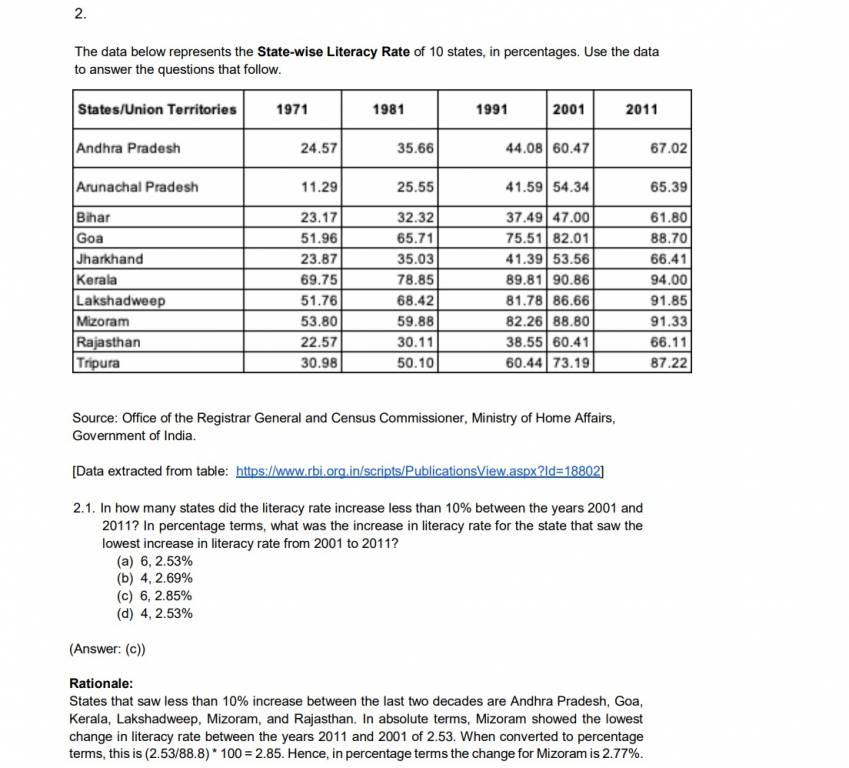
Another example of CLAT 2025 Quantitative Techniques questions is as under:
Commonly asked questions
The CLAT Syllabus is published by the Consortium. The syllabus has been announced. Candidates who are preparing for the exam must note that there are no changes made in the syllabus so far. Candidates can check the syllabus by visiting the official website. You can only download the PDF from website.
The CLAT 2027 UG syllabus includes five subjects: English Language, Current Affairs & GK, Legal Reasoning, Logical Reasoning, and Quantitative Techniques. The exam will be for 120 MCQs. Candidates will get 2 hours to complete the exam.
No, the Consortium has not made any changes to the CLAT Syllabus for 2027 exam. It further clarified that the exam pattern has also not been modified this year.
Candidates should prioritise understanding legal principles and their application to factual situations. Extensive memorisation of section numbers is generally less useful than understanding the underlying concepts.
Explore colleges based on CLAT
Want better recommendations?
There is a 90% more chance of getting best college recommendations by sharing preferences.
- Chat with our counselor
- Get your personalised list of colleges & exams matching your preferences
CLAT 2027 Quantitative Techniques: Important Topics
Some of the important CLAT topics that candidates should prepare for the Quantitative Techniques section include:
| Important Topics for CLAT Quantitative Techniques Section |
|
|---|---|
| Ratios and Proportions |
Basic Algebra |
| Statistics |
|
| Profit and Loss |
Time, Distance and Work |
Important CLAT 2027 Quantitative Techniques Books
Important CLAT books that candidates can refer to prepare for the Quantitative Techniques section include:
- Fast Track Objective Arithmetic by Arihant Publications
- 30 days wonder for Maths by S Chand
- Quantitative Aptitude for Competitive Examinations by Pearson
Section-Wise CLAT 2027 Preparation Tips
Click on the links below to know how to prepare for different sections of the CLAT 2027 exam below:
Explore more Law exams with upcoming dates

12 Sep '26
16 Sep '26
7 Aug '26 - 10 Nov '26
13 Nov '26
1 Sep '26 - 4 Dec '26
16 Sep '26
12 Sep '26 - 20 Sep '26
15 Sep '26 - 22 Sep '26
12 Sep '26 - 30 Sep '26
23 Oct '26 - 27 Oct '26
CLAT Free Mock Test 2027 by Shiksha
Check the table below to access Shiksha’s free CLAT Mocks for practice:

News & Updates
Explore Other Exams
7 Aug '26 - 10 Nov '26 | AILET 2027 Registration |
30 Nov '26 | AILET 2027 Admit Card |
8 Jun '25 | LSAT India 2025 May Session Re... |
May '25 | LSAT India 2025 May Exam |
12 Sep '26 - 30 Sep '26 | ULSAT 2026 Phase 6 Exam |
10 Sep '26 | ULSAT 2026 Application Last Da... |
17 Aug '26 - 4 Dec '26 | SLAT Application Form 2027 |
16 Sep '26 | SLAT Mock Test 2027 |
26 Jul '26 | RULET 2026 First Merit List |
9 Jul '26 | RULET 2026 Third Merit List |
Student Forum
 Anything you would want to ask experts?
Answered 6 days ago
S
Contributor-Level 10
Answered a week ago
Yes, the Consortium removed two Test Cities from the CLAT 2027. The removed test cities are Vellore and Tiruvarur. CLAT 2027 exam date is December 6.
N
Contributor-Level 7
Answered a week ago
Candidates are required to pay the CLAT Registration/Form fee as per their category. The Consortium prescribed the category-wise form fee. Without submitting the CLAT form fee, the registration will not be completed.
M
Contributor-Level 6
Answered a week ago
No, a domicile certificate is not mandatory for all candidates. It is only required if you intend to claim a reservation/ seat under state quota (offered by specific NLUs). Students can skip this document if they are applying solely under the All-India open category.
N
Contributor-Level 6
Answered a week ago
Yes, only Indian Citizens can fill and appear in CLAT. The Foreign nationals can take admission in NLUs but through different official channel.
Contributor-Level 9
Answered a week ago
No, candidates who fulfill OP Jindal Global University BBA LLB (hons) eligibility criteria cannot apply with a CLAT-UG score. This institute only accepts admission based on LNAT-UK exam. No other entrance exams are accepted during admissions to this course.
Y
Contributor-Level 10
Answered a week ago
The Consortium of National Law Universities (NLUs) has notified that the CLAT 2027 exam date is December 6, 2026. The exam will be held offline in pen-and-paper mode.
S
Contributor-Level 7
Answered a week ago
The Consortium of NLUs activated the CLAT Registration form on August 3. The candidates should note that the last date to register for CLAT 2027 is October 31. The Consortium notified that the CLAT 2027 exam date is Dcember 6.
R
Contributor-Level 6
Answered a week ago
No, there is no such provision given by the Consortium to fill the CLAT registration form offline. Candidates must complete the CLAT 2027 registration 2027 on or before the last date. The candidates should note that the CLAT 2027 exam date is December 6.
A
Contributor-Level 6
Answered a week ago
CLAT does not give a fixed number for grammar. The exam is fully passage-based. Grammar is tested inside English Language, which carries around 20% weightage.
S
Contributor-Level 10
She has over 10 years of experience in the education and publishing sectors. She specialises in exam coverage and content creation. At Shiksha, she writes, analyses, and presents information for students preparing f
Read Full Bio