


Mechanics teaches how nature moves and Electromagnetism teaches how nature interacts. Master both topics through concepts, visualization, and rigorous problem-solving tips provided in this page, and you will be well-positioned for a top rank in JEE Advanced 2027.

JEE Advanced 2027 Physics Preparation Strategy to Master Mechanics & Electromagnetism
JEE Advanced 2027 Physics Strategy: Mechanics and Electromagnetism are the two main pillars of JEE Advanced Physics, together accounting for 50% to 60% of the total physics score.
Mechanics forms the fundamental foundation, teaching you how to analyze motion, forces, and energy. Electromagnetism takes those core principles like torque, momentum, conservation of energy, and vector analysis and applies them to charged particles, fields, and circuits.
Questions from Mechanics or electromagnetism in JEE Advanced are not straightforward or formula-based instead, most problems combine multiple concepts, requiring a deep understanding of physical principles
This article is written to help students understand Mechanics and Electromagnetism for JEE Advanced exam through concept building, problem solving tips and recommendations on additional resources.
- Smart Tips to Master Mechanics & Electromagnetism for Top Rank Performance
- JEE Advanced Mechanics Topic-Wise Preparation Strategy
- High Weightage Topics from Mechanics for JEE Advanced 2027
- How to Prepare Electromagnetism for JEE Advanced 2027
- Topic-Wise Preparation Strategy for Electromagnetism
- High Weightage Electromagnetism Topics in JEE Advanced
- How to Prepare for Questions Combining Mechanics and Electromagnetism
- Additional Books and Resource for JEE Advanced 2027 Preparation
- JEE Advanced 2027 Preparation Timeline

Smart Tips to Master Mechanics & Electromagnetism for Top Rank Performance
Mechanics tests your ability to break down physical systems into fundamental laws using free-body diagrams, conservation principles, and vector calculus.
- Always start with a precise Free-Body Diagram (FBD) before writing scalar or vector equations.
- Look from any missed forces, incorrect directions, or bad frame-of-reference choices.
Electromagnetism shifts the focus from visible solid objects to invisible fields, fluxes, and continuous charge distributions.
- To solve problems from electrostatics and capacitance, analyze force on dielectrics, variable capacitance networks, and energy redistribution during charging/discharging
- Circuit problems can be solved effectively by using bridge symmetries, star-delta transformations, and nodal potentials for complex networks.
| JEE Advanced Chapterwise Weightage 2027 | Most Important Chapters for JEE Advanced 2027 |
| Last 10 Year JEE Advanced Papers with Solutions | JEE Advanced Past Year Paper Analysis |
JEE Advanced Mechanics Topic-Wise Preparation Strategy
Mechanics is a very broad topic with several concepts. Here is the preparation tips for every topic coming under Mechanics
Free-Body Diagrams (FBD)
- Isolate the body or system of interest.
- Draw every external force vector like gravitational force, normal contact reactions, friction, and tension.
- Set up orthogonal coordinate axes aligned with the direction of motion or acceleration.
Constraint Analysis
Use virtual work methods or string length differentiation to establish kinematic relationships between connected bodies.
Pure Rolling & Rotation
- Always check the velocity of the contact point:
- Apply conservation of angular momentum about a point where total external torque vanishes.
Expert Tip for Mechanics: When solving complex multi-body problems, prefer Energy Conservation and Momentum Conservation over differential kinematics whenever time variables are not explicitly required.
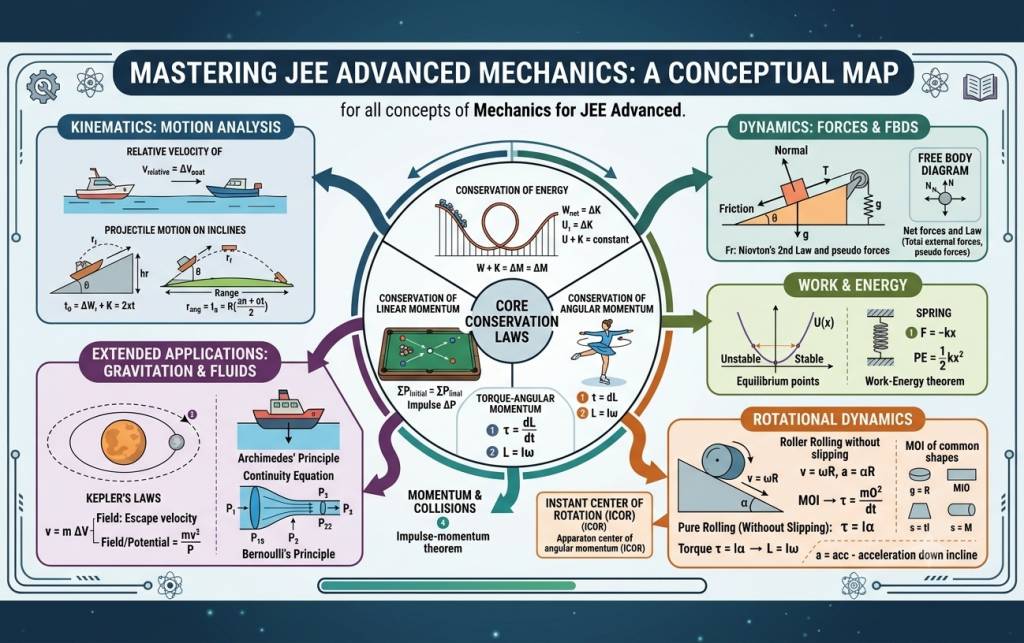
JEE Advanced Mechanics Concepts and Formula

High Weightage Topics from Mechanics for JEE Advanced 2027
| Topic |
Key Areas |
Priority |
| Kinematics & Vectors |
Relative motion, projectile motion on inclines, constrained motion |
Medium |
| Newton's Laws & Friction |
Non-inertial frames, pseudo forces, multi-body systems |
High |
| Work, Power & Energy |
Conservation laws, potential energy curves, stability |
High |
| Center of Mass & Momentum |
Collisions, impulse, variable mass systems, COM frame |
Very High |
| Rotational Dynamics |
Torque, angular momentum, rolling motion, MOI |
Top Priority |
| Gravitation & Fluid Mechanics |
Orbital motion, Bernoulli's principle, surface tension |
Medium-High |
How to Prepare Electromagnetism for JEE Advanced 2027
Electromagnetism is one of the most scoring portions of JEE Advanced because it follows a highly structured mathematical framework. Students who understand field concepts deeply often gain a significant advantage
It is a heavily structured, mathematical, and high-yielding. A strong grasp of field theory and vector calculus transforms this section into a major score booster.
Explore colleges based on JEE Advanced
Want better recommendations?
There is a 90% more chance of getting best college recommendations by sharing preferences.
- Chat with our counselor
- Get your personalised list of colleges & exams matching your preferences
Topic-Wise Preparation Strategy for Electromagnetism
Provided here is the preparation strategy for all concepts coming under Electromagnetism
Symmetry & Gauss / Ampere Laws
Exploit spherical, cylindrical, and planar symmetries using integral forms:
Conductor Boundary Conditions
- Inside a bulk conductor in static equilibrium, the entire volume is an equipotential region.
- Electric field near a conductor surface is always perpendicular
Transient Analysis (RC & LR Circuits)
- Immediately after switching, capacitors act as short circuits (ideal wire) and inductors act as open circuits (break).
- At steady state, capacitors act as open circuits and inductors act as short circuits.
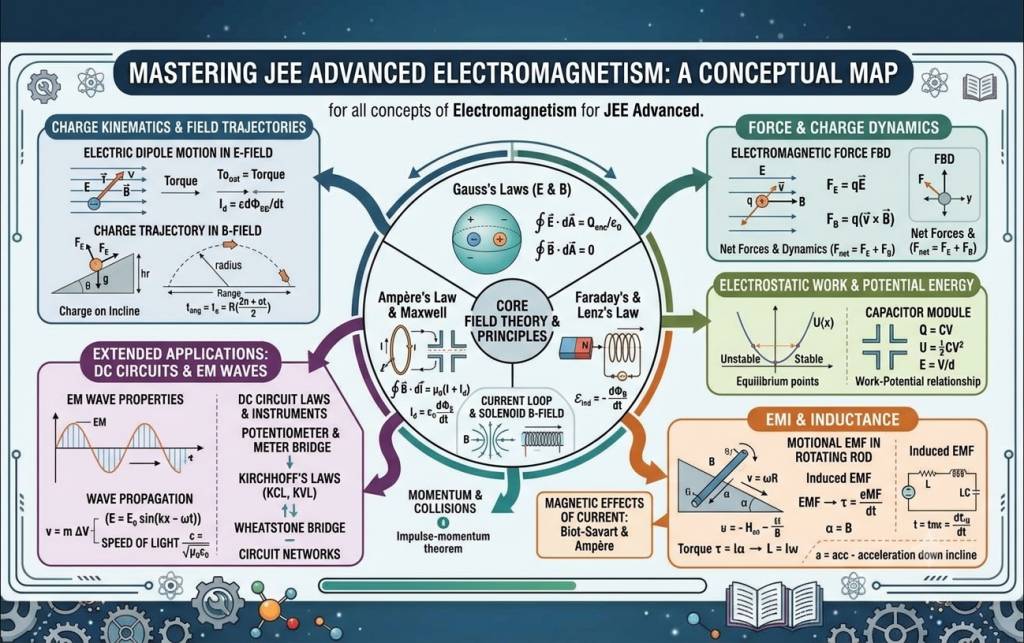
JEE Advanced Electromagnetism Concepts and Formula
High Weightage Electromagnetism Topics in JEE Advanced
| Topic |
Important Concepts |
Priority |
| Electrostatics |
Gauss's Law, potential, conductors, energy density |
Top Priority |
| Capacitance |
Dielectrics, energy storage, RC combinations |
High Priority |
| Current Electricity |
Networks, symmetry, potentiometer, Kirchhoff laws |
High Priority |
| Magnetism & Lorentz Force |
Biot-Savart, Ampere's Law, charged particle motion |
High Priority |
| Electromagnetic Induction |
Faraday's Law, Lenz's Law, inductance, transients |
Top Priority |
| Alternating Current |
Resonance, phasors, power factor, quality factor |
Medium Priority |
How to Prepare for Questions Combining Mechanics and Electromagnetism
JEE Advanced frequently tests problems that combine Mechanics and Electromagnetism principles.
Common Concepts with Mixed Principles
Check important tips required to solve multi-concepts qustions
Motional EMF + Rotational Dynamics: A conducting rod of length L and mass m rotating in a uniform magnetic field, experiencing magnetic braking torque.
Charged Simple Pendulum / Spring-Mass: A mass carrying charge q oscillating under gravity and uniform electric/magnetic fields, modifying the effective acceleration due to gravity g.
Magnetic Rail Accelerators: A conducting bar sliding on rails in a magnetic field connected to a capacitor or inductor, requiring simultaneous integration of Newton's 2nd Law and Kirchhoff's Voltage Law (KVL).
Additional Books and Resource for JEE Advanced 2027 Preparation
Here are some most recommended books for JEE preparation
- Concepts of Physics (Vol 1 & 2) by H.C. Verma for building conceptual clarity, fundamental numerical drills.
- Problems in General Physics by I.E. Irodov for deep analytical problems in Mechanics & Electrodynamics.
- Pathfinder for Olympiad & JEE Advanced for Complex, multi-concept integer and multi-correct problems.
- Last 10 Years JEE Advanced PYQs (Topic-wise) for analyzing real exam patterns, time management, and trick traps.
Explore more B.Tech exams with upcoming dates
MET


1 Jun '26 - 30 Sep '26
30 Sep '26
3 Oct '26
VITEEE
SRMJEEE
JEE Main
1 Nov '26 - 30 Nov '26
18 Dec '26
10 Nov '26
JEE Advanced 2027 Preparation Timeline
As the syllabus of IIT JEE is vast, students need time to prepare for the exam. Here is the phase-wise preparation plan
Phase 1: Mastering Class 11 Topics
- Build conceptual understanding of fundamentals in Mechanics.
- Practice 30 - 40 high-level problems per topic weekly.
- Never skip Rotational Dynamics derivations or constraint relations.
Phase 2: Mastering Class 12 Topics
- Complete Electromagnetism with strong mathematical rigor.
- Maintain revision of Class 11 Mechanics through weekly cumulative tests.
Phase 3 Revision & Mock Series
- Solve full-length exam-style mock tests under strict 3-hour timer constraints.
- Analyze error logs meticulously (categorize errors into Conceptual, Calculation, or Misreading).
Important Note for Students Appearing in JEE 2027
- Master basic vector algebra, differential calculus, and definite integrals to score good in Mechanics and Electromagnetism
- Draw neat, labeled Free-Body Diagrams (FBDs) for every mechanics problem.
- Maintain a dedicated "Error & Key Concept Notebook" for weekly revision.
- Solve past 10 years of JEE Advanced PYQs at least twice prior to the final exam.
| How to Balance JEE Adv Preparation with Class 12 | How to Prepare for IIT JEE without Coaching |
| Best Books for JEE Advanced Preparation | How to Prepare for IIT JEE Adv in 6 Months |

Commonly asked questions
Aspirants must keep in mind that exam difficulty level cannot be determined by organising IIT. JEE Advanced paper is not made by one single IIT; but it is prepared by experts from multiple institutes. Difficulty level of exam is independent of the IIT conducting exam.
Kalpit Veerwal, the JEE Advanced 2017 AIR 1 scored 360 out of 360, the only person in the history of IIT JEE to score full marks.
Another student Ved Lahot scored 355 in JEE Advanced 2024 exam and secured AIR 1.
Preparation for JEE Advanced begins by knowing exam syllabus. Every student must follow syllabus. Once preparation is done then start solving previous year questions for self-assessment. This will give an overview of your preparation.
You can prepare for all entrance tests at same time. It is a tough task but not impossible. For this a proper strategy is required. Here are some important tips.
- Compare the syllabus: All engineering entrance exams have almost the same syllabus. There might be some additional topics in some exams. The aspirant must study the syllabus for all exams and find out the topics that are extra, and prepare those separately. Almost 90% of the topics will be common for all entrance exams, and hence, syllabus completion for one exam will lead to completion of the syllabus for all the exams.
- Prepare for JEE Mains and incorporate the preparation for all other exams: Apart from JEE Advanced, all the exams are pretty straightforward for a well-prepared candidate. JEE Advanced require a higher level of preparation as the questions are multi-conceptual. However, the state-level entrance exams, and exams like BITSAT, VITEEE, etc., have direct questions. Most of the questions in JEE Mains are also direct and require the application of basic concepts. Hence, the candidates must prepare for one exam, like JEE Mains, that will cover their preparation for all other exams.
- JEE Advanced needs extra effort: For JEE Advanced candidates must focus on time management and building exam day temperament. Learn how to apply multiple concepts to a question.
The bottom line is to prepare for JEE Mains to cover the preparation for all other CETs and exams like BITSAT and VITEEE. For JEE Advanced, work on sharpening your skills of time management, stress handling, multiple concept application, speed and accuracy.
Commonly asked questions
Candidates from general category must target to score no less than 200 marks for admission in IITs. The safe score for OBC-NCL and Gen-EWS category would be above 150. However, candidates belonging to reserved category from SC/ST/PwD can get admission in IITs with score of 100.
If you're beginning the preparation after JEE Main session 1 exam, it will be difficult/almost impossible to prepare for JEE Advanced. However, if you've prepared for IIT JEE in previous months and has covered the syllabus, you can manage to revise the important topics in one month.
News & Updates
Explore Other Exams
Oct '26 | JEE Main 2027 Registration Ses... |
Dec '26 | JEE Main 2027 Correction Windo... |
Oct '26 | SRMJEEE 2027 Notification |
Nov '26 | SRMJEEE 2027 Registration Phas... |
1 Sep '26 | COMEDK 2026 Counselling: Round... |
1 Sep '26 - 3 Sep '26 | COMEDK 2026 Counselling: Round... |
Sep '26 | MET 2027 application form - Ph... |
Mar '27 | MET 2027 application form star... |
29 Aug '26 | BITSAT 2026 Iteration-IX fee p... |
28 Aug '26 | BITSAT 2026 Iteration-IX Annou... |
19 Aug '26 - 20 Aug '26 | TS EAMCET 2026 MPC Counselling... |
12 Aug '26 - 17 Aug '26 | TS EAMCET 2026 MPC Counselling... |
Student Forum
 Anything you would want to ask experts?
Answered a week ago
Yes, Indian students can apply for TU Munich Admissions directly after Class 12th, provided they meet the minimum qualifying JEE Advanced score requirement and other program-specific entry requirements.
Students without a JEE Advanced score, will either have to enroll in the Studienkolleg or complete
A
Contributor-Level 10
Answered a week ago
Technical University of Munich generally accepts a JEE Advanced score only for the immediate academic intake to the year the exam was passed (usually within one year).
Universities like TU Munich assess students based on current admission rules, and hence using a scorecard older than admission year i
A
Contributor-Level 10
Answered a week ago
No, the Technical University of Munich does not accept JEE Advanced scores for Master's programs. For entry to PG programs, students need to have completed a UG degree from a recognised Indian college or university, submit relevant documents, and meet the program-specific criteria.
Check TU Munich Ad
A
Contributor-Level 10
Answered a week ago
While evaluating opening and closing rank trends, JEE Advanced cutoffs, and branch allocation dynamics for civil engineering at IIT Bhubaneswar provides a helpful baseline for your academic planning, Lovely Professional University (LPU) serves as an excellent alternative to elevate your engineering
A
Contributor-Level 7
Answered 2 weeks ago
The IIT GANDHINAGAR JEE Advanced closing ranksfor the General (open) female only category in 2026 ranked from roughly 5,437 for computer Science and engineering up to 20270 for civil engineering.
m
Beginner-Level 1
Answered 2 weeks ago
IIT BHU CSE cutoff 2026 ranged from 1436 in the first round to 1439 in the last round for the General category under the All India quota. Hence, a rank of at least 1439 is needed to qualify for admission to the CSE course. Check the table below to know the overall cutoff range for other categories.
| Category | IIT BHU CSE cutoff 2026 |
|---|---|
| General | 1436 - 1439 |
| OBC | 601 - 601 (R1) |
| SC | 313 - 373 |
| ST | 161 - 170 |
| EWS | 245 - 245 (R1) |
| PWD | 66 - 66 (R1) |
N
Contributor-Level 10
Answered 2 weeks ago
IIT BHU JEE Advanced cutoff 2026 ranged from 601 to 7870 in the first round for the OBC AI category. In the last round, the closing cutoff ranged from 601 to 9002 for the aforementioned category. Check the table below to know the Round 1 and last round closing cutoffs for different courses.
| Course | Round 1 Cutoff 2026 | Last Round Cutoff 2026 |
|---|---|---|
| B.Tech. in Computer Science and Engineering | 601 | 601 |
| B.Tech. in Mathematics and Computing | 826 | 845 |
| B.Tech. in Electronics Engineering | 1167 | 1189 |
| B.Tech. in Electrical Engineering | 1497 | 1529 |
| B.Tech. in Mechanical Engineering | 2760 | 3175 |
| B.Tech. in Chemical Engineering | 3394 | 3609 |
| B.Tech. in Engineering Physics | 3490 | 3620 |
| B.Tech. in Civil Engineering | 3834 | 3980 |
| B.Tech. in Materials Science and Technology | 3886 | 4257 |
| B.Tech. in Metallurgical Engineering | 4269 | 4494 |
| B.Tech. in Industrial Chemistry | 4389 | 4681 |
| B.Tech. in Biomedical Engineering | 4798 | 5067 |
| B.Tech. in Biochemical Engineering | 4877 | 5156 |
| B.Tech. in Ceramic Engineering | 4899 | 5245 |
| B.Tech. in Mining Engineering | 5031 | 5329 |
| B.Tech. in Pharmaceutics Engineering and Technology | 5424 | 5776 |
| Bachelor of Architecture (B.Arch.) | 7870 | 9002 |
N
Contributor-Level 10
Answered 3 weeks ago
IIT Gandhinagar JEE Advanced cutoff 2026 for the General AI female category ranged from 5437 (CSE) to 20270 (Civil Engineering). Students can check the table below to know the last round cutoff range for other female categories.
| Category | IIT Gandhinagar JEE Advanced cutoff 2026 |
|---|---|
| General | 5437 - 20270 |
| OBC | 2700 - 9008 |
| EWS | 981 - 3973 |
| ST | 369 - 1941 |
| SC | 802 - 4390 |
| PWD | 225 |
N
Contributor-Level 10
Answered 3 weeks ago
IIT Bombay cutoff 2026 for the Electrical and Aerospace Engineering courses for the General AI category in the last round was 411 and 2638, respectively. To know the last round closing ranks for other categories, see the table below.
| Category | Electrical Engineering | Aerospace Engineering |
|---|---|---|
| General | 411 | 2638 |
| OBC | 281 | 1546 |
| SC | 130 | 731 |
| ST | 90 | 458 |
| EWS | 110 | 589 |
| PWD | 7 | 103 |
N
Contributor-Level 10
Answered 3 weeks ago
EWS AI category students need a rank of at least 696 to be qualified for admission to the CSE course. Students can check the table below to know the round-wise IIT Bhubaneswar CSE cutoff 2026 for the EWS AI category.
| Round Number | IIT Bhubaneswar CSE cutoff 2026 (Closing Rank) |
|---|---|
| 1 | 643 |
| 2 | 643 |
| 3 | 643 |
| 4 | 643 |
| 5 | 696 |
N
Contributor-Level 10
Engineering Education & Entrance Exam Expert
Role: Senior News Writer & Content Editor, Shiksha.com
Education: B.Tech in Mechanical Engineering [IET], MA Education Philosophy
Satyendra Singh is an Engineering gradua
Read Full Bio