
JEE Main Syllabus 2027: Complete Topics List with Chapterwise Weightage
Joint Entrance Exam (JEE) Main 2027 ( JEE Main )


JEE Main 2027 Exam Date Session 1
22 Jan '27 - 24 Jan '27


JEE Main Syllabus 2027 PDF Download: The National Testing Agency will soon release the JEE Mains 2027 syllabus. The syllabus of JEE Main exam covers NCERT class 11 and 12 chapters of Physics, Chemistry and Mathematics for Paper 1 (BE/BTech). For Paper 2A and 2B, the syllabus covers General Aptitude, Mathematics, & Drawing and General Aptitude, Mathematics & Planning chapters.
Since there’s no change in NCERT curriculum, the JEE Main syllabus 2027 will remain similar to last year. Candidates can download the JEE Main syllabus pdf from this page to prepare for the exam.
Candidates must not that the difficulty level and depth of problems differs in JEE and boards. To score good marks in JEE Mains, candidates must practice solving difficult, multi-concepts questions. We’ve also provided here JEE Main chapterwise weightage by analyzing past year papers to pick important chapters for the exam.
Also Check: JEE Main Chapterwise PYQ PDF Download
- JEE Mains 2027 Syllabus PDF Download
- JEE Main 2027 Syllabus for Paper 1 (BE/BTech)
- JEE Main Syllabus 2027 for Paper 2 (BArch and BPlan)
- JEE Main Chapter-Wise Weightage 2027
- JEE Main Exam Pattern 2027 Overview
- JEE Main 2027 Syllabus FAQs

JEE Mains 2027 Syllabus PDF Download
Once the JEE Main 2027 syllabus PDF is released by NTA, we will upload it below. Until then, candidates should prepare for JEE Main using the previous year's syllabus.
JEE Mains Syllabus 2027 PDF Download NTA
| JEE Main Paper |
Syllabus PDF Download |
| Paper 1 (BE/BTech) |
Download PDF |
| Paper 2A (BArch) |
Download PDF |
| Paper 2B (BPlan) |
Download PDF |
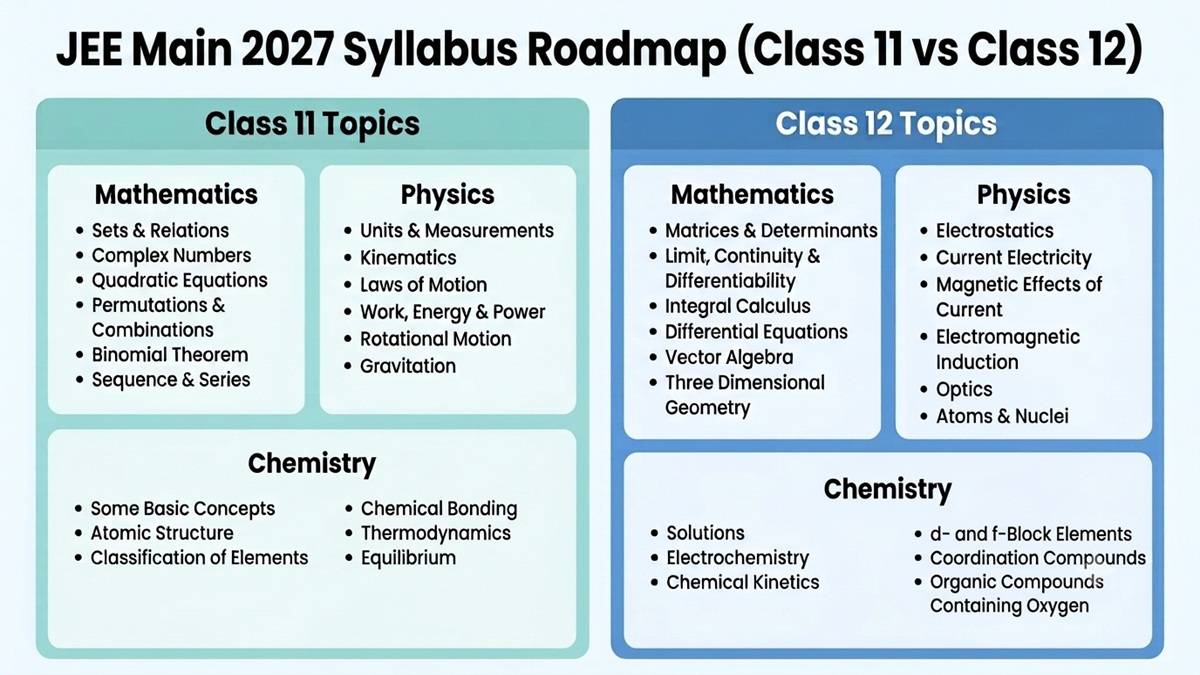
JEE Main Syllabus 2027 Class 11 and 12 Topics

JEE Main 2027 Syllabus for Paper 1 (BE/BTech)
Check complete details of all units, chapters and topics covered in JEE Main syllabus of Paper 1 (BE/BTech).
JEE Mains Syllabus for Maths
| Class |
Domain |
Units |
Important Topics |
| Class 11 |
Algebra |
Sets, Relations & Functions |
Sets & properties, Power set, Types of relations, Equivalence relations, Functions (definition & domain/range) |
| Class 11 |
Algebra |
Complex Numbers & Quadratic Equations |
Argand plane, Modulus & argument, Roots & coefficients, Nature of roots |
| Class 11 |
Algebra |
Permutations & Combinations |
Fundamental counting principle, P(n,r) & C(n,r) applications |
| Class 11 |
Algebra |
Binomial Theorem |
Expansion for positive integral index, General & middle terms |
| Class 11 |
Algebra |
Sequence & Series |
AP & GP, Insertion of AM and GM, Relation between AM & GM |
| Class 11 |
Trigonometry |
Trigonometry |
Trigonometric identities, Formulas, and Functions |
| Class 11 |
Coordinate Geometry |
Co-ordinate Geometry & Conics |
Cartesian coordinates, Straight lines, Circles, Parabola, Ellipse, Hyperbola |
| Class 11 |
Statistics |
Statistics |
Measures of dispersion, Mean, Variance, Standard deviation |
| Class 12 |
Algebra |
Matrices & Determinants |
Matrix algebra, Determinants (2&3 order), Adjoint & inverse, Systems of linear equations |
| Class 12 |
Calculus |
Advanced Relations & Inverse Trig |
One-one & onto functions, Composition of functions, Inverse Trigonometric Functions |
| Class 12 |
Calculus |
Limit, Continuity & Differentiability |
Limits, Differentiability, Composite/implicit differentiation, Monotonicity, Maxima & Minima |
| Class 12 |
Calculus |
Integral Calculus |
Fundamental integrals, Substitution/parts/partial fractions, Definite integrals & Area bounded |
| Class 12 |
Calculus |
Differential Equations |
Order & degree, Separation of variables, Homogeneous & linear differential equations |
| Class 12 |
Vectors & 3D |
Vector Algebra |
Scalar & vector products (Dot & Cross), Components in 2D/3D |
| Class 12 |
Vectors & 3D |
Three Dimensional Geometry |
Direction cosines/ratios, Line equations, Skew lines & shortest distance |
| Class 12 |
Statistics & Probability |
Probability |
Addition & multiplication theorems, Bayes' Theorem, Probability distributions |
JEE Mains Syllabus for Physics
| Class |
Domain |
Units |
Important Topics |
| Class 11 |
Mechanics |
Units & Measurements |
SI units, Least count, Dimensions, Significant figures, Error analysis |
| Class 11 |
Mechanics |
Kinematics |
Frame of reference, 1D & 2D motion, v-t/x-t graphs, Projectile & circular motion |
| Class 11 |
Mechanics |
Laws of Motion |
Newton's laws, Impulse, Momentum conservation, Friction, Circular motion dynamics |
| Class 11 |
Mechanics |
Work, Energy & Power |
Work-energy theorem, Potential energy of springs, Collisions (1D & 2D) |
| Class 11 |
Mechanics |
Rotational Motion |
Centre of mass, Torque, Angular momentum conservation, Parallel/perpendicular axes theorems |
| Class 11 |
Mechanics |
Gravitation |
Universal law, Acceleration due to gravity ($g$), Kepler's laws, Escape & orbital velocity |
| Class 11 |
Thermal Physics |
Properties of Solids & Liquids |
Elasticity (Hooke's law), Pascal's law, Viscosity, Bernoulli's principle, Surface tension |
| Class 11 |
Thermal Physics |
Thermodynamics |
Zeroth, First (Isothermal/Adiabatic), and Second laws of thermodynamics |
| Class 11 |
Thermal Physics |
Kinetic Theory of Gases |
Ideal gas equation, RMS speed, Degrees of freedom, Equipartition of energy |
| Class 11 |
Waves & SHM |
Oscillations & Waves |
SHM equations, Simple pendulum, Traveling & standing waves, Harmonics & Beats |
| Class 12 |
Electrodynamics |
Electrostatics |
Coulomb's law, Electric dipole & field, Gauss's law, Capacitors & dielectrics |
| Class 12 |
Electrodynamics |
Current Electricity |
Drift velocity, Ohm's law, Kirchhoff's laws, Wheatstone bridge, Metre bridge |
| Class 12 |
Electrodynamics |
Magnetic Effects & Magnetism |
Biot-Savart & Ampere's laws, Galvanometer conversion, Para/Dia/Ferromagnetic materials |
| Class 12 |
Electrodynamics |
EMI & Alternating Currents |
Faraday's & Lenz's laws, Inductance, LCR series circuits, Transformers & AC generators |
| Class 12 |
Electrodynamics |
Electromagnetic Waves |
Displacement current, EM wave characteristics, EM spectrum |
| Class 12 |
Optics & Modern |
Optics |
Ray optics (Mirrors, Lenses, Prisms) & Wave optics (Huygens principle, YDSE, Diffraction) |
| Class 12 |
Optics & Modern |
Dual Nature of Matter |
Photoelectric effect, Einstein's equation, De Broglie relation |
| Class 12 |
Optics & Modern |
Atoms & Nuclei |
Rutherford & Bohr models, Hydrogen spectrum, Mass defect, Binding energy, Fission/Fusion |
| Class 12 |
Optics & Modern |
Electronic Devices |
Semiconductors, p-n junction diodes, Rectifiers, Zener diode, Logic gates |
| Class 12 |
Practicals |
Experimental Skills |
Vernier calipers, Screw gauge, Meter bridge, Prism, Diode curves, etc. (18 Experiments) |
JEE Mains Syllabus for Chemistry
| Class |
Domain |
Units |
Important Topics |
| Class 11 |
Physical Chemistry |
Some Basic Concepts |
Dalton's theory, Mole concept, Stoichiometry, Empirical & Molecular formulas |
| Class 11 |
Physical Chemistry |
Atomic Structure |
Bohr model, Quantum numbers, Shapes of s,p,d orbitals, Aufbau & Hund's rules |
| Class 11 |
Inorganic Chemistry |
Classification of Elements |
Periodic table trends (Radii, IE, Electron gain enthalpy, Oxidation states) |
| Class 11 |
Inorganic Chemistry |
Chemical Bonding |
VSEPR theory, Hybridization, Molecular Orbital Theory (MOT), Hydrogen bonding |
| Class 11 |
Physical Chemistry |
Chemical Thermodynamics |
First & Second laws, Hess's Law, Enthalpies of reaction, Gibbs free energy |
| Class 11 |
Physical Chemistry |
Equilibrium |
Chemical & Ionic equilibrium (pH, Le Chatelier's principle, Buffers) |
| Class 11 |
Physical Chemistry |
Redox Reactions |
Oxidation numbers, Balancing redox equations |
| Class 11 |
Organic Chemistry |
Purification & Analysis |
Distillation, Chromatography, Qualitative/Quantitative analysis of C, H, N, Halogens, S, P |
| Class 11 |
Organic Chemistry |
Basic Principles (GOC) |
IUPAC nomenclature, Isomerism, Inductive/Resonance effects, Carbocations & Carbanions |
| Class 11 |
Organic Chemistry |
Hydrocarbons |
Alkanes, Alkenes (electrophilic addition, ozonolysis), Alkynes, Benzene substitution |
| Class 12 |
Physical Chemistry |
Solutions |
Concentration terms, Raoult's Law, Colligative properties, Van 't Hoff factor |
| Class 12 |
Physical Chemistry |
Electrochemistry |
Kohlrausch's law, Nernst equation, Galvanic & Electrolytic cells |
| Class 12 |
Physical Chemistry |
Chemical Kinetics |
Rate law, Order & molecularity, Zero & first-order kinetics, Arrhenius equation |
| Class 12 |
Inorganic Chemistry |
p-Block Elements |
Group 13 to 18 elements: Configuration and general property trends |
| Class 12 |
Inorganic Chemistry |
d- and f-Block Elements |
Transition metals, Oxidation states, Catalytic/magnetic properties, K2Cr2O7, KMnO4 |
| Class 12 |
Inorganic Chemistry |
Coordination Compounds |
IUPAC nomenclature, Werner's theory, VBT, Crystal Field Theory (CFT), Isomerism |
| Class 12 |
Organic Chemistry |
Organic Halides |
Haloalkanes & Haloarenes, mechanisms, Chloroform, DDT |
| Class 12 |
Organic Chemistry |
Oxygen Compounds |
Alcohols, Phenols, Ethers, Aldehydes & Ketones (Aldol, Cannizzaro), Carboxylic Acids |
| Class 12 |
Organic Chemistry |
Nitrogen Compounds |
Amines (1°, 2°, 3° identification, basic strength), Diazonium salts |
| Class 12 |
Organic Chemistry |
Biomolecules |
Carbohydrates, Proteins, Amino acids, Nucleic acids (DNA/RNA), Vitamins |
| Class 12 |
Organic Chemistry |
Practical Chemistry |
Salt analysis (cations & anions), Functional group tests, Titrations (KMnO4) |
JEE Main Syllabus 2027 for Paper 2 (BArch and BPlan)
Candidates can check the JEE Main Paper 2 Syllabus for BArch and BPlan courses below:
JEE Main Paper 2 Syllabus for BArch
| Subjects | Topics |
| Mathematics | Sets, Relations and Functions, Complex Numbers and Quadratic Equations, Matrices and Determinants, Permutations and Combinations, Mathematical Inductions, Binomial Theorem and its Simple Applications, Sequence and Series, Limits, Continuity and Differentiability, Integral Calculus, Differential Equations, Coordinate Geometry, Three-dimensional Geometry, Vector Algebra, Statistics and Probability, Trigonometry, Mathematical Reasoning |
| General Aptitude | Awareness of persons, Buildings, and Materials: Objects, Texture related to Architecture and build environment. Visualising three-dimensional objects from two-dimensional drawings. Visualizing. Different sides of three-dimensional objects. Analytical Reasoning Mental Ability (Visual. Numerical and Verbal) |
| Three-dimensional- perception: Understanding and appreciation of scale and proportions of objects, building forms and elements, colour texture harmony and contrast Design and drawing of geometrical or abstract shapes and patterns in pencil. Transformation of forms both 2D and 3D union, subtraction rotation, development of surfaces and volumes, Generation of Plan, elevations and 3D views of objects, Creating two-dimensional and three-dimensional compositions using given shapes and forms. | |
| Drawing | Sketching of scenes and activities from memory of urbanscape (public space, market, festivals, street scenes, monuments, recreational spaces, etc), landscape (riverfronts. Jungle. Gardens, trees. Plants, etc.) and rural life. |
JEE Main Syllabus Paper 2B (BPlan)
| Subjects | Topics |
| Mathematics | Sets, Relations and Functions, Complex Numbers and Quadratic Equations, Matrices and Determinants, Permutations and Combinations, Mathematical Inductions, Binomial Theorem and its Simple Applications, Sequence and Series, Limits, Continuity and Differentiability, Integral Calculus, Differential Equations, Coordinate Geometry, Three-dimensional Geometry, Vector Algebra, Statistics and Probability, Trigonometry, Mathematical Reasoning |
| General Aptitude | Awareness of persons, Buildings, and Materials: Objects, Textures related to Architecture and building environment Visualising three-dimensional objects from two-dimensional drawings. Visualizing. Different sides of three-dimensional objects. Analytical Reasoning Mental Ability (Visual. Numerical and Verbal) |
| Three-dimensional- perception: Understanding and appreciation of scale and proportions of objects, building forms and elements, colour texture harmony and contrast Design and drawing of geometrical or abstract shapes and patterns in pencil. Transformation of forms both 2D and 3D union, subtraction rotation, development of surfaces and volumes, Generation of plans, elevations and 3D views of objects, Creating two-dimensional and three-dimensional compositions using given shapes and forms. | |
| Planning | General Awareness: General knowledge questions and knowledge about prominent cities, development issues, government programs, etc. |
| Social Science: The idea of nationalism, nationalism in India, pre-modern world, 19th-century global economy, colonialism, and colonial cities, industrialization, resources, and development, types of resources, agriculture, water, mineral resources, industries, national economy; Human Settlements | |
| Power-sharing, federalism, political parties, democracy, the constitution of India | |
| Economic development- economic sectors, globalization, the concept of development, poverty; Population structure, social exclusion, and inequality, urbanization, rural development, colonial cities, | |
| Thinking Skills: Comprehension (unseen passage); map reading skills, scale, distance, direction, area, etc.; critical reasoning; understanding of charts, graphs, and tables; basic concepts of statistics and quantitative reasoning. |
JEE Main Chapter-Wise Weightage 2027
Candidates can refer the JEE Main syllabus weightage given here. This has been calculated basis the JEE Main previous year question papers of past 3 years. It mentions number of questions asked from a particular chapter over the years and its overall weightage. JEE Main chapterwise weightage will help candidates to understand important chapters and plan their studies accordingly.
JEE Main Chapterwise Weightage for Physics
|
Chapter |
No. of Questions in 2024 |
No. of Questions in 2025 |
No. of Questions in 2026 |
Overall Weightage |
|
Electrostatics & Capacitors |
43 |
49 |
33 |
High |
|
Properties of Matter |
40 |
31 |
32 |
High |
|
Current Electricity |
50 |
20 |
26 |
High |
|
Ray Optics |
19 |
42 |
27 |
High |
|
EMI & Alternating Current |
42 |
18 |
25 |
High |
|
Magnetic Effects & Magnetism |
35 |
29 |
21 |
High |
|
Atoms & Nuclei |
41 |
19 |
21 |
Medium |
|
Units & Measurements |
25 |
32 |
21 |
Medium |
|
Kinematics |
35 |
21 |
17 |
Medium |
|
Rotational Motion |
23 |
27 |
23 |
Medium |
|
Wave Optics |
22 |
20 |
23 |
Medium |
|
Laws of Motion |
33 |
12 |
19 |
Medium |
|
Semiconductors & Logic Gates |
22 |
17 |
18 |
Low |
|
Thermodynamics |
18 |
22 |
17 |
Low |
|
Dual Nature of Radiation & Matter |
20 |
18 |
14 |
Low |
|
Electromagnetic Waves |
20 |
12 |
16 |
Low |
|
Gravitation |
22 |
13 |
8 |
Low |
|
Kinetic Theory of Gases |
20 |
12 |
11 |
Low |
|
Work, Energy & Power |
19 |
13 |
11 |
Low |
|
Oscillations (SHM) |
14 |
13 |
13 |
Low |
|
Waves & Sound |
11 |
12 |
7 |
Low |
|
Experimental Skills |
15 |
4 |
10 |
Low |
|
Calorimetry & Heat Transfer |
2 |
12 |
6 |
Low |
|
Centre of Mass & Collisions |
8 |
7 |
5 |
Low |
JEE Main Chapterwise Weightage for Chemistry
|
Chapter |
No. of Questions in 2024 |
No. of Questions in 2025 |
No. of Questions in 2026 |
Overall Weightage |
|
General Organic Chemistry |
64 |
32 |
28 |
High |
|
Coordination Compounds |
36 |
37 |
31 |
High |
|
Hydrocarbons |
43 |
29 |
25 |
High |
|
Chemical Bonding |
48 |
23 |
19 |
High |
|
Mole Concept & Redox Reactions |
32 |
27 |
23 |
Medium |
|
d- & f-Block Elements |
40 |
20 |
19 |
Medium |
|
Solutions |
28 |
26 |
20 |
Medium |
|
Amines |
28 |
20 |
23 |
Medium |
|
Chemical Thermodynamics |
22 |
30 |
19 |
Medium |
|
Electrochemistry |
28 |
24 |
18 |
Medium |
|
Chemical & Ionic Equilibrium |
18 |
25 |
26 |
Medium |
|
Chemical Kinetics |
19 |
26 |
24 |
Medium |
|
p-Block Elements |
35 |
16 |
17 |
Medium |
|
Atomic Structure |
21 |
22 |
23 |
Medium |
|
Aldehydes, Ketones & Carboxylic Acids |
20 |
26 |
15 |
Medium |
|
Purification & Characterisation of Organic Compounds |
21 |
21 |
19 |
Medium |
|
Biomolecules |
22 |
17 |
19 |
Low |
|
Periodic Table & Periodicity |
20 |
22 |
16 |
Low |
|
Practical Chemistry (Salt Analysis & Tests) |
25 |
12 |
15 |
Low |
|
Haloalkanes & Haloarenes |
14 |
13 |
10 |
Low |
|
Alcohols, Phenols & Ethers |
15 |
5 |
16 |
Low |
JEE Main Chapterwise Weightage for Mathematics
|
Chapter |
No. of Questions in 2024 |
No. of Questions in 2025 |
No. of Questions in 2026 |
Overall Weightage |
|
Integral Calculus (incl. Area) |
64 |
49 |
43 |
High |
|
Sets, Relations & Functions |
41 |
35 |
29 |
High |
|
3D Geometry |
41 |
35 |
28 |
High |
|
Matrices & Determinants |
42 |
33 |
29 |
High |
|
Limits, Continuity & Differentiability |
46 |
27 |
23 |
High |
|
Sequences & Series |
33 |
29 |
28 |
High |
|
Differential Equations |
39 |
23 |
21 |
High |
|
Vector Algebra |
38 |
22 |
23 |
High |
|
Ellipse & Hyperbola |
21 |
28 |
25 |
Medium |
|
Trigonometry & Inverse Trigonometry |
22 |
23 |
24 |
Medium |
|
Permutations & Combinations |
20 |
25 |
22 |
Medium |
|
Probability |
26 |
22 |
17 |
Medium |
|
Binomial Theorem |
24 |
22 |
14 |
Medium |
|
Complex Numbers |
24 |
19 |
17 |
Medium |
|
Quadratic Equations |
22 |
16 |
19 |
Low |
|
Straight Lines |
25 |
18 |
14 |
Low |
|
Application of Derivatives |
28 |
14 |
8 |
Low |
|
Circle |
20 |
14 |
13 |
Low |
|
Statistics |
14 |
8 |
15 |
Low |
|
Parabola |
9 |
13 |
12 |
Low |
Also Check:
| JEE Mains Syllabus with Weightage |
High-weightage chapters for JEE Main 2027 (5 year analysis) |
JEE Main Exam Pattern 2027 Overview
The exam pattern for JEE Mains 2027 will be announced soon. As per the previous year JEE Main exam pattern, the NTA conducts the exam in online mode as a computer-based test for all three papers, except for the drawing part of Paper 2A, which is held offline on an A4 sheet. More details about the exam pattern can be checked below.
JEE Mains Question Distribution
| Subjects | Number of Questions | Marks | ||
| Paper 1: BE/BTech | Section A | Section B | ||
| Physics | 20 | 5 | 100 | |
| Chemistry | 20 | 5 | 100 | |
| Math | 20 | 5 | 100 | |
| Total | 75 | 300 | ||
| Subjects | Section A | Section B | ||
| Paper 2A: BArch | Math | 20 | 5 | 100 |
| General Aptitude | 50 | 200 | ||
| Drawing | 2 | 100 | ||
| Total | 77 | 400 | ||
| Subjects | Section A | Section B | ||
| Paper 2B: BPlan | Maths | 20 | 5 | 100 |
| General Aptitude | 50 | 200 | ||
| Planning | 50 | 100 | ||
| Total | 75 | 400 | ||
JEE Mains Marking Scheme
| Question Type |
Correct Answer |
Incorrect Answer |
Unanswered |
| MCQs (Multiple Choice) |
+4 marks |
-1 mark |
0 marks |
| NAT (Numerical Answer Type) |
+4 marks |
-1 mark |
0 marks |
Exam Duration of JEE Mains
| Papers | Duration For Non-PwD/PwBD Candidates | Duration For PwD/PwBD Candidates |
| Paper 1: BE/Btech | 3 Hours | 4 Hours |
| Paper 2A: BArch | 3 Hours | 4 Hours |
| Paper 2B: BPlan | 3 Hours | 4 Hours |
| Paper 2A and 2B Both | 3 Hours 30 Minutes | 4 Hours 10 Minutes |
JEE Main 2027 Syllabus FAQs
Check the Frequently Asked Questions (FAQs) related to the JEE Main 2027 Syllabus.
No both are not same. But some topics are similar in JEE Main and JEE Advanced. Students who qualify the JEE Main exam and are among the top 250000 students are eligible to take the JEE Advanced. Due to this reason majority of syllabi are the same, but a few extra topics are added in JEE Advanced.
Students who are in class 12 and would also be appearing in JEE Mains exam mostly find it difficult to manage both their class/school and JEE studies. However, all these students have an advantage over others/droppers aspirants as there are many common topics in class 12 and JEE.
To benefit, they must identify all the topics that are common and study those first. Secondly, cover the topics that have more weightage in class 12 and complete them. Before a few days of JEE Mains, study specifically for JEE. This way, they can manage both class 12 and JEE efficiently.
Candidates should take JEE Main mock tests at least once a week. However, in the last month before exam, frequency should be increased to 3 to 4 mock exam per week.
The official NTA JEE Main Syllabus contains 52 major units/chapters across all three subjects.
Clearing the JEE Main exam in first attempt is not a difficult task. Several students clear JEE Main while in class 12. One thing that makes it easy to clear JEE Main with class 12 is that students are in regular touch of most JEE syllabus. To score good marks in JEE Main in the first attempt, it is advised that you study class 11 and 12 topics thoroughly, clear all the concepts and solve mock test papers. Also, NCERT books which you study in class 11 and 12 are the best books for JEE Main preparation. Students must study NCERT properly and solve all the questions in the book and do not memorize the concepts as some students do rather understand the concepts.
Questions in JEE Mains exam is a blend of all the topics covered in the syllabus. However, there are some topics that are very much important and should be paid extra attentions while preparing for the exam. The list of important JEE Main topics are
Mathematics
- 3D Geometry
- Vector
- Applications of Derivatives
- Definite Integrals
- Limit, Cnntinuity and Differentiability
Physics
- Heat and Thermodynamics
- Electromagnetic Waves
- Ray & Wave Optics
- Kinematics
- Current Electricity
- Magnetism
Chemistry
- Electrochemistry
- Chemical Kinetics
- Thermodynamics
- p-block elements
- Chemical Bonding
The JEE Main 2027 syllabus PDF is made available on the official website of jeemain.nta.nic.in.
Do your research to choose the best book for JEE Main preparation. You can talk to your teachers before you decide. Some books recommended for your preparation are given below:
| Subjects | Books |
|---|---|
| Physics |
|
| Chemistry |
|
| Mathematics |
|
Chapterwise weightage of class 11 and 12 topics in JEE Main are mentioned below:
- Physics: Current Electricity Waves AC, Magnetism, Laws of Motion Work, Power and Energy.
- Chemistry the high weightage topics are s and p block elements, Coordination compounds, Thermodynamics Gaseous state, Chemical bonding, Atomic structure, Polymers, Environmental Chemistry Organic Chemistry.
- Mathematics, the high weightage topics are Sequence and Series Vectors and 3D, Integral and Differential Calculus, Definite and Indefinite Integral.
Time required to cover JEE Main syllabus changes from one student to another student. In general, to complete the entire JEE Main syllabus, students would require around 1 year. The ideal time to start preparing for JEE Main is class 11 as the syllabus for JEE and class 11-12 is similar. Students who are studying in class 11 can point out the topics that are common in both and pay special emphasis to those topics.
Students can download the JEE Main syllabus 2027 from the official website of JEE Mains 2027 once released.
Paper 1 has 75 questions where Physics Chemistry and Mathematics, each section has 25 questions. Out of 25 questions, 20 are MCQs and five are numerical value questions. You must answer all 5 numerical value-type questions. All 20 multiple-choice questions are compulsory. Complete all 75 questions in 3 hours.
JEE Main syllabus is based on class 11 and 12 Physics, Chemistry and Maths topics. If you have focused while studying, then it will be easy to prepare for the exam otherwise, you may find it difficult. NCERT textbook is the best for Chemistry and Physics. You can also refer to other books for exam preparation. There are many preparation books suggested by the toppers of Joint Entrance Examination Main.
Explore top B.E. / B.Tech exams
Jun '26 | JoSAA 2026 starts |
1 Jun '26 | JEE Advanced 2026 Result Date |
Oct '26 | MHT CET 2027 Registration |
Nov '26 | MHT CET 2027 Form Correction |
Dec '26 | BITSAT 2027 Application Form S... |
Mar '27 | BITSAT 2027 Form Correction Se... |
Jan '27 | CUET 2027 Application Process |
Feb '27 | CUET 2027 Correction Window |
25 Sep '26 | BiPC Final Phase Seat Allotmen... |
21 Sep '26 | Third Round Seat Allotment |
Oct '26 | MET 2027 application form - Ph... |
Mar '27 | MET 2027 application form star... |
7 Aug '26 | IPU BTech 2026 Spot Seat Allot... |
4 Aug '26 - 5 Aug '26 | IPU BTech 2026 Spot Round Regi... |
7 Oct '26 | WBJEE 2026 Decentralised Couns... |
4 Oct '26 | WBJEE 2026 Decentralised Couns... |
Feb '27 | COMEDK Application Form 2027 |
Feb '27 | COMEDK Mock Test Release Date ... |
31 Oct '26 | Last Date for submitting Quali... |
6 Jun '26 - 13 Jun '26 | JMI Entrance Exam 2026 Counsel... |
11 Sep '26 | Classes Start |
7 Sep '26 | Round 3 Final Seat Allotment |
Oct '26 | VITEEE 2027 Registration Start... |
Apr '27 | VITEEE 2027 Mock Test Release ... |
27 Jul '26 - 28 Jul '26 | Physical Certificate Verificat... |
23 Jul '26 | Third Round Seat Acceptance |
19 Aug '26 - 20 Aug '26 | TS EAMCET 2026 MPC Counselling... |
12 Aug '26 - 17 Aug '26 | TS EAMCET 2026 MPC Counselling... |
Nov '26 | AEEE 2027 Phase 1 Registration... |
Jan '27 | AEEE 2027 slot booking |
18 Dec '26 | NTA CSIR NET December 2025 Exa... |
Jul '26 | NTA AIAPGET 2026 Exam Date |
22 Sep '26 | WBJEE JELET 2026 Seat Allotmen... |
18 Sep '26 - 20 Sep '26 | WBJEE JELET 2026 Counselling R... |
Nov '26 | GITAM GAT 2027 registration fo... |
Dec '26 | GITAM GAT 2027 result phase 1 |
14 Aug '26 | CUSAT CAT 2026 SC/ST Special R... |
11 Aug '26 | CUSAT CAT 2026 B.Tech Third Re... |
Jan '27 | KEAM 2027 registration |
Feb '27 | KEAM 2027 last date to upload ... |

JEE Main Exam
Student Forum
 Anything you would want to ask experts?
Answered Yesterday
If your JEE Main score is not strong, Galgotias University can be a practical option to consider. It offers multiple B.Tech programmes and gives preference to JEE Main scores while also allowing admission based on its programme-specific eligibility criteria. Compare fees, branch, curriculum, and opp
D
Contributor-Level 7
Answered a week ago
According to the tentative schedule, JEE Main 2027 counselling registration is likely to commence in June 2027 after the conclusion of both exam sessions.
H
Beginner-Level 5
Answered a week ago
The cutoff rank in Round 7 for BTech Computer Science & Engineering under General All India category is 53,013. It is the most competitive branch in the institute.
H
Beginner-Level 5
Answered a week ago
Yes, JEE Main is compulsory for admission in B.Tech course at SGSITS.
H
Beginner-Level 5
Answered a week ago
After qualifying JEE Main, students need to register themselves for MP BE Counselling, choose colleges/branches, attend rounds and verify documents to secure admission.
H
Beginner-Level 5
Answered a week ago
Getting into B.Tech CSE is straightforward. You need to have passed 10+2 with Physics and Mathematics, along with Chemistry, Biotechnology, Biology, or a Technical Vocational subject. Marks from boards like CBSE, ISC, and PSEB are accepted. JEE Main scores are also recognised under the RBUEdge Schol
P
Contributor-Level 6
Answered a week ago
Yes, JEE Main scores are recognised under the RBUEdge Scholarship Program, so your entrance exam effort can also help reduce your fees. A higher score falls in a higher scholarship slab, with the top slab offering a 60% waiver on the course fee. This is a nice reward for the hard work that goes into
A
Contributor-Level 6
Answered 2 weeks ago
The JEE Main Round 7 cutoff 2026 for SGSITS Indore ranged from 53,013 to 90,468 for General All India candidates across BTech branches.
H
Beginner-Level 5
Answered 2 weeks ago
If a student has appeared for JEE Main, they can apply for B.Tech admission at Galgotias University through the university's admission process. JEE Main scores are considered for preference in the merit list, along with the eligibility requirements of the chosen B.Tech programme. After applying, the
S
Contributor-Level 8
Answered 2 weeks ago
For B.Tech admissions, Galgotias University primarily considers eligibility based on Class 12 qualifications and its admission process. JEE Main scores may also be considered for admission, depending on the programme and admission criteria for that year. CUET acceptance can vary by course and admiss
P
Beginner-Level 5
2259 Institutes accepting JEE Main
 4.5
4.5- ₹ 8.00 Lakh
- 4 years
- |
- Full Time
SRM Institute of Science and Technology, Kattankulathur
Kattankulathur, Chennai • Private
- ₹ 8.00 Lakh
- 4 years
- |
- Full Time
- ₹ 8.00 Lakh
- 4 years
- |
- Full Time

Explore more B.Tech exams with upcoming dates
 IEMJEE 2026 Exam Dates - Phase 3 1 Jun '26 - 31 Oct '26 KLEEE 2027 Application Form - Phase 1 21 Sep '26 - 2 Dec '26
Which private university is best for BTech, if we don't score good in JEE Main?