
JEE Mains Syllabus 2027: Official PDF Download, Class 11 & 12 Deleted Topics & Chapter-Wise Weightage
Joint Entrance Exam (JEE) Main 2027 ( JEE Main )


JEE Main 2027 Exam Date Session 1
22 Jan '27 - 24 Jan '27


JEE Main Syllabus 2027: NTA will release the JEE Mains syllabus 2027 on the official website. The syllabus will be available once the information for the upcoming session is uploaded at jeemain.nta.nic.in, tentatively in the month of October 2026. Until the latest syllabus is released, candidates can refer to the previous year's syllabus to prepare for JEE Main 2027.
The JEE Mains 2027 syllabus includes 3 subjects - Physics, Chemistry and Maths. The syllabus follows NCERT based topics from Class 11 and 12. Students should cover all topics mentioned in the NTA JEE Mains 2027 syllabus to prepare for the exam. On this page, we have provided the JEE Main syllabus PDF and have also discussed the high-weightage chapters and important topics. Read below to know all the details.
- JEE Mains 2027 Syllabus PDF Download
- Does the JEE Mains Syllabus Go Beyond NCERT?
- JEE Mains 2027 Deleted vs Retained Topics: What You Can Actually Skip
- Where to Download the Official JEE Main Syllabus 2027 PDF?
- JEE Main Syllabus 2027 for Paper 1 (BE/BTech)
- JEE Main Syllabus for Paper 2 (BArch and BPlan)
- JEE Mains Class 11 Syllabus 2027
- JEE Main 2027 Class 12 Syllabus
- JEE Mains Syllabus Analysis 2027: Important Class 11 vs Class 12 Topics
- High-Yield and 'Do-or-Die' Topics from JEE Main 2027 Syllabus
- Some Myths Around NTA JEE Main Syllabus
- JEE Main Exam Pattern 2027 Overview
- JEE Main Preparation Strategy 2027
- JEE Main 2027 Syllabus FAQs


JEE Mains 2027 Syllabus PDF Download
Once the JEE Main 2027 syllabus PDF is released by NTA, we will upload it below. Until then, candidates should prepare for JEE Main using the previous year's syllabus. NTA rarely changes the syllabus; the past year syllabus can be used to prepare for the upcoming JEE Mains exam.
Download JEE Mains Syllabus PDF:
| JEE Main Paper |
Syllabus PDF Download |
| Paper 1 (BE/BTech) |
|
| Paper 2A (BArch) |
|
| Paper 2B (BPlan) |

Commonly asked questions
To crack JEE Mains on the first attempt, candidates need to start preparation as soon as possible. Get hold of conceptual clarity, consistent speed, and smart time management.
Time required to cover JEE Main syllabus changes from one student to another student. In general, to complete the entire JEE Main syllabus, students would require around 1 year. The ideal time to start preparing for JEE Main is class 11 as the syllabus for JEE and class 11-12 is similar. Students who are studying in class 11 can point out the topics that are common in both and pay special emphasis to those topics.
Chapterwise weightage of class 11 and 12 topics in JEE Main are mentioned below:
- Physics: Current Electricity Waves AC, Magnetism, Laws of Motion Work, Power and Energy.
- Chemistry the high weightage topics are s and p block elements, Coordination compounds, Thermodynamics Gaseous state, Chemical bonding, Atomic structure, Polymers, Environmental Chemistry Organic Chemistry.
- Mathematics, the high weightage topics are Sequence and Series Vectors and 3D, Integral and Differential Calculus, Definite and Indefinite Integral.

Does the JEE Mains Syllabus Go Beyond NCERT?
The question every JEE aspirant asks: "Is NCERT enough for JEE Main?"
There are two aspects:
- All topics in JEE Mains syllabus 2027 are covered in NCERT class 11 and 12 syllabus.
- However, just preparing from NCERT books is not enough to score 90+ percentile in JEE Mains 2027.
While NCERT thoroughly maps to the JEE Main syllabus, relying on it alone is rarely enough to secure a top score.
In Chemistry, 60% to 80% of questions come directly from NCERT, and it provides a solid conceptual baseline for Physics and Mathematics. To break into the 90+ percentile group, candidates must supplement NCERT's basic problems with JEE Main question papers and reference books for tougher problem-solving practice.
JEE Mains 2027 Deleted vs Retained Topics: What You Can Actually Skip
Is there any change in JEE Main Syllabus 2027? - It is very unlikely that NTA will make any changes to the JEE Mains 2027 syllabus. The syllabus has remained unchanged since 2024.
A few changes were made in the syllabus in 2024, by removing several topics from Physics, Chemistry, and Mathematics. Candidates are advised not to study the deleted chapters for the JEE Mains exam 2027. The deleted topics from the JEE Mains syllabus are:
- Mathematics: The Mathematical Induction and Mathematical Reasoning units have been removed.
- Physics: In Physics, the Communication Device unit has been removed from the syllabus.
- Chemistry: Surface Chemistry, States of Matter, General Principles and Processes of Isolation of Metals, s-block elements, Hydrogen, Environmental Chemistry, Alcohol, Phenol and Ether, and Polymers chapters have been removed.
What NTA Revised JEE Mains Syllabus?
NTA revised the syllabus for the following major reasons:
- Reduce student stress: Lightens the study load to match post-COVID school curriculum cuts.
- Level the playing field for all boards: NTA consulted over 40 state and central boards to ensure no student is tested on topics missing from their local textbooks.
- Match NEP 2020 goals: Keeps the exam aligned with current national education standards.
- Cut outdated topics: Removes repetitive and obsolete content.
Where to Download the Official JEE Main Syllabus 2027 PDF?
Apart from the official syllabus PDF available on this page, candidates can directly download the syllabus PDF from jeemain.nta.nic.in. It is the official website for JEE Mains 2027 exam and the only authentic source for JEE Mains syllabus download, pattern and other information.
Apart from the official website, candidates can check the syllabus on the JEE Mains 2027 information brochure.
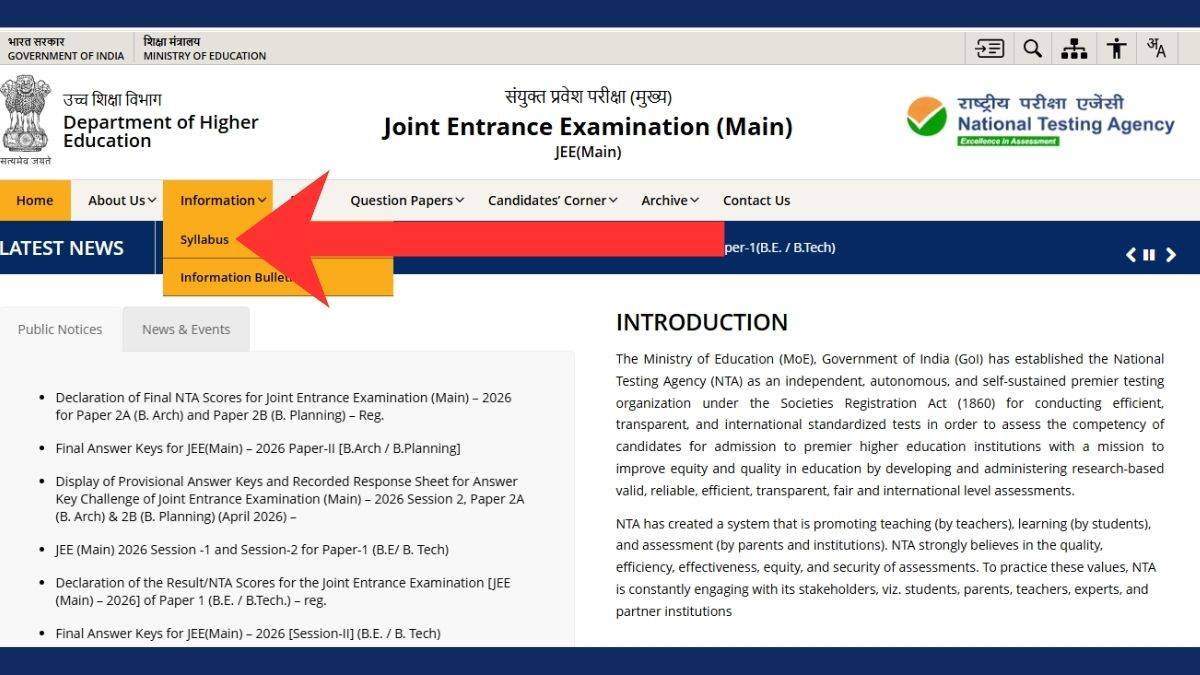
JEE Main syllabus PDF download
JEE Main Syllabus 2027 for Paper 1 (BE/BTech)
We have provided below the syllabus for JEE Mains 2027 preparation for Maths, Physics and Chemistry (Paper 1 - BE/BTech):
JEE Main 2027 Paper 1 Syllabus for Maths
Candidates can check below the Units and topics included in the JEE Mains Maths syllabus 2027:
| Chapter / Unit |
Topics |
|---|---|
| Unit 1: Sets, Relations and Functions |
Sets and their representation; union, intersection and complement of sets and their algebraic properties; power set; relations, types of relations, equivalence relations, functions; one-one, into and onto functions; composition of functions |
| Unit 2: Complex Numbers and Quadratic Equations |
Complex numbers as ordered pairs of reals; representation in the form a + ib and in a plane; Argand diagram; algebra of complex numbers; modulus and argument; quadratic equations in real and complex number systems; relations between roots and coefficients; nature of roots; formation of quadratic equations with given roots |
| Unit 3: Matrices and Determinants |
Matrices, algebra of matrices, types of matrices; determinants and matrices of order two and three; evaluation of determinants; area of triangles using determinants; adjoint and inverse of a square matrix; test of consistency and solution of simultaneous linear equations using matrices |
| Unit 4: Permutations and Combinations |
Fundamental principle of counting; permutations and combinations; meaning of P(n, r) and C(n, r); simple applications |
| Unit 5: Binomial Theorem and its Simple Applications |
Binomial theorem for a positive integral index; general term and middle term; simple applications |
| Unit 6: Sequence and Series |
Arithmetic and Geometric progressions; insertion of arithmetic and geometric means between two given numbers; relation between A.M. and G.M. |
| Unit 7: Limit, Continuity and Differentiability |
Real-valued functions, algebra of functions (polynomial, rational, trigonometric, logarithmic, exponential); inverse functions; graphs of simple functions; limits, continuity, differentiability; differentiation of sum, difference, product, quotient; differentiation of trigonometric, inverse trigonometric, logarithmic, exponential, composite and implicit functions; derivatives up to order two; applications of derivatives — rate of change, increasing/decreasing functions, maxima and minima |
| Unit 8: Integral Calculus |
Integral as anti-derivative; fundamental integrals (algebraic, trigonometric, exponential, logarithmic); integration by substitution, by parts, by partial fractions; integration using trigonometric identities; standard integral forms (1/(x²+a²), 1/√(x²±a²), 1/(a²−x²), etc.); fundamental theorem of calculus; properties and evaluation of definite integrals; areas bounded by simple curves |
| Unit 9: Differential Equations |
Ordinary differential equations, order and degree; solution by separation of variables; solution of homogeneous and linear differential equations of the type dy/dx + p(x)y = q(x) |
| Unit 10: Co-ordinate Geometry |
Cartesian system, distance formula, section formula, locus and its equation; slope of a line, parallel and perpendicular lines, intercepts. Straight line: forms of equations, intersection of lines, angles between lines, concurrence of three lines, distance of a point from a line, centroid/orthocentre/circumcentre. Circle & Conic Sections: standard and general forms of a circle, radius and centre, circle with given diameter endpoints, intersection of line and circle, equations of parabola, ellipse and hyperbola in standard forms |
| Unit 11: Three Dimensional Geometry |
Coordinates of a point in space, distance between two points, section formula, direction ratios and direction cosines, angle between two intersecting lines; equation of a line; skew lines and shortest distance between them |
| Unit 12: Vector Algebra |
Vectors and scalars; addition of vectors; components of a vector in 2D and 3D; scalar and vector products |
| Unit 13: Statistics and Probability |
Measures of dispersion; mean, median, mode of grouped/ungrouped data; standard deviation, variance, mean deviation. Probability: probability of an event, addition and multiplication theorems, Bayes' theorem, probability distribution of a random variable |
| Unit 14: Trigonometry |
Trigonometric identities and functions; inverse trigonometric functions and their properties |
JEE Mains Paper 1 Syllabus 2027 for Physics
Candidates can check below the Units and topics included in the JEE Main Physics syllabus 2027:
| Chapter / Unit |
Topics |
|---|---|
| Unit 1: Units and Measurements |
Units of measurement, systems of units, SI units, fundamental and derived units, least count, significant figures, errors in measurement; dimensions, dimensional analysis and applications |
| Unit 2: Kinematics |
Frame of reference, motion in a straight line, speed and velocity, uniform/non-uniform motion, average speed, instantaneous velocity, uniformly accelerated motion, velocity-time and position-time graphs, relative velocity; motion in a plane, projectile motion, uniform circular motion |
| Unit 3: Laws of Motion |
Force and inertia, Newton's laws of motion, momentum, impulse; conservation of linear momentum and applications; equilibrium of concurrent forces; static and kinetic friction, laws of friction, rolling friction; dynamics of uniform circular motion — centripetal force, vehicle on level/banked road |
| Unit 4: Work, Energy and Power |
Work by constant and variable force, kinetic and potential energy, work-energy theorem, power; potential energy of a spring, conservation of mechanical energy, conservative and non-conservative forces, motion in a vertical circle; elastic and inelastic collisions in one and two dimensions |
| Unit 5: Rotational Motion |
Centre of mass of two-particle system and rigid body; torque, angular momentum, conservation of angular momentum; moment of inertia, radius of gyration, values for simple geometrical objects, parallel and perpendicular axes theorems; equilibrium of rigid bodies, rotational motion equations, comparison of linear and rotational motion |
| Unit 6: Gravitation |
Universal law of gravitation; acceleration due to gravity and its variation with altitude/depth; Kepler's laws; gravitational potential energy and potential; escape velocity, satellite motion — orbital velocity, time period, energy |
| Unit 7: Properties of Solids and Liquids |
Elastic behaviour, stress-strain, Hooke's law, Young's/bulk modulus, modulus of rigidity; fluid pressure, Pascal's law, viscosity, Stoke's law, terminal velocity, streamline/turbulent flow, critical velocity, Bernoulli's principle; surface energy and surface tension, angle of contact, drops/bubbles/capillary rise; heat, temperature, thermal expansion, specific heat, calorimetry, change of state, latent heat; conduction, convection, radiation |
| Unit 8: Thermodynamics |
Thermal equilibrium, zeroth law, heat/work/internal energy; first law of thermodynamics, isothermal and adiabatic processes; second law of thermodynamics — reversible and irreversible processes |
| Unit 9: Kinetic Theory of Gases |
Equation of state of a perfect gas, work done on compressing a gas; kinetic theory assumptions, concept of pressure, kinetic interpretation of temperature, RMS speed, degrees of freedom, law of equipartition of energy, specific heat capacities of gases, mean free path, Avogadro's number |
| Unit 10: Oscillations and Waves |
Periodic motion, time period, frequency, displacement function, periodic functions; SHM and its equation, phase, spring oscillations, energy in SHM, simple pendulum; wave motion, longitudinal/transverse waves, wave speed, displacement relation, superposition, reflection, standing waves in strings/organ pipes, harmonics, beats |
| Unit 11: Electrostatics |
Electric charges and conservation, Coulomb's law, superposition, continuous charge distribution; electric field, field lines, dipole, torque on dipole; electric flux, Gauss's law and applications (wire, sheet, shell); electric potential, potential energy, equipotential surfaces; conductors, insulators, dielectrics, polarization; capacitors, series/parallel combination, parallel plate capacitor, energy stored |
| Unit 12: Current Electricity |
Drift velocity, mobility, Ohm's law, resistance, I-V characteristics; electrical energy and power, resistivity, conductivity, series/parallel resistors, temperature dependence; internal resistance, EMF, cells in series/parallel; Kirchhoff's laws, Wheatstone bridge, Metre bridge |
| Unit 13: Magnetic Effects of Current and Magnetism |
Biot-Savart law, Ampere's law and applications (straight wire, solenoid); force on moving charge and current-carrying conductor, force between parallel currents, torque on current loop, moving coil galvanometer; magnetic dipole moment, bar magnet, magnetic field lines, dia/para/ferromagnetism, effect of temperature |
| Unit 14: Electromagnetic Induction and Alternating Currents |
Faraday's law, induced EMF, Lenz's law, eddy currents, self/mutual inductance; AC peak/RMS values, reactance, impedance, LCR circuit, resonance, power in AC circuits, wattless current, AC generator, transformer |
| Unit 15: Electromagnetic Waves |
Displacement current, characteristics of EM waves, transverse nature; electromagnetic spectrum and applications |
| Unit 16: Optics |
Reflection, spherical mirrors, mirror formula; refraction, thin lens/lens maker formula, total internal reflection, magnification, power of lens, combination of lenses, refraction through prism, microscope and telescope; wave optics — Huygens' principle, interference (YDSE, fringe width), diffraction (single slit), polarization, Brewster's law, Polaroid |
| Unit 17: Dual Nature of Matter and Radiation |
Photoelectric effect, Hertz and Lenard's observations, Einstein's photoelectric equation; de Broglie relation and matter waves |
| Unit 18: Atoms and Nuclei |
Alpha-particle scattering, Rutherford's and Bohr's atomic models, energy levels, hydrogen spectrum; composition and size of nucleus, atomic masses, mass-energy relation, mass defect, binding energy per nucleon, nuclear fission and fusion |
| Unit 19: Electronic Devices |
Semiconductors, p-n junction diode I-V characteristics, diode as rectifier, LED, photodiode, solar cell, Zener diode as voltage regulator; logic gates (OR, AND, NOT, NAND, NOR) |
| Unit 20: Experimental Skills |
Vernier calipers, screw gauge, simple pendulum, metre scale, Young's modulus, surface tension, viscosity, speed of sound, specific heat, resistivity by metre bridge, Ohm's law, galvanometer figure of merit, focal length of mirrors/lens, prism deviation, refractive index, diode/Zener characteristics, component identification |
JEE Mains Paper 1 Syllabus 2027 for Chemistry
The JEE Main syllabus for Chemistry can be divided into: Physical, Inorganic and Organic Chemistry. The syllabus for each is mentioned below:
Physical Chemistry
| Chapter / Unit |
Topics |
|---|---|
| Unit 1: Some Basic Concepts in Chemistry |
Matter and its nature, Dalton's atomic theory, atom/molecule/element/compound; laws of chemical combination; atomic and molecular masses, mole concept, molar mass, percentage composition, empirical and molecular formulae; chemical equations and stoichiometry |
| Unit 2: Atomic Structure |
Electromagnetic radiation, photoelectric effect, hydrogen spectrum; Bohr model — postulates, energy and radii of orbits, limitations; dual nature of matter, de Broglie relation, Heisenberg uncertainty principle; quantum mechanical model, atomic orbitals, quantum numbers, shapes of s/p/d orbitals, electron spin; Aufbau principle, Pauli's exclusion principle, Hund's rule, electronic configuration, stability of half-filled/filled orbitals |
| Unit 3: Chemical Bonding and Molecular Structure |
Kossel-Lewis approach, ionic and covalent bonds; ionic bonding and lattice enthalpy; electronegativity, Fajan's rule, dipole moment, VSEPR theory and molecular shapes; valence bond theory, hybridization, resonance; molecular orbital theory, LCAO, bonding/antibonding orbitals, sigma/pi bonds, bond order/length/energy; metallic bonding, hydrogen bonding |
| Unit 4: Chemical Thermodynamics |
System and surroundings, extensive/intensive properties, state functions, entropy, types of processes; first law — work, heat, internal energy, enthalpy, heat capacity, Hess's law, enthalpies of bond dissociation/combustion/formation/atomization/sublimation/phase transition/hydration/ionization/solution; second law — spontaneity, ΔS and ΔG as criteria; ΔG° and equilibrium constant |
| Unit 5: Solutions |
Concentration expressions — molality, molarity, mole fraction, percentage; vapour pressure and Raoult's law, ideal/non-ideal solutions; colligative properties — relative lowering of vapour pressure, depression of freezing point, elevation of boiling point, osmotic pressure; molecular mass determination, abnormal molar mass, van't Hoff factor |
| Unit 6: Equilibrium |
Concept of dynamic equilibrium; physical equilibria (solid-liquid, liquid-gas, gas-gas, solid-gas), Henry's law; chemical equilibrium — law of chemical equilibrium, Kp and Kc, ΔG and ΔG°, factors affecting equilibrium, Le Chatelier's principle; ionic equilibrium — weak/strong electrolytes, acid-base concepts (Arrhenius, Bronsted-Lowry, Lewis), ionization constants, pH scale, common ion effect, salt hydrolysis, solubility product, buffer solutions |
| Unit 7: Redox Reactions and Electrochemistry |
Oxidation and reduction, redox reactions, oxidation number, balancing redox reactions; electrolytic and metallic conduction, molar conductivity, Kohlrausch's law; electrochemical cells — electrolytic and galvanic cells, electrode potentials, EMF, Nernst equation, cell potential and Gibbs energy, dry cell, lead accumulator, fuel cells |
| Unit 8: Chemical Kinetics |
Rate of reaction, factors affecting rate; elementary and complex reactions, order and molecularity; rate law, rate constant; zero and first order reactions — differential/integral forms, half-life; effect of temperature, Arrhenius theory, activation energy; collision theory of bimolecular gaseous reactions |
Inorganic Chemistry
| Chapter / Unit |
Topics |
|---|---|
| Unit 9: Classification of Elements and Periodicity in Properties |
Modern periodic law, periodic table; s, p, d and f block elements; periodic trends — atomic/ionic radii, ionization enthalpy, electron gain enthalpy, valence, oxidation states, chemical reactivity |
| Unit 10: p-Block Elements |
Group 13 to Group 18 — electronic configuration, periodic/group trends in physical and chemical properties, unique behaviour of the first element in each group |
| Unit 11: d- and f-Block Elements |
Transition elements — configuration, occurrence, characteristics, physical properties, ionization enthalpy, oxidation states, atomic radii, colour, catalytic behaviour, magnetic properties, complex formation, interstitial compounds, alloy formation; preparation/properties/uses of K₂Cr₂O₇ and KMnO₄; lanthanoids and actinoids — configuration, oxidation states, lanthanoid contraction |
| Unit 12: Coordination Compounds |
Introduction, Werner's theory, ligands, coordination number, denticity, chelation, IUPAC nomenclature, isomerism; valence bond approach, crystal field theory basics, colour and magnetic properties; importance in qualitative analysis, metal extraction, biological systems |
Organic Chemistry
| Chapter / Unit |
Topics |
|---|---|
| Unit 13: Purification and Characterisation of Organic Compounds |
Crystallization, sublimation, distillation, differential extraction, chromatography; qualitative detection of N, S, P, halogens; quantitative estimation of C, H, N, halogens, S, P; empirical and molecular formulae calculations |
| Unit 14: Some Basic Principles of Organic Chemistry |
Tetravalency of carbon, shapes of molecules, hybridization; classification by functional groups; homologous series; structural and stereoisomerism; IUPAC/trivial nomenclature; covalent bond fission (homolytic/heterolytic), free radicals, carbocations, carbanions, electrophiles, nucleophiles; inductive effect, electromeric effect, resonance, hyperconjugation; substitution, addition, elimination, rearrangement reactions |
| Unit 15: Hydrocarbons |
Classification, isomerism, IUPAC nomenclature, preparation, properties. Alkanes: conformations (Sawhorse, Newman), halogenation mechanism. Alkenes: geometrical isomerism, electrophilic addition mechanism, Markovnikov's/peroxide effect, ozonolysis, polymerization. Alkynes: acidic character, addition reactions, polymerization. Aromatic hydrocarbons: benzene structure and aromaticity, electrophilic substitution, halogenation, nitration, Friedel-Crafts alkylation/acylation, directive influence of substituents |
| Unit 16: Organic Compounds Containing Halogens |
Preparation, properties, reactions; nature of C-X bond, substitution mechanisms; uses and environmental effects of chloroform, iodoform, freons, DDT |
| Unit 17: Organic Compounds Containing Oxygen |
Alcohols, Phenols, Ethers: identification of 1°/2°/3° alcohols, dehydration mechanism; phenol acidity, electrophilic substitution, Reimer-Tiemann reaction; ether structure. Aldehydes and Ketones: carbonyl group nature, nucleophilic addition, reactivity comparison, HCN/NH₃ derivative addition, Grignard reagent, oxidation, reduction (Wolff-Kishner, Clemmensen), α-hydrogen acidity, aldol condensation, Cannizzaro reaction, haloform reaction, distinguishing tests. Carboxylic Acids: acidic strength and affecting factors |
| Unit 18: Organic Compounds Containing Nitrogen |
Preparation, properties, reactions, uses. Amines: nomenclature, classification, structure, basic character, identification of 1°/2°/3° amines. Diazonium Salts: importance in synthetic organic chemistry |
| Unit 19: Biomolecules |
Carbohydrates: classification, aldoses/ketoses, monosaccharides (glucose, fructose), constituent sugars of oligosaccharides. Proteins: α-amino acids, peptide bond, polypeptides, protein structure levels, denaturation, enzymes. Vitamins: classification and functions. Nucleic Acids: DNA/RNA constitution, biological functions. Hormones: general introduction |
| Unit 20: Principles Related to Practical Chemistry |
Detection of extra elements (N, S, halogens); detection of functional groups (hydroxyl, carbonyl, carboxyl, amino); preparation of Mohr's salt, potash alum, acetanilide, p-nitro acetanilide, aniline yellow, iodoform; titrimetric exercises (acids, bases, indicators, oxalic acid vs KMnO₄, Mohr's salt vs KMnO₄); qualitative salt analysis (cations & anions); enthalpy of solution/neutralization, sol preparation, kinetics of iodide-peroxide reaction |
Commonly asked questions
Paper 1 has 75 questions where Physics Chemistry and Mathematics, each section has 25 questions. Out of 25 questions, 20 are MCQs and five are numerical value questions. You must answer all 5 numerical value-type questions. All 20 multiple-choice questions are compulsory. Complete all 75 questions in 3 hours.
The previous year's JEE Mains question papers can be downloaded from the website of Shiksha, and also from the official website - nta.ac.in.
Students can download the JEE Main syllabus 2027 from the official website of JEE Mains 2027 once released.
JEE Main Syllabus for Paper 2 (BArch and BPlan)
Candidates can check the JEE Main Paper 2 Syllabus for BArch and BPlan courses below:
JEE Main Paper 2 Syllabus for BArch
| Subjects | Topics |
| Mathematics | Sets, Relations and Functions, Complex Numbers and Quadratic Equations, Matrices and Determinants, Permutations and Combinations, Mathematical Inductions, Binomial Theorem and its Simple Applications, Sequence and Series, Limits, Continuity and Differentiability, Integral Calculus, Differential Equations, Coordinate Geometry, Three-dimensional Geometry, Vector Algebra, Statistics and Probability, Trigonometry, Mathematical Reasoning |
| General Aptitude | Awareness of persons, Buildings, and Materials: Objects, Texture related to Architecture and build environment. Visualising three-dimensional objects from two-dimensional drawings. Visualizing. Different sides of three-dimensional objects. Analytical Reasoning Mental Ability (Visual. Numerical and Verbal) |
| Three-dimensional- perception: Understanding and appreciation of scale and proportions of objects, building forms and elements, colour texture harmony and contrast Design and drawing of geometrical or abstract shapes and patterns in pencil. Transformation of forms both 2D and 3D union, subtraction rotation, development of surfaces and volumes, Generation of Plan, elevations and 3D views of objects, Creating two-dimensional and three-dimensional compositions using given shapes and forms. | |
| Drawing | Sketching of scenes and activities from memory of urbanscape (public space, market, festivals, street scenes, monuments, recreational spaces, etc), landscape (riverfronts. Jungle. Gardens, trees. Plants, etc.) and rural life. |
JEE Main Syllabus Paper 2B (BPlan)
| Subjects | Topics |
| Mathematics | Sets, Relations and Functions, Complex Numbers and Quadratic Equations, Matrices and Determinants, Permutations and Combinations, Mathematical Inductions, Binomial Theorem and its Simple Applications, Sequence and Series, Limits, Continuity and Differentiability, Integral Calculus, Differential Equations, Coordinate Geometry, Three-dimensional Geometry, Vector Algebra, Statistics and Probability, Trigonometry, Mathematical Reasoning |
| General Aptitude | Awareness of persons, Buildings, and Materials: Objects, Textures related to Architecture and building environment Visualising three-dimensional objects from two-dimensional drawings. Visualizing. Different sides of three-dimensional objects. Analytical Reasoning Mental Ability (Visual. Numerical and Verbal) |
| Three-dimensional- perception: Understanding and appreciation of scale and proportions of objects, building forms and elements, colour texture harmony and contrast Design and drawing of geometrical or abstract shapes and patterns in pencil. Transformation of forms both 2D and 3D union, subtraction rotation, development of surfaces and volumes, Generation of plans, elevations and 3D views of objects, Creating two-dimensional and three-dimensional compositions using given shapes and forms. | |
| Planning | General Awareness: General knowledge questions and knowledge about prominent cities, development issues, government programs, etc. |
| Social Science: The idea of nationalism, nationalism in India, pre-modern world, 19th-century global economy, colonialism, and colonial cities, industrialization, resources, and development, types of resources, agriculture, water, mineral resources, industries, national economy; Human Settlements | |
| Power-sharing, federalism, political parties, democracy, the constitution of India | |
| Economic development- economic sectors, globalization, the concept of development, poverty; Population structure, social exclusion, and inequality, urbanization, rural development, colonial cities, | |
| Thinking Skills: Comprehension (unseen passage); map reading skills, scale, distance, direction, area, etc.; critical reasoning; understanding of charts, graphs, and tables; basic concepts of statistics and quantitative reasoning. |
Commonly asked questions
JEE Main syllabus is based on class 11 and 12 Physics, Chemistry and Maths topics. If you have focused while studying, then it will be easy to prepare for the exam otherwise, you may find it difficult. NCERT textbook is the best for Chemistry and Physics. You can also refer to other books for exam preparation. There are many preparation books suggested by the toppers of Joint Entrance Examination Main.
Time required to cover JEE Main syllabus changes from one student to another student. In general, to complete the entire JEE Main syllabus, students would require around 1 year. The ideal time to start preparing for JEE Main is class 11 as the syllabus for JEE and class 11-12 is similar. Students who are studying in class 11 can point out the topics that are common in both and pay special emphasis to those topics.
JEE Mains Class 11 Syllabus 2027
The JEE Main syllabus includes Class 11 and Class 12 topics. The chapters in JEE Mains 2027 syllabus, that are from Class 11 are:
JEE Main Class 11 Physics Syllabus 2027
| Unit 1 |
Topics |
|---|---|
| Physical World and Measurement |
Scope and excitement; nature of physical laws; Physics, technology and society, Need for measurement: Units of measurement; systems of units; SI units, fundamental and derived units. Length, mass and time measurements; accuracy and precision of measuring instruments; measurement errors; significant figures; dimensions of physical quantities, dimensional analysis and its applications. |
| Kinematics |
Frame of reference, Motion in a straight line: Position-time graph, speed and velocity. Uniform and non-uniform motion, average speed and instantaneous velocity. Uniformly accelerated motion, velocity time and position-time graphs, relations for uniformly accelerated motion (graphical treatment), Elementary concepts of differentiation and integration for describing motion. Scalar and vector quantities: Position and displacement vectors, general vectors and notation, equality of vectors, multiplication of vectors by a real number; addition and subtraction of vectors. Relative velocity, Unit vectors. Resolution of a vector in a plane - rectangular components. Scalar and Vector products of Vectors, Motion in a plane. Cases of uniform velocity and uniform acceleration - projectile motion. Uniform circular motion. |
| Laws of Motion |
Intuitive concept of force. Inertia, Newton’s first law of motion; momentum and Newton’s second law of motion; impulse; Newton’s third law of motion, Law of conservation of linear momentum and its applications, Equilibrium of concurrent forces. Static and kinetic friction, laws of friction, rolling friction, lubrication. Dynamics of uniform circular motion: Centripetal force, examples of circular motion (vehicle on level circular road, vehicle on banked road). |
| Work, Energy and Power |
Work done by a constant force and a variable force; kinetic energy, work-energy theorem, power, Notion of potential energy, potential energy of a spring, conservative forces; conservation of mechanical energy (kinetic and potential energies); non-conservative forces; motion in a vertical circle; elastic and inelastic collisions in one and two dimensions. |
| Motion of System of Particles and Rigid Body |
Centre of mass of a two-particle system, momentum conservation and centre of mass motion. Centre of mass of a rigid body; centre of mass of uniform rod, Moment of a force, torque, angular momentum, conservation of angular momentum with some examples, Equilibrium of rigid bodies, rigid body rotation and equation of rotational motion, comparison of linear and rotational motions; moment of inertia, radius of gyration. Values of M.I. for simple geometrical objects (no derivation). Statement of parallel and perpendicular axes theorems and their applications. |
| Gravitation |
Kepler’s laws of planetary motion. The universal law of gravitation. Acceleration due to gravity and its variation with altitude and depth, Gravitational potential energy; gravitational potential. Escape velocity, orbital velocity of a satellite. Geostationary satellites. |
| Properties of Bulk Matter |
Elastic behaviour, Stress-strain relationship, Hooke’s law, Young’s modulus, bulk modulus, shear modulus, modulus of rigidity, Poisson’s ratio; elastic energy, Pressure due to a fluid column; Pascal’s law and its applications (hydraulic lift and hydraulic brakes). Effect of gravity on fluid pressure, Viscosity, Stokes’ law, terminal velocity, Reynold’s number, streamline and turbulent flow. Critical velocity, Bernoulli’s theorem and its applications, Surface energy and surface tension, angle of contact, excess of pressure, application of surface tension ideas to drops, bubbles and capillary rise, Heat, temperature, thermal expansion; thermal expansion of solids, liquids, and gases, Anomalous expansion. Specific heat capacity: Cp , Cv - calorimetry; change of state - latent heat, Heat transfer - conduction and thermal conductivity, convection and radiation. Qualitative ideas of Black Body Radiation, Wein’s displacement law, and GreenHouse effect. Newton’s law of cooling and Stefan’s law |
| Thermodynamics |
Thermal equilibrium and definition of temperature (zeroth law of Thermodynamics). Heat, work and internal energy, First law of thermodynamics. Isothermal and adiabatic processes. Second law of thermodynamics: Reversible and irreversible processes. Heat engines and refrigerators. |
| Behaviour of Perfect Gas and Kinetic Theory |
Equation of state of a perfect gas, work done on compressing a gas, Kinetic theory of gases: Assumptions, concept of pressure. Kinetic energy and temperature; rms speed of gas molecules; degrees of freedom; law of equipartition of energy (statement only) and application to specific heat capacities of gases; concept of mean free path, Avogadro’s number. |
| Oscillations and Waves |
Periodic motion - period, frequency, displacement as a function of time. Periodic functions. Simple harmonic motion (SHM) and its equation; phase; oscillations of a spring - restoring force and force constant; energy in SHM - kinetic and potential energies; simple pendulum - derivation of expression for its time period; free, forced and damped oscillations (qualitative ideas only), resonance, Wave motion. Longitudinal and transverse waves, speed of wave motion. Displacement relation for a progressive wave. Principle of superposition of waves, reflection of waves, standing waves in strings and organ pipes, fundamental mode and harmonics. Beats. Doppler effect. |
JEE Main Class 11 Chemistry Syllabus 2027
| Units |
Topics |
|---|---|
| Some Basic Concepts of Chemistry |
General Introduction: Importance and scope of chemistry, Historical approach to particulate nature of matter, laws of chemical combination, Dalton’s atomic theory: concept of elements, atoms and molecules, Atomic and molecular masses. Mole concept and molar mass; percentage composition and empirical and molecular formula; chemical reactions, stoichiometry and calculations based on stoichiometry. |
| Structure of Atom |
Discovery of electron, proton and neutron; atomic number, isotopes and isobars. Thomson's model and its limitations, Rutherford’s model and its limitations, Bohr’s model and its limitations, concept of shells and subshells, dual nature of matter and light, de Broglie’s relationship, Heisenberg uncertainty principle, concept of orbitals, quantum numbers, shapes of s, p and d orbitals, rules for filling electrons in orbitals - Aufbau principle, Pauli exclusion principle and Hund’s rule, electronic configuration of atoms, stability of half filled and completely filled orbitals. |
| Classification of Elements and Periodicity in Properties |
Significance of classification, a brief history of the development of the periodic table, modern periodic law and the present form of the periodic table, periodic trends in properties of elements -atomic radii, ionic radii, inert gas radii, ionisation enthalpy, electron gain enthalpy, electronegativity, valence. Nomenclature of elements with atomic number greater than 100. |
| Chemical Bonding and Molecular Structure |
Valence electrons, ionic bond, covalent bond, bond parameters, Lewis structure, polar character of covalent bond, covalent character of ionic bond, valence bond theory, resonance, geometry of covalent molecules, VSEPR theory, concept of hybridization involving s, p and d orbitals and shapes of some simple molecules, molecular orbital theory of homonuclear diatomic molecules (qualitative idea only). Hydrogen bond. |
| States of Matter: Gases and Liquids |
Three states of matter, intermolecular interactions, types of bonding, melting and boiling points,role of gas laws in elucidating the concept of the molecule, Boyle’s law, Charle’s law, Gay Lussac’s law, Avogadro’s law, ideal behaviour, empirical derivation of gas equation, Avogadro number, ideal gas equation. Kinetic energy and molecular speeds (elementary idea), deviation from ideal behaviour, liquefaction of gases, critical temperature, Liquid State - Vapour pressure, viscosity and surface tension (qualitative idea only, no mathematical derivations). |
| Thermodynamics |
Concepts of system, types of systems, surroundings, work, heat, energy, extensive and intensive properties, state functions. First law of thermodynamics - internal energy and enthalpy, heat capacity and specific heat, measurement of ΔU and ΔH, Hess’s law of constant heat summation, enthalpy of : bond dissociation, combustion, formation, atomization, sublimation, phase transition, ionisation, solution and dilution. Introduction of entropy as a state function, Second law of thermodynamics, Gibbs energy change for spontaneous and non-spontaneous process, criteria for equilibrium. Third law of thermodynamics -Brief introduction |
| Equilibrium |
Equilibrium in physical and chemical processes, dynamic nature of equilibrium, law of mass action, equilibrium constant, factors affecting equilibrium - Le Chatelier’s principle; ionic equilibrium - ionisation of acids and bases, strong and weak electrolytes, degree of ionisation, ionisation of polybasic acids, acid strength, concept of pH., Hydrolysis of salts (elementary idea), , buffer solutions, Henderson equation, solubility product, common ion effect (with illustrative examples). |
| Redox Reactions |
Concept of oxidation and reduction, redox reactions, oxidation number, balancing redox reactions in terms of loss and gain of electrons and change in oxidation numbers , applications of redox reactions. |
| Hydrogen |
Position of hydrogen in periodic table, occurrence, isotopes, preparation, properties and uses of hydrogen; hydrides - ionic, covalent and interstitial; physical and chemical properties of water, heavy water; hydrogen peroxide-preparation, reactions, use and structure; hydrogen as a fuel. |
| s- Block Elements (Alkali and Alkaline earth metals) |
Group 1 and Group 2 elements: General introduction, electronic configuration, occurrence, anomalous properties of the first element of each group, diagonal relationship, trends in the variation of properties (such as ionisation enthalpy, atomic and ionic radii), trends in chemical reactivity with oxygen, water, hydrogen and halogens; uses. Preparation and Properties of Some Important Compounds: Sodium carbonate, sodium chloride, sodium hydroxide and sodium hydrogen carbonate, biological importance of sodium and potassium. CaO, CaCO3 , and industrial use of lime and limestone, biological importance of Mg and Ca. |
| Some p-Block Elements |
General Introduction to p-Block Elements Group 13 elements: General introduction, electronic configuration, occurrence, variation of properties, oxidation states, trends in chemical reactivity, anomalous properties of first element of the group; Boronphysical and chemical properties, some important compounds: borax, boric acids, boron hydrides. Aluminium: uses, reactions with acids and alkalis. Group 14 elements: General introduction, electronic configuration, occurrence, variation of properties, oxidation states, trends in chemical reactivity, anomalous behaviour of first element. Carbon - catenation, allotropic forms, physical and chemical properties; uses of some important compounds: oxides. Important compounds of silicon and a few uses : silicon tetrachloride, silicones, silicates and zeolites, their uses. |
| Organic Chemistry - Some Basic Principles and Techniques |
General introduction, methods of purification, qualitative and quantitative analysis, classification and IUPAC nomenclature of organic compounds. Electronic displacements in a covalent bond: inductive effect, electromeric effect, resonance and hyperconjugation. Homolytic and heterolytic fission of a covalent bond: free radicals, carbocations, carbanions; electrophiles and nucleophiles, types of organic reactions. |
| Hydrocarbons |
Classification of Hydrocarbons. Aliphatic Hydrocarbons: Alkanes - Nomenclature, isomerism, conformations (ethane only), physical properties, chemical reactions including free radical mechanism of halogenation, combustion and pyrolysis. Alkenes- Nomenclature, structure of double bond (ethene), geometrical isomerism, physical properties, methods of preparation; chemical reactions: addition of hydrogen, halogen, water, hydrogen halides (Markovnikov’s addition and peroxide effect), ozonolysis, oxidation, mechanism of electrophilic addition. Alkynes - Nomenclature, structure of triple bond (ethyne), physical properties, methods of preparation, chemical reactions: acidic character of alkynes, addition reaction of - hydrogen, halogens, hydrogen halides and water. Aromatic hydrocarbons - Introduction, IUPAC nomenclature; Benzene: resonance, aromaticity ; chemical properties: mechanism of electrophilic substitution - nitration sulphonation, halogenation, Friedel Crafts alkylation and acylation; directive influence of functional group in mono-substituted benzene; carcinogenicity and toxicity. |
| Environmental Chemistry |
Environmental pollution - Air, water and soil pollution, chemical reactions in atmosphere, smogs, major atmospheric pollutants; acid rain, ozone and its reactions, effects of depletion of ozone layer, greenhouse effect and global warming - pollution due to industrial wastes; green chemistry as an alternative tool for reducing pollution, strategy for control of environmental pollution. |
JEE Main Class 11 Mathematics Syllabus 2027
| Units |
Topics |
|---|---|
| Sets and Functions |
Sets and their representations. Empty set. Finite and Infinite sets. Equal sets. Subsets. Subsets of the set of real numbers, especially intervals (with notations). Power set. Universal set. Venn diagrams. Union and intersection of sets. Difference of sets. Complement of a set, Properties of Complement sets. Relations and Functions: Ordered pairs, Cartesian product of sets. Number of elements in the Cartesian product of two finite sets. Cartesian product of the reals with itself (upto R × R × R). Definition of relation, pictorial diagrams, domain, co-domain and range of a relation. Function as a special kind of relation from one set to another. Pictorial representation of a function, domain, co-domain and range of a function. Real valued function of the real variable, domain and range of these functions, constant, identity, polynomial, rational, modulus, signum and greatest integer functions with their graphs. Sum, difference, product and quotients of functions. Trigonometric Functions: Positive and negative angles. Measuring angles in radians and in degrees and conversion from one measure to another. Definition of trigonometric functions with the help of unit circle. Truth of the identity sin2 x + cos2 x = 1, for all x. Signs of trigonometric functions and sketches of their graphs. Expressing sin (x+ y) and cos (x + y) in terms of sin x, sin y, cos x and cos y |
| Algebra |
Principle of Mathematical Induction, Complex Numbers and Quadratic Equations, Linear Inequalities, Permutations and Combinations, Binomial Theorem, Sequence and Series |
| Coordinate Geometry |
Straight Lines, Conic Sections, Introduction to Three-dimensional Geometry |
| Calculus |
Limits and Derivatives |
| Mathematical Reasoning |
Mathematically acceptable statements. Connecting words/phrases - consolidating the understanding of “if and only if (necessary and sufficient) condition”, “implies”, “and/or”, “implied by”, “and”, “or”, “there exists” and their use through variety of examples related to real life and Mathematics. Validating the statements involving the connecting words - difference between contradiction, converse and contrapositive. |
| Statistics and Probability |
Statistics, Probability |
JEE Main 2027 Class 12 Syllabus
JEE Mains Syllabus Analysis 2027: Important Class 11 vs Class 12 Topics
B.Tech exams you must check out
Exams for which registrations will start soon

Sep '26
High-Yield and 'Do-or-Die' Topics from JEE Main 2027 Syllabus
Some Myths Around NTA JEE Main Syllabus
JEE Main Exam Pattern 2027 Overview
Commonly asked questions
Do your research to choose the best book for JEE Main preparation. You can talk to your teachers before you decide. Some books recommended for your preparation are given below:
| Subjects | Books |
|---|---|
| Physics |
|
| Chemistry |
|
| Mathematics |
|
Candidates should take JEE Main mock tests at least once a week. However, in the last month before exam, frequency should be increased to 3 to 4 mock exam per week.
The best way to handle tough topics in any subject is to study the concepts of that particular topic. The conceptual understanding of any topic gives us the clarity to solve theoretical as well as numerical questions from that topic. NCERT text books are the best material to understand the core concepts.
JEE Main Preparation Strategy 2027
Commonly asked questions
JEE Main is conducted for multiple courses and the syllabus is different for each course. The syllabus of JEE Main Paper 1 (BE/B.Tech) includes class 11 and 12 Physics, Chemistry and Mathematics topics. For JEE Main paper 2A B.Arch the syllabus consists of Mathematics, General Aptitude and Drawing. Similarly, for JEE Main Paper 2B B. Plan the syllabus is Mathematics, General Aptitude and Planning. Candidates can check and download the detailed topics-wise JEE Main syllabus on the Shiksha page as well as on the official website jeemain.nta.nic.in.
Time required to cover JEE Main syllabus changes from one student to another student. In general, to complete the entire JEE Main syllabus, students would require around 1 year. The ideal time to start preparing for JEE Main is class 11 as the syllabus for JEE and class 11-12 is similar. Students who are studying in class 11 can point out the topics that are common in both and pay special emphasis to those topics.
JEE Main 2027 Syllabus FAQs
As per the analysis of JEE Main marks vs percentile, 120 marks would be around 95 to 97 percentile.
JEE Mains syllabus can be completed in 6 months considering that almost every topic of JEE syllabus is similar to class 11 and 12 syllabus. However, completing the syllabus does not mean that candidates will get a good score. JEE Main exam tests your conceptual and analytical understanding of topics. To get a good score, you need to have good understanding of core concepts and also use to of applying them in solving numerical questions.
No both are not same. But some topics are similar in JEE Main and JEE Advanced. Students who qualify the JEE Main exam and are among the top 250000 students are eligible to take the JEE Advanced. Due to this reason majority of syllabi are the same, but a few extra topics are added in JEE Advanced.
Students who are in class 12 and would also be appearing in JEE Mains exam mostly find it difficult to manage both their class/school and JEE studies. However, all these students have an advantage over others/droppers aspirants as there are many common topics in class 12 and JEE.
To benefit, they must identify all the topics that are common and study those first. Secondly, cover the topics that have more weightage in class 12 and complete them. Before a few days of JEE Mains, study specifically for JEE. This way, they can manage both class 12 and JEE efficiently.
JEE Main is conducted twice a year: in January and April.
JEE Main Exam
Student Forum
 Anything you would want to ask experts?
Answered Yesterday
Yes, Galgotias University accepts JEE , CUET marks for BTech.
T
Beginner-Level 2
Answered a week ago
According to the MSU Baroda CSE Cutoff 2026 for the General AI category, the maximum rank accepted was 900019 in the last round (Round 3).
As seen from the table below, admission for the General and ST category was the toughest and the easiest for the CSE course. For more information, check the table
N
Contributor-Level 10
Answered a week ago
The JEE Mains 2027 notification can be expected in the last week of September 2026 or in the first week of October 2026.
A
Contributor-Level 8
Answered a week ago
The JEE Mains 2027 session 1 application form is expected to be released in the last week of October 2026.
M
Contributor-Level 8
Answered a week ago
NTA has released JEE Main 2027 Session 1 exam date. Session 2 exam dates are expected soon:
- Session 1: January 22, 23, 24, 28, 29 and 30 2027. January 31 will be buffer day.
- Session 2: First week of April 2027
N
Contributor-Level 8
Answered a week ago
Yes, IEM Kolkata offers JEE Main scholarships to BTech students as financial assistance. Students with rank 1-10,000 in JEE Main are eligible to receive full tuition fee waiver for four-years.
G
Contributor-Level 10
Answered 2 weeks ago
No, a JEE Main score alone is not sufficient for direct entry to UG courses at the TUM. For direct entry to UG courses at TU Munich having a qualifying JEE Advanced score is mandatory.
Students with a JEE Main score and a Class 12th completion certificate will need to take the Studienkolleg (prepar
A
Contributor-Level 10
Answered 2 weeks ago
Not always. While most reputed colleges prefer JEE Main scores, some private engineering colleges in Indore also offer direct admission based on Class 12th merit, especially under management quota seats. So, if you haven't cleared JEE Main with a strong rank, you may still get into a decent private
T
Contributor-Level 10
Answered 2 weeks ago
Yes, JECRC University grants scholarship to BTech students based on JEE Main scores. Check below score-wise scholarship:
- Candidates with JEE Main percentile score of 85 to 89.99 (General Category), shall get 15% scholarship on Tuition Fee.
- Candidates with JEE Main percentile score of more than 90 (Ge
R
Contributor-Level 10
Answered 2 weeks ago
No. While there is an overlap, the GUJCET syllabus is more aligned with state-level board books and is less advanced than JEE Main.
V
Contributor-Level 8
2215 Institutes accepting JEE Main
 4.5
4.5- ₹ 8.00 Lakh
- 4 years
- |
- Full Time
SRM Institute of Science and Technology, Kattankulathur
Kattankulathur, Chennai • Private
- ₹ 8.00 Lakh
- 4 years
- |
- Full Time
- ₹ 8.00 Lakh
- 4 years
- |
- Full Time

Explore more B.Tech exams with upcoming dates
IEMJEE 2026 Exam Dates - Phase 3 1 Jun '26 - 30 Sep '26
Does Galgotias University accept CUET/JEE Main scores for B.Tech admissions?