
JEE Main 2027: Exam Date (Out), Registration, Eligibility, Syllabus & Complete Guide
Joint Entrance Exam (JEE) Main 2027 ( JEE Main )


JEE Main 2027 Exam Date Session 1
22 Jan '27 - 24 Jan '27


JEE Main is a national-level engineering entrance exam conducted for Class 12 passed/appearing students for UG engineering admissions in courses like BTech/BE, BArch and BPlanning. The scores of the JEE Main exam are used for admission to NITs/IIITs/GFTIs. Additionally, the top 2.5 lakh rank holders become eligible for JEE Advanced for IIT admissions.
National Testing Agency (NTA) conducts the exam in computer-based test mode in India as well as abroad. The exam is held twice a year - in January and April. The best score of the candidate out of both sessions is used for ranking and admissions. Around 16 lakh candidates register for the exam, and of them, approximately 15 lakh appear across both sessions.
JEE Main exam serves two purposes:
-
Direct Admission: Primary and mandatory entrance exam for NITs, IIITs and GFTIs admissions.
-
Qualifying Exam: JEE Mains is a qualifying exam for JEE Advanced, which is held for admission to the IITs. Candidates appearing for JEE Main must meet the JEE Main qualifying cutoff to be eligible for the Advanced exam.
This page covers everything about JEE Main, from the exam to admission, and how to plan the exam preparation if aiming for the 2027 session. Get JEE Main details on eligibility, application process, exam pattern, syllabus, question papers, cutoff, counselling process and more.
- What is JEE Main Exam - Purpose, Opportunities, Structure & Competition
- JEE Mains 2027 Dates and Schedule
- Latest Updates on NTA JEE Mains 2027
- JEE Main 2027 Exam Highlights
- JEE Main 2027 Student Roadmap
- JEE Main Eligibility Criteria 2027
- JEE Main 2027 Registration
- JEE Mains 2027 Exam Pattern
- JEE Main 2027 Syllabus
- JEE Main Question Paper & Mock Tests
- NTA JEE Mains 2027 Preparation Tips
- JEE Main 2027 Admit Card, City Intimation Slip & Exam Centres
- JEE Main 2027 Answer Key & Response Sheet
- JEE Main Marks vs Percentile vs Rank
- JEE Main 2027 Result
- JEE Mains Cutoff - Qualifying Cutoff vs. Admission Cutoff
- JEE Main 2027 Counselling - JoSAA & CSAB
- Top Private & Government Colleges Accepting JEE Mains
- JEE Main 2027 Frequently Asked Questions


What is JEE Main Exam - Purpose, Opportunities, Structure & Competition
JEE Main is a national level engineering entrance exam. It is the most popular entrance exam that engineering aspirants take to pursue their college education in engineering, architecture, and planning fields. It comprehensively tests applicants on their understanding and application of higher secondary (Classes 11 and 12) Mathematics, Physics, and Chemistry.
Evaluation of the JEE Main Exam
To reduce stress for candidates taking multiple entrance tests, India created the unified AIEEE in 2002. It became known as JEE Main in 2013, serving as the admission test for NITs, IIITs, GFTIs, as well as a qualifier for JEE Advanced conducted by CBSE. Since 2019, the National Testing Agency (NTA) has conducted it as a computer-based test held in multiple sessions, using percentile scoring.
Opportunities via JEE Mains
JEE Main scores have multiple uses. Candidates who appear for the exam have the advantage of choosing from multiple opportunities, such as -
-
IIT admissions: Candidates who qualify the JEE Main qualifying cutoff score (percentile) can apply for JEE Advanced for IIT admissions.
-
Admissions to NITs, IIITs, GFTIs: Based on JEE Main scores (percentile), candidates are assigned ranks. The JEE Main ranks are then utilised in JoSAA counselling for admission and seat allotment to NITs/IIITs/GFTIs.
-
Admission to top private colleges: Many top private colleges also use JEE Main scores for admissions, such as Amrita Vishwvidyapeetham, Amity University, SOA University - Siksha 'O' Anusandhan, Thapar University, etc.
-
State-level counselling and University admissions: Many state-level counselling processes are held based on JEE Main ranks for admission to top Universities and constituent colleges. Such as UPTAC Counselling, HSTES, JAC Delhi, JAC Chandigarh, REAP, etc.
Structure of JEE Mains Exam - Paper 1, 2A, 2B At a Glance
The JEE Main exam has three papers, and each paper serves as a selection exam for three different courses. Check below:
| Paper |
Purpose |
Subjects in Exam |
|---|---|---|
| JEE Main Paper 1 - BE/BTech |
Candidates seeking admission to the BE/BTech course must appear for this paper. |
Maths, Physics and Chemistry |
| JEE Main Paper 2a - BArch |
Candidates seeking admission to the BArch course must appear for this paper. |
Maths, General Aptitude, and Drawing |
| JEE Main Paper 2b - BPlan |
Candidates seeking admission to the BPlan course must appear for this paper. |
Maths, General Aptitude, and Planning-based questions |
JEE Mains 2027 Dates and Schedule
Take a look at the table below for the complete schedule of JEE Main 2027 exam
| Dates | Upcoming Exam Dates |
|---|---|
| Oct ' 26 - Nov ' 26 | JEE Main 2027 Registration Session 1 TENTATIVE |
| Dec ' 26 | JEE Main 2027 Correction Window Session 1 TENTATIVE |
| Jan ' 27 | JEE Main 2027 photo verification certificate upload last date (for non-aadhaar candidates) TENTATIVE |
| Jan ' 27 | JEE Main Admit Card 2027 Session 1 TENTATIVE |
| 22 Jan ' 27 - 24 Jan ' 27 | JEE Main 2027 Exam Date Session 1 |
| 28 Jan ' 27 - 30 Jan ' 27 | JEE Main 2027 Exam Date Session 1 |
| 31 Jan ' 27 | JEE Main 2027 Exam Date Session 1 (Buffer Date) |
Latest Updates on NTA JEE Mains 2027
The JEE Mains exam cycle for the upcoming session will commence soon. NTA has just announced JEE Main 2027 Session 1 exam dates at nta.ac.in. The complete exam details and schedule are awaited.
Track the latest events and updates on JEE Mains 2027 below:
| JEE Main 2027 Update | Current Status |
|---|---|
| Session 1 exam dates | Announced: January 22, 23, 24, 28, 29 and 30, 2027 Buffer date: January 31, 2027 |
| JEE Mains notification | Expected Soon: September 2026; exact dates awaited (Based on the previous year's timeline, NTA released the first official notification for Aadhaar update on September 29.) |
| Session 1 registration | Expected: Last week of October; exact dates awaited (Based on the previous year's timeline, NTA started session 1 registrations on October 31) |
| Session 1 application last date | Expected: Last week of November; exact dates awaited (Based on the previous year's timeline, NTA closed session 1 registrations on November 27) |
| Session 2 exam date | Expected: April 2027; detailed dates awaited (NTA conducts JEE Main session 1 in April every year) |
| 2027 information bulletin | Awaited |
| 2027 detailed syllabus/pattern | Awaited |
🔴 Live Tracking: The above table contains the latest and official updates from NTA. As soon as any new update is announced by NTA, the above tracker will be updated. Stay tuned!
JEE Main 2027 Exam Highlights
Check the key highlights of the JEE Main 2027 exam below:
| JEE Mains Exam Particulars |
Details |
|---|---|
| Name of the Exam |
Joint Entrance Examination - Main |
| Conducting body |
National Testing Agency |
| Sessions |
Two (January and April) |
| Papers |
Three |
| Mode |
Computer-Based Test |
| Language of the exam |
All India: English, Hindi, Urdu Regional: Assamese, Bengali, Gujarati, Kannada, Malayalam, Marathi, Odia, Punjabi, Tamil, Telugu |
| Official website |
What to Expect in JEE Mains 2027?
NTA has not yet announced any new addition or changes in the pattern, eligibility or syllabus of the exam. Hence as of now, we can expect a similar level of difficulty and pattern to be followed in the JEE Main 2027 exam. Expect the exam pattern and format to remain stable at 75 total questions worth 300 marks per session, divided equally among Physics, Chemistry, and Mathematics.
-> Look out for these high weightage chapters for JEE Mains 2027:
- Physics: Modern Physics, Electrostatics, Current Electricity, and Thermodynamics.
- Chemistry: Chemical Bonding, General Organic Chemistry (GOC), Coordination Compounds, and Physical Chemistry.
- Mathematics: Integral and Differential Calculus, Coordinate Geometry, Matrices, and Vector Algebra
JEE Main 2027 vs JEE Advanced 2027: How the Two Exams Connect
JEE Main and JEE Advanced are two different exams with a whole different purpose. Every JEE Advanced candidate must first clear the JEE Main qualifying cutoff - only the top 2.5 lakh JEE Main rank holders (across all categories) become eligible to register for JEE Advanced.
The two exams are typically 8-10 weeks apart:
-
JEE Advanced is usually held in the fourth or fifth week of May.
-
Registration for JEE Advanced opens right after the JEE Main Session 2 results, so candidates aiming for IITs should have their JEE Advanced specific revision plan ready before the JEE Main Session 2 results are out, not after.
- The syllabus of both exams is different and not the same. Candidates should review the syllabus of JEE Advanced and Mains separately.
- The exam pattern of JEE Advanced is more challenging than JEE Main. Students should study both patterns carefully.
JEE Main 2027 Student Roadmap
Students attempting the JEE Mains 2027 exam, should follow the roadmap below to keep up with their JEE journey:
| Stage |
Student Action |
Primary Shiksha Resource |
|---|---|---|
| Understand the exam |
Complete details of the exam (eligibility, admission criteria, pattern, etc) |
|
| Plan |
Check dates and create the preparation timeline |
|
| Register |
Complete application and payment |
|
| Prepare |
Complete syllabus, solve PYQs and take mocks |
|
| Practise |
Attempt previous-year papers and model papers |
|
| Test |
Measure speed, accuracy and weak areas |
|
| Appear |
Check city slip, admit card and exam-day instructions |
|
| Evaluate |
Check response sheet and answer key |
|
| Plan admission |
Interpret rank and shortlist colleges/branches |
|
| Counselling |
Fill choices and complete admission formalities |
JEE Main Eligibility Criteria 2027
The National Testing Agency (NTA) maintains a strict distinction between eligibility to appear for JEE Main and eligibility for admission to centrally funded institutes (NITs, IIITs, CFTIs/GFTIs) via JoSAA/CSAB.
Knowing both before registering prevents wasting preparation time and attempt limits on exams for institutions you may not qualify to enter.
1. Eligibility to Appear for JEE Main
These criteria determine whether you can register for and write the exam.
- Age Limit: There is no minimum or upper age limit for JEE Main set by NTA. Any candidate who meets the qualifying examination conditions can sit for the exam.
- Qualifying Year Window: You can appear for JEE Main for a maximum of 3 consecutive years starting from the year you first appeared for/passed your Class 12 (or equivalent) board exam. (e.g., if you passed Class 12 in 2025, your 3-year window to appear for JEE Mains is 2025, 2026, and 2027).
- Attempt Limit: NTA has set the attempt limit for JEE Mains to 3 times in 3 consecutive years.
- Board Percentage to Appear: No minimum percentage is required to sit for the exam. Simply passing Class 12 (or appearing in the ongoing academic year) is sufficient to register.
2. Eligibility for Admission (JoSAA / CSAB Rules)
Even with a 99.9 percentile in JEE Main, you cannot take a seat at an IIT, NIT, IIIT, or GFTI unless you meet these criteria. Check these before applying so you know if you need to take board improvement exams.
Subject Combination in Qualifying Exam (Class 12):
| Course |
Subject Requirements for Class XII / Equivalent qualifying Examination |
|---|---|
| BE/BTech and all courses where admission is based on Paper 1 |
Passed the qualifying examination with Physics, Mathematics, a language, one from the Chemistry/Biotechnology/Biology/Technical Vocational subject, and any subject other than the above four. |
| BArch and all courses where admission is based on Paper 1 |
Passed the qualifying examination with Physics, Chemistry, Mathematics, and two more subjects other than the above three. |
| BPlan and all courses where admission is based on Paper 1 |
Passed the qualifying examination with Mathematics and four other subjects. |
Class 12 Minimum Marks Criterion (The "75% Rule"):
-
General / EWS / OBC-NCL: Minimum 75% aggregate marks in Class 12, OR rank within the top 20 percentile of your respective qualifying board.
-
SC / ST / PwD: Minimum 65% aggregate marks in Class 12, OR rank within the top 20 percentile of your board.
💡Calculation rule: JoSAA calculates the percentage across 5 subjects: Physics, Mathematics, Chemistry/Biology/Biotech/Vocational, a Language, and any other fifth subject with the highest score.
-
B.Arch / B.Planning Specific Admission Criteria: At least 50% aggregate marks in Class 12, with at least 50% in Physics, Chemistry, and Mathematics
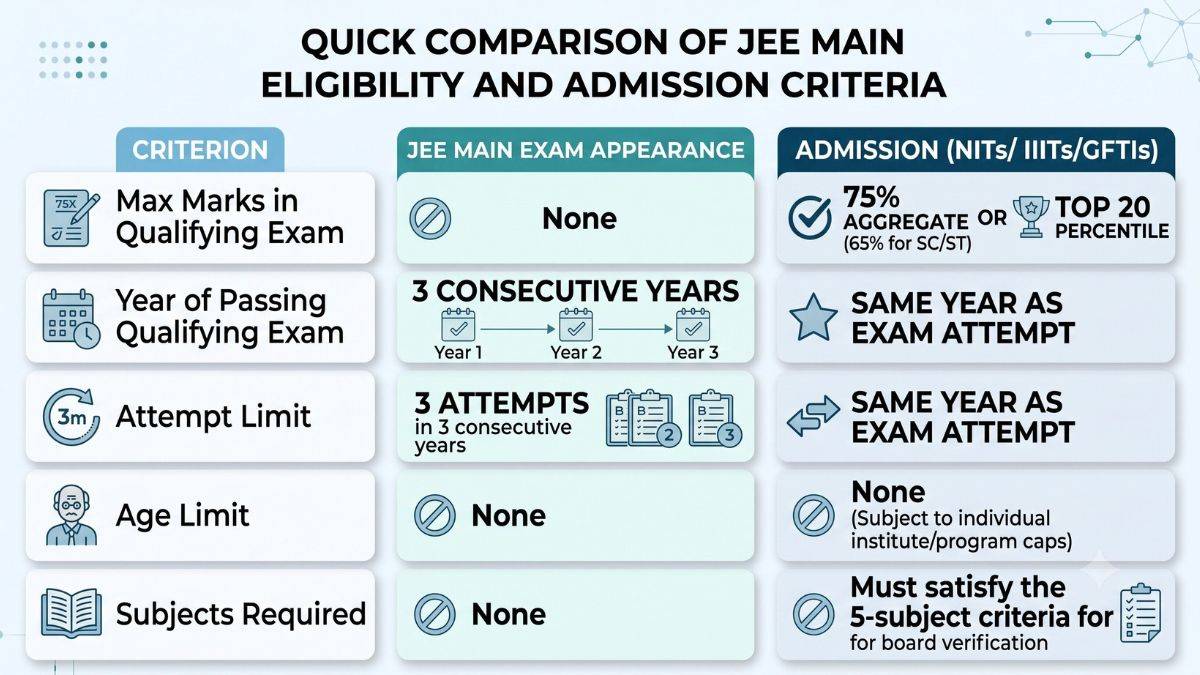
Quick Comparison of Eligibility to Appear in JEE Main and Admission Criteria
💡Want to know about JEE Main eligibility in detail? Read -> JEE Main eligibility criteria
Other Important Criteria to Check Before Filling the JEE Mains Form
State of Eligibility
The state code of eligibility in JEE Main is the code of the state where a candidate has passed or appeared for their Class 12 (or equivalent) qualifying examination
-
The State Code of Eligibility directly decides your home state quota for admissions into NITs, IIITs, and GFTIs during JoSAA counselling.
-
It does not depend on your native place, birthplace, or current residential address.
-
For example, if you live in Haryana but pass Class 12 from a school in New Delhi, your state code of eligibility is Delhi.
Category Certificate Validity
If applying under Gen-EWS or OBC-NCL, the certificate must follow the Central List format (not state-specific lists) and must be issued on or after April 1 of the admission calendar year to be valid at JoSAA reporting.
Home State vs Other State Quota for NIT Admissions
Home State (HS) Quota and Other State (OS) Quota are seat reservation categories used during engineering college admissions in India, like in the NITs via JEE Mains.
-
Home State (HS) Quota: Seats reserved for candidates who passed their qualifying examination (Class 12) from the same state where the NIT is located. Generally accounts for 50% of the total seats in that specific institute
-
Other State (OS) Quota: Seats open to candidates who completed their Class 12 schooling from a state other than the one where the institute is situated. This accounts for the remaining 50% of the total seats in that institute.
JEE Main 2027 Reservation Criteria
The JEE Main 2027 reservation policy allocates seat percentages as mandated by the Government of India for admissions into NITs, IIITs, and GFTIs.
| Category |
Reserved Seats |
|---|---|
| GEN-EWS |
10% of seats in every course |
| OBC-NCL |
27% of seats in every course |
| SC |
15% of seats in every course |
| ST |
7.5% of seats in every course |
| PwBD |
5% of seats in each of the GENERAL, GEN-EWS, OBC- NCL, SC and ST categories |
JEE Main 2027 Registration
The JEE Main 2027 application form is released on the official website, jeemain.nta.nic.in. To apply for the exam, candidates have to mandatorily fill out the application form as per the schedule. Candidates can either apply for session 1 or session 2, or they can apply for both attempts. The forms for both attempts are released separately.
How to Apply for JEE Main: Step by Step Instructions
Instructions on how to fill JEE Main 2027 application form are mentioned below.
-
New Registration: Go to the official portal, click on the registration link, and select "New Registration". Enter your basic details like name, date of birth, mobile number, and email address to generate an Application Number and Password.
-
Fill Application Form: Log in using your new credentials. Enter your personal, academic (Class 10 and Class 12 details), category, and identity details. Choose your preferred exam cities, paper, session, and medium.
-
Upload Documents: Upload scanned copies of your passport-size photograph, signature, Class 10 certificate, category/PwD proofs (if applicable), and complete any live photo capture or identity proof requirements.
-
Pay the Fee: Pay the required application fee online through net banking, debit card, credit card, or UPI based on your category and gender.
-
Download Confirmation Page: Review all entered details carefully before final submission, then download and print the confirmation page for your records.
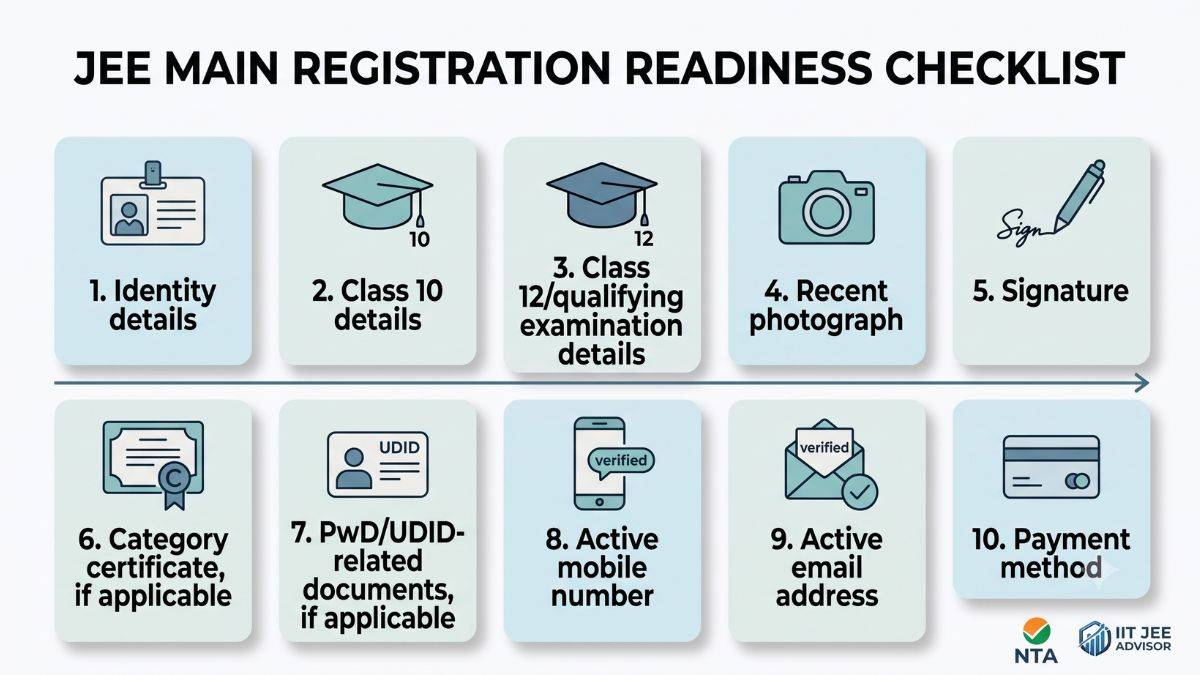
JEE Main Registration Readiness Checklist
JEE Main Application Fee
Based on the previous session (JEE Main 2027 fee will be confirmed in the official brochure):
| Category |
JEE Mains Registration Fees |
|---|---|
| Male candidates of Unreserved/ EWS/OBC category |
For Centres in India - INR 1,000 For Centres Outside India - INR 5,000 |
| Female candidates in the Unreserved/EWS/OBC category |
For Centres in India - INR 900 For Centres Outside India - 4,000 |
| SC/ST/PwD/Transgender category candidates |
For Centres in India - INR 500 For Centres Outside India - 2,500 |
*Note: The application fee for JEE Main 2027 will be confirmed in the official information brochure. Figures above reflect the previous session and are shown for planning purposes only.
Documents & Image Specifications for JEE Main 2027 Registration
Here is a table showing JEE Main 2027 photo and signature size guidelines. Candidates can check the size specifications document-wise below.
| Document |
Size |
Dimension |
|---|---|---|
| Photograph |
10 kb to 200 kb |
3.5 x 4.5 cms |
| Signature |
10 kb to 100 kb |
3.5 x 1.5 cms |
| Class 10th certificate |
50 kb to 300 kb |
- |
| PwD certificate (If applicable) |
50 kb to 300 kb |
- |
Documents Required to Fill JEE Main Form 2027
Applicants can find the list of JEE Main 2027 documents below:
-
Aadhaar Card / Passport / PAN Card / Voter ID
-
Class 10th marksheet
-
Photograph of the examinee
-
Signature of the candidate
-
Income certificate (if applicable)
-
Caste certificate (if applicable)
-
UDID card (for PwD candidates)
Is Aadhaar and DigiLocker Mandatory for JEE Main Registration 2027?
Aadhaar and DigiLocker are not mandatory for JEE Main registrations. While the NTA system prioritises Aadhaar verification or DigiLocker authentication for identity, other IDs like Passport, PAN Card, or Voter ID can be used. However, using these alternatives may require additional steps, such as a photo verification certificate.
Also Read: JEE Main 2027 DigiLocker Registration Login
💡For complete details on how to apply for JEE Mains, form correction, how to upload documents, etc., read -> JEE Main Application Form
How Many Candidates Register & Appear for JEE Main Exam?
The data in the table below shows the number of candidates registering and appearing for JEE Mains over the years:
| Year |
No. of Registered Candidates |
No. of Candidates Appeared |
|---|---|---|
| 2026
|
January: 13,55,293 |
January - 13,04,653 |
| April - 11,10,904 |
April - 10,34,330 |
|
| 2025
|
January - 13,11,544 |
January - 12,58,136 |
| April - 10,61,840 |
April - 9,92,350 |
|
| 2024
|
January - 12,31,874 |
January - 11,70,036 |
| April - 11,79,569 |
April - 10,67,959 |
|
| 2023 |
January - 8,60,064 |
January - 8,23,967 |
| April - 9,31,334 |
April - 8,83,367 |
|
| 2022 |
June - 8,72,970 |
June - 7,69,604 |
| July - 6,22,034 |
July - 5,40,242 |
|
| 2021 |
February - 6,52,628 |
February - 6,21,033 |
| March - 6,19,641 |
March - 5,56,248 |
|
| July - 7,09,611 |
July - 5,43,553 |
|
| August - 7,67,700 |
August - 4,81,419 |
|
| 2020 |
8,58,000 |
8,00,532 |
Competition Analysis: Registrations have grown by roughly 55-60% since 2020, while the ratio of candidates who actually appear versus register has stayed fairly consistent at 93-96% each session. Candidates should keep in mind the competition while preparing for NTA JEE Mains exam.
JEE Mains 2027 Exam Pattern
The JEE Main exam pattern stays the same each year. The pattern is notified to the students via the latest NTA JEE information brochure. Check the exam pattern being followed below.
JEE Main 2027 Paper 1 Exam Pattern
| Particulars |
Paper 1 (BE/BTech) |
|---|---|
| Subjects |
Maths, Physics and Chemistry |
| Sections |
Section A with MCQs and Section B with NATs |
| Mode |
Computer Based |
| Total Marks |
300 |
| Total number of questions |
75 |
| Subject wise marks |
100 in each section (Maths, Physics, Chemistry) |
| Subject wise number of questions |
20 MCQs & 5 NATs in each section (Maths, Physics, Chemistry) |
| Marking scheme |
+4 for each correct answer -1 for each wrong answer 0 for no attempt |
💡Also Read: How to Avoid Negative Marking in JEE Mains - Tips & Strategies
JEE Main 2027 Paper 2a & 2b Exam Pattern
| Particulars |
Paper 2A (BArch) |
Paper 2B (BPlan) |
|---|---|---|
| Subjects |
Maths, Aptitude, Drawing |
Maths, Aptitude, Drawing |
| Section |
Part 1 is Maths Part 2 is Aptitude Part 3 is drawing-based |
Part 1 is Maths Part 2 is Aptitude Part 3 is Planning-based |
| Types of questions |
Part 1 (Section A) has MCQs Part 1 (Section B) has NATs Part 2 has MCQs Part 3 has subjective drawing questions |
Part 1 (Section A) has MCQs Part 1 (Section B) has NATs Parts 2 & 3 have MCQs |
| Mode |
Parts 1 and 2 are computer-based Part 3 is pen and paper-based |
Computer Based |
| Total Marks |
400 |
400 |
| Total number of questions |
77 |
100 |
| Subject wise marks |
Maths - 100 Aptitude - 200 Drawing - 100 |
Maths - 100 Aptitude - 200 Planning - 100 |
| Subject wise number of questions |
Maths - 20 MCQs & 5 NATs Aptitude - 50 Drawing - 2 |
Maths - 20 MCQs & 5 NATs Aptitude - 50 Planning - 25 |
| Marking scheme |
+4 for each correct answer -1 for each wrong answer 0 for no attempt |
+4 for each correct answer -1 for each wrong answer 0 for no attempt |
💡For more details on JEE Mains marking scheme and question distribution, read -> JEE Main Exam Pattern
JEE Main 2027 Syllabus

JEE Main Question Paper & Mock Tests
NTA JEE Mains 2027 Preparation Tips

JEE Main 2027 Admit Card, City Intimation Slip & Exam Centres
 Admit Card: Jan ' 27

JEE Main 2027 Answer Key & Response Sheet
Answer Key: Feb ' 27
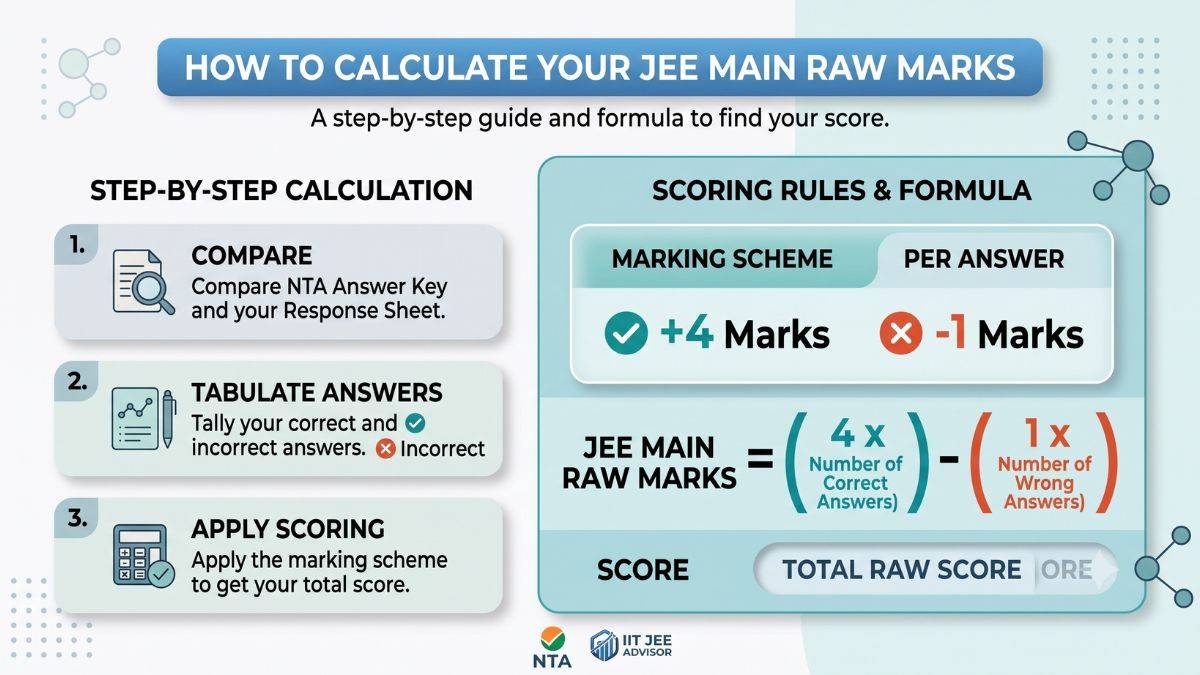
JEE Main Marks vs Percentile vs Rank

JEE Main 2027 Result
Result: Feb ' 27
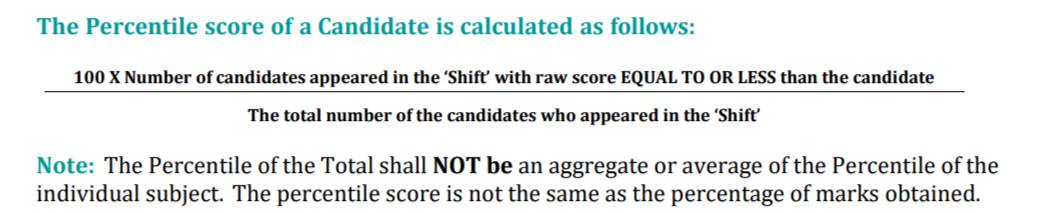

JEE Mains Cutoff - Qualifying Cutoff vs. Admission Cutoff

JEE Main 2027 Counselling - JoSAA & CSAB
Counselling: Jun ' 27
Top Private & Government Colleges Accepting JEE Mains
JEE Main 2027 Frequently Asked Questions
The rank obtained thugh JEE Main marks vs percentile data is an expected rank and not the actual rank. Candidates must note that the actual JEE Main rank is given in JEE Mains result release by the NTA.
JEE Main counselling and seat allotment has many processes. Once seat is allotted to a candidate, you have option of Accept and Freeze, Accept and Float and Slide. If you are satisfied with allotted seat and select first option, you cannot participate in next round counselling. If you are not satisfied, select second or third option to participate in next round with the current seat.
Candidates can face difficulty in payment of application fees due to various reasons like
- Slower internet connection while paying fees
- Slow bank server
- Insufficient balance in bank
In case any candiate faces issues while trying to pay JEE Main application fees, they should try paying the fees after some time. Candidates can also try logging out the application form process once and then try paying application fee again after logging in. If the situation still persists, students can contact NTA JEE Main helpline number.
JEE Main 2027 shift 1 exam reporting time is 7 am. The exam centre gates will close at 8:30 am. No candidate will be allowed after this deadline.
When two candidates score same marks in JEE Main, the NTA resolves tie by giving weightage to candidates haveing the highest marks in Maths>Physics>Chemistry. In case ties still persist, the weightage will be given to candidates with less incorrect questions in subjects in the same order.
Candidates will be able to check these details on the JEE Main scorecard:
JEE Main Application Number, JEE Main Roll Number, Name & Date of Birth, Qualifying Status, All India Rank secured by a candidate in the exam, category-wise All India Rank (AIR) of the Candidate, Subject-wise scores, aggregate score in all three subjects of both sessions. You can download your Joint Entrance Examination-Main Result from the official website. The official website is jeemain.nta.nic.in. Note that, there is no provision to re-evaluate/re-check JEE Main result.
To make corrections in the JEE Main application form, candidates have login to their accounts on the JEE Main official website using their application number and password.
Objections raising fee in JEE Main answer key is INR 200 per question. You can pay it online using internet banking or credit/debit card. The exact fees to be paid depends on total questions selected for grievance.
No, candidates are not required to send the prinout of JEE Main application form to the NTA office.
If your photo is not clear on the JEE Mains admit card, then contact the NTA helpline as soon as possible.
JEE Main participating institutes include:
- IITs
- NITs
- IIITs
- IIEST
- CFTIs.
The JEE Main city intimation slip is an official document released by the NTA before the exam that informs candidates of the specific city where their exam centre is located. The city slip also contains the allotted exam date.
To download the JEE Main exam city intimation slip, candidates can use the process below:
- Visit the official website jeemain.nta.nic.in
- Click on the city intimation link on the home page
- Log in using your application number and password
- Download the city slip
To download your JEE Main admit card, visit jeemain.nta.nic.in, click the download link, login using your Application Number and Date of Birth, and download the PDF.
The best way to handle tough topics in any subject is to study the concepts of that particular topic. The conceptual understanding of any topic gives us the clarity to solve theoretical as well as numerical questions from that topic. NCERT text books are the best material to understand the core concepts.
Chapterwise weightage of class 11 and 12 topics in JEE Main are mentioned below:
- Physics: Current Electricity Waves AC, Magnetism, Laws of Motion Work, Power and Energy.
- Chemistry the high weightage topics are s and p block elements, Coordination compounds, Thermodynamics Gaseous state, Chemical bonding, Atomic structure, Polymers, Environmental Chemistry Organic Chemistry.
- Mathematics, the high weightage topics are Sequence and Series Vectors and 3D, Integral and Differential Calculus, Definite and Indefinite Integral.
Students are not allowed to carry calculators inside the exam centre in JEE Main exam. Students can use the virtual calculator available on the screen during the exam. Virtual calculators will be available on the computer screen of students during the JEE Main exam.
Some of the best books for JEE Main preparation are as follows:
For Physics, candidates can refer to: NCERT Class 11 and 12 Textbooks, Concepts of Physics (Vol. 1 and 2) by HC Verma, Fundamentals of Physics by Halliday, Resnick & Walker and Problems in General Physics by I.E Irodov.
For Maths, candidates should refer to the NCERT Class 11 and 12 Textbooks and Objective Mathematics by RD Sharma.
For Chemistry, candidates can check books like NCERT Textbooks for classes 11 and 12, Modern Approach to Chemical Calculations by RC Mukherjee, and Organic Chemistry by OP Tandon.
2251 Institutes accepting JEE Main
 4.5
4.5- ₹ 8.00 Lakh
- 4 years
- |
- Full Time
SRM Institute of Science and Technology, Kattankulathur
Kattankulathur, Chennai • Private
- ₹ 8.00 Lakh
- 4 years
- |
- Full Time
- ₹ 8.00 Lakh
- 4 years
- |
- Full Time

Explore more B.Tech exams with upcoming dates
 IEMJEE 2026 Exam Dates - Phase 3 1 Jun '26 - 30 Sep '26 KLEEE 2027 Application Form - Phase 1 21 Sep '26 - 2 Dec '26