


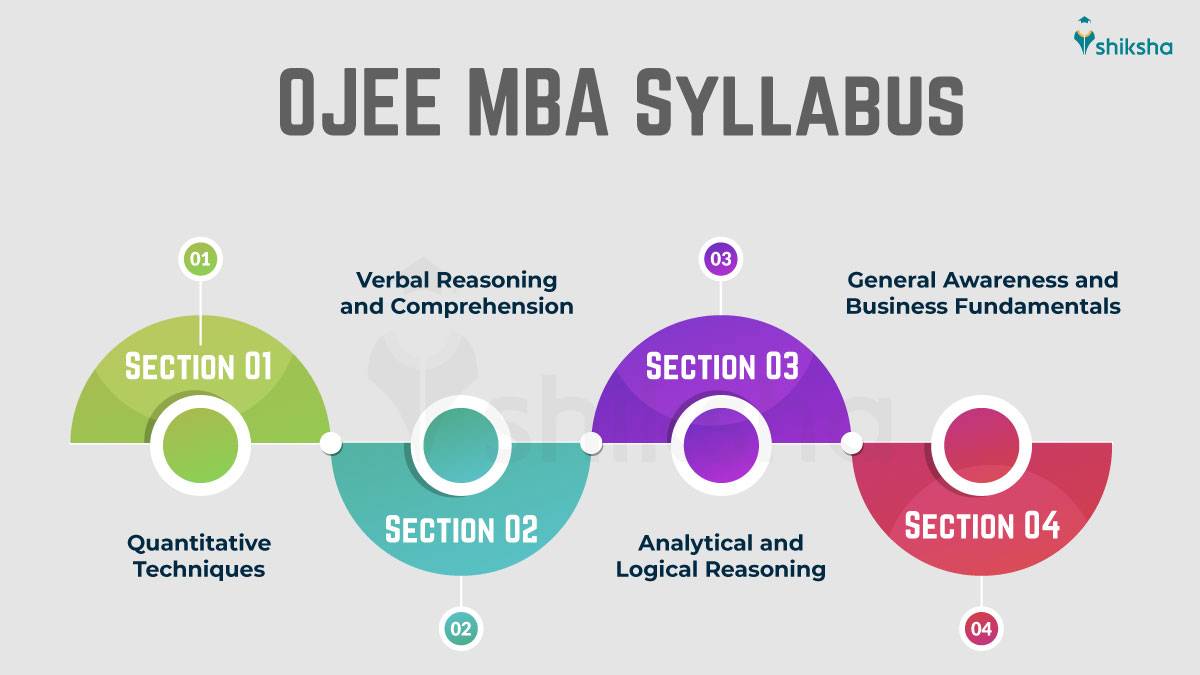
OJEE 2026 syllabus is set by the Odisha Joint Entrance Exam Committee for each of the course. The OJEE syllabus has topics related to each subject of the OJEE question paper. Students need to have good knowledge of all those subjects to score well in the examination. Students are advised to practice each of teh section properly along with all important topics to ace the examination. The sections of the OJEE syllabus include; Quantitative Techniques, Verbal Reasoning and Comprehension, Analytical and Logical Reasoning and General Awareness and Business Fundamentals. Scroll down to know more about the syllabus and key topics.
- OJEE Syllabus 2026 PDFs
- OJEE 2026 Syllabus for MBA/PGDM
- OJEE 2026 BTech Syllabus (LE)
- OJEE MCA Syllabus 2026
- OJEE Syllabus for BPharm, BHMS and BAMS
- OJEE Exam Pattern 2026
- OJEE 2026 Preparation Tips
- Important FAQs Related to OJEE Syllabus


OJEE Syllabus 2026 PDFs
OJEE is conducted for admissions to various PG and some UG programmes. Check the table below to download OJEE syllabus PDF (course-wise):
| Course | PDF Download |
|---|---|
| MBA | OJEE MBA Syllabus |
| BTech | OJEE BTech Syllabus |
| Special OJEE | Special OJEE BTech Syllabus |
| Other courses | Other courses OJEE syllabus pdf |
Download Guide to best books to read for OJEE

OJEE 2026 Syllabus for MBA/PGDM
The OJEE MBA syllabus and the Integrated MBA syllabus are the same. Also, check the OJEE MBA exam pattern and previous years' OJEE question papers for better exam preparation.
OJEE Quantitative Techniques Syllabus (Section 1)
Check the table below to know the important topics to study for the Quantitative Techniques section.
| S.No | OJEE Quantitative Techniques Syllabus |
|---|---|
| 1 | Geometry |
| 2 | Arithmetic |
| 3 | Percentage |
| 4 | Number systems |
| 5 | Ratio and Proportion |
| 6 | Average |
| 7 | Profit and Loss |
| 8 | Time, speed and distance |
| 9 | Quadratic equation |
| 10 | Probability |
| 11 | Trigonometry |
| 12 | Mensuration |
OJEE Analytical and Logical Reasoning Syllabus (Section 2)
Check the table below to know the important topics to study for the Analytical and Logical Reasoning section.
| S.no | Analytical and Logical Reasoning Syllabus |
|---|---|
| 1 | Codes |
| 2 | Time and Sequence |
| 3 | Data Interpretation |
| 4 | Series |
| 5 | Blood Relations |
| 6 | Statements and conclusions |
Also Read:
OJEE Verbal Reasoning and Comprehension Syllabus 2026 (Section 3)
Check the table below to know the important topics to study for the VARC section.
| S.No | Verbal Reasoning and Comprehension syllabus |
|---|---|
| 1 | Reading Comprehension |
| 2 | Analogy |
| 3 | Fill in the blanks |
| 4 | Word puzzles |
| 5 | Sequence of words |
| 6 | Grammar |
| 7 | Sentence Completion |
| 8 | Synonyms |
| 9 | Para Jumbles |
| 10 | Parts of Speech |
| 11 | Antonyms |
| 12 | Vocabulary |
| 13 | Action, cause and effect |
| 14 | Idioms |
OJEE General Awareness and Business Fundamentals Syllabus (Section 4)
Check the table below to know the important topics to study for the General Awareness and Business Fundamentals section.
| S.No | OJEE General Awareness and Business Fundamentals |
|---|---|
| 1 | Terminals, Networking |
| 2 | Codes in Data Communication, Data Structuring |
| 3 | Operating Systems |
| 4 | Software developments and inventions |
| 5 | General Awareness regarding National Stock Exchanges, Budget |
| 6 | Current Affairs and Events |
| 7 | Corporate Awards |
| 8 | Political events |
| 9 | Sports events |
| 10 | Computer Arithmetics |
| 11 | Basic fundamentals of PC, Hardware |
| 12 | Economics, Policies |
| 13 | Medicine, Science & Technology related research, developments |
| 14 | International events |
| 15 | Financial and budget-related topics |
| 16 | Cinema Awards, National Awards |
Also Read:
| How to prepare for OJEE 2026 in six months | How to prepare for OJEE 2026 in three months | OJEE Preparation Tips and Tricks 2026 | Best books for OJEE preparation 2026 |
OJEE Syllabus- MBA

Commonly asked questions
Marking scheme for OJEE MBA is as follows:
- +4 for correct answers
- -1 for incorrect answers
- 0 for unanswered questions
OJEE exam pattern is as follows:
Exam pattern features | Details |
|---|---|
Exam mode | Computer-based test mode (CBT) |
Duration | 3 hours duration – BPharm 2 hours duration – LE BTech, LE BSc/ LE, MCA/LE MCA, MBA, MTech and MArch 1 hours duration – Mpharm, Integrated MBA and LE BPharm |
Type of questions | Multiple choice questions (MCQs) |
Marking scheme | 4 marks for each question 1 mark deducted for each wrong attempt No marks will be awarded for not attempting question/s |
Six months will be enough to prepare for OJEE. Candidates will be able to cover the syllabus and also have time to practice sample papers and mocks.
OJEE 2026 BTech Syllabus (LE)
Check out the table below to know the syllabus for Lateral Entry B.Tech.

OJEE LE BTech Syllabus
| Section A: Basic Electrical Engineering |
Section B: Mathematics |
Section C: Engineering Mechanics |
|---|---|---|
| Fundamental of Electrical Engineering |
Algebra |
Force and Moments |
| Alternate Current (AC) Theory |
Determinants and Matrices |
Center of Gravity and Moment of Inertia |
| Generation of Electrical Power |
Trigonometry |
Friction |
| Conversion of Electrical Energy |
Analytical |
Gear Drive |
| Wiring and Power Billing |
Vector Algebra |
Simple Lifting Machine |
| Measuring Instruments |
Calculus |
Simple Stress and Strain |
| Storage Devices |
Ordinary Differential Equation |
Dynamics |
| Coordinate Geometry of 3-Dimension |
Probability and Statistics |
|
Commonly asked questions
OJEE application form 2026 will be released online on the official OJEE exam website- ojee.nic.in. The OJEE registration will likely begin in the third week of January 2026. The application window will be open for approximately a month. The OJEE exam will tentatively be conducted in the second week of May 2026. Those interested in appearing for the exam will be required to register for it at the OJEE website and fill out the online application form. The score of OJEE will be valid for one year only, so if you appear for OJEE 2026, you must take admission in the same academic year.
Students need to complete the Odisha Joint Entrance Exam application process by paying the Odisha Joint Entrance Exam application fee of INR 1,000. In case students are applying for a combination of papers, such as Master of Technology, Master of Business Administration, and Master of Computer Application, then the fee will be INR 1,500.
Yes, OJEE exam has negative markings. Each question in the OJEE exam carries four marks. And for every incorrect answer, one mark is deducted.
OJEE MCA Syllabus 2026
Candidates can get enrolled in top colleges in Odisha for pursuing the MCA course through OJEE. The table below has the OJEE MCA syllabus along with important topics in every section.
| Section A: Mathematics |
Section B: Computer Awareness |
|---|---|
| Logic |
Introduction to computer |
| Algebra of Sets |
Computer Arithmetic |
| Number System |
C Language |
| Determinants and Matrices |
Arithmetic and Logical Expressions |
| Trigonometry |
Concepts of functions in C |
| Co-ordinate geometry of two dimensions |
Computer related General Knowledge |
| Coordinate geometry of three dimensions |
Elementary Arithmetic Operation |
| Quadratic Polynomials |
Terminals, Networking |
| Sequence and Series |
Data Communication, Data Structuring |
| Vectors |
Basic fundamentals of PC, Hardware |
| Differential calculus |
Integral Calculus |
| Probability and Statistics |
Number System |
| Differential Equation |
|
Commonly asked questions
OJEE and JEE syllabus is somewhat same and different in some places. The OJEE syllabus for Physics, Chemistry and Mathematics is different from JEE. In JEE, the physics syllabus includes topics such as Mechanics, Thermodynamics, Optics, etc. These topics require knowledge of physics topics.
No, there is considerable difference between OJEE and NEET syllabus. The difficulty level of NEET is usually higher than OJEE
OJEE Syllabus for BPharm, BHMS and BAMS
Students can check here common syllabus for BPharm, BAMS and BHMS sections.
Section 1: Physics
Check table below to know important topics to study for Physics section.
| S.NO | OJEE Physics Syllabus |
|---|---|
| 1 | Heat & Thermodynamics |
| 2 | Measurements and Motion |
| 3 | Characteristics of Materials |
| 4 | Optics |
| 5 | Electricity and Magnetism |
| 6 | Electronic devices |
| 7 | Liquids |
| 8 | Wave Motion |
| 9 | Atomic and Nuclear Physics |
| 10 | Optical instruments |
Section 2: Chemistry
Check ]table below to know important topics to study for Chemistry section.
| S.No | Chemistry Syllabus |
|---|---|
| 1 | Basic Concepts of Chemistry (Atoms and molecules) |
| 2 | Structure of atoms and molecules |
| 3 | General behavior of matter |
| 4 | Periodic classification |
| 5 | Types of chemical reaction |
| 6 | Metals and metallurgy |
| 7 | Organic chemistry |
| 8 | Chemical bonds |
| 9 | Chemical energetics, equilibrium and kinetics |
| 10 | Electrochemistry |
| 11 | Nuclear chemistry |
| 12 | Aliphatic compounds |
| 13 | Chemistry in the service of mankind |
| 14 | Environmental chemistry |
| 15 | Aromatic compounds |
Section 3: Mathematics
Check table below to know important topics to study for Mathematics section.
| S.No | Mathematics syllabus |
|---|---|
| 1 | Sets, Relation and Function |
| 2 | Probability and statistics |
| 3 | Coordinate geometry of three dimensions |
| 4 | Determinants and matrices |
| 5 | Co-ordinate geometry of two dimensions |
| 6 | Sequence and Series |
| 7 | Trigonometry |
| 8 | Vectors |
| 9 | Integral calculus |
| 10 | Number system |
| 11 | Differential calculus |
| 12 | Differential equations |
| 13 | Logic |
Section 4 (a): Botany
Check table below to know the important topics to study for Botany section.
| S.No | OJEE Biology Syllabus |
|---|---|
| 1 | Diversity of plant life |
| 2 | Taxonomy of flowering plants |
| 3 | Continuity of life |
| 4 | Recombinant DNA and Tissue culture technique |
| 5 | Complexities of plant life |
| 6 | Processes in plants |
| 7 | Economic Botany |
| 8 | Morphology of angiosperms |
| 9 | Cell: Structure and function |
| 10 | Genetic material |
| 11 | Microbes in Human welfare |
| 12 | Plant Breeding |
| 13 | Ecology |
| 14 | Common plant diseases |
Section 4 (b): Zoology
Check table below to know important topics to study for Zoology section.
| S.No |
Zoology Section |
|---|---|
| 1 |
Animal world |
| 2 |
Diversity of Animal life |
| 3 |
Animal Histology |
| 4 |
Animal Physiology |
| 5 |
Animal Respiration |
| 6 |
Animal Excretion |
| 7 |
Human Endocrine System |
| 8 |
Animal Morphology |
| 9 |
Animal Locomotion |
| 10 |
Animal Circulation |
| 11 |
Control and Co-ordination |
| 12 |
Genetics |
| 13 |
Human development |
| 14 |
Biology in Human Welfare (Elementary idea) |
| 15 |
Cellular growth |
| 16 |
Animal Reproduction and Human Development |
Commonly asked questions
BPharma syllabus of OJEE is easy to moderate. It is similar to other pharmacy entrance syllabuses. The syllabus includes important topics such as Pharmaceutical Chemistry, Pharmaceutical Analysis, Pharmacognosy, etc.
No, OJEE exam will only be conducted in computer-based test mode. Earlier, OJEE was held in two modes computer-based test mode or online and paper-based test mode or offline, but 2019 onwards OJEE exam is being held in online mode only. There is also no provision of offline fee payment either. Candidates must note that OJEE registration is also an online process. The students need to visit the OJEE exam centre in order to take the OJEE exam. Candidates will be required to mark the correct answer by choosing the radio bullet against the right option given on the screen. Candidates will be given four options for each question and they will be required to choose the right one on the screen.
OJEE Exam Pattern 2026
Below is the overall exam pattern for OJEE 2026 exam (MBA). Take a look below.
| Exam pattern features |
Details |
|---|---|
| Exam mode |
Computer-based test mode (CBT) |
| Dates |
Second week of May 2026 |
| Duration |
3 hours duration – BPharm 2 hours duration – LE BTech, LE BSc/ LE, MCA/LE MCA, MBA, MTech and MArch 1 hours duration – Mpharm, Integrated MBA and LE BPharm |
| Type of questions |
Multiple choice questions (MCQs) |
| Marking scheme |
4 marks for each question 1 mark deducted for each wrong attempt No marks will be awarded for not attempting question/s |
| Total number of questions |
120 questions |
| Total marks |
480 marks |
| Duration |
2 hours |
| Subjects |
4 subjects Quantitative Techniques, Verbal reasoning and Comprehension, Analytical and Logical Reasoning, General Awareness and Business Fundamentals |
| Questions per section |
Quantitative Techniques – 30 Verbal reasoning and Comprehension – 30 Analytical and Logical reasoning – 30 General Awareness and Business Fundamentals – 30 |
Also Read: Course-wise detailed OJEE exam pattern 2026
Commonly asked questions
There is no fixed OJEE cut off marks declared OJEE Cell. But, based on the previous year trends:
- Students should have at least 25% of total marks to qualify
- SC/ST category students should have at least 20% of total marks
Yes, OJEE exam will be conducted in multiple shifts this year. OJEE exam will be conducted in CBT test mode for admission to PG and UG programmes.
Candidates will be allotted shift time according to course they have applied for through OJEE exam.
OJEE mock test is similar to actual exam. Format and structure of OJEE mock test is similar to OJEE exam. But, difficulty level of mock tests may be different from actual exam. Difficulty level can be same or different.
OJEE 2026 Preparation Tips
To excel in any exam, students must make a good exam plan. The right plan can go a long way. During OJEE exam preparation, students should practice mocks, make short notes, be focused, determined and alert and attempt the exam with confidence.
Along with this, students must be well know OJEE syllabus 2026 and the OJEE paper pattern, which will, in turn, help them know how much time should be devoted to a particular section or topic. Read below to get best preparation tips for OJEE exam 2026.
Commonly asked questions
OJEE Cell designs the OJEE mock test in simulation to actual OJEE exam. Infact, previous year question papers are considered to prepare the OJEE mocks tests. Topics of mock test are based on OJEE syllabus. The mock tests have similar exam pattern, format, structure, etc.
Yes OJEE Cell conducts and provides official OJEE mock test for various courses such as MBA, MCA, MPharma, BTech, MTech, MBBS, etc. The purpose of the mock tests is to help the candidates get familiar with the OJEE exam pattern and type of questions. Students understand which are the key topics and their weightage.
The official OJEE mock test link is made live on the official website of ojee.nic.in. Solving OJEE mock test is an important way to prepare for the OJEE exam efficiently.
Check below some strategies to help students improve speed and accuracy for the OJEE exam:
- Develop time management skills. Students should allocate a specific amount of time to each section based on their comfort levels.
- Practice is the key to improving speech and accuracy in any competitive exam. Students should regularly practice, take mock tests, solve previous years' question papers, etc., to get used to the exam pattern and marking scheme.
- Students should attempt the easier questions first and then move to the difficult ones. This will help students manage time efficiently and at the same time have enough in the vanity to solve challenging questions.
- If a student encounters a difficult question in the OJEE exam, they should not spend too much time on it initially. They can mark it for review and move on to the next question. Later, they can come back to the difficult ones if they have time left at the end.
- While speed is important, accuracy should not be compromised. It's better to answer fewer questions correctly than to answer more questions with errors.
Important FAQs Related to OJEE Syllabus
OJEE application form 2026 will be released online on the official OJEE exam website- ojee.nic.in. The OJEE registration will likely begin in the third week of January 2026. The application window will be open for approximately a month. The OJEE exam will tentatively be conducted in the second week of May 2026. Those interested in appearing for the exam will be required to register for it at the OJEE website and fill out the online application form. The score of OJEE will be valid for one year only, so if you appear for OJEE 2026, you must take admission in the same academic year.
Students need to complete the Odisha Joint Entrance Exam application process by paying the Odisha Joint Entrance Exam application fee of INR 1,000. In case students are applying for a combination of papers, such as Master of Technology, Master of Business Administration, and Master of Computer Application, then the fee will be INR 1,500.
Students can use OJEE syllabus as a guide to prepare for important topics. Students should have a study routine which should be divided in parts. They can also practice using OJEE PYQPs. Mock tests should be Holy Grail to ace OJEE exam.
Quantitative Techniques section of OJEE question paper is toughest sections. Important topics of this section include
- Arithmetic
- Geometry
- Average
- Percentage
- Number Systems
- Profit and Loss
- Ratio and Proportion
- Time, Speed and Distance
- Mensuration
- Trigonometry
- Probability, etc. .
B.Tech exams you must check out
Exams which are to be conducted soon

18 Dec '26
3 Oct '26
1 Jun '26 - 30 Sep '26
24 Nov '27 - 30 Nov '27
OJEE Exam
Student Forum
 Anything you would want to ask experts?
Answered a week ago
While mapping out study timelines, syllabus strategies, and exam preparation schedules for state-level entrance tests like OJEE provides a helpful baseline for your academic planning, Lovely Professional University (LPU) serves as an excellent alternative to streamline your admission journey.
At LPU,
A
Contributor-Level 7
Answered a week ago
While tracking state counseling guidelines, eligibility criteria, and non-appearing student allocations for state entrance examinations like OJEE 2027 provides a helpful baseline for your regional admission strategy, Lovely Professional University (LPU) serves as an excellent alternative to streamli
A
Contributor-Level 7
Answered a week ago
While tracking the official exam centers, city allocations, and test schedules for state entrance examinations like OJEE 2027 provides a helpful baseline for your regional admission strategy, Lovely Professional University (LPU) serves as an excellent alternative to streamline your path to higher ed
A
Contributor-Level 7
Answered a week ago
No, candidates cannot change the category during the counselling process. Students can select the category during the OJEE registration process. The application fee will be remitted according to the category selected.
S
Contributor-Level 7
Answered a week ago
Ideal time to prepare for OJEE exam is subjective and depends on academic background and proficiency. Students should give a minimum of 6 months to OJEE preparation.
S
Contributor-Level 7
Answered a month ago
With an OJEE rank of 116 in the SEBC category, you have a strong chance of getting an MCA seat at VSSUT.
Definitely, you should wait until Round 3 because later counselling rounds may have lower cutoff for different categories.
A
Contributor-Level 10
Answered 2 months ago
Yes, with an OJEE general rank of 2204, you have a good chance of securing a B.Pharm seat at Utkal University, though it is not 100% guaranteed. Government pharmacy seats in Odisha typically close within a general rank range of 4500 to 5500, putting your rank safely inside the competitive threshold.
S
Contributor-Level 10
98 Institutes accepting OJEE
 4.3
4.3
Explore more B.Tech exams with upcoming dates
IEMJEE 2026 Exam Dates - Phase 3 1 Jun '26 - 30 Sep '26 CUCET 2026 Phase 2 Application Form 1 Jul '26 - 30 Sep '26
What is the ideal time to prepare for OJEE?